

Business Ideas Near Pachpadra Refinery
A Desert Region’s Industrial Awakening
Economic turning points happen in a region’s history that affect the whole. Economic turning points happen in a region’s economic history that impact the whole of the region’s economy. Today, Barmer, the westernmost district of Rajasthan, which was once more famous for its sand dunes and textiles, is in one of those times. The inaugurating of the first Greenfield Integrated Refinery-cum-Petrochemical Complex at Pachpadra is not a mere energy story. It’s really a manufacturing and business transformation story. This is the most important land & feedstock opportunity in western India after decades for first generation entrepreneurs and MSME investors looking for real scalable business ideas in industrial India.
The comparison with the Kolar Gold Fields of Karnataka in which a remote, resource-rich region was dramatically reordered by a single large industrial anchor is intentional. Developed at a cost exceeding ₹79,450 crore by HPCL Rajasthan Refinery Limited (HRRL), a joint venture between Hindustan Petroleum Corporation Limited (HPCL) and Government of Rajasthan, Pachpadra Refinery is already leading to land appreciations, investments in logistics connectivity, and industrial clustering in the downstream sector. More than 100 sq km around the refinery has been identified for the development of petrochemical and allied industries by the government. RIICO is developing over 800 industrial plots in 5 industrial zones. The ecosystem is taking shape and smart money — this time in the form of investment in MSME-scale projects — is on the move.
This article provides a practical, consultant-led review of the sector, the opportunity, the government support mechanism and some specific ideas for business start-ups to consider. If you are interested in manufacturing businesses with a defensible raw material advantage and strong policy support, take a closer look at the Pachpadra ecosystem, where manufacturers can position their products close to major demand centers.
Why This Sector Is Growing Fast
The Pachpadra complex is no ordinary refinery. It is one of the world’s most technologically advanced refineries with a Nelson Complexity Index of 17, placing it in the top 25% of refineries worldwide. This is important to downstream entrepreneurs who get a much wider variety of petrochemical products from a high-complexity refinery other than fuel.(Business Ideas Near Pachpadra Refinery)
Feedstock That Changes the Economics
The refinery will also be capable of generating large volumes of high-value petrochemicals along with BS-VI fuels. The latter are: 1 MMTPA of Polypropylene (PP); 0.5 MMTPA of LLDPE; 0.5 MMTPA of HDPE and Benzene, Toluene, 1,3-Butadiene. These outputs are the inputs to dozens of downstream manufacturing processes in plastics, packaging, textiles, automotive components, construction materials and agri-inputs.
Currently, India imports polymers worth more than ₹61,000 crore per year, not because domestic production is insufficient, but because only a few regions have polymer conversion capacity, which remains fragmented across the country. This mismatch is directly addressed by the Pachpadra refinery. For the first time, west India (Rajasthan, Gujarat border areas and North India with big FMCG and agriculture markets) will have local large-scale source of polypropylene and polyethylene. This is a huge proximity benefit. Cost of logistics can be the key to profitability in polymer processing companies.
Get Detailed Insights from This Book: Profitable Plastic Industries
A Market That Cannot Wait for Late Entrants
Indian industry estimates predict the plastic industry is projected to expand from around USD 44 billion to USD 64 billion by 2031. There is, however, a greater demand than the local downstream processors in the states such as Rajasthan, Uttar Pradesh and Madhya Pradesh. Hence, entrepreneurs that establish their processing units prior to the cluster’s development are able to secure lower land costs, less competition and first-mover supply relations with regional manufacturers.
Besides, there are around 40% of the market in India that Rajasthan has access to through neighbouring states. More than 58% of the landmass of the state is covered under the Delhi-Mumbai Industrial Corridor (DMIC). The state has the third largest national highway network and the fifth largest rail network in India, having access to major ports such as Mundra, Kandla and JNPT. As a result, manufacturing of Pachpadra products can be made available to domestic markets quickly, and to export markets efficiently.
Government Policies and Incentives Supporting New Businesses
Rajasthan has built up a strong policy structure to attract manufacturing investment towards the Pachpadra cluster. This isn’t a place where entrepreneurs are working in isolation. They are stepping into one of the most favourable industrial investment climates in India today.
Rajasthan Investment Promotion Scheme (RIPS 2024)
MSMEs in Manufacturing Sector avails 75% reimbursement of State GST paid for 10 years under the Rajasthan Investment Promotion Scheme 2024. This is an outstanding support — a substantial part of the state’s tax revenues is sent back to the manufacturer as working capital relief. The maximum amount of capital subsidy offered for plastic alternatives units is ₹40 lakh and for the agro and food processing units is ₹1.5 crore. Eligible industrial projects can also benefit from electricity duty exemptions and stamp duty concessions.
The Rajasthan MSME Policy 2024, which will remain in force until March 2029, is a supporting policy for the RIPS and offers interest subsidy of up to 8% per annum under MLUPY, collateral-free loans under CGTMSE, and a Raj Udyog Mitra certificate that waives inspections by the state for five years on MSME units. The RajNivesh Portal brings a single window solution; it combines more than 120 services under 14 departments to make compliance much simpler.(Business Ideas Near Pachpadra Refinery)
Central Government Schemes Available
Collateral free loans are available from the Ministry of MSME’s Credit Guarantee Fund Trust for Micro and Small Enterprises (CGTMSE) at the central level for the eligible entrepreneurs. The Department of Chemicals and Petrochemicals has introduced an incentive scheme called Production Linked Incentive (PLI) for chemicals and petrochemicals for encouraging production linked to utilities units. Further, the PMEGP (Prime Minister’s Employment Generation Programme) and the New Petrochemical Scheme, Plastic Parks also alleviate the cost of infrastructure for the new MSMEs.
Further, the Make in India programme and the Startup identification regime of DPIIT offers further tax benefits and quick registration of IP assets to the innovation-driven enterprises in this area. State and central schemes if well prepared with proper documentation can cover 30-40% initial project cost.
Multiple Business Ideas for Startups Near Pachpadra Refinery
The business ideas mentioned below specifically match Pachpadra’s available feedstock, infrastructure, and emerging demand patterns. They are all potential manufacturing avenues for MSMEs and first-generation entrepreneurs, and can be made scalable.
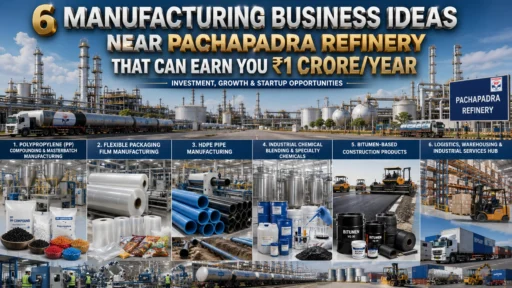
1. Polypropylene (PP) Compounding and Masterbatch Manufacturing
Compounding ranks among the most promising MSME-scale projects in the downstream petrochemical, or PP, value chain and offers one of the safer business opportunities. The reasoning is simple – OEMs and industrial customers do not buy raw PP resin. Manufacturers must formulate them with specific compounds to achieve the impact modification, glass filling, flame resistance, UV stabilisation, and other properties required for particular applications. The Pachpadra refinery will be able to produce 1 MMTPA of PP, which is one of the nearest sources of large-scale PP for the manufacturers in Rajasthan, Gujarat and Haryana. The entrepreneur who has established a compounding unit in RIICO Pachpadra industrial zone enjoy the advantage is that it is cheaper for him as he can get raw material from Pachpadra, as it’s located in the same area.
Manufacturers use the same process and feedstock to produce masterbatches, requiring relatively moderate capital investment. These masterbatches serve the packaging, automotive, and appliance industries. This is where the relationship gets sticky if a compounded grade or masterbatch formulation has been approved by an OEM. It is difficult to change suppliers in the middle of a production run. This enables steady and regular revenue streams which are very useful for first generation business owners with their working capital. The investment for a mid-size compounding unit is generally between ₹3 crore and ₹6 crore and the EBITDA margins are constantly between 15-22%.
Get Detailed Project Report (DPR): Plastics & Polymer Manufacturing Guide
2. Flexible Packaging Film Manufacturing (LLDPE / HDPE-Based)
In India, flexible packaging is the biggest consumer of polyethylene.
It covers packaging films, pouches, laminates, wrapping films, and stretch films that FMCG companies, food processors, pharmaceutical companies, and e-commerce businesses commonly use. Gujarat, Maharashtra and Tamil Nadu are the States with a very high level of dependency on plastic packaging. The agriculture, food processing and retail sectors of Rajasthan (with a huge and ever-expanding consumer base) is significantly underserved. The bulk of business packaging material comes from a distance of more than 1000 kms, which results in 5-7 days of lead time and higher MOQs. The new MSME packaging unit established close to Pachpadra puts a fresh spin on this.
The advantage of raw material is built in with the introduction of LLDPE and HDPE from the refinery complex. The cost of investment for a medium scale flexible packaging unit generally ranges from ₹3.5 crore to ₹5.5 crore at MSME. Moreover, the government’s Extended Producer Responsibility (EPR) guidelines issued by the Central Pollution Control Board (CPCB) are now incentivizing FMCG and retail companies to directly move towards registered EPR compliant packaging suppliers, and this is a direct benefit to a new formally registered MSME over informal competitors.
View Full Project Details: Flexible Packaging: Market & Industry Outlook
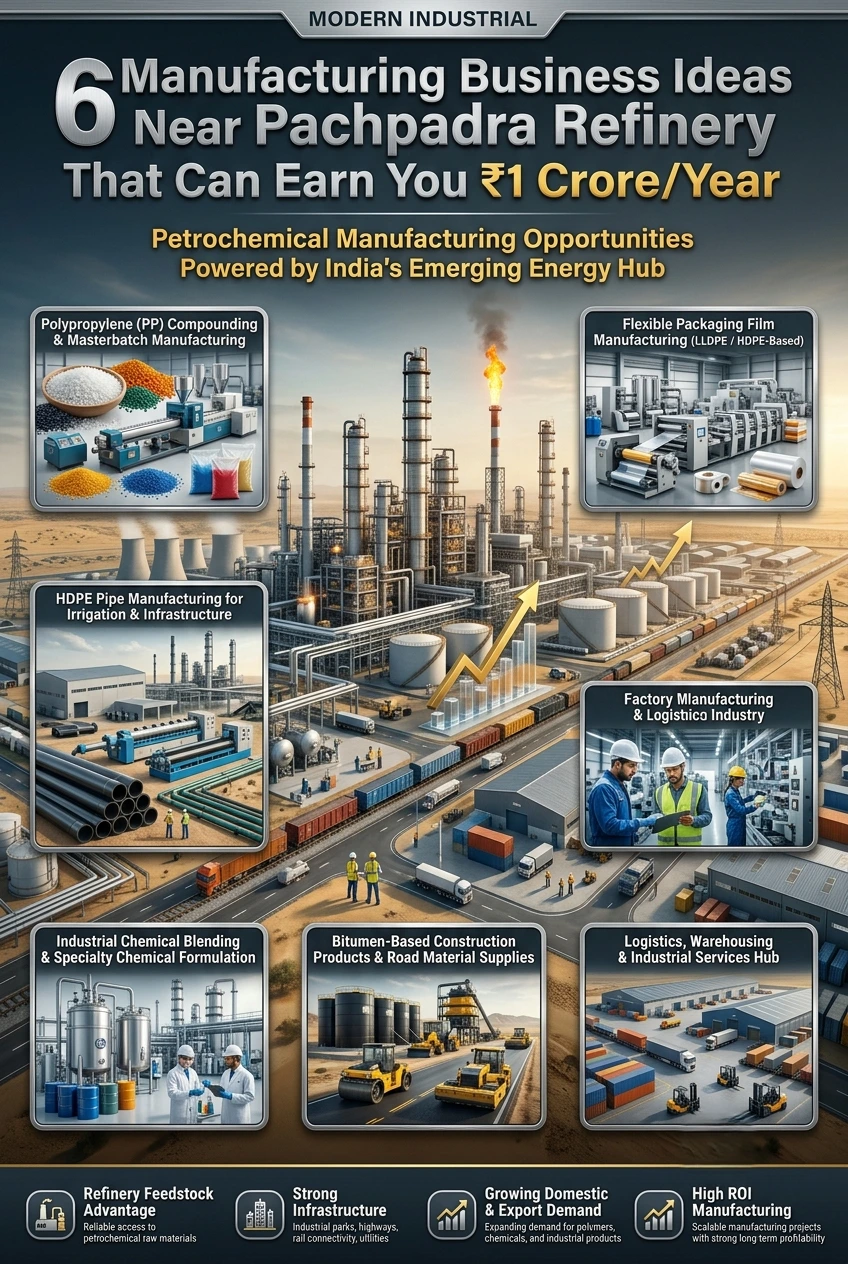
3. HDPE Pipe Manufacturing for Irrigation and Infrastructure
The demand-supply gap for both HDPE and LLDPE in India is more than two million tonnes per year. Agricultural water management, which includes drip irrigation lines, lateral pipes and main distribution pipes, is one of the biggest consumers of HDPE pipes and Rajasthan is one of the largest agricultural states in India. There are various government initiatives such as Pradhan Mantri Krishi Sinchayee Yojana (PMKSY) and irrigation expansion programmes at the state level, which are constantly pushing demand for HDPE irrigation piping. Also, the cities and towns in Rajasthan, which are growing at a rapid pace, have a continuous demand for HDPE infrastructure piping for urban water supply projects, sewage networks and Smart Cities Mission.
MSME producing HDPE pipes in Pachpadra enjoys the advantage of being both the source of the raw material and the target market. The investment cost of a medium capacity HDPE pipe machine is around ₹2 crore to ₹4 crore based on pipe capacity and product diameter range. Margins are sound, repeat purchases are government driven and demand is essentially non-cyclical. While consumer products market entry can be difficult for first time entrepreneurs, B2G (business-to-government) supply of commodity pipes is much simpler.(Business Ideas Near Pachpadra Refinery)
Related Article: How to Start a HDPE/PP Plastic Recycling Plant in India: Investment, Machinery & Profit Margins
4. Industrial Chemical Blending and Specialty Chemical Formulation
Benzene, Toluene and 1,3-Butadiene are significant petrochemicals produced at the Pachpadra complex. Manufacturers use these aromatic chemicals as bases for a variety of specialty chemical formulations, including paints and coatings, adhesives and sealants, construction chemicals, textile chemicals, and synthetic rubber compounds. India has a large dependency upon importing specialty chemicals valued of hundreds of thousands of crores per year and the demand supply gap is widening over time. This type of direct supply of these aromatic feedstocks at low logistics cost is an advantage to an entrepreneur establishing a chemical blending and formulation facility around Pachpadra. As opposed to base chemical plants, specialty chemical formulation companies need not the vast capital.
They, however, achieve success by formulation accuracy, ISO and BIS certification and long-term agreements with industrial retailers. The cost of a small to medium blending unit can begin from as low as ₹1.5 crore and go up. The Saraf family of Maharashtra launched the business Vinati Organics and created a global business by discovering a niche chemical — ATBS — which had very few producers in the world and withstood a big market share in the international market. The Pachpadra cluster allows you to have a similar niche focus for all the MSME founders in Rajasthan.
5. Bitumen-Based Construction Products and Road Material Supplies
In addition to polymer products, the refinery will produce a large amount of bitumen as a by-product of the vacuum distillation (VD) and delayed coking (DC) units. Bitumen is an important binding material in the construction of roads and India’s massive highway development initiatives like Bharatmala and state road development programmes are ensuring robust long-term demand for bitumen. But bitumen is just a commodity, though. The business opportunity lies in high-margin, value-added bitumen derivatives, including modified bitumen, polymer-modified bitumen (PMB), waterproofing compounds, and bitumen emulsions.
An entrepreneur establishing a modified bitumin or bitumen emulsion plant near Pachpadra finds himself right in the middle of two strong demand engines – the feedstock that comes from the refinery, and the huge road and infrastructure projects pipeline in Rajasthan. Railway authorities are enhancing connectivity, and developers are installing the Barmer-Palanpur pipeline around the refinery in the state. Setting up a PMB or bitumen emulsion unit requires an investment of ₹2.5 crore to ₹5 crore. Government road projects procure these products in large volumes, creating revenue opportunities over a 3–5-year period.(Business Ideas Near Pachpadra Refinery)
6. Logistics, Warehousing, and Industrial Services Hub
Not all businesses in Pachpadra need to be chemical manufacturing. The industrial cluster will create a huge demand for logistics services — tank farm storage for petrochemical products, bonded warehouses for raw materials and finished goods, industrial packaging service companies and maintenance and engineering service companies. The industrial units have sprung in numbers in the RIICO industrial zones making these services a captive and expanding market.
If a logistics and warehousing entrepreneur establishes a business before the cluster is fully occupied, they can secure long-term contracts with manufacturing companies. This can create a steady revenue stream.
A mid-sized warehouse-cum-logistics facility may require an investment of ₹2 crore to ₹7 crore. The exact investment will depend on land size, automation levels, and cold storage requirements.
High-margin, low-asset industrial services can also perform well in a manufacturing cluster of this size. These services may include quality control testing, equipment calibration, safety audits, and industrial maintenance.
Access Complete Business Plan: Warehouse Business Project Report
Import–Export Opportunity Analysis
The site of Pachpadra refinery is strategically well placed for export-oriented manufacturing. The ports of Mundra, Kandla and JNPT, the busiest ports of India, are located within feasible logistics distance from Rajasthan. These ports can provide competitive transit times into Middle East, Africa, and Southeast Asian markets for the products produced by the refinery and thus the products produced in the downstream cluster of the refinery.(Business Ideas Near Pachpadra Refinery)
The export value of plastics products in India in the latest year covered by Plastics Export Promotion Council (Plexconcil) is USD 11.54 billion. MSMEs also played a major role in value added exports of plastics mainly in products like packaging films, woven sacks and engineering components. But presently, these exports are restricted to small percentage of Rajasthan. With locally available feedstock, plastic manufacturers in Rajasthan can significantly improve their cost structure and reduce their reliance on imports. Raw materials will account for about 60–70% of the total cost of the polymer product during polymer processing. If logistics savings reduce costs by 3–5%, they can make material export prices more competitive.
Choose the right startup backed by real market demand
In addition, the PP woven sacks used in a wide range of applications in South Asia and Africa, such as cement packaging, fertiliser packaging, grain packaging, and sugar packaging, are a high-volume export product for which the manufacturers in Rajasthan, close to Pachpadra, would have a natural feedstock proximity benefit. HDPE mulch films, drip irrigation pipes and greenhouse covering films are other agricultural inputs which also have good export demand in Central Asia, the Middle East and East Africa. Market access assistance, buyer-seller meets, documentation assistance for export is available to MSMEs to access these export markets from the Plexconcil (Plastics Export Promotion Council of India).
Specialty aromatic chemicals made from the refinery’s benzene and toluene products now are expensive and expensive imports. The downstream cluster of Pachpadra can directly supply the domestic market with locally formulated paints, adhesives, sealants, and construction chemicals, replacing imported products. These import flows are monitored by the Indian Chemical Council and it can be helpful in assisting entrepreneurs to choose the most impactful substitutions.
Indian MSME Success Stories: Lessons for New Entrepreneurs
Large corporations are not the only ones who will bring the transformation at Pachpadra. History also reveals that most of the industrial complexes downstream are developed by mid-scale entrepreneurs who come in early, run it well, and grow it up slowly. Three Indian MSME cases provide insights into Pachpadra’s upcoming entrepreneurs.
Ashok Chaturvedi and UFlex Ltd.: Downstream Polymer Innovation as a Global Strategy
The founder of UFlex Ltd, Ashok Chaturvedi, made a deliberate choice; to champion the cause of polymer conversion and innovation in downstream sector rather than compete with upstream resin producers in the world’s largest flexible packaging company. From its humble beginning in Noida, UFlex has expanded successfully by understanding flexible pack technology, laminates, specialised films, and polyester packaging and establishing export links with international customers. The message for Pachpadra entrepreneurs is loud and clear; if you are in the business, the refinery will give you the feedstock advantage. The difference that you make in your life downstream is your differentiation. The expertise of one processing niche (compounding, film extrusion or specialty lamination) and the ability to guarantee quality are worth more than bidding against volume.(Business Ideas Near Pachpadra Refinery)
Vinati Organics: Niche Specialty Chemical Dominance
The Saraf family behind Vinati Organics, Maharashtra, built a global company around a remarkably narrow idea: identify a specialty chemical traded in global markets with relatively few active producers, develop cost-effective production technology in India, and then dominate the market. Now, Vinati has a global revenue share of around 65% in the ATBS market, which started with an MSME scale. The aromatics chemicals from the refinery, such as benzene, toluene and butadiene, are the starting points for similar niche product development journeys for entrepreneurs around Pachpadra. Such a model can be replicated in other segments, such as specialty adhesives, synthetic rubber compounds, and performance coatings, by developing formulations, securing quality certifications, and building relationships in export markets.
Nirma Group: Formulation Discipline at Scale
Karsanbhai Patel’s Nirma Group is a refreshing example of the other lesson, however: that the chemistry industry companies that succeed are those built on a foundation of formulation discipline, cost control, and reliable supply, not product glamour. Nirma’s entry into the detergent business in the face of established multinational competitors was no small feat because of its unwavering consistency in product quality, pricing and distribution to the rural areas. The message for the entrepreneurs who are establishing the downstream units of the petrochemical industry near Pachpadra is operational discipline.
Quality consistency is the lifeline of polymer processing companies. Your packaging film is not an option for an FMCG company. Your modified bitumen can’t handle variability in a road construction project. Day one of business offers a small MSME unit the opportunity to establish internal quality systems, which form the foundation for business relationships and help generate long-term profits.(Business Ideas Near Pachpadra Refinery)
How NPCS Can Help You Enter This Opportunity
It is at this industrial turning point that we have supported first-generation entrepreneurs and MSME investors for decades through Niir Project Consultancy Services (NPCS). Pre-investment analysis is crucial when transforming a region like Barmer from an agricultural hinterland into a petrochemical manufacturing centre. The difference between a well-planned project and a costly mistake can be significant.
NPCS provides professional consulting for businesses looking to enter the Pachpadra downstream ecosystem. We prepare Market Survey cum Detailed Techno-Economic Feasibility Reports (DPRs) to support informed investment decisions. Our reports cover detailed manufacturing processes and process flow diagrams. They also include market research, demand analysis, product mix, and capacity planning based on available feedstock. In addition, we provide machinery specifications and raw material sourcing strategies. Complete project financials are also included. These cover capital cost estimates, revenue projections, profitability analysis, break-even points, IRR, and payback period.(Business Ideas Near Pachpadra Refinery)
Our objective is to help entrepreneurs evaluate feasibility, profitability, and long-term scalability before committing capital. For a sector as promising — and as technical — as the Pachpadra downstream cluster, a professionally prepared DPR is not a formality. It is your risk management tool and your investor credibility document.
Pachpadra Downstream Ecosystem: Key Business Metrics at a Glance
| Business Segment | Est. MSME Investment (₹ Crore) | Feedstock from HRRL | EBITDA Margin (%) | Primary Market |
| PP Compounding / Masterbatch | 3 – 6 | Polypropylene (1 MMTPA) | 15 – 22% | Auto, Packaging, Appliance OEMs |
| Flexible Packaging Films | 3.5 – 5.5 | LLDPE, HDPE | 12 – 18% | FMCG, Pharma, E-Commerce |
| HDPE Pipe Manufacturing | 2 – 4 | HDPE | 14 – 20% | Irrigation, Infrastructure Projects |
| Specialty Chemical Blending | 1.5 – 5 | Benzene, Toluene, Butadiene | 18 – 28% | Paints, Adhesives, Textiles |
| Modified Bitumen / PMB | 2.5 – 5 | Bitumen (Refinery By-Product) | 16 – 24% | Road Construction Projects |
| Logistics / Warehousing | 2 – 7 | N/A (Service) | 20 – 35% | Industrial Cluster Clients |
Source: RIICO Pachpadra Industrial Zone data, Cabinet Committee on Economic Affairs HRRL approval, industry feasibility benchmarks.
Frequently Asked Questions (FAQs)
Q1. What makes Pachpadra different from other industrial zones in India?
Pachpadra is unique because it combines a large-scale refinery with integrated petrochemical production — meaning downstream MSMEs get access to polypropylene, LLDPE, HDPE, and aromatics from a single, local source. Most other industrial zones in India require entrepreneurs to source these raw materials from Gujarat or Maharashtra, adding significant logistics cost and supply risk. The RIICO industrial zones nearby further reduce land and infrastructure costs compared to established clusters.
Q2. How much investment is required to start a downstream manufacturing unit near Pachpadra?
The entry at MSME-level is from 1.5 cr (chemical blending) to 6 cr (medium-scale pp compounding) based on the business vertical. Rajasthan MSME Policy 2024 helps in bringing down effective project cost further with options of interest subvention, capital subsidy, andSGST reimbursement. Collateral-free CGTMSE covered loans may also be arranged for eligible entrepreneurs, lowering the equity capital needed at the entry point.
Q3. Is it too early to invest, given the refinery just started operations?
Not really. In fact, first-mover advantage exists in the case of early entry. As land costs at RIICO zones at Pachpadra are still relatively inexpensive than established industrial locations in Gujarat or Maharashtra – they are currently between ₹ 2,500-6,000 per sq m – it will make sense for entrepreneurs to establish their business units when the cluster is not fully occupied so that land will be cheaper, more plots readily available, and early entrants would establish initial supply relations with local industries. The refinery reached mechanical completion in phases and commissioning has started in some of its units, while feedstocks would be available gradually as the plant scales up.
Q4. What government clearances does a new manufacturing unit near Pachpadra need?
New MSME units in Rajasthan can obtain a Raj Udyog Mitra Acknowledgement Certificate. This certificate provides freedom from certain state laws for five years. It also exempts eligible units from the approval and inspection process during this period. RajNivesh is Rajasthan’s single-window portal. It offers more than 120 services across 14 state government departments. These services help businesses obtain time-bound clearances. Common approvals include Udyam Registration, GST Registration, Factory License, and Pollution Control Board consent. Most of these approvals can be obtained simultaneously through the digital portal.
Q5. Which business idea near Pachpadra is safest for a first-time entrepreneur?
Polypropylene compounding and HDPE pipe manufacturing offer first-generation entrepreneurs one of the simplest entry routes. Both serve broad, repeat-demand markets, use well-understood technology, provide access to technical talent through CIPET (Central Institute of Petrochemicals Engineering and Technology), and involve relatively straightforward quality certification requirements. Modified bitumen production is also attractive for entrepreneurs with connections to road construction project procurement.
Q6. Can I export products manufactured near Pachpadra?
Yes, and this is one of the significant advantages of the location. Pachpadra is within practical logistics distance of Mundra and Kandla ports. Plexconcil (Plastics Export Promotion Council of India) actively supports MSME plastic manufacturers in accessing international markets. There’s substantial export potential for PP woven bags, HDPE films, special chemicals, and polymer compounds in South Asia, the Middle East and East Africa. Since margins from export orders tend to be better than the same products domestically, especially post gaining quality certifications.
Conclusion: The Time to Move Is Now
Rajasthan’s KGF moment is real, measurable, and time-sensitive. The Pachpadra Refinery is not simply an energy infrastructure project. It is the anchor of an emerging industrial ecosystem — one that will generate feedstock for dozens of downstream businesses, create demand for logistics and industrial services, and fundamentally reorder the industrial geography of western India.(Business Ideas Near Pachpadra Refinery)
For MSME entrepreneurs and manufacturing investors, the opportunity is early-stage and consequential. The combination of locally available petrochemical feedstock, the most MSME-friendly government policy environment Rajasthan has ever constructed, 800+ industrial plots available at competitive prices, and a massive underserved regional market — all arriving simultaneously — is rare. These conditions rarely coincide so cleanly.
However, opportunity windows in developing industrial clusters are finite. As the cluster matures, land prices rise, competition increases, and the first-mover advantage that early entrants enjoy disappears. The entrepreneurs who move today — with the right product selection, a credible feasibility plan, and the discipline to build around quality — will be the ones telling success stories five years from now.
The business ideas outlined in this article are not speculative. They draw on the Pachpadra refinery’s actual petrochemical outputs, India’s proven downstream polymer demand, and the Rajasthan government’s policy incentives designed specifically to attract manufacturing investment to the region. The analysis, the data, and the logic all point in the same direction.(Business Ideas Near Pachpadra Refinery)
Pachpadra is ready. The question is: are you?
References and Citations
- HPCL Rajasthan Refinery Limited (HRRL) – https://www.hindustanpetroleum.com/hp-refineries
- Cabinet Committee on Economic Affairs (CCEA) – HRRL Cost Revision – https://www.pib.gov.in/PressReleasePage.aspx?PRID=2250055
- Rising Rajasthan – Chemicals & Petrochemicals Investment Opportunities – https://rising.rajasthan.gov.in/chemicals-and-petrochemicals
- Rajasthan MSME Policy 2024 – iStart Rajasthan – https://istart.rajasthan.gov.in/public/Policies/2024/rajasthan-msme-policy-2024.pdf
- Ministry of MSME, Government of India – https://msme.gov.in
- Plexconcil – Plastics Export Promotion Council of India – https://www.plexconcil.org
- Indian Chemical Council – https://www.indianchemicalcouncil.com
- Make in India – Ministry of Commerce & Industry – https://www.makeinindia.com
- RajNivesh Single Window Portal – Government of Rajasthan – https://rajnivesh.rajasthan.gov.in