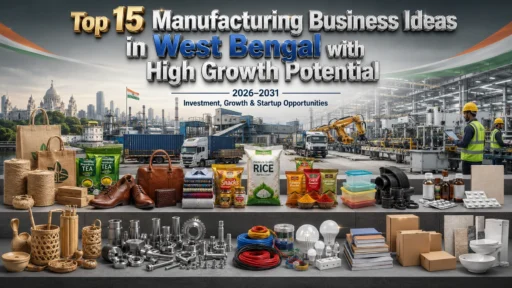


Manufacturing Business Ideas in West Bengal
West Bengal is slowly emerging as one of the most promising industrial hubs of the country — and early movers will reap huge dividends. The state of West Bengal with its over 9.5 crore population, its deep port connectivity through Kolkata, cost competitiveness of the manufacturing ecosystem and state incentives under the West Bengal Industrial Development Corporation (WBIDC) is quite promising to establish a successful manufacturing business. The analysis is designed for businesses that are considering investing in the range of ₹18–20 crore.
Here are 15 business ideas for manufacturing that have high potential in terms of demand, margin and government support. Each project is based on commercial logic, not only opportunity theory. From a first-generation entrepreneur to an MSME investor or a businessman ready to prepare a detailed project report (DPR), the suggestions here can aid you in making confident choices regarding the allocation of your investment.
Get Detailed Project Report (DPR): West Bengal Business Opportunities Guide
Why West Bengal Makes Sense for Manufacturing Right Now
The region of west Bengal has always been the industrial hub of India, where jute, steel, engineering products, chemicals etc. have been made. But, over the years of political instability, there had been investor uncertainty. That’s a story that is turning around quickly. The state government has inked MoUs worth more than ₹3.42 lakh crore at various Bengal Global Business Summits and ground-level investments are on the way. The industrial corridors such as Raghunathpur, Durgapur and Kalyani are now getting serious attention from the domestic manufacturers as well as export players.
Moreover, the geographical location is advantageous bringing Bangladesh, Nepal and Bhutan as well as the ASEAN corridor within easy reach of manufacturers in West Bengal. The Kolkata Port Trust manages one of the greatest amounts of cargo in India. As a result, industries such as food processing, plastics, industrial chemicals, and packaging are structurally strong here and face lower competition from other states, particularly from the landlocked states.
In addition, the state has a skilled manpower base, particularly in the engineering and textiles sectors, which makes it more cost-effective than Maharashtra and Gujarat. This difference in cost can mean an extra 8-12% net margin over a five-year time frame for a ₹20 crore project.(Manufacturing Business Ideas in West Bengal)
Government Policies and Incentives Powering the Manufacturing Sector
Even the most serious manufacturer should not go into West Bengal without a thorough understanding of the incentives available. The state has a multi-layered support mechanism that can substantially lower the effective project cost and enhance early cash flows.
West Bengal Incentive Schemes for MSMEs
West Bengal MSME Policy and West Bengal Industrial Policy offer capital investment subsidy, which varies from 15% to 30% based on the location of the project, type of investment. Higher subsidy percentages are given to units located in ‘backward’ areas or ‘notified’ industrial areas. Further, the government provides power tariff subsidy and stamp duty exemption and waives conversion charge on industrial land. These benefits alone can give you a saving of ₹2-4 crore on the upfront capital expenditure for a ₹20 crore project.
Central Government Schemes Applicable in West Bengal
There are a number of schemes which are obviously relevant at the central level. The Production Linked Incentive (PLI) scheme by the Ministry of Commerce and Industry includes industries such as food processing, textiles, specialty chemicals, and other high-potential industries in West Bengal. The Credit Guarantee Fund Trust for Micro and Small Enterprises offers collateral-free loans of ₹2 crore. Priority Sector Lending at concessional rate is available for the MSMEs to avail after getting the Udyam Registration from the MSME Ministry. Furthermore, the DPIIT’s Make in India initiative offers regulatory fast-track to new manufacturing projects.
Please check the official portal of the Ministry of MSME (msme.gov.in) for the latest guidelines of the schemes. State by state, industrial parks and eligibility for incentives are listed on the WBIDC portal (wbidc.com).
15 Manufacturing Business Ideas with ₹18–20 Crore Investment in West Bengal
Based on demand fundamentals, raw material availability, advantages of the state of West Bengal, and reasonable projections of ROI, the following 15 projects are evaluated. Each is capable of being used as an independent manufacturing unit supported by DPR funds.
1. Food Processing Unit – Snacks and Ready-to-Eat Products
Food processing is one of the commercially viable manufacturing business ideas in West Bengal since the base of the agriculture is rice, potato, mustard and vegetables. A mid-scale food processing unit can be established on ₹18-20 cr with a production capacity of extruded snacks, namkeen, prepared rice products or prepared ready to eat (RTE) meals. Demand is increasing by 12-15% per year from both the domestic retail and institutional markets (such as railways, airlines and hospitals). The border trade routes in Kolkata already exist for exports to Bangladesh and Nepal. The PM Formalisation of Micro Food Processing Enterprises (PM FME) offers extra funding assistance. Branded processed foods are one of the more predictable investments at this level with margins of 18-28% at the gross level.
Explore This Book: Handbook on Fruits, Vegetables & Food Processing with Canning & Preservation
2. Jute Diversified Products (JDP) Manufacturing
Jute is a product of West Bengal. But the actual opportunity in the current times is not the traditional gunny bags but the diversified products of jute – jute composites, jute geotextiles, floor coverings made of jute and eco-packaging. The need for sustainable and biodegradable packaging solutions has skyrocketed in recent years, with global brands looking for alternatives to plastic packaging. The National Jute Board, Ministry of Textiles gives substantial financial assistance and linkage support to the JDP manufacturers. A ₹20cr Ebitda company based on export grade jute composites and geotextiles can be realistically targeted at 22-30% margins. Additionally, the raw jute procurement price in West Bengal is still the lowest in the globe which creates an inherent ‘cost moat’ to any competitor outside West Bengal.
Check Out This Recommended Book: The Complete Book on Jute & Coir Products (with Cultivation & Processing)
3. Industrial Plastic Components (Injection Moulding)
In a world where India is emerging as a manufacturing giant, India’s demand for precision plastic components is on the rise, from automotive ancillaries to consumer electronics. The ₹18-20 crore injection molding plant in West Bengal will cater to the local OEMs in Durgapur–Asansol–Howrah industrial belt, and also provide to the retail and packaging industry of Kolkata. The business model is ideal for a B2B contract manufacturing business model because the OEM client will be responsible for making the capital investment, thereby minimizing your capital risk. The gross margins for this segment will generally be between 25 – 35% depending on product complexity as well as client mix. Moreover, integration of plastic recycling brings the circular economy element which resonates well with ESG investors and also provides incentive for recycling under the Extended Producer Responsibility (EPR) scheme in India.(Manufacturing Business Ideas in West Bengal)
4. Pharmaceutical Formulations (Tablets, Capsules, Liquids)
West Bengal has a large and expanding base of pharma manufacturing with Kolkata being a regional pharma distribution centre in eastern India. The plant to establish a WHO-GMP compliant unit for pharmaceutical formulations for generic tablets, capsules and oral liquids will cost around ₹18-20 crore (plant, machines, regulatory approvals, working capital). The price of domestic generic drugs is rising and the Jan Aushadhi Kendras and the government procurement via HLL Lifecare are continuing to promote the domestic market. Further, it is a contract manufacturing option where established pharma companies can generate immediate revenues with less marketing expenses (CMO model). A high barrier to entry and a regulated and licensed business with excellent pricing power and repeat institutional demand.
5. Corrugated Box and Packaging Material Manufacturing
Due to the e-commerce explosion, packaging is now a much more economically significant cost. The demand for corrugated boxes is increasing more rapidly than production in many regional markets, with each market having a unique set of products in demand. West Bengal is a significant E-commerce fulfilment centre for eastern India and is facing a shortage of good quality corrugated packaging. The automated corrugated box plant can cater to the needs of FMCG companies, e-commerce fulfilment centres, export houses and all of them together with an investment of ₹18-20 crore. Raw material is the kraft paper paper is available from the nearby port in Kolkata. The working capital cycle is generally 30 to 45 days in this business and once the quality standards are established, the clients are loyal. Maintaining machine uptime over 85%, and consistent volumes, can deliver net margins ranging from 14-20%.(Manufacturing Business Ideas in West Bengal)
View Full Project Details: Explore the Corrugated Sheet Board & Boxes Manufacturing Guide
6. PVC Pipes and Fittings Manufacturing
PVC pipes are consistently demanded in India for infrastructure development activity, such as housing, irrigation and municipal water supply, etc. The upcoming Jal Jeevan Mission projects and urbanization projects in West Bengal are a captive market for a new PVC Pipes & Fittings plant. A unit of 8,000–12,000 metric tonnes can be installed at a cost of ₹18–20 crore to cater to both government orders and the retail distribution trade. PVC resin (raw material) is purchased from Reliance, ONGC or imported from Kolkata port at competitive prices. The business is volume based and net margins are between 12-18%. When qualified, government procurement channels offer a lot of visibility of revenue, reducing business risk in the process.
7. Steel Fabrication and Structural Steel Components
Durgapur and Burnpur, West Bengal, are located in close proximity to some of the steel production centres, thereby providing structural steel fabricators with an unparalleled advantage in terms of raw material cost. A structural fabrication plant that can be accessed by industrial construction, infrastructure and pre-engineered building (PEB) companies can produce decent revenues with comparatively minimal marketing activity as long as it costs about ₹20 crore. The Indian PEB market is in a growth stage owing to the warehousing and logistics boom. The gross margin in fabrication is in the range of 15-22%. The visibility of contract orders is usually 6-12 months with predictable cash flow. This is also a business that scales well — doubling the size of the second shift or adding a second CNC cutting unit doubles output without a commensurate increase in the investment.
Related Article: How to Start a Steel Fabrication Business in India: Plant Setup, Investment & Profit Guide
8. Agro-Chemical Formulations (Pesticides, Herbicides)
West Bengal is one of the foremost agricultural states of India where more than 5 million hectares of land is farmed. Crop protection chemicals include insecticides, fungicides, herbicides and plant growth regulators and their demand is recurrent and structural. An agro-chemical formulation plant costing ₹18–20 crore could manufacture technical concentrates as well as market-ready formulations in its own brand for existing companies or in a toll-manufacturing mode. It has to be licensed by Central Insecticides Board and Registration Committee (CIBRC) and when it is done then it will provide a permanent entry barrier. It has a considerable export potential to Bangladesh, Sri Lanka and ASEAN markets as agrochemicals produced in India have a strong reputation for quality.(Manufacturing Business Ideas in West Bengal)
Download the Full Guide: Complete Technology Book on Pesticides & Agrochemicals
9. Textile Weaving and Technical Fabrics Unit
The tradition of textile is very old in West Bengal, there are weaving centres in Murshidabad, Nadia and Howrah. But the opportunity today is in technical and functional fabrics, and not the traditional handloom. Industrial woven fabrics for automotive, geotextiles, medical and filter applications have much higher margins than commodity textiles. Technical Textile unit with an investment of ₹18-20 crores can cater to OEMs, infrastructure firms and export demand. The PLI scheme introduced by the Ministry of Textiles for technical textiles is specially geared towards this opportunity. Additionally, the capital subsidy under Amended Technology Upgradation Fund Scheme (ATUFS) is available for textile machinery which would help in reducing the effective cost of the plant by 15-25% based on the type of machinery.
Read the Complete Book Here: The Complete Technology Book on Textile Processing with Effluent Treatment
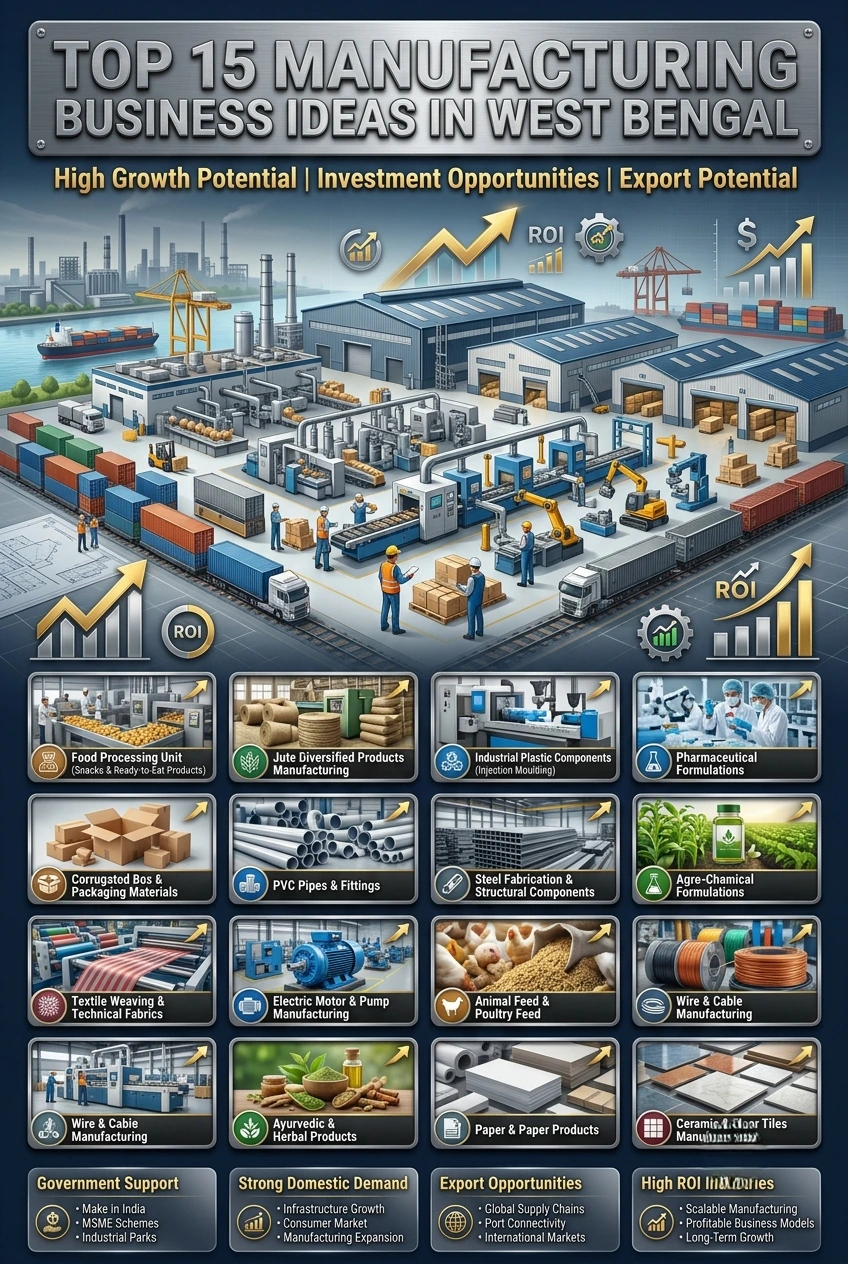
10. Electric Motor and Pump Manufacturing
The government’s efforts on energy efficiency and electrification in India are resulting in a constant demand for BEE star-rated electric motors and agricultural pumps. The engineering legacy in and around Howrah and Kolkata in West Bengal offers a pool of skilled manpower, parts suppliers and a proven vendor network. A new motor and pump manufacturing plant with a capacity of ₹18–20 crore can cater to the agriculture, water supply and industrial markets. The Government initiatives such as PM KUSUM encourage the purchase of solar-powered pumps, thus increasing the market demand for energy-efficient pump motors in the agricultural sector. The domestic motor industry has an annual value of thousands of crores and is expected to keep growing as manufacturing expands and there is an investment in the infrastructure.
11. Animal Feed and Poultry Feed Manufacturing
West Bengal is one of the biggest producers of fish and poultry in the country. The demand for scientifically formulated animal feeds (for poultry, aquaculture and cattle) is rapidly increasing as farmers switch from homemade to scientifically designed compound feeds. With modernized automatic machines, a ₹18 to 20 crore feed mill can manufacture pelleted poultry feed, extruded fish feed and cattle concentrate. Raw material such as maize, soybean meal and fish meal are easily available in the state. The business model has a high level of repeat purchase and low customer acquisition cost, and there is an increasing volume of organised demand associated with contract farming operations. Typical margins for steady state operations are in the 12-18% EBITDA range.
12. Wire and Cable Manufacturing
Wire and cable demand is huge and growing rapidly in India due to the growth of the Power sector along with the installation of Transmission Lines, Renewable Energy and Urban Electrification. A ₹20 crore Wire and Cable factory in West Bengal can manufacture the low voltage and medium voltage power cables, housing wires, industrial cables etc. You can buy copper and aluminium raw material with a great efficiency from the commodity market of Kolkata or you can directly purchase it from the Metal Scrap Trade Corporation (MSTC). Business is successful when operating on a regional distribution basis. Bulk order opportunities are available in government infrastructure projects. In this industry gross margins average about 14-20%, and good volume scalability exists as the volume of the plants grows.(Manufacturing Business Ideas in West Bengal)
Explore This Book: Manufacture of Electrical Cables, Wire and Wire Products Handbook
13. Ayurvedic and Herbal Products Manufacturing
In recent years, there has been one of the most significant changeovers of consumer preference towards the Ayurvedic and herbal products segment. The combination of health awareness, avoiding the addition of artificial additives, and international health fads has resulted in a market expanding 15–20% each year. There is a raw material advantage to West Bengal as they have the opportunity of having a vast supply base of medicinal plants in the Terai forests and in the foothills of the Himalayas. The AYUSH-licensed manufacturing unit has the capacity to manufacture a portfolio of products, ranging from herbal supplements to ayurvedic medicines, personal care products and nutraceuticals, for a crore of rupees. There is great potential for brand building in this category, and an export opportunity to the US, UK and Middle East, supported by growing wellness and diaspora interest.
Check Out This Recommended Book: Handbook on Herbal Products (Medicines, Cosmetics, Toiletries, Perfumes)
14. Paper and Paper Products Manufacturing
The paper and board market in India has a good structural growth in packaging, education and publishing industries. The state of West Bengal is very favourable for establishing a specialty paper or recycled paper manufacturing unit due to the availability of bamboo, agricultural residues and recycled fibre through the city of Kolkata. It is possible to set up a mini paper plant on an investment of ₹18-20 crore with an annual production capacity of 8,000-12,000 tonnes of kraft paper, newsprint or specialty paper for packaging. Corrugated packaging industry, which is expanding because of e-commerce, is forming captive demand channel. Moreover, eastern India offers a premium differentiation opportunity in tissue paper and hygiene paper products because the region has not yet achieved strong structural penetration.
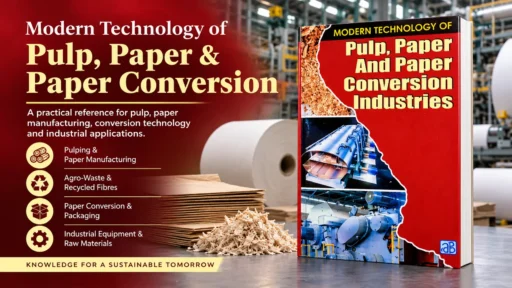
Download the Full Guide: Modern Technology of Pulp, Paper and Paper Conversion Industries
15. Ceramic and Floor Tiles Manufacturing
The opportunity to manufacture ceramics is geographically based, due to West Bengal’s clay deposits, especially in Bankura and Birbhum. The real estate and construction industry in India has a steady demand for floor and wall tiles. But eastern India will continue to be highly dependent on Gujarat-procured tiles, thereby providing a great opportunity for the local supply of a ceramic tile plant with a capacity of ₹18-20 crore. One used to retail distribution and other used to government construction contracts, each with daily production capacity of 15,000 to 20,000 square metres. Reducing the amount of fuel used in the kiln operation is the main margin driver and modern tunnel kiln technology is much more fuel efficient than traditional kilns.(Manufacturing Business Ideas in West Bengal)
Import–Export Opportunity Analysis for West Bengal Manufacturers
The geographical advantage of West Bengal makes it one of the most strategic states for export-based manufacturing in India. The state is also bordering three key trade partners of India on the ground — Bangladesh, Nepal and Bhutan. Together Kolkata Port and Haldia Port process millions of tonnes of cargo every year, offering cost effective ocean freight access to Southeast Asia, Middle East and Europe.
This is a good geography for food processors, jute goods producers, agro-chemicals manufacturers, pharma formula makers and technical textile manufacturers. Bangladesh imports more than $1 billion worth of processed and raw materials from India every year. Besides, India’s Look East Policy and 15-member BIMSTEC trade bloc is enhancing logistics and customs regime for the manufacturers of West Bengal targeting the Bay of Bengal region.
On the import side, manufacturers in capital-intensive industries such as PVC pipes, wire and cables, and pharma formulations are having an advantage due to the efficient raw material import infrastructure of the port of Kolkata, especially in the specialty resins, active pharmaceutical ingredients (APIs), and metal commodities segments. The DGFT India portal (dgft.gov.in) and the FIEO (Federation of Indian Export Organisations) are helpful resources for obtaining the latest trade data.
Identify high-growth industries before others do
Indian MSME Success Stories: Lessons for New Entrepreneurs
Emami Limited – From a Small Kolkata Shop to a ₹15,000 Crore Brand
Emami Limited, co-founded by R.S. Agarwal and R.S. Goenka, started as a small retail chemist shop in Kolkata. The founders realized that despite the huge unmet needs for herbal and Ayurvedic personal care products in India, there was a lack of structural penetration. They developed a business model with a primary focus on manufacturing, investing in plant quality, product formulation, and distribution with care. Emami’s brands such as Boroplus, Navratna Oil and Fair and Handsome are now household names. The takeaway: When the founders have the insight of the consumer and the discipline of manufacturing, West Bengal can create businesses for the global FMCG market.(Manufacturing Business Ideas in West Bengal)
Keventer Agro – Food Processing Built on Supply Chain Intelligence
The Keventer group is based in Kolkata, and founded one of the most well-known food processing companies in eastern India, called Keventer Agro. The group began manufacturing dairy and fruit-based beverages and gradually increased manufacturing capacity according to consumer trend of demand. They made a key strategic decision to invest in cold chain infrastructure – this minimized wastage and allowed premium pricing. Keventer’s model highlights the significance of supply chain control for new food processing entrepreneurs as well as the manufacturing process itself.
IFB Industries – Engineering Excellence from Kolkata
Indian Fine Blanks (later known as IFB Industries) of Kolkata began as a manufacturer of precision engineering components and later moved into the home appliance business. The company’s original concept: investment in German engineered manufacturing technology and parity with international standards of quality was the company’s competitive moat. IFB is today a brand that is recognized in the country in the field of washing machines, dishwashers and kitchen appliances. The clear lesson is for manufacturing entrepreneurs running a business with cost of ₹20 crore, investing in technology and product differentiation is the key that gives them the pricing power that volume does not provide.
Professional Feasibility Support Before You Invest
The investment of ₹20 crore in manufacturing business is not based on a general market optimism. When viewed at this level of detail, it is not possible to prepare a detailed, professionally done Techno-Economic Feasibility Report (DPR) without it being a mandatory part of sound capital allocation.(Manufacturing Business Ideas in West Bengal)
Niir Project Consultancy Services (NPCS) offers professional services for preparing new industry project Market Survey cum Detailed Techno-Economic Feasibility Reports (DPRs) for setting up new industries and manufacturing enterprises. NPCS reports include all the detailed manufacturing processes, demand analysis and market studies, process flow diagrams, product mix and capacity planning, machinery and raw material specification and complete project financials with the profitability analysis of the project. The aim is to guide entrepreneurs in determining the feasibility, profitability, and long-term viability of their business before investing in it. For projects with an investment of ₹20 crore in any of the above sectors, a professionally executed DPR can uncover cost optimisation potential, risk factors, and realistic IRR predictions that you can’t find on generic online templates.
Comparative Project Overview: 15 Manufacturing Business Ideas in West Bengal
| S.No. | Business / Project | Est. Investment (₹ Cr) | Gross Margin (%) | Key Advantage in WB | Export Potential | Key Scheme |
| 1 | Food Processing (Snacks/RTE) | 18–20 | 18–28% | Agri base, border trade | High | PM FME, PLI |
| 2 | Jute Diversified Products | 18–20 | 22–30% | Cheapest raw jute | Very High | NJB Scheme |
| 3 | Plastic Components (Injection) | 18–20 | 25–35% | OEM ecosystem, Howrah | Medium | EPR, WB MSME |
| 4 | Pharma Formulations | 18–20 | 20–30% | Distribution hub | High | WHO-GMP support |
| 5 | Corrugated Packaging | 18–20 | 14–20% | E-commerce hub | Medium | WB Industrial Policy |
| 6 | PVC Pipes and Fittings | 18–20 | 12–18% | Jal Jeevan Mission | Low | WBIDC Incentive |
| 7 | Steel Fabrication | 18–20 | 15–22% | Steel proximity | Medium | Make in India |
| 8 | Agro-Chemical Formulations | 18–20 | 18–25% | Agri state, border | High | CIBRC License |
| 9 | Technical Textiles | 18–20 | 20–28% | Weaving clusters | High | PLI Textiles, ATUFS |
| 10 | Electric Motors & Pumps | 18–20 | 18–24% | Engineering legacy | Medium | BEE Star scheme |
| 11 | Animal & Poultry Feed | 18–20 | 12–18% | Fish/poultry state | Low | WB Agri Policy |
| 12 | Wire and Cable | 18–20 | 14–20% | Port access for copper | Medium | Power sector schemes |
| 13 | Ayurvedic/Herbal Products | 18–20 | 22–35% | Medicinal plant access | High | AYUSH PLI |
| 14 | Paper & Paper Products | 18–20 | 15–22% | Bamboo, recycled fibre | Medium | WB MSME Policy |
| 15 | Ceramic & Floor Tiles | 18–20 | 18–25% | Clay deposits, Bankura | Low | WBIDC Park |
FAQ: Starting a ₹20 Crore Manufacturing Business in West Bengal
Q1. Which sector offers the best ROI for a ₹20 crore manufacturing investment in West Bengal?
At this investment range, you can explore: diversified jute products, pharma formulations, ayurvedic products, and technical textiles-these yield the highest gross margins (22-35%). That said, ROI also varies according to your execution ability, target clients and market standing, among others. A proper DPR can help you forecast your expected returns.
Q2. What government subsidies are available for a manufacturing unit in West Bengal?
West Bengal MSME policy and Industrial Policy has capital investment subsidy ranging from 15-30%, power tariff subsidy, Stamp duty exemption and Interest subvention. From centre side there are many support like PLI scheme, CGTMSE, Udyam Registration benefit etc. Together, these can reduce effective project cost by ₹2–5 crore on a ₹20 crore project.
Q3. How long does it take to get a manufacturing unit operational in West Bengal?
Project Cycle Generally, the cycle time varies from 18-30 months (land acquisition to commissioning/commercial production) for most industries. The project cycle for the pharma and agro-chemical sectors may be slightly longer as the approval time is relatively longer. Food processing and packaging units can be faster — sometimes 12–15 months if land and key approvals are secured early.
Q4. Is there export potential for West Bengal manufactured goods?
Definitely. Export-led manufacturing is especially appealing to West Bengal because of its border trade with Bangladesh, Nepal and Bhutan-coupled with port access at Kolkata and Haldia-and established demand for jute items, food processing, pharma, agro-chemicals and herbal/ayurvedic items from nearby countries and international wellness markets.
Q5. Do I need a Detailed Project Report (DPR) before applying for a loan?
Yes. Banks and financial Institutions demand for project report (DPR) is compulsory for term loan over 1 crore.
The project must have a minimum size of over ₹20 crore. To process the loan and subsidy applications, applicants must prepare a professional Detailed Project Report (DPR) covering the manufacturing process, market demand, project cost, profit and loss, cash flow statement, Internal Rate of Return (IRR), and Debt Service Coverage Ratio (DSCR).
Q6. How do I evaluate if a manufacturing business idea is genuinely viable in West Bengal?
Evaluate four factors: (1) raw material proximity and cost in West Bengal, (2) demand density in the state and accessible export markets, (3) applicable government incentives and their effective financial value, and (4) competitive landscape — specifically whether you can carve a sustainable margin advantage. Consulting a reputed feasibility report firm before investing is the most practical way to validate all four parameters rigorously.
Conclusion: West Bengal Is an Undervalued Manufacturing Opportunity
West Bengal is at an inflection point. The industrial infrastructure is improving. Government incentives are real and accessible. Export corridors are widening. And entrepreneurial capital is beginning to flow in — not yet in a flood, but certainly in a meaningful stream. Consequently, founders who make well-researched, DPR-backed investment decisions now are likely to benefit from first-mover advantages in several of these 15 sectors before competition intensifies.(Manufacturing Business Ideas in West Bengal)
A ₹20 crore manufacturing business in West Bengal is not a speculative bet. It is a calculated industrial play that geography, policy, and market fundamentals support. However, the difference between success and a costly mistake often comes down to quality of pre-investment analysis. Therefore, invest in a professional feasibility study before you invest in the factory. The numbers will thank you.