

PM Surya Ghar Gets $890 Million World Bank Boost: 5 Business Opportunities for Indian Entrepreneurs in 2026
India’s residential solar revolution has received a big global thumbs up. On 9th July 2026, the Board of Executive Directors of the World Bank approved a $890 million financing package to support the Indian government’s flagship PM Surya Ghar: Muft Bijli Yojana programme — and this is not just governmental support being backed by the world’s biggest development bank. This approval marks the beginning of one of the most profitable business routes of the decade for Indian entrepreneurs, MSMEs and startup founders.(PM Surya Ghar Business)
The financing will release an extra $4.2bn of private sector finances via commercial loans, as Economic Times said this week. It makes for a scale of almost $5 billion ecosystem, comprising manufacturing, installation, maintenance, financial services, and digital platforms, all focused on installation of solar panels on the 10 million rooftops of India.
Timing is key. The India solar rooftop market is progressing from pilot to commercialization, with 9.56 GW of rooftop capacity already installed, and more than 2.62 million systems deployed since the scheme’s launch in February 2024. Businesses which are developed around this curve, rather than after it, will create the most value for the entrepreneur.
What Recent Economic Times Reporting Means for Founders
The coverage of the World Bank approval by the Economic Times sheds light on an important change in structures: India is no longer a solar country of only utility scale plants in Rajasthan or Gujarat. The residential rooftop market, which has received little attention for so long, is now the key growth market.
These are the updates for a development:
- The World Bank financing package consists of an $820 million IBRD loan, a $60 million concessional loan from the World Bank’s Clean Technology Fund and a $10 million IBRD Liveable Planet Fund grant.
- A direct focus on the household level of solar adoption is achieved through private capital mobilisation through commercial loans of $4.2 billion, which will require the need for solar finance intermediaries and fintech platforms.
- The programme has a definite goal of empowering distribution companies (DISCOMs), banks and solar vendors as a single service provider – a strong signal for B2B solution builders.
- There will be an estimated 1.7 million jobs created in manufacturing, installation, operations & maintenance — implications for labour supply, training and skilling are immediate business gaps.
- MSMEs can align to the government’s target of 7.5 million by December 2026 and 10 million by FY26-27 for rooftop installations being hard demand.
It is evident from the market intelligence in the Economic Times here that it is not all about solar panel making. It’s in the process of creating end-to-end solar homes solutions from lead generation to project finance to after-sales service. Readers of this signal reading and act accordingly will be in a high-growth, policy-supported, and internationally subsidized market.
Get Detailed Insights from This Book: Solar PV Power and Solar Products Handbook
Why the Residential Rooftop Solar Industry Is Growing Now
This is a moment of structural growth – and not just a blip – due to several forces coming together.
Policy-Backed Demand
The outlay of the PM Surya Ghar scheme is Rs 75,021 crore. The subsidies are already being rolled out — more than Rs 17,967 crore have been disbursed to beneficiaries since the launch. Procurement and installation velocity will ramp up as 6.5 million applications are in the pipeline and are slated for installation in December 2026.
Household Economics Are Compelling
Rooftop solar power is now financially feasible for most middle-class Indian households with a 4–6-year payback period and a 25-year lifespan of the panels. The cost of electricity rises and the price of panels drops, making the financial argument for adoption even better with each passing quarter. This value proposition means that the advantage lies with entrepreneurs that sell this value.
Market Has Moved Beyond Early Adopters
India has crossed 27 GW of total solar capacity with the bulk being from utility-scale projects. Residential rooftop has been lagging behind. The World Bank intervention in particular aims to overcome this bottleneck by tackling the financing gaps at the household level — i.e. the target market is the 100-million-plus urban and semi-urban homeowner base.(PM Surya Ghar Business)
Global Capital Is Validating the Opportunity
The World Bank is not simply writing a cheque when it spends $890 million, and then co-mobilises $4.2 billion from the private sector. It is lowering the risk for commercial lenders, insurers and investors in the industry. This is a lot easier for solar startups and MSMEs to raise working capital, avail bank credit, and also find equity investors.
Government Policies and Incentives You Must Know
The policy architecture needs to be thoroughly grasped by entrepreneurs entering the space. Both the Ministry of MSME and Startup India have frameworks that can be directly used to support business ventures related to solar energy.
- PM Surya Ghar Muft Bijli Yojana — It provides subsidy for 1 kW to 3 kW solar systems with the following subsidy rates: 60% for 2kW system and 40% for 1kW after 2kW. Households get up to 300 units of free electricity monthly.
- PLI Scheme for Solar PV Modules — Production Linked Incentive scheme for solar manufacturing provides incentives for solar PV module manufacturing, thereby reducing the reliance on imports and providing an opportunity for a solar PV module supply chain domestically.
- Net Metering Policy — Many states have put in place regulations that permit rooftop solar owners to feed excess electricity back into the grid, further compounding the attractiveness of the solar rooftop solution and providing a continuous revenue stream for the solution provider.
- Solar lending comes under the definition of priority sector by RBI, which means banks are keen on using their money in this sector. A direct entry for solar finance platforms and NBFCs.
- Government’s domestic content requirement for solar gear provides an opportunity for the solar component manufacturers in India.
The DPIIT’s benefits for startups, including tax exemptions, quick IP registration, and participation in government procurement, are also applicable to startups in solar technology.
5 High-Potential Business Ideas Emerging from This Development
1. Solar System Integration and Installation (EPC Services)
The most direct opportunity is. Engineering, Procurement, and Construction (EPC) companies that install rooftop solar systems end to end for residential clients are in dire need, with little availability compared to the demand target. A Tier-2 or Tier-3 city MSME EPC operation adopting government empanelment can develop a maintenance contract business model and referral model to generate a recurring revenue. India must have thousands of certified installation companies most of which are not present yet as per the 7.5 million installation target by December 2026.
Access Complete Business Plan: Renewable Energy Sector: Green Power, Solar, Wind & Bioenergy
2. Solar Financing and NBFC Platform
Private capital mobilisation is the World Bank’s $4.2 billion private capital mobilisation where the funds are specifically funneled into commercial lending. The focal point of this capital flow is an NBFC or fintech that provides solar-specific EMI products, solar loan origination, and/or Buy Now Pay Later (BNPL) for solar systems. This eases the strain on customer acquisition costs by leveraging existing banks under RBI’s priority sector lending policy.
3. Solar Component Manufacturing (Mounting Structures & Wiring)
Panel manufacturing needs to invest a lot of capex, whereas the rest of the systems like mounting structure, junction boxes, MC4 connectors, earthing kit, cable management system are high-margin import-substitution products. Many of these components are imported now into India. Within 24 months, a manufacturer aiming for SIDBI funding and empanelment in government tenders can establish an MSME enterprise with an annual turnover of ₹10–50 crore.
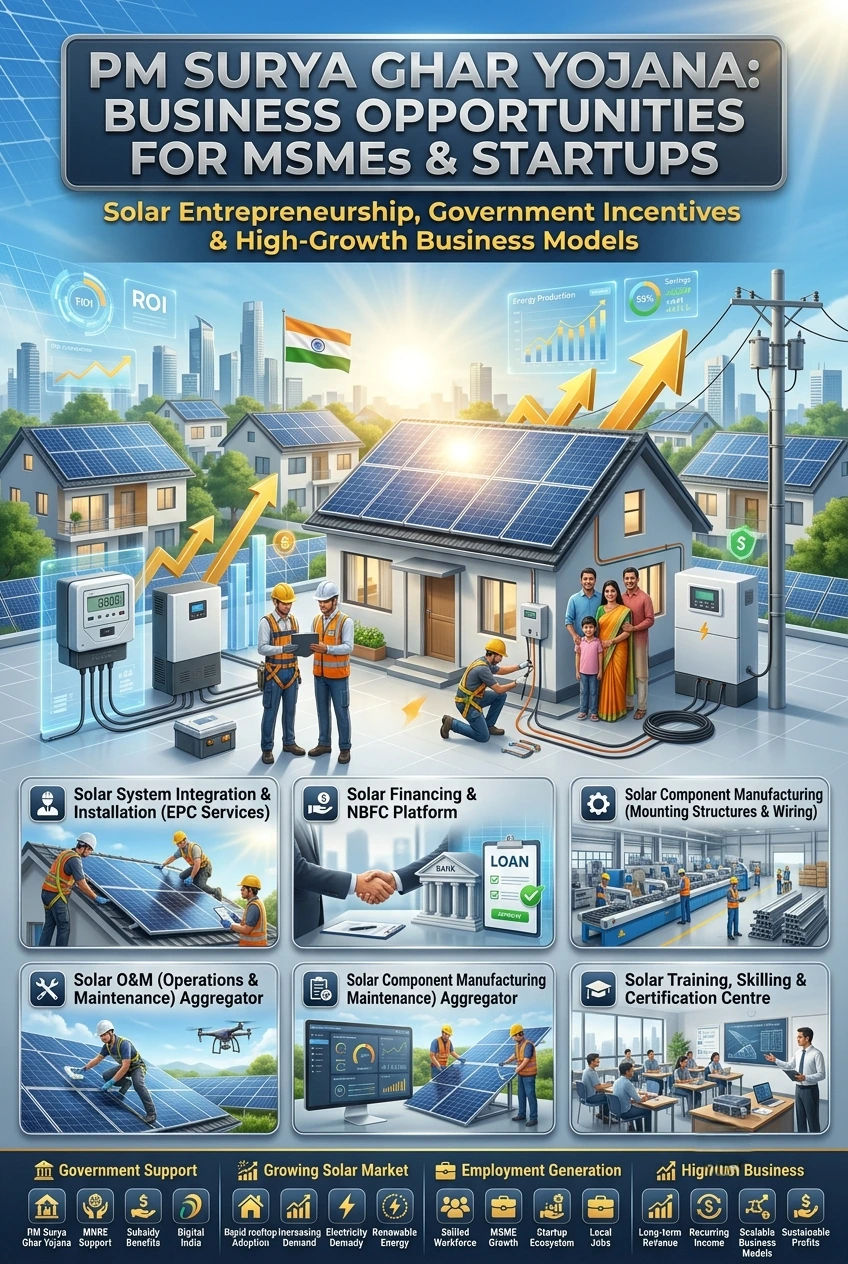
4. Solar O&M (Operations & Maintenance) Aggregator
Annual maintenance for all installed solar systems requires panel cleaning, inverter servicing, performance monitoring, and warranty management. With 2.62 million systems already out in the field and millions more to follow, an O&M aggregator platform brings trained technicians to homeowners, resulting in a recurring high-margin subscription business. You can consider it an “Urban Company for solar maintenance” because it requires relatively low startup capital and offers high scalability.
5. Solar Training, Skilling, and Certification Centre
The programme is expected to create 1.7 million jobs. However, India is currently lacking in skilled workforce to fill the positions. NSDC (National Skill Development Corporation) aligned solar skilling centre, which provides NABCEP equivalent certification and employment, fills a critical gap. This model works especially well in industrial towns or semi-urban areas with a sizeable labour pool but limited access to organized technical training.
Import–Export Opportunity Analysis
Roof top solar boom brings with it unique trade possibilities. Export-import oriented entrepreneurs should make a study of both export and import. Export Promotion Schemes (EPS) by the Directorate General of Foreign Trade (DGFT) are available for exports of solar equipment, such as MEIS and RoDTEP benefits.
Export Opportunities
- India is making tremendous strides towards solar manufacturing. Under the PLI scheme, domestic manufacture will increase and Indian manufacturers will be able to look into export markets in Southeast Asia, Africa, and the Middle East, all of which have residential solar programmes.
- Indian MSMEs can compete in the global supply chains with the following components: Solar-grade aluminium mounting structure, polymer junction box, and specialised solar cables.
- India can bring exportable services to the solar market in less developed countries in engineering services – design, project management and commissioning.
Discover business ideas that actually make money
Import Substitution Opportunities
- The high-efficiency solar cells (monocrystalline PERC, TOPCon) continue to be mainly imported. PLI support for cell manufacturing is for domestic manufacturers who are early movers.
- High import dependence of solar inverters, especially string inverter and microinverter for domestic applications. There’s a government procurement market and there’s a private demand market for a domestic manufacturer that’s going to this niche.
- Battery storage systems (solar-plus-storage) is another emerging area of import substitution in India as it steps towards 24×7 solar homes.
Indian MSME Success Stories Rooftop Solar
Haryana-Based Solar EPC Firm Scales with PMSGMBY
In early 2024, a small EPC firm in the town of Karnal, Haryana got the empanelment with the state DISCOM under the PM Surya Ghar scheme. The company expanded its customer base from government agencies and grew to process subsidy applications, scaling from 12 installations per month to more than 200 by the end of 2025, with 45 trained technicians. They had an edge in the market: a proprietary mobile app for monitoring after installation that cut 60% of customer complaints.(PM Surya Ghar Business)
Tamil Nadu MSME Manufacturer Captures Mounting Structure Market
In 2023, one precision engineering MSME from Coimbatore shifted their focus from general structural fabrication to solar mounting structures.One precision engineering MSME in Coimbatore changed its business from structural fabrication to solar mounting structures in 2023. The company now has galvanised steel fabrication lines and is a certified BIS partner, providing mounting systems to more than 30 EPC companies in South India. The revenue jumped from ₹2.8 crore to ₹18 crore in just 18 months. The company is now in talks with a UAE distributor for export orders.
Gujarat Fintech Startup Builds Solar Loan Platform
The solar financing gap was spotted by a Surat based fintech startup early on. The platform brings rural households in touch with bank partners who have solar-specific EMI products, and levies origination fees and commissions based on performance. The startup has raised a Series A round from a VC firm based in Mumbai, who specializes in climate-related investments. The startup raised a Series A round from a VC fund based in Mumbai which focuses on investments in climate change.
How Niir Project Consultancy Services (NPCS) Can Help
Creating a business in the rooftop solar industry requires more than a great concept. It needs a bankable project report, a technology roadmap, a market feasibility analysis, and a clear understanding of regulations.(PM Surya Ghar Business)
Niir is India’s premier industrial consultancy and feasibility report provider with over 40 years of experience across 5,000+ industries. If you are an entrepreneur or MSME exploring rooftop solar opportunities, NPCS can help. Whether you are an EPC contractor, component manufacturer, O&M service provider, or training institute, NPCS provides you with the following:
- Detailed Project Reports (DPRs) including technology selection, plant layout, sourcing of machinery, financial estimates
- Market feasibility studies in line to subsidy timelines and state policies of PMSGMBY
- Documentation support for MSMEs and banks on solar project financing
- Technology transfer and manufacturing set up assistance for production of solar BOS components
- Provide import-export strategy consulting services in the field of solar equipment trade.
The banks, financial institutions, government and investors accept the NPCS reports as credible and bankable documents. For entrepreneurs who want to enter this business with a clear vision and confidence, NPCS provides the analytical framework to help them convert an opportunity into a funded, operational business.
Related Article: Solar Panel Manufacturing Business in India: Cost, Profit, Investment & Complete Startup Guide
PM Surya Ghar Rooftop Solar: Key Data Snapshot (2026)
| Parameter | Details |
| World Bank Financing Package | $890 million (IBRD loan + CTF + Livable Planet Fund) |
| Private Capital Mobilised | $4.2 billion through commercial lending |
| Government Scheme Outlay | Rs 75,021 crore (PM Surya Ghar: Muft Bijli Yojana) |
| Installations Since Launch | 2.62 million+ systems (as of March 2026) |
| Installed Capacity | 9.56 GW rooftop solar (March 2026) |
| Scheme Target | 10 million households (FY 2026-27) |
| December 2026 Target | 7.5 million homes |
| Jobs to Be Created | 1.7 million across manufacturing, installation, services |
| Subsidies Disbursed | Rs 17,967 crore in central financial assistance |
| Subsidy Coverage | 60% for first 2 kW; 40% for next 1 kW |
| Free Electricity | Up to 300 units per month for beneficiary households |
| Scheme Launch Date | February 13, 2024 |
Frequently Asked Questions (FAQs) for Founders
1. What is the PM Surya Ghar: Muft Bijli Yojana and how does it create business opportunities?
PM Surya Ghar is India’s flagship rooftop solar programme for 10 million households. It provides subsidies, financing support, and policy incentives to encourage solar adoption. For entrepreneurs, the scheme creates strong government-backed demand. It offers opportunities in solar installation, manufacturing, maintenance, financing, and skill training. Demand will likely grow rapidly, while businesses and skilled professionals currently fall short of meeting the programme’s ambitious scale.
2. Do I need a government licence to start a solar EPC business under this scheme?
Yes. To access government-incentivized leads and the subsidy mechanism, your solar EPC company should get empanelled with the state DISCOMs. This involves buying BIS-certified products and getting relevant licenses for your electrician/electrical contractor. Technical requirements vary across different states, but a well-prepared MSME can meet them without much difficulty.
3. How much capital does a solar installation business require to start?
Lean business: The initial investment of ₹15–30 lakh covers working capital, tools, testing equipment, one licensed electrician, business registration, and DISCOM empanelment. To scale the business to 50+ installations per month, you may need an investment of ₹75 lakh to ₹1.5 crore. This amount also covers financing for solar panels and inverters.
4. What financing options are available for solar MSMEs?
Solar MSMEs can seek financing from SIDBI through green energy windows. They can also approach NABARD for rural solar projects and commercial banks under the RBI’s priority sector lending framework. The World Bank’s backing for the PM Surya Ghar scheme boosts commercial banks’ interest in financing solar MSMEs. Also, for equity finance and project finance needs, they may contact the green investment facilitating services of Invest India.
5. Is there an export opportunity for Indian solar MSMEs?
Sure. With India’s expanding domestic solar manufacturing capabilities, PLI schemes, and relatively low manufacturing costs, Indian businesses have strong export opportunities. Demand is particularly high for balance-of-system products such as mounting structures, junction boxes, and cables. Engineering services and rooftop solar project management are also in high demand in countries like Bangladesh, Sri Lanka, Kenya, Nigeria, and Vietnam. These countries are expanding residential solar programs, but their local manufacturing capacity remains limited.(PM Surya Ghar Business)
6. How can I find reliable market data and project reports for a solar business?
Niir Project Consultancy Services (NPCS) compiles these project reports to help entrepreneurs analyze new business opportunities, market potential, and the feasibility of solar manufacturing and service ventures. Each report includes investment estimates, machinery requirements, raw material details, and financial projections. These insights support business planning and strengthen bank loan applications.
Conclusion: The Window Is Open — Act Before It Narrows
The World Bank’s $890 million commitment to India’s PM Surya Ghar programme, reported by Economic Times, is not just a headline. It is a market signal of rare clarity: $5 billion in combined public and private capital is about to enter India’s residential solar ecosystem, and the businesses that capture this wave are those being built today.
India has a December 2026 target of 7.5 million rooftop solar installations. As of mid-2026, approximately 2.62 million have been deployed. That means roughly 4.88 million more installations need to happen in the next six months. The installation capacity, financing infrastructure, skilled workforce, and maintenance network to support this surge does not yet fully exist. That gap is the opportunity.(PM Surya Ghar Business)
For Indian entrepreneurs and MSMEs, the message from Economic Times’s reporting is unambiguous: this is not a sector to watch from the sidelines. The policy support is in place. The global capital is committed. The household demand is real. Entrepreneurs now need to execute opportunities in installation, manufacturing, financing, maintenance, and skilling.
Entrepreneurs who build their solar businesses today will not just benefit from a government scheme. They will be building permanent, scalable enterprises in India’s clean energy economy — one that is growing toward a ₹5 lakh crore market by 2030. The window is open. The question is who moves first.