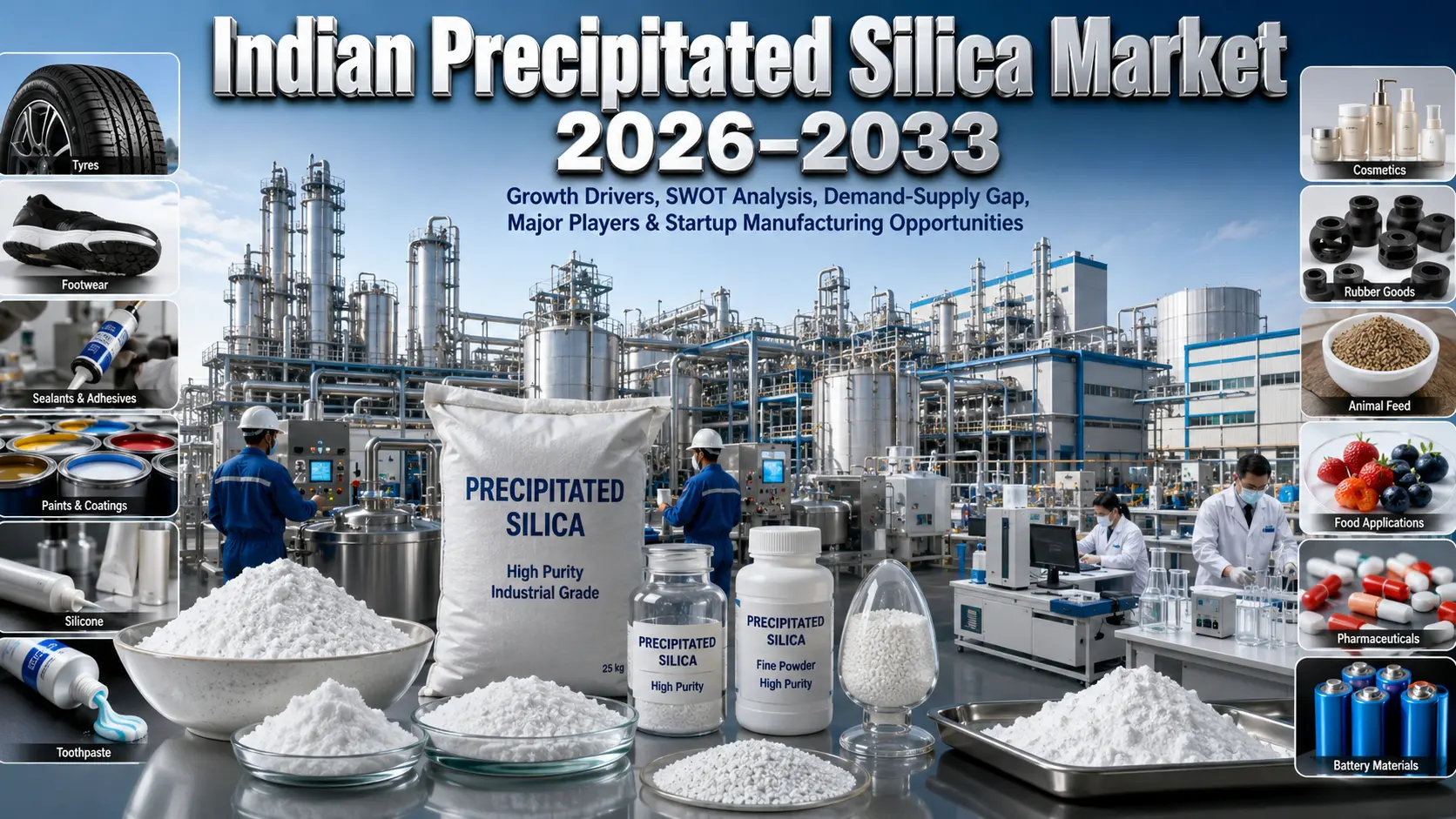

Indian Precipitated Silica Market
Market Insight
India’s precipitated silica market is at a pivotal juncture for both the industry’s trajectory and policy support. The global tire chemical market is expected to reach $76.2 million in 2022 and $210.1 million by the end of 2033, growing at a compound annual growth rate exceeding 10%. The global market for tires will not have a narrow base demand as it covers many applications including the automotive industry and tire production, as well as the food & feed additives industry, the pharmaceuticals industry, the oral care industry, and even the agrochemicals industry, and footwear sector to have an extensive and robust consumption base for the industry.
Demand–Supply Gap: Although there are a few large domestic producers, India still relies on specialty and high-performance grades of precipitated silica from the international suppliers, particularly in Highly Dispersible Silica (HDS) applications such as fuel efficient and green tyres. Their domestic supply capacity is being built up but growth in demand, especially from India’s rapidly expanding tire industry and plans to export agrochemicals, is on par with the increased production. This puts a distinct spotlight on new manufacturing investments for the near future.
Tata Chemicals Ltd., Madhu Silica Pvt. Ltd. and AksharChem India Ltd. are the three major domestic manufacturers that have key stances in both rubber-grade and specialty-grade segments.
Introduction: Why Precipitated Silica Deserves Closer Industrial Attention
Precipitated silica is one of those many specialty chemicals that plays an important but unnoticed role in the Indian industrial economy, and is essential to products that millions of Indians use daily. Any fluoride toothpaste bought at a supermarket uses precipitated silica as its main abrasive and thickening agent. The MRF or Apollo tyre fitted to a recently purchased SUV contains silica compounds that decrease rolling resistance and increase fuel efficiency. The pesticide formulation used in a wheat field in Punjab contains precipitated silica as a carrier, which helps spread the active ingredients evenly across the field. Silica based rubber reinforcement is the key contribution to the durability and flex resistance of a pair of safety shoes’ footwear sole.(Indian Precipitated Silica Market)
The multi-sector relevance is exactly this makes precipitated silica an exceptionally solid business opportunity. Compared to any single-use chemical tied to one end market, precipitated silica is a multipurpose chemical, and each of the major verticals that use it is currently expanding in India.
The Manufacturing Process: What Makes Precipitated Silica Commercially Viable
Precipitated Silica is an amorphous form of silicon dioxide (SiO), produced by a tightly controlled chemical precipitation process. The principal route to produced it consists of the interaction of sodium silicate (water glass), made from quartz sand and soda ash with a mineral acid (usually sulphuric acid), under rigorously controlled temperature,pH and agitation conditions. The process then filters and washes the precipitate, dries and mills it to yield silica powders with different surface areas, particle sizes and structures.
In India, the second pathway of production is more important and a silica source from rice husk ash (RHA) is used. India is one of the largest countries in the world for rice production and vast amount of agricultural waste is rice husk.
When burned in a controlled manner, rice husk generates ash with a high amorphous silica content of 85 to 92%, making it a very pure raw material. Treating this ash with sodium hydroxide followed by acid precipitation produces the final silica product. The main raw material available in this route is agro-waste, which costs nearly nothing. This route converts an environmental liability (open burning of rice husk contributes to air pollution and many states have banned it) into a value-added product while also offering significant cost benefits.
The rice husk ash route is especially appealing for small and medium business (SMBs). The capital investment for a small/medium production unit of RHA technology amounts to ₹3-8 crore, the studies indicate that the IRR is 20-30% under well-managed operation. The ability to manufacture precipitated silica at MSME-scale is now firmly within the financial grasp of MSME entrepreneurs, particularly in the rice belt states such as Punjab, Haryana, Uttar Pradesh, West Bengal, Andhra Pradesh and Telangana.
Get Detailed Project Report (DPR): Rice Husk Value-Added Products Guide
Market Size and Growth Trajectory: Numbers That Investors Should Know
The Indian precipitated silica market, valued at USD 76.2 million, is on a trajectory to reach USD 210.1 million by 2033, growing at a CAGR of approximately 10.5% over the 2026–2033 forecast period. In volume terms, the market stood at approximately 162.35 kilotons in 2025 and is expected to reach 205.69 kilotons by 2031, reflecting steady, defensible growth driven by real industrial consumption rather than speculative demand.
This expansion is occurring in a favorable global environment. The global precipitated silica market is also expanding at a CAGR of around 6.4% during the forecast period and will generate more than USD 2.61 billion in revenue by 2033. Asia-Pacific is contributing more than 43% of global precipitated silica revenues. India is one of the fastest growing contributors in that regional bloc because of its automotive, agrochemical and pharmaceutical industry.
Diversification in application sectors is the hallmark of India’s growth story. The rubber and tire market currently holds the largest share of market revenue in the country with more than 57%, due to rising sales of passenger vehicles and the structural transition to radial tire technology. However, the agrochemicals business is expected to grow at a CAGR of more than 10.6%, while the oral care and personal care business has carved out a growing niche among Indian consumers upgrading their hygiene product purchases. This diversification also suggests that a downturn in any one end use market isn’t likely to have a major impact on the overall demand picture.
Application-Wise Analysis: Understanding Where the Growth Is
Rubber and Tires: The Dominant Segment
Rubber reinforcement is the largest use in India, comprising more than 36% of the market volume in tires alone. Precipitated silica, particularly in Highly Dispersible Silica (HDS) form, has gradually replaced carbon black as the filler of choice in today’s rubber formulations. Performance gains can be measured – for example, estimates suggest that silica-reinforced formulations offer better wet grip and reduce rolling resistance (potentially by up to 20%), leading to improved fuel efficiency – properties that vehicle manufacturers (OEMs) and authorities highly value.
According to The Society of Indian Automobile Manufacturers (SIAM), overall, 4.3 million passenger vehicle sales registered in India in FY2024-25. This was the highest annual sales of passenger vehicles of any country in its history, where utility vehicles accounted for 65% of total passenger vehicle sales. Indian Tyre market anticipated to expand by 7.49% CAGR, reach $27.67 Billion by 2034. All new cars sold bring about replacement tires that will require replacement every 3-5 years, creating a long lasting and cumulative demand-pull aftermarket.
Another driver of the accelerated silica sales of electric vehicles. EV tires have to be able to support more weight from the batteries themselves, but also reduce rolling resistance to improve range. This not only makes silica loaded compounds preferred but even essential in EV tyres. The Indian EV tire market is expected to experience a CAGR of more than 32% till 2030, thus creating high-volume growth opportunities for precipitated silica manufacturers.
Get Detailed Insights from This Book: The Complete Book on Rubber Processing and Compounding Technology
Agrochemicals: The Fastest-Growing Application
The agrochemical market in India is an interesting secondary demand case. Due to its high surface area and absorption capacity, manufacturers use precipitated silica as a carrier for wettable powders, granular insecticide formulations and fungicides. These properties help ensure uniform distribution of the active ingredient and longer shelf stability, which generic carriers such as calcium carbonate or clay can’t guarantee.
The Indian agrochemical market is projected to grow at a CAGR of 11.8% till 2029, as the government approves new actives, farmers increasingly adopt IPM, and buyers consciously shift towards higher-efficacy products. Indian agrochemical exports posted good volume momentum in H1 FY2025, as global inventories returned to normalcy. The Ministry of Chemicals and Fertilizers (MOCF) Chemicals and Petrochemicals division has been actively promoting localization of agrochemical value chain, bringing down dependency on imports and establishing a steady demand for various specialty chemicals, such as precipitated silica, which are produced locally.
Oral Care and Personal Care: The Premium Segment
Precipitated silica is the “workhorse” of modern toothpaste formulations, and performs multiple functions as a thickener, abrasive and whitening agent. The oral care market in India is growing at the rate of 7–9% per year, with an increase in health consciousness, the premiumisation of oral care products, from gel-formulate to whitening products and from herbal to non-herbal, and a rise in awareness about oral care. Consumer brands need to demand pharma quality silica, which must have a consistent quality and particle size distribution, and a surface chemistry with higher margins and longer-term relationships.
There is also a growing demand for cosmetics and skin care products. Cosmetics manufacturers employ precipitated silica in products such as foundations and sunscreen as a thickener, an exfoliant carrier, and a matting agent. Specialty silica grades are poised to grow faster than the industry average in India’s beauty and personal care market, which is undergoing a structural transformation and could reach a value of ₹20,000+ crore by 2022.
Food Industry and Pharmaceuticals: Niche but High-Value
Precipitated silica is used in the food industry as an anti-caking agent for powdered foods such as baby formula, protein supplements and spices. In pharmaceuticals, manufacturers use it to enhance the flowability of granulations for tablet formulation and improve the weight uniformity of the final pharmaceuticals. These are regulatory applications that demand food-safe or pharmaceutical-grade silica in accordance with food safety requirements; premium pricing and stable procurement contracts with large FMCG and pharmaceutical manufacturers.
Related Article: Top Pharmaceutical Industry Consultants in India: A Practical Guide for Entrepreneurs
Regional Analysis: Where India’s Precipitated Silica Market Concentrates
Western India: The Production hub – Maharashtra and Gujarat combined share around 34% market volume for India’s precipitated silica market. The region offers a distinct advantage because India’s automotive OEM corridor (Pune–Mumbai belt), chemical industrial estates (Dahej, Ankleshwar, and Vapi-based GIDC clusters), and soda ash producers are concentrated there. This concentration supports conventional precipitated silica manufacturing, which uses soda ash as an important raw material. The Development of Dahej at AksharChem India is a typical example of Gujarat’s existing chemical landscape that is drawing and sustaining investments in the specialty chemical sector.
Southern India – The Fastest Growing Region: Tamil Nadu is emerging as a manufacturing hub in South India, and experts expect the state to achieve a CAGR of 4.41% by 2031. Apollo Tyres, MRF, Bridgestone and many other large companies manufacturing tyres are the single largest consumers of precipitated silica in Sriperumbudur–Oragadam belt near Chennai. The resolution for an investment of ₹775 crore to boost Cuddalore plant capacity by 50 kilotonnes per annum (ktpa) by November 2025 brings a clear sign of the focus on South India in the future silica supply scenario in the country.(Indian Precipitated Silica Market)
Northern India — The Emerging Opportunity: Northern India, especially the state of Punjab, Haryana, and Uttar Pradesh has abundance of rice husks, agrochemicals demand and is close to footwear manufacturing hubs (Agra, Kanpur). North India is especially well-positioned to supply rice husk ash as a low-cost silica source for small-scale agro-waste precipitated silica plants serving rubber goods, footwear, and agrochemical carrier applications.
SWOT Analysis of the Indian Precipitated Silica Market
Strengths
India has a well-developed, integrated downstream demand base with large, organized and growing market segments in tire, rubber goods, agrochemicals and FMCG. Availability of domestic raw materials is adequate: quartz sand and soda ash are made domestically and the rice husk is also found as a waste product in the agricultural belt states at very low cost. Developing pool of chemical engineers, process technologists and specialty chemical manufacturers which offers a rich talent pool of technical manpower. Tata Chemicals, one of the established players, has made it clear that large scale, export ready production is possible.
Weaknesses
While specialty and Highly Dispersible Silica (HDS) grades continue to be much smaller than the demand from the premium tire and automotive markets, there is a continued reliance on multinational suppliers for these. High environmental compliance costs—such as those imposed by the Central Pollution Control Board for zero liquid discharge—add to the capital expense, and can be especially tough on smaller producers with shallower balance sheets. The standardization of process is not uniform at MSME scale and quality consistency is also a challenge in establishing long term supply agreements with OEMs.
Opportunities
The electric vehicle revolution will probably create the biggest structural opportunity for the Indian precipitated silica industry in the coming decade. Only silica-based rubber compounds can reliably meet EV-specific tire requirements, such as low rolling resistance, high load capacity, and noise reduction. This creates a captive, rapid growth market which domestic producers should be able to supply. Further, the agrochemical export plans of India combined with the rising demand for Made-in-India active ingredients in international market will drive the demand for silica as secondary demand in the medium term.
The Ministry of MSME and Startup India programme by the Department for Promotion of Industry and Internal Trade (DPIIT) along with its support structure, including collateral free loans under CGTMSE, technology upgradation support, and tax concession for DPIIT registered Startup are able to provide a meaningful support ecosystem for new chemical manufacturing startup companies. The Make in India initiative’s thrust on chemical sector further reinforces the business of domestic capacities building.
Threats
But, despite the high freight costs, China continues to bid lower than the domestic manufacturer in the lower specification grades. This leads to a structural floor below where domestic manufacturers can make a profit on commodity grades. The old path to soda ash production introduces volatility to the price of the product due to a variety of factors, such as a fall in natural soda ash production in the United States and its effect on the soda ash trade flows around the world. Furthermore, carbon black is still maintaining its position in the heavy-duty commercial vehicle tire market where wet-grip performance is not a top priority in terms of volume, which means there’s a volume substitution risk.
Demand–Supply Gap: Where the Business Opportunity Lies
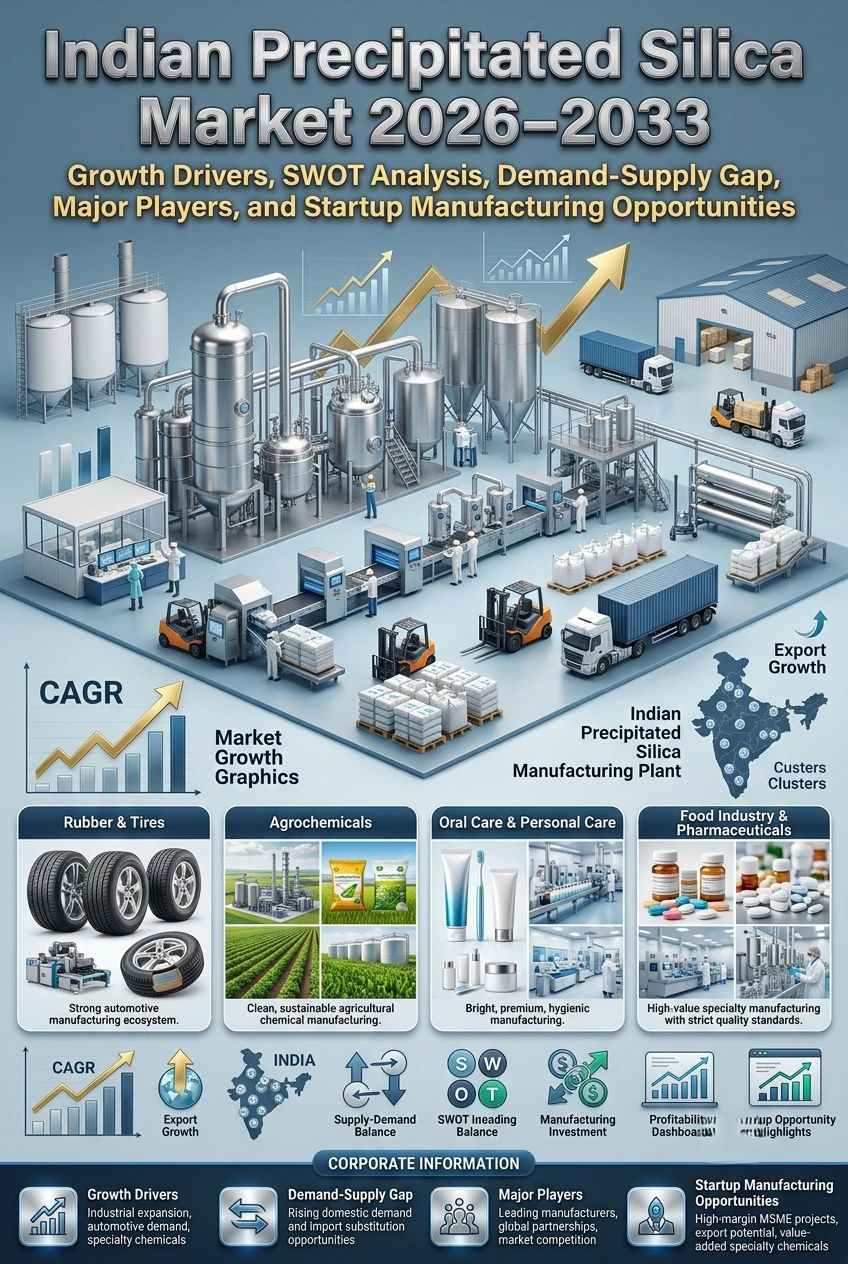
Although its installed precipitated silica production capacity has gone up with investments by Tata Chemicals and AksharChem, it has failed to match the rate at which the demand for precipitated silica is increasing, especially for the automotive and tire industry which demands for high grade as well as high demand HDS precipitated silica. The gap is narrower in standard rubber-grade silica, but is significant in high-performance, pharmaceutical and agrochemical-grade silica.
Major tyre companies such as MRF, Apollo Tyres, CEAT and JK Tyre have ramped up their plans to source from India under the Atmanirbhar Bharat model, but they continue to need consistent, high-purity HDS grades – the matrix of which no domestic supplier is yet capable of producing at scale. This provides a commercially viable, validated opportunity for new production units that can produce performance tires using the correct process technology.(Indian Precipitated Silica Market)
Likewise, India’s growing agrochemical formulations industry is constantly short of supply of precipitated silica of wettable powder grade with high absorption value. The agrochemicals formulation companies engaged in export business complain about the volatility of silica price in importation and that it is in search of stable domestic supply sources which can provide quality silica. A medium-sized scale MSME business can definitely fill this sort of gap in the market.
India’s trade balance in specialty chemicals clearly indicates that the country is importing more of these specialty chemical subcategories than it exports, according to the Chemicals and Petrochemicals Division of the Ministry of Chemicals and Fertilizers. One area where India can directly benefit from this import dependence, build domestic capacity, and contribute to export potential is precipitated silica, particularly specialty grades.
Major Indian Players: The Competitive Landscape
Tata chemicals Ltd. is the biggest domestic manufacturer and the most active player in the Indian market. The company has made huge investments in its operations in Tamil Nadu, such as the expansion in Cuddalore, which will increase its capacity by 50 kilotonnes per annum, from 13.8 ktpa. Tata Chemicals has also made strategic acquisitions such as the buy of Cuddalore plant of Allied Silica to include HDS manufacturing capacity in its portfolio. The company also has a structural advantage over its smaller competitors, as it has integrated soda ash production and existing relationships with some of the larger OEMs in the tire business.
Madhu Silica Pvt. Ltd. stands out as India’s most diversified precipitated silica manufacturing company, offering more than 50 different grades of silica for applications such as rubber reinforcement, anti-caking, oral care, agrochemical carriers, and specialty coatings. The company is based in Gujarat and has been in operation since many years now and is one of the top leading independent precipitated silica producers from India and also has a strong relationship with international and domestic buyers.
AksharChem India Ltd. is a key mid-tier company with its planned capacity expansion at Dahej facility, which saw its production capacity jump to 18,000 TPA in June 2025. AksharChem has an advantage of being located in Gujarat which has soda ash supply chain and the chemical cluster ecosystem of GIDC. The company has concentrated on its tire and rubber manufacturing business segment.
Other important names in the Indian market include Oriental Silicas Corporation, PPG Industries (which QEMETICA acquired), Evonik Industries (which recently restructured its “Smart Effects” division), and Solvay, which actively serves the high-performance tier of the market with globally standardized “HDS” grades.
Startup and MSME Opportunity: A Practical Investment Assessment
The Indian precipitated silica market offers a real and commercially viable start-up opportunity, but start-up companies need to understand that they can gain a competitive advantage.
The commodity rubber-grade is large volume, but competitive and price-sensitive, and will have a degree of cost efficiency that will be difficult for a new small-scale unit to match at first. One of the three strategic niches that are more secure for a startup or MSME investor is:
Agro-Waste Based Production Units in Rice Belt States
use of rice husk ash as the main raw material in the agro-waste based Production Units in the rice belt states will significantly cut input cost and will be in line with the environmental sustainability goals and the agro-waste management incentives of the states. The investment volume of the units in agrochemical carrier and rubber goods would be ₹3-8 crore in the range of 500-2,000 TPA scale. Agro-waste valorization projects can be financed through NABARD and SIDBI.
Explore This Book: Products From Waste (Industrial & Agro Waste)
Food-Grade and Pharmaceutical-Grade Specialty Silica
This is a more upscale market that requires a higher level of investment and is available at a premium price (2-3 times commodity rubber grade prices) and with long purchase contracts from nutraceutical brands, packaged food companies, and pharmaceutical manufacturers. The quality specifications are stringent—GMP accreditation, food safety standards, particle size control—but for a new business owner with the necessary understanding of process and quality, the margins are much greater and the competition much less in this area.
Grade Silica for Domestic FMCG Brands – Oral Care
India has a ₹20,000 crore market, which branded toothpaste companies (Colgate, HUL, Dabur, and Patanjali) mainly serve with a consistent and specified grade of precipitated silica. By aligning with mid-tier brands in the personal care sector seeking to secure a domestic supply of a key ingredient, a mid-scale unit can enjoy a strategic partnership.
Specialty chemical manufacturing has become a key priority area for the Chemicals and Petrochemicals Division of the Ministry of Chemicals & Fertilizers under the Atmanirbhar Bharat value chain localization policy and plans. The indirect downstream demand tailwind thus created by the Production Linked Incentive (PLI) framework for various sectors such as pharmaceuticals and agrochemicals is also available to the suppliers of precipitated silica who can leverage the PLI-supported manufacturing clusters.
FICCI’s Chemical Industry Committee, Specialty chemicals have always been identified as one of the highest value addition segments that are available to the Indian manufacturers and it also makes India a potential market to replace a major portion of the imported chemicals in the medium term owing to its process engineering capacities, well developed chemical industrial infrastructure and competitive energy and labor cost.
Import–Export Dynamics: The Trade Dependency Story
India’s precipitated silica trade is a double-sided story: it is a significant exporter of ‘regular’ rubber-grade silica to the markets of Southeast Asia and the Middle East, but a significant importer of ‘high quality’ silica from Germany, the USA and China. Exports have been increasing steadily and India is among the top three countries in the world by volume of precipitated silica exports by shipments, indicative of the country’s proven production capacity in commodity grades.
The high value part of the trade equation, however, is not as good. India’s persistent trade deficit of specialty and HDS grades from specialty silica importers from Germany’s Evonik and Belgium’s Solvay, coupled with the specialty silica from China, is a major challenge. A trade deficit of more than USD 4 billion in chemical industry has been consistently recorded in India over the past few years by the Ministry of Commerce & Industry, and precipitated silica specialty grades play a role in this.
This dependency on imports – counterintuitively – is the strongest indicator of market opportunity. If India imports a material, it has a proven market. A domestic producer can manufacture material with the same quality and reliability as the imported material and capture the market with a 15–25% landed-cost advantage over imports.
Policy Environment: Government Support as a Growth Catalyst
The government of India policy framework offers relevant assistance to specialty chemical industry at various levels. The chemicals industry has been identified as a priority manufacturing segment under Make in India, and will get single window clearance and investor facilitation support, along with increased visibility to the international procurement teams seeking alternatives to China.
The CGTMSE scheme under the Ministry of MSME offers collateral-free credit assurances of up to ₹2 crore for first-generation chemical entrepreneurs, who lack asset security and have been a key constraint for them. Additional liquidity support is provided to manufacturing ventures in priority chemical sub-sectors through the SIDBI Make in India Soft Loan Fund for MSMEs, at subsidised rates.(Indian Precipitated Silica Market)
Industrial development corporations (IDC) provide further subsidy packages for chemical park units to incentivize Gujarat, Tamil Nadu, Maharashtra and Andhra Pradesh. Industrial development corporations (IDC) provide further subsidy packages for chemical park units to incentivize Gujarat, Tamil Nadu, Maharashtra and Andhra Pradesh. All entrepreneurs starting to business in the precipitated silica sector must plan these state-level incentives carefully in the context of the project’s cost optimization.
Key Risks and Mitigation Considerations
Last but not least, there should be a realistic risk assessment in any feasibility study. Some of the primary risks for a new precipitated silica plant will be:
Global and volatile pricing of raw materials: Soda ash prices fluctuate worldwide, particularly as tightening supply affects natural soda ash production plants. Mitigation: diversify raw material strategy by using rice husk ash as other silica source for lower grade products, and negotiates the medium-term price contracts with the soda ash suppliers.
Environmental Compliance: According to the CPCB’s draft guidelines, greenfield units will incur 15–20% of their capital costs on ZLD systems and water recycling infrastructure. Mitigation: incorporate ZLD compliance into the design of new projects, instead of adding on to an existing project, and take advantage of state level green industry incentives that reimburse clean production infrastructure.
Chinese Competition in Commodity Grades: Chinese-made silica rubber may be able to continue to compete with domestic prices for non-performance applications. Mitigation: also shift towards production of value-added, specification-oriented grades (as opposed to commodity rubber grades) with less competition from China, such as pharmaceutical, food or oral care grades.
Choose the right startup backed by real market demand
NPCS: Professional Consulting Support for Your Precipitated Silica Project
Entering a specialty chemical manufacturing segment like precipitated silica requires more than market optimism — it requires technically grounded project planning, regulatory compliance mapping, process technology selection, and financial modeling that reflects real-world operating conditions. This is precisely the support that Niir Project Consultancy Services (NPCS) provides.
With more than 4 decades of experience of making of Market Survey and DPR for various chemical and food and beverage, pharma and agri based products, an NPCS feasibility report would for precipitated silica manufacturing include:
- Detailed Manufacturing Process: Step-by-step process description covering precipitation, filtration, washing, drying, and milling stages — including both sodium silicate and rice husk ash routes.
- Market Research and Demand Analysis: Application-wise consumption data, identified demand-supply gaps, key buyer segments, and pricing benchmarks.
- Process Flow Diagrams (PFD/BFD): Engineering-grade diagrams mapping material flows, equipment specifications, and utilities requirements.
- Product Mix and Capacity Planning: Grade-specific capacity recommendations based on market opportunity, capital availability, and technical constraints.
- Machinery and Raw Material Specifications: Vendor-neutral specifications for reaction vessels, filter presses, spray dryers, and classification equipment, along with raw material sourcing guidance.
- Import–Export Dependency Analysis: Quantified assessment of the domestic supply gap and export market potential across key product grades.
- Project Financials and Profitability Evaluation: Full financial model including capital investment, operating cost structure, revenue projections, break-even analysis, IRR, NPV, and debt service coverage ratios.
NPCS’s mission is to equip entrepreneurs, investors, and MSME promoters with a solid analytical basis to ascertain the technical feasibility, economic viability, marketability, and potential for expansion of a new precipitated silica plant – prior to investment.
FAQ: Indian Precipitated Silica Market
Q1. What is precipitated silica and why is it important for Indian industry?
Precipitated silica is an amorphous structure of silicon dioxide that manufacturers produce through chemical precipitation and characterize by precisely controllable particle size. Due to its wide range of applications, industries use precipitated silica as an additive and reinforcing filler in tyre and rubber products, as a carrier in agrochemicals, as a thickener and abrasive in toothpaste, and as an anti-caking agent in food and feed products and a functional additive in pharmaceuticals. This has given the precipitated silica to play a significant role in the consumer and industrial economics of India.
Q2. What is the projected market size of the Indian precipitated silica sector through 2033?
Indian precipitated silica market size in terms of value, to expand from US$ 76.2 Million in the base year, to over US$ 210.1 Million in the year 2033, and the compound annual growth rate of this market in India, from the base year to 2033 will be at around 10.5%. The market will likely grow in volume from around 162 kilotons to more than 205 kilotons in the near term.
Q3. Which application segment holds the largest share in the Indian market?
Rubber and tires together represent more than 57% of market revenue, while the tire sub-segment alone contributes more than 36% of volume as record vehicle sales, radial tire adoption, and the growing demand from new-age electric vehicles drive the use of low-rolling-resistance, silica-reinforced rubber tire compounds.
Q4. Which states in India are the most important production and consumption centers?
Western India — particularly Gujarat and Maharashtra — represents the largest production and consumption cluster, with approximately 34% of market share. South India, anchored by Tamil Nadu’s tire manufacturing ecosystem, is the fastest-growing region. North India — Punjab, Haryana, and Uttar Pradesh — holds emerging potential driven by rice husk abundance and proximity to rubber goods and footwear manufacturing.
Q5. Can a small-scale or MSME unit enter this sector profitably?
Yes, with a well-chosen entry strategy. MSME-scale producers using rice husk ash technology can establish viable units at capital costs of ₹3–8 crore with strong IRR potential. The most defensible entry segments for new entrants are agrochemical-carrier grade, oral care grade, and food/pharmaceutical grade silica — where scale advantages of the large incumbents are less decisive and value-addition commands premium pricing.
Q6. What government schemes support precipitated silica manufacturing by MSMEs?
The MSME Credit Guarantee Scheme (CGTMSE) provides collateral-free loans up to ₹2 crore. The SIDBI Make in India Soft Loan Fund provides subsidized financing for manufacturing MSMEs. The Startup India programme by DPIIT offers three-year tax exemptions and patent fee rebates for recognized startups. The National Mission on Sustainable Agriculture (NMSA) supports agro-waste valorisation projects. State-level industrial development corporations offer additional capital subsidies, land at concessional rates, and infrastructure support within designated chemical industrial estates.
Q7. What is the key competitive challenge facing new entrants in this sector?
The challenge comes from competitive pressures from dominant domestic manufacturers (Tata Chemicals and Madhu Silica) for the rubber grade products, and competition from China for generic grade products. New entrants will need to find their competitive edge by way of product differentiation with grade specialisation, advantage from being an agro-waste based player with cost advantages, proximity to relatively under-penetrated demand centers or high technical service for selected segments of the specialty product application segments.
Key Citations and References:
- Society of Indian Automobile Manufacturers (SIAM) — Annual automobile sales and production data for India
- Ministry of Chemicals and Fertilizers — Chemicals and Petrochemicals Division — Industry policy, trade data, and sector development initiatives
- Make in India — Chemicals Sector — Investment facilitation and sector-specific manufacturing support
- Startup India (DPIIT) — Entrepreneur support schemes, tax incentives, and MSME benefits
- FICCI Chemical Industry Committee — Specialty chemicals sector advocacy, trade analysis, and investment opportunity assessment
- Ministry of MSME — Credit Guarantee Fund Trust (CGTMSE) — Collateral-free financing for small and micro enterprises in manufacturing