India Rare Earth Magnet Scheme
The Ministry of Heavy Industries has recently extended the deadline for the bidding process in the country’s flagship Rare Earth Permanent Magnet (REPM) scheme from July 29, 2026.Recently, the Ministry of Heavy Industries extended the bidding timeline for its flagship Rare Earth Permanent Magnet (REPM) scheme till July 29, 2026, which has significant consequences for the manufacturing sector in the country. The government has now shifted this important deadline because they wanted more people, both domestic and international, to be able to participate, as reported in the Economic Times. This does not happen to be a minor administrative extension. It signals that India is taking serious action toward its aspiration of building a world-class rare earth magnet industry, even though the sector has not yet achieved scale.
The financial commitment of the scheme is at ₹7,280 crore and aims to provide an integrated manufacturing capacity of 6,000 metric tonnes per annum (MTPA) of sintered NdFeB (Neodymium-Iron-Boron) magnets. Electric vehicles, wind turbines, aerospace machinery, defence equipment and consumer electronics are all essential applications of these magnets. Currently, China is responsible for more than 85% of the world’s production of rare earth magnets. India imports almost everything that it requires. The Economic Times development shows that this dependency is breaking down — in a big way.
The message for entrepreneurs, MSMEs and startup founders is clear – a new industrial value chain is emerging in India, and now is the perfect time to join.
What Recent Economic Times Reporting Means
On June 26, 2026, the Ministry of Heavy Industries has announced to extend the bid due date from June 29, 2026 to July 29, 2026 under its scheme to promote production of Sintered NdFeB Rare Earth Permanent Magnets. The opening of the technical bids also has been moved.
This extension is significant in two significant ways:
- First, it validates interest from several potential bidders needing more time to find the technology partners, raw material supply agreements and project execution planning.
- Second, it is a sign of a government eager not only to meet capacity quotas, but to attract reputable and capable manufacturers who will be able to deliver.
In November 2025, the Union Cabinet approved the scheme, and in March 2026, authorities invited global tenders. Bidders can create an integrated Sintered NdFeB REPM manufacturing plant in India and get a capital subsidy as well as sales linked incentive. The bidding adopts Least Cost System (LCS) on Central Public Procurement (CPP) Portal, which is transparent and competitive.
If MSMEs and startups are serious about developing the rare earth magnet industry in India, the Economic Times report could be a market bell ring. As large plants come online, they will require ancillary suppliers, service providers, testing labs, skilled technicians, and logistics experts. The opportunity is not only in the building of magnets, but in anything around the production of magnets.
Get Detailed Project Report (DPR): Rare Earth Permanent Magnet: A High-Growth Strategic Manufacturing Opportunity for Startups
Why the Rare Earth Magnet Industry Is Growing in India
This scheme comes at a convenient time. Three strong factors are driving home the need for the production of rare earth magnets locally:
1. China’s Export Restrictions Are Reshaping Global Supply Chains
In 2025, China decided to cut export supply of rare earth elements, causing huge shock to the worldwide electronics, auto, and aerospace sectors. Similar disruptions occurred in Japan in 2010. This time, India has taken note. The Economic Times has been monitoring the trend of diversification of global supply chains and its impact on industrial policies in India for many years.(India Rare Earth Magnet Scheme)
2. India’s EV and Renewable Energy Targets Demand Domestic Supply
The EV industry is growing at a fast pace in India. Both EVs use NdFeB magnets. Wind turbines require 200 to 600 kilograms of permanent magnets for every megawatt of capacity. The domestic magnet demand is mind boggling as India has several hundred GW of renewable energy targets. Analysts estimate annual demand at 4,000–5,000 tonnes, valued at $200–$300 million, and project that total demand will exceed $600 million by 2030.
3. The Make in India Push Is Now Backed by Serious Capital
This policy offers ₹7,280 crore in actual investment and incentives on sales, as compared to previous policy announcements, which had less muscle behind them. IREL (India) Ltd. will provide guaranteed quantity of NdPr oxide to selected manufacturers. The Make in India initiative and the Startup India ecosystem are both geared to help ancillary players in this value chain.
Government Policies & Incentives That Founders Must Know
This ecosystem already provides a well-established policy architecture for founders and MSMEs:
- REPM Scheme Capital Subsidy: It provides ₹750 crore as capital subsidy and ₹6,450 crore as sales-based incentives to eligible manufacturers.
- CGTMSE Support: For working capital and term loans, MSMEs who provide services to the MSMEs can avail the Credit Guarantee Fund Trust through the MSME Ministry portal.
- The Startup India Recognition: Startups registered under Startup India can claim income tax exemption under Section 80-IAC of the Income Tax Act, which applies directly to ancillary REPM businesses.
- The Department for Promotion of Industry and Internal Trade (DPIIT) is actively assisting single-window clearances of manufacturing units in this space for critical minerals.
- Assured Feed Stock from IREL, India’s only public sector Ore mining & refining enterprise: Three lowest-bid manufacturers will be assured with supply of feed stock from IREL.
- Direct Skills India alignment to equipping workforce development startups in hydrometallurgy, powder metallurgy and rare earth chemistry training programs, which can be co-funded under the Skill India Mission.
5 High-Potential Business Ideas for Startups and MSMEs
The rare earth magnet business model generates not just one opportunity, but a whole rare earth magnet economy. Let’s look at five of the strongest areas for Indian entrepreneurs to enter:
Business Idea 1: Precision Component Manufacturing for Magnet Plants
Sintered NdFeB magnet plant requires sintering trays, vacuum furnace lining and handling fixtures of non-reactive materials. These are high specification, B2B manufacturing niches. An advanced CNC capable MSME can create custom product lines just for magnet plant operators. The capacity will be 5-8 plants coming online over the next 4-5 years to provide a stable and recurring revenue base.(India Rare Earth Magnet Scheme)
The estimated startup cost is ₹40-80 lakh per plant for customer while the potential is ₹3-5 crore per annum per plant.
Get Detailed Insights from This Book: Handbook on Rare Earth Metals and Alloys (Properties, Extraction, Preparation and Applications)
Business Idea 2: Rare Earth Magnet Testing and Quality Certification Lab
The automotive, aerospace, and defence sectors require the supplier to be qualified extensively before the adoption of new magnet suppliers, which takes 12-24 months. There will be a huge demand for magnetic properties (coercivity, remanence and energy product) and corrosion resistance and thermal stability certified by independent testing laboratories that can validate these properties. Currently there are few such specialized labs in India.
Estimated Startup profit: ₹3–5 lakh per month | Revenue Potential: ₹40–60 lakh per month | Growth Period: 5 years
Business Idea 3: Rare Earth Recycling Venture
The recovery rate of neodymium from Ndfeb magnets using hydrometallurgy is more than 90%. The magnet recycling demand will be significantly ramped up, as India’s installed base of EV motors and consumer electronics expands. A city with urban collection network in cities such as Delhi, Mumbai and Bengaluru, supplying a centralized acid dissolution and solvent extraction plant, can create a business around a circular economy with good policy tailwinds.
Estimated Start-up cost: ₹75 lakh to ₹1.5 crore, which can reach to ₹5 to ₹12 crore annually by 2029.
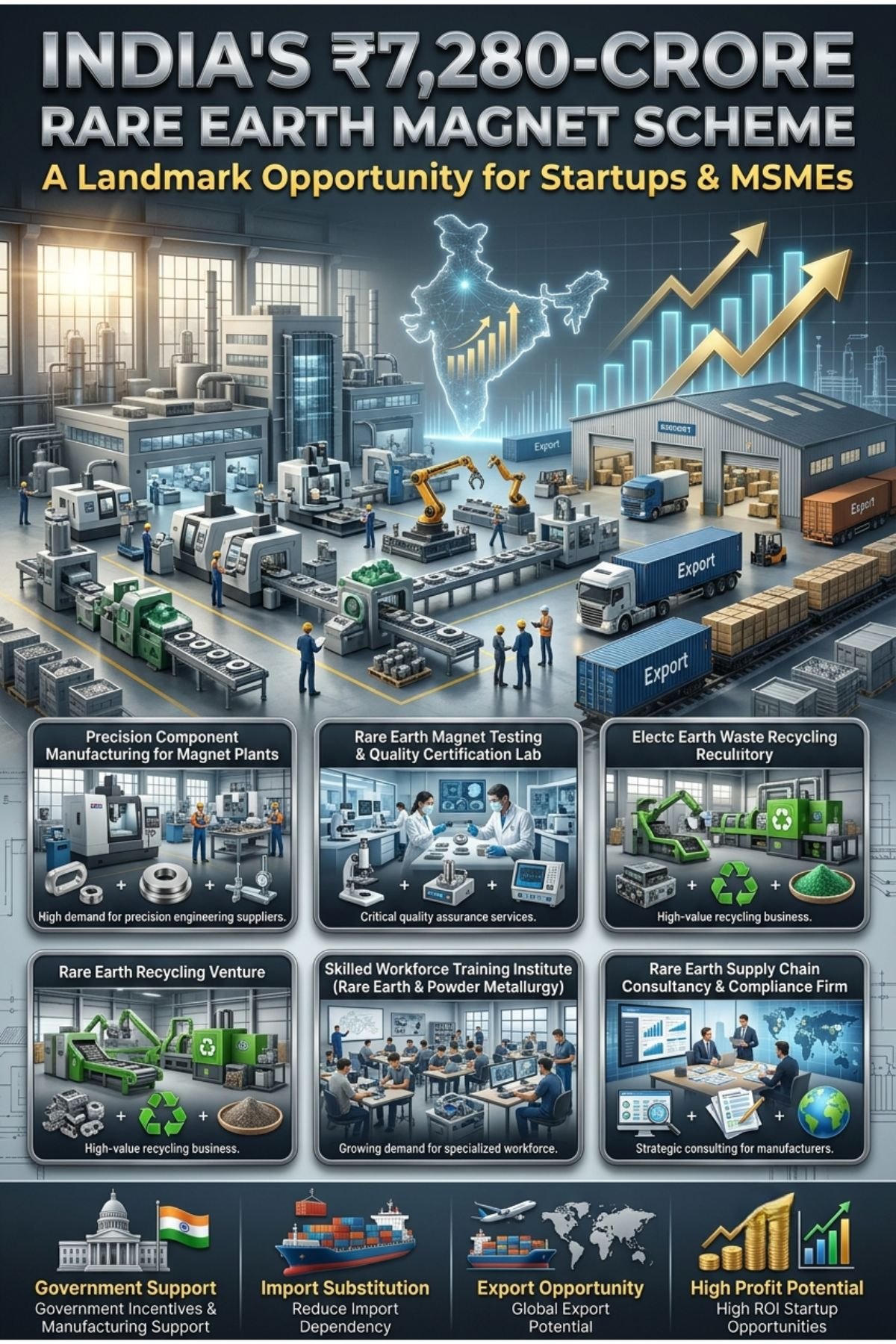
Business Idea 4: Skilled Workforce Training Institute (Rare Earth and Powder Metallurgy)
India possesses only a handful of trained experts in the field of hydrometallurgy, only a few in rare earth separation chemistry and no one in manufacturing of magnets. The vocational training institute that ARCI Hyderabad and Skill India co-designed can serve the 5–8 large plants expected to come online between 2028 and 2031. Re-skilling of chemists and metallurgists in neighbouring sectors can also be a part of training programmes.
Estimated ROI: 14–18% annually on the total investment, or with the government co-funding.
Business Idea 5: Rare Earth Supply Chain Consultancy and Compliance Firm
Global buyers, especially in Europe and the USA, are now looking for transparency in the supply chain, a conflict mineral check, and documentation of carbon footprints. The Indian consultancy, which focuses on mapping the supply chain, ESG compliance, and regulatory advisory, will see high demand from both the Indian manufacturers wanting to sell to customers overseas and the overseas buyers looking to buy from India.
This is expected to generate a revenue of ₹1.5-3 crore per year and require an estimated startup capital of ₹15-30 lakh.(India Rare Earth Magnet Scheme)
Related Article: Rare Earth Magnet Manufacturing Business in India: Cost, Profit, Project Report & Government Scheme
Import–Export Opportunity Analysis
India now depends on China and Japan to supply almost 100% of its rare earth permanent magnet needs. The substitution of import magnets by domestic-manufactured magnets is great given that the domestic capacity is coming online under REPM scheme.
- Import Substitution Opportunity: India has an annual import bill of rare earth magnets of $200-$300 million. This can be significantly cut as the domestic capacity of 6,000 MTPA comes on stream.
- The U.S., Germany, Japan and South Korea are all keen to de-depend on Chinese rare earth magnets. These markets can be completed by an Indian manufacturer having verified quality and transparency in the supply chain.
- APEDA traditionally works on Agricultural exports but the Invest India platform offers export facilitation support and global buyer linkages for advanced manufacturing industries such as Rare Earth materials.
- India’s critical mineral policy, driven by demands at home and abroad, has been the consistent theme of the Economic Times. Rare earth magnets are found to be at the crossroads of these two forces.
Indian MSME Success Stories in Strategic Manufacturing
India’s industrial landscape has proven time and again its ability to respond to strategic challenges when supported by policy and funding:
- Jai-Mag Industries: One of the few NdFeB magnet manufacturers in India, Jai-Mag has taken a strong footing in the market by supplying its products to many international markets through its proprietary technology, thereby proving that the Indian businesses are not lagging behind when it comes to quality and pricing.
- ARCI Hyderabad (DST): The International Advanced Research Centre for Powder Metallurgy and New Materials successfully tested the first pilot plant based on the technical path for commercial manufacturing of rare earth permanent magnets based on Nd-Fe-B.
- C-MET Hyderabad: Performs pilot scale processing of Nd-Pr metals and NdFeB alloys by hydrometallurgical methods and builds a knowledge base which can be used by emerging start-ups to collaborate on.
These institutional anchors equate to a starting point that is not from scratch. The process has already been proven at research institutions, pilot plants and early commercial facilities. Now the policy window, the capital and the market demand are all aligned.(India Rare Earth Magnet Scheme)
About NPCS: Your Feasibility Research Partner
NPCS (Niir Project Consultancy Services) is India’s foremost industrial feasibility report and project consultancy website. NPCS offers bankable feasibility reports, market intelligence, and project profiles for entrepreneurs, MSMEs and startup founders in rare earth processing, advanced materials, precision manufacturing and strategic industrial sectors spanning 5,000+ industries.
Whether you are considering becoming a component manufacturer, testing laboratory, rare earth magnet recycling company, or training institution, an NPCS feasibility report provides you with the project cost and technology options, regulatory roadmap, and financial projections necessary to approach banks and investors with confidence.
Identify high-growth industries before others do
Key Data: India’s Rare Earth Permanent Magnet Scheme at a Glance
| Parameter | Details |
| Scheme Name | Rare Earth Permanent Magnet (REPM) Manufacturing Scheme |
| Approving Authority | Union Cabinet, November 2025 |
| Total Outlay | ₹7,280 Crore |
| Capital Subsidy | ₹750 Crore |
| Sales-Linked Incentives | ₹6,450 Crore |
| Target Manufacturing Capacity | 6,000 MTPA (Sintered NdFeB) |
| Bid Capacity Range per Unit | 600 to 1,200 MTPA |
| Current Bid Deadline | July 29, 2026 (Extended) |
| Current Import Dependency | Near 100% from China and Japan |
| India’s Annual Import Value | USD 200–300 million |
| Projected Market by 2030 | USD 600+ million |
| Key End-Use Sectors | EV, Wind Energy, Defence, Aerospace, Electronics |
| NdPr Oxide Supplier | IREL (India) Ltd. — Central PSU under DAE |
| Bidding Portal | Central Public Procurement (CPP) Portal |
Frequently Asked Questions (FAQs) — Founder Edition
Q1. Can an MSME directly bid for manufacturing capacity under the REPM scheme?
The scheme is designed for integrated manufacturers capable of handling 600 to 1,200 MTPA of sintered NdFeB production. This requires significant capital and technology. However, MSMEs with the financial backing, technology partnerships (including from Japan, Germany, or South Korea), and operational expertise can certainly bid. The more immediate opportunity for most MSMEs lies in the ancillary and service ecosystem surrounding the large plants.
Q2. What are the most capital-efficient entry points for startups?
Entry points testing & certifying labs, rare earths & metal recycling co, & workforce training co. It is capital efficient entry with set up costs of between 15 Lakh and 2.5 Cr. Revenues take 18-24 months. Precision component makers require larger capital set ups. But gives more secure long term revenue streams.
Q3. Is there government funding available for ancillary businesses in this ecosystem?
Yes. The Credit Guarantee Fund Trust for MSMEs (CGTMSE) under the MSME Ministry provides working capital and term loans without collateral for ancillary suppliers and service providers. Startup India recognition opens access to Section 80-IAC tax exemptions. Skill India co-funding is available for training institutes. Visit www.msme.gov.in and www.startupindia.gov.in for application details.
Q4. What is the biggest challenge for new entrants in rare earth magnet manufacturing?
As pointed out by ET and domain experts, the key challenge for Indian entrepreneurs is process know-how rather than funding. Manufacturing high-performance sintered NdFeB magnets requires expertise in complex powder metallurgy, oxygen-free controlled-environment processing, and specialized heat-treatment techniques. Developing this expertise is challenging and typically takes several years of experience. Start-ups can learn from institutions such as ARCI Hyderabad, C-MET, or international licensors.
Q5. What are the export opportunities for Indian rare earth magnet businesses?
The US, Germany and Japan are looking at de-risking their dependence on China in the rare earth magnet ecosystem. Indian firms that have proven quality, supply-chain clarity, as well as competitive pricing, could be ideally placed to woo buyers from these geographies. Support from government organizations, such as Invest India (www.investindia.gov.in) is available to link producers in India with global buyers across sectors of interest to these economies.
Q6. When will the first REPM manufacturing plants actually come online in India?
Depending on typical time scales for projects on an industrial scale, manufacturer tender winners would likely initiate their commercial product rollout during the years 2028-2031. Plant commissioning and equipment installation will take 2–3 years from these start dates. This creates a 2–3-year runway for auxiliary startups to ramp up production and establish relationships with plant operators before demand increases significantly. The window for entry is now, not in 2028.
Conclusion: The Magnet That Can Pull Your Startup Forward
The Economic Times development of June 26, 2026 is not just a tender extension notice. It is a milestone in time, a loud and clear message that India is developing strategic industrial capability which is not present in the industry in such a scale. The ₹7,280 crore REPM scheme is India’s most ambitious push for critical mineral self-reliance, and the opportunity to join this ecosystem is available now.
The context is heightened by the global situation. The rare earth export ban has become a security issue for the big economies as they seek to diversify their rare earth supply chains. India has its own rare earth deposits in the oceans, strong domestic demand, and a government willing to invest in the sector’s transition. These factors position India to play a major role in the rare earth industry over the coming decade.
The Economic Times signal is actionable for founders and MSMEs. Precision component manufacturers, testing labs, recycling businesses, lab workforce trainers, and supply chain consultants all have viable, capital-efficient entry points. The large manufacturers that are awarded the tender from the government will require partners, suppliers and service providers. The ecosystem is being put together here and now.
There’s no better opportunity in industrial opportunity than this. The capital is approved. Capital is authorized. The market demand is substantiated. The government’s intention is crystal clear. The only question is, how soon can you get into this ecosystem?