
PMEGP Project Cost Calculation
Every question that is asked about PMEGP finally reduces to one thing; exactly how much cash does the entrepreneur require, how much will the bank provide and how much of that will be covered through the government subsidy for “margin money”? The scheme guidelines provide a clear answer to this question, but they express it through categories and percentages that require a little translation to convert them into rupees for a specific project.
After PMEGP revised its guidelines in December 2023, the maximum project cost eligible for margin money subsidy increased to ₹50 lakh for manufacturing units and ₹20 lakh for projects in the service and business sectors. It is preferable to get the calculation right at the planning stage, before drafting the DPR, as this prevents a typical problem: realizing halfway through the application that the project cost does not fit into the assumed subsidy structure. A woman entrepreneur in a remote and backward area initiates a food processing unit, and the government provides her with a 35% subsidy; this means that she needs to take a bank loan for only about 60% of the project requirement after accounting for her own 5% contribution.
The Three Components of PMEGP Financing
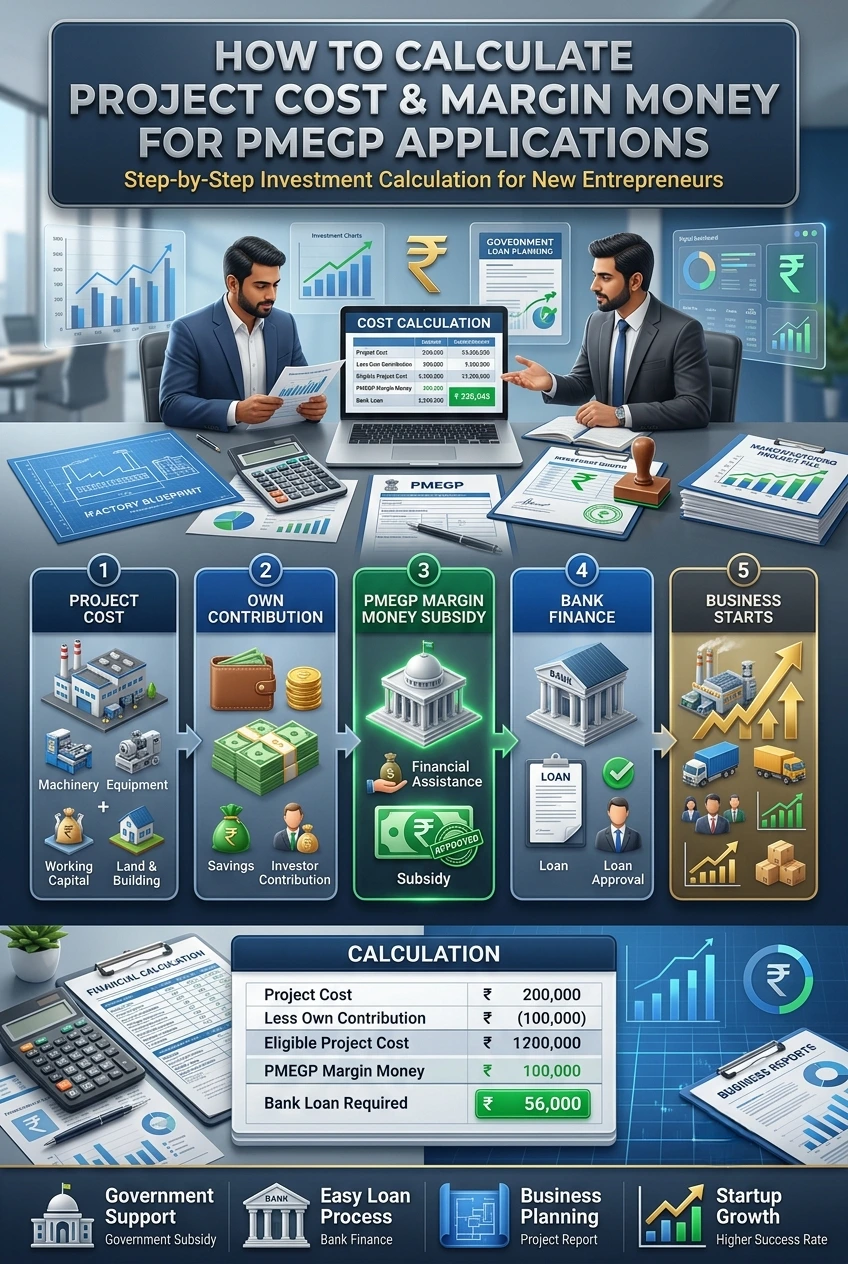
Each PMEGP supported project comes with three financial instruments, which always sum to 100 per cent of the project admissible: the entrepreneur’s contribution, the bank loan and the government’s margin money subsidy.
The cost of the project constitutes 10% of the entrepreneur for general category and 5% for special category applicants (special category includes SC, ST, OBC, women, minorities, ex-servicemen, persons with disability and residents of the North Eastern Region, hill and border areas). The margin money subsidy varies from 15 to 35 per cent depending on category and location as outlined in the table below. The bank provides the loan for the remaining amount after the promoter contributes his share and the subsidy covers between 60 and 75 per cent of the project cost.
Related Article: Why 88% of PMEGP Loan Applications Get Rejected by Banks
The Subsidy Matrix: Category and Location
The subsidy percentage is based on just two factors – whether the applicant is considered general or special category and whether the project is rural or urban. The lowest subsidy rate is granted to general category applicants in urban areas (15 per cent), the highest to special category applicants in rural areas (35 per cent). The response rates are 25 percent for general category in rural areas and 25 percent in urban areas.
That is, two different applicants or locations may require different financing structures when evaluating the same project. A general category applicant and an applicant setting up an urban unit must be able to arrange financing for 85 percent of the project cost, with the other 15 percent delivered via margin money, whilst an applicant and a special category applicant setting up the same urban unit in a rural area must be able to arrange financing for 65 percent – with the remaining 35 percent coming through margin money.
A Worked Example: ₹20 Lakh Manufacturing Project
Suppose a manufacturing project has an admissible cost of ₹20 lakh (the maximum admissible cost for manufacturing projects is ₹50 lakh). In an urban area, for a general category applicant, the break-up of loan amount is as follows: Bank loan of ₹15 lakh or 75 per cent of the project cost, margin money subsidy of ₹3 lakh and own contribution of ₹2 lakh.
But for a woman entrepreneur (a special category applicant), who is setting up an identical project worth of ₹20 lakh in a rural area, the structure is very different: own contribution of ₹1 lakh (5 percent), margin money subsidy of ₹7 lakh (35 percent) and a bank loan of ₹12 lakh, or 60 percent of the project cost. The overall investment remains the same, but the subsidy reduces the bank loan repayment burden for the entrepreneur by ₹3 lakh and lowers the initial investment amount required from the entrepreneur by ₹1 lakh.
This disparity makes it crucial to resolve the location and applicant type early in project planning, even before purchasing machinery or leasing a shed, as these factors directly define the total amount of external funding needed for a project.
Get Detailed Insights from This Book: Just For Starters: How To Become A Successful Businessman?
What Counts Toward “Project Cost”
The cost of developing a project for PMEGP typically includes the cost of building or shed construction, plant and machinery, other assets necessary for the project, and the cost of land (unless the entrepreneur already owns the land or it is under lease).
The revised guidelines treat working capital separately and set different caps: 40% of the project cost for manufacturing projects and up to 60% of the project cost for service or trading projects.
The importance of getting this right is that the subsidy on margin money is based on the admissible project cost, and if an individual does not qualify as a project cost, they do not receive subsidy even if they make up a part of their overall costs (most often the cost of land itself does not qualify as a project cost).
The Margin Money Lock-In and Adjustment Process
The margin money subsidy is not paid out in cash at the beginning. The bank holds it in a separate account and adjusts it against the bank loan only after the unit becomes operational and performs well, usually for a period of three years. If the entrepreneur incurs lower actual capital expenditure than the sanctioned amount, the bank adjusts the margin money accordingly and returns the excess amount to the Khadi and Village Industries Commission instead of keeping it.(PMEGP Project Cost Calculation)
As a result, entrepreneurs should keep some practical implications for DPR costing in mind: they should base the figures in the project report on the actual expected cost rather than an inflated figure intended to increase the subsidy amount. The subsidy will match the amount the entrepreneur actually spends. If the entrepreneur overestimates the cost and the actual expense turns out to be lower, they can claim the excess subsidy back after completing the required administrative process.
View Full Project Details: Project Reports & Profiles
NPCS InsightGetting the subsidy calculation right at the DPR stage — correct category, correct location, correct treatment of working capital versus project cost — avoids a frustrating mid-process discovery that the numbers do not add up the way the entrepreneur assumed. NPCS structures PMEGP-bound DPRs with the subsidy matrix built in from the first draft, so the means-of-finance section matches what the scheme will actually sanction.(PMEGP Project Cost Calculation) |
PMEGP Subsidy Matrix
| Category | Area | Own Contribution | Margin Money Subsidy | Bank Loan Share |
| General | Urban | 10% | 15% | 75% |
| General | Rural | 10% | 25% | 65% |
| Special (SC/ST/OBC/Women/Minorities/Ex-servicemen/PwD/NER/Hill/Border) | Urban | 5% | 25% | 70% |
| Special (as above) | Rural | 5% | 35% | 60% |
Worked Example: ₹20 Lakh Manufacturing Project
| Component | General / Urban | Special Category / Rural |
| Total project cost | ₹20,00,000 | ₹20,00,000 |
| Own contribution | ₹2,00,000 (10%) | ₹1,00,000 (5%) |
| Margin money subsidy | ₹3,00,000 (15%) | ₹7,00,000 (35%) |
| Bank loan | ₹15,00,000 (75%) | ₹12,00,000 (60%) |
Turn your budget into a successful business plan
Project Cost Ceilings and Working Capital Caps
| Item | Manufacturing Sector | Service / Business Sector |
| Maximum project cost (new units, margin money eligible) | ₹50 lakh | ₹20 lakh |
| Working capital cap | Up to 40% of project cost | Up to 60% of project cost |
| Maximum cost for upgradation (2nd loan) | ₹1 crore | ₹25 lakh |
Why This Calculation Belongs in the DPR, Not as an Afterthought
The subsidy matrix involves simple arithmetic once you know the category and location, but it directly affects the means-of-finance section of the DPR — the section that appraisal teams check first to verify whether the funding sources actually balance against the project cost. Therefore, if a DPR gets this calculation wrong, it creates an immediate inconsistency, even if every other section is strong, and the applicant must resolve it before moving the application forward.(PMEGP Project Cost Calculation)
Niir Project Consultancy Services builds the PMEGP subsidy matrix into the DPR from the outset, ensuring the means-of-finance figures reflect the correct percentages for the applicant’s category and the project’s location, and categorising the project cost correctly between capital expenditure and working capital so that the subsidy calculation uses the right base.
Getting the Numbers Right Before the DPR Is Drafted
The single most useful exercise before starting a PMEGP application is a back-of-envelope version of the table above: confirm the applicant’s category, confirm whether the project location counts as rural or urban for scheme purposes, and run the project cost through the relevant subsidy percentage to see what the bank loan requirement actually looks like.(PMEGP Project Cost Calculation)
Doing this early helps avoid difficult changes later. It guides decisions on machinery budget, keeping the project cost under ₹10 lakh for simpler documentation, and planning working capital separately from capital costs.
A project designed with the subsidy structure in mind is more likely to pass DPR preparation and bank appraisal smoothly without major changes.
Frequently Asked Questions
Does the margin money subsidy reduce the loan amount upfront, or only later?
The beneficiary keeps the subsidy in a separate account during a lock-in period, typically around three years, and adjusts it against the loan only after verifying that the unit is operational. It does not reduce the disbursed loan amount upfront, but it does reduce the effective principal once adjusted.
Is working capital included in the project cost used to calculate the subsidy?
Separate attention has been given to working capital, which has been capped separately. The limit is up to 40% of the project cost for manufacturing projects and up to 60% for service or trading projects. The margin money subsidy rate is calculated on the eligible project cost. This cost mainly includes capital expenditure.
What happens if the actual machinery cost is lower than what was estimated in the DPR?
Margin Money.
If the actual expense differs, the subsidy amount will be revised proportionally. KVIC will adjust any excess subsidized amount that the entrepreneur does not utilize against the repayment instead of the entrepreneur.
Can a general category applicant claim the special category subsidy rate by partnering with someone from a special category?
The category determination depends on the applicant’s documented status. Claiming a higher subsidy rate without proper eligibility proof, such as a valid caste, category, or other certificate, amounts to misrepresentation. It may affect the validity of the application.
Is Udyam registration required before the margin money is adjusted?
Yes, under the revised guidelines, new units must complete Udyam registration before physical verification and margin money adjustment.
Where can an entrepreneur get help working through these calculations for their specific project?
Niir Project Consultancy Services prepares PMEGP-bound DPRs with the correct subsidy matrix. It considers project cost, category, and location to ensure the means-of-finance section matches the scheme’s sanctioned figures.
Sources and Further Reading
IIFL – PMEGP Subsidy Amount & Eligibility: Complete Guide: iifl.com
Moneyview – PMEGP Loan Details: Latest Complete Guide: moneyview.in
NextWhatBusiness – PMEGP Scheme: Step-by-Step Guide to Get Approved: nextwhatbusiness.com
Delhi Khadi and Village Industries Board – Revised PMEGP Scheme Guidelines: dkvib.delhi.gov.in
Government Schemes Updates – Prime Minister Employment Generation Programme (PMEGP): govtschemesindia.com