Nutraceutical Manufacturing Business
Nutraceuticals and Dietary supplements in India’s health product manufacturing industry are among the most approachable and localizable business opportunities owing to the relatively low regulatory hurdles, high demand, good margin profile and excellent e-commerce export potential. One of the fastest-growing consumer markets globally is the nutraceutical market (vitamins, minerals, herbal supplements, protein supplements, omega-3s, probiotics and specialty health ingredients). India’s natural benefits – abundant biodiversity, proven manufacturing expertise in botanical extracts and manufacturing costs, propel it in the right direction to claim a much bigger market share of this global opportunity. Pharmexcil has a requirement for exporting Nutraceutical products and the FSSAI’s regulatory framework is clear and offers a licence pathway for nutraceutical manufacturers who want to export products.
Why Nutraceuticals Are One of India’s Biggest Export Opportunities
The nutraceutical market has been expanding steadily in the past decade, at around 7% to 9% per year, as ageing populations in developed markets drive the need for products for older consumers, as well as a growing awareness of the need for health in younger consumers around the world, and as the focus of healthcare shifts toward prevention. This was dramatically accelerated by the COVID-19 pandemic, and immunity boosting supplements, Vitamin D, zinc and herbal adaptogens saw surges in demand which have continued since the pandemic in most cases.(Nutraceutical Manufacturing Business)
In certain categories of nutraceuticals, India has a raw material structural advantage as it is difficult to replicate certain botanicals, ayurvedic adaptogens and bioactives obtained from spices. Today, health-conscious people in the US, UK, Germany, and Australia can name Indian nutraceutical products such as Ashwagandha, Turmeric Curcumin, Boswellia, Moringa and Amla. This recognition by consumers is a result of decades of market building with the benefit of all Indian exporters of nutraceuticals at present.
Related Article: Nutraceutical Ingredients Manufacturing: Startup Guide for Entrepreneurs Entering the ₹50,000-Crore Indian Market
Government Policies and Regulatory Framework
Nutraceuticals and dietary supplements are regulated by the Food Safety and Standards (Health Supplements, Nutraceuticals, Food for Special Dietary Use, Food for Special Medical Purpose, Functional Food and Novel Food) Regulations 2018 by the Food Safety and Standards Authority of India (FSSAI). Nutraceutical manufacturing units having an annual turnover of more than ₹ 20 crore should obtain a Central FSSAI licence while that below ₹ 20 crore should obtain a state FSSAI licence.
The Pharmexcil portal is mandated to export nutraceutical products and it offers support in getting the products approved for market, guidance on regulatory issues and registration by RCMC (Registration Committee for Medicines and Clinical Trials) for nutraceutical exporters. Membership with Pharmexcil gives the access to DGFT RoDTEP benefits for export of nutraceuticals.
The DGFT e-Commerce Export Handbook for MSMEs particularly stresses on the areas of export of the nutraceuticals and dietary supplements in particular, and guidance on FDA notification process, Amazon Global Selling compliance and courier-mode export procedures for supplement products in particular.
The Ministry of AYUSH is promoting exports of botanical nutraceuticals, especially those that are also part of the AYUSH category such as Ashwagandha, Triphala, Shatavari, etc.
Business Ideas in Nutraceutical Manufacturing and Export
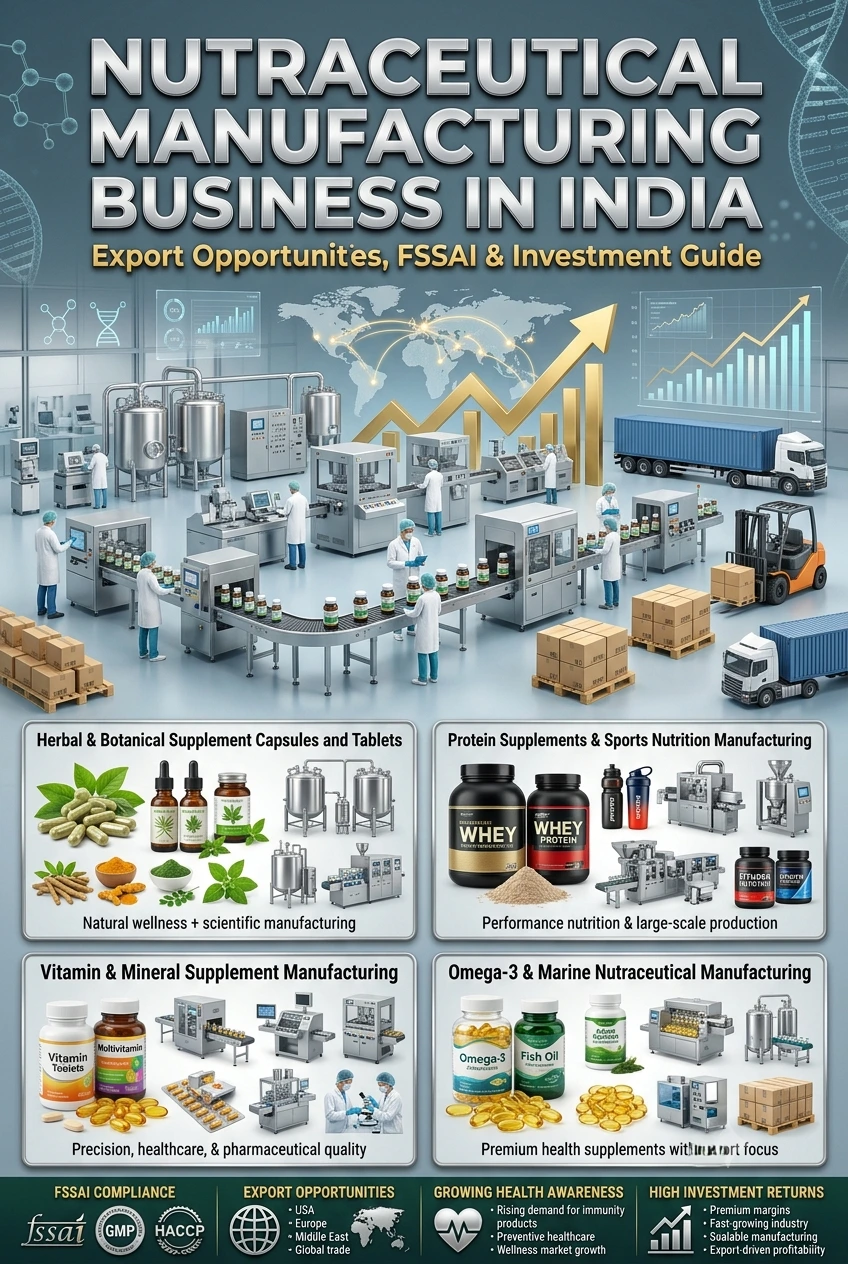
1. Herbal and Botanical Supplement Capsules and Tablets
Encapsulated and tableted herbal supplements lead India’s nutraceutical exports. These products include Ashwagandha capsules, Turmeric Curcumin tablets, Moringa leaf capsules, Brahmi memory supplements, and Triphala digestive capsules. An FSSAI-approved plant facility with capsule filling, tablet compression, blister packaging, and quality testing equipment can produce these products with an investment of ₹35 lakh to ₹80 lakh. But ecommerce sites such as Holland Barrett online, Amazon, Vitacost or iHerb offer direct market access without any traditional retail distribution partnership with the US, UK and Australian consumer. Indian herbal supplement brands have successfully scaled to e-commerce with some managing to meet an annual turnover of ₹1 crore to ₹5 crore just with Amazon Global Selling.(Nutraceutical Manufacturing Business)
Get Detailed Insights from This Book: Herbal Cosmetics & Ayurvedic Medicines (EOU)
2. Protein Supplements and Sports Nutrition Manufacturing
The fastest growing nutraceutical sub-segment worldwide is whey protein, plant-based protein powders (pea protein, rice protein, soy protein), pre-workout supplements and BCAAs. The domestic sports nutrition market in India is expanding at 20% plus per year and there is immense export potential in the sports nutrition industry to Southeast Asia, Middle East and Africa. The investment required for a protein supplement manufacturing unit is around ₹50 lakh to ₹1.5 crore which includes the cost of investments for blending, flavouring, packaging and quality testing. Besides the Indian dairy industry foundation, this country also offers an opportunity to use whey protein concentrate as a raw material for the domestic whey protein market. The key market access investment is in export packaging in internationally standard pouches and tubs with compliant nutritional labelling.
3. Vitamin and Mineral Supplement Manufacturing
The most widely available and most popular category of nutraceutical manufacturing worldwide is the multivitamin tablets and capsules, individual vitamins, minerals and combinations. Investment in a vitamin and mineral supplement manufacturing unit ranges from ₹40 lakh to ₹1 crore for the compression, encapsulation, coating and packaging. For regulated market exports, compliance with the USP (US Pharmacopeia) and BP (British Pharmacopeia) standards and claims on the label are crucial to the quality of ingredients. The US dietary supplement market is a $50+ billion consumer marketplace in which Indian manufacturers can do a level playing field on quality and price.
4. Omega-3 and Marine Nutraceuticals
Fish oil omega-3s, marine collagen, krill oil, and other marine-based nutraceuticals form a premium product category. Global demand is rising due to growing cardiovascular, joint, and brain health wellness trends. Coastal fisheries and aquaculture industry in India offers a natural raw material base for the manufacture of marine nutraceuticals. The investment required for setting up a fish oil extraction and encapsulation unit ranges from ₹60 lakh to ₹1.5 crore. IFOS (International Fish Oil Standards) certification adds to the market access in regulated markets. Omega-3 supplement sales are more than $4 billion a year worldwide and are growing steadily in every demographic group.(Nutraceutical Manufacturing Business)
Get Detailed Project Report (DPR): Omega 3 Fatty Acid from Sewage Water Project Report
Import-Export Opportunity Analysis
India’s nutraceutical export trajectory is strongly positive. The Pharmexcil export data and FSSAI export statistics show consistent growth in dietary supplement and health food product exports. The US, UK, Germany, UAE, and Australia are the leading destinations. E-commerce has dramatically lowered the market entry barrier — Indian nutraceutical brands that would have needed years of distribution partnership building to reach US retail shelves can now access US consumers directly through Amazon within 60 to 90 days of product launch.
The model of FBA where an Indian manufacturer ships to Amazon’s warehouse in USA, UK or Germany and Amazon ships directly to the consumer, is now the most prevalent route for Indian nutraceutical exporters into these markets. The cheap cost of Indian manufacturing combined with a unique authentic Ayurveda product identity and Amazon’s market penetration makes this an extremely potent market entry model which no standard B2B export method could match.(Nutraceutical Manufacturing Business)
Indian MSME Success Stories in Nutraceutical Exports
Organic India, founded by Bharat Mitra, built one of India’s most recognised herbal supplement export brands — particularly Tulsi tea and Ashwagandha supplements — by combining certified organic ingredient sourcing with authentic Ayurvedic product positioning and US market distribution partnerships. Their brand-led approach demonstrates that nutraceutical export success requires investment in brand building alongside manufacturing quality.
Himalayan Organics and several Uttarakhand-based MSME nutraceutical companies have built strong Amazon India and export revenue. They focus on Himalayan herb-based supplements such as Shilajit, Ashwagandha, and Triphala. Premium packaging and authentic sourcing stories further strengthen their market appeal. Their direct-to-consumer digital sales model proves that small manufacturers can achieve global reach without traditional distribution infrastructure.
OZiva, a Mumbai-based plant-based nutrition company, built a multi-hundred crore nutraceutical brand through clean nutrition and Indian botanical ingredients. Businesses combining sports nutrition with Ayurvedic ingredients can command premium prices and build strong consumer loyalty in domestic and export markets.
How NPCS Supports Nutraceutical Export Business Planning
We at Niir Project Consultancy Services (NPCS) provide professional consulting for the preparation of Market Survey cum Detailed Techno-Economic Feasibility Reports (DPRs) for setting up new nutraceutical and dietary supplement manufacturing and export businesses. Our reports include formulation development and FSSAI compliance planning, product category selection strategy, e-commerce export roadmap, raw material sourcing analysis, and complete project financials with profitability projections. Our objective is to help entrepreneurs evaluate feasibility, profitability, and long-term scalability before investing.
Find the most profitable startup for your investment range
Nutraceuticals Export Business: Key Data Overview
| Nutraceutical Category | Investment Range | Key Certification | Target Markets | Typical Margin |
| Herbal Botanical Supplements | ₹35L – ₹80L | FSSAI + Organic + USP | US, UK, Australia | 40–70% |
| Protein and Sports Nutrition | ₹50L – ₹1.5 Cr | FSSAI + NSF | US, ME, SE Asia | 30–55% |
| Vitamins and Minerals | ₹40L – ₹1 Cr | FSSAI + USP / BP | US, EU, Gulf | 25–45% |
| Omega-3 / Marine | ₹60L – ₹1.5 Cr | FSSAI + IFOS | US, EU, Australia | 35–55% |
| Probiotic Supplements | ₹50L – ₹1.2 Cr | FSSAI + ISO 22000 | US, EU, Gulf | 40–65% |
Frequently Asked Questions (FAQ)
1. What FSSAI licence is needed for nutraceutical manufacturing?
A Central FSSAI License is required for nutraceutical manufacturers with an annual turnover exceeding Rs. 20 crore. Companies with an annual turnover below Rs. 20 crore can obtain a State FSSAI License. All exported nutraceutical products must comply with the Food Safety and Standards (Health Supplements and Nutraceuticals) Regulations. They must also meet the prescribed food safety and labeling requirements.
2. Is FDA registration required for exporting supplements to the US?
The US FDA mandates that all food facility owners, manufacturers of dietary supplements exporting to the US and others who own or operate a business that manufactures, processes, packs, or holds food in the United States register as a food facility with FDA as per 21 CFR Part 1. Furthermore, a New Dietary Ingredient (NDI) notice could be necessary if a particular ingredient was not marketed or sold in the United States prior to October 1, 1994. All dietary supplements must adhere to the FDA dietary supplement labelling laws and must contain a Supplement Facts panel.
3. What is USP certification and is it required for US exports?
USP (US Pharmacopeia) certification confirms that an ingredient or finished product meets the quality standards of the United States Pharmacopeia. The certification is voluntary. However, it serves as a strong indicator of quality and trust for buyers. Many leading US retailers require or prefer USP-certified products. These include Whole Foods, Vitamin Shoppe, and selected Amazon Marketplace tiers.
4. How do I start selling nutraceuticals on Amazon Global Selling?
Complete amazon global selling seller registration, select one US,UK or German market place. Register as an Amazon seller and obtain approval for the supplement category. This process requires FDA registration, product documentation, and compliant packaging labels. Send your inventory to an Amazon Fulfillment Center through FBA. Then publish optimized product listings with high-quality descriptions and content. The DGFT’s Amazon Global Selling E-Commerce Export Handbook for Indian Nutraceutical Exporters explains the entire process step by step. It also guides sellers through registration, exports, and compliance. You may also find other DGFT guidance documents useful.
5. What is the difference between FSSAI food supplements and AYUSH medicines?
Health supplements and nutraceuticals are FSSAI-regulated products that promote daily health and wellness. People consume them regularly to support overall well-being, not to treat diseases. AYUSH-licensed medicines — including Ayurvedic, Unani, and Siddha formulations — are medicines that can make therapeutic claims based on classical formulation texts. Many Indian nutraceutical companies sell the same botanical ingredient under both FSSAI (supplement claim) and AYUSH (therapeutic claim) regulatory frameworks for different market channels.
6. Can organic certification be used as a marketing differentiator for nutraceutical exports?
Yes, and it is increasingly a buyer requirement rather than just a differentiator. NPOP organic certification from India, along with USDA NOP and EU organic equivalency, helps nutraceutical manufacturers earn 20%–50% price premiums. It also provides access to premium retail channels unavailable to non-certified products.
Conclusion
Nutraceuticals and dietary supplements offer one of the most accessible, scalable, and high-margin business opportunities in India’s pharmaceutical and health product export sector. MSMEs can manage the regulatory framework with relative ease. E-commerce export channels also reduce market entry barriers significantly. India enjoys a strong competitive advantage because of its abundant botanical raw materials. These natural resources help manufacturers create authentic products with clear global differentiation. The global nutraceutical market is large and expanding rapidly. Buyers actively seek plant-based, heritage-backed, and scientifically standardised supplements. India is uniquely positioned to meet this growing demand. Entrepreneurs who focus on quality manufacturing, authentic ingredient sourcing, and strong branding can build successful export businesses through effective e-commerce strategies. Nutraceutical exports remain one of the most rewarding opportunities in India’s health economy today.