Introduction: India Corn Derivatives Market
The Argo-processing industry in India is experiencing rapid growth because of increasing demand for processed foods and pharmaceuticals and nutraceuticals and personal care products. Within this landscape, corn derivatives, such as starch, liquid glucose and sorbitol, have become important industrial inputs. These products are no longer restricted to food applications but have found wide-spread use in pharmaceutical, textile, paperboard, adhesive and fermentation industries.
Despite the fact that India is one of the largest producers of maize in the world, there is still a limited level of industrial processing of maize. This imbalance in the availability of raw materials and the processing capability at downstream stages has led to a high demand-supply gap, which presents a great opportunity for new investments in manufacturing.
Read More: Fruits, Vegetables, Corn and Oilseeds Processing Handbook
Maize Production of India vs Industrial Utilization
India produces over 36 million tonnes of maize every year, but a limited amount of it is converted into industrial derivatives. A majority of maize is still being used as poultry feed or is sold as a raw commodity, which leaves little value realization.
This imbalance leads to:
- Low value addition at farm and industry level
- Dependence on imports for refined derivatives
- For employment and industrial growth
Increasing wet milling capacity is the obvious way to overcome this structural gap.
Major Demand Factors of Corn Derivatives
Demand for starch and glucose derivatives has been growing steadily in various sectors. Starch is used widely as a thickener, binder and sizing agent and glucose syrup is important for sweetening and formulation stability.
Major demand drivers are:
- Expansion of manufacturing of processed food and confectionery
- Growth of domestic pharma production under PLI schemes
- Rising consumption of personal care and oral care products
- Increased use of glucose and dextrose in fermentation industries
These trends are predicted to continue well into the next decade.
Read More: Maize (Corn) Products in India (Starch, Glucose, Dextrose, Sorbitol) Trends, Opportunities, Market Analysis and Forecasts (Upto 2017)
Sorbitol and Glucose: Increasing Import Reliance
India has abundant maize supplies yet the country relies on imports for pharmaceutical grade sorbitol and specialty glucose syrups. This is mainly because of low domestic refining and purification infrastructure.
The effect of import dependence includes:
- Higher input costs of pharmaceutical and FMCG manufacturers
- Exposure to supply chain disruptions at the global level
- Some of the factors causing the outflow of foreign exchange are: – Increased foreign exchange outflow
Establishing advanced wet milling plants in India can mitigate these problems to a large extent.(India Corn Derivatives Market)
Integrated Wet Milling: A Technically-Proven Model
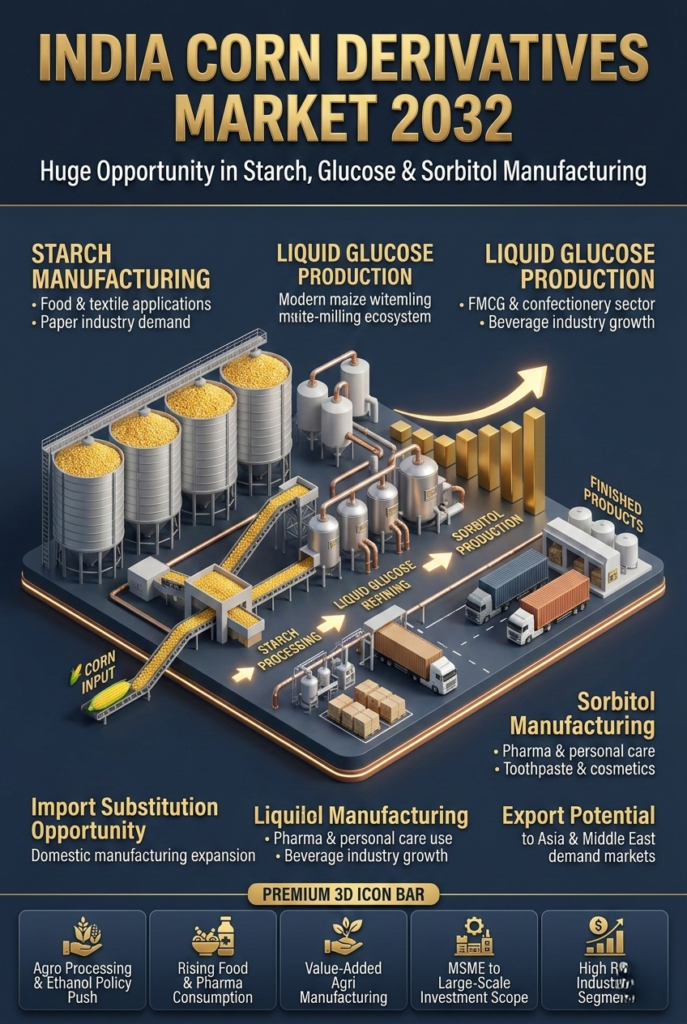
Integrated maize wet milling plants provide diverse production and steady revenue streams. In this process, maize is steeped, ground and separated to extract the starch, which is further processed to glucose, dextrose and sorbitol.
Some of the advantages of integrated plants are:
- Several finished products from one raw material
- Better capacity utilization
- Reduced risk in the market with product diversification
In addition, by-products such as maize germ oil and gluten feed improve overall profitability.
Read More: Maize, Corn and its By Products , Derivatives, Maize Processing Industry, Corn Starch, Dextrose, Liquid Glucose, Sorbitol, Oil, Gluten, Germ Oil, Wet Milling, Maize Starch Plant & related Products, High-Fructose Corn Syrup (HFCS)Projects
Existing Players in the Industry and Market Gaps
India’s organised maize processing industry consists of companies like Gujarat Ambuja Exports Ltd, Sukhjit Starch & Chemicals Ltd, Riddhi Siddhi Gluco Biols Ltd and Roquette India Pvt. Ltd.
However, the processing facilities are concentrated in few regions, whereas the demand is dispersed in multiple pharmaceutical and FMCG clusters. This geographical mismatch paves the way for decentralized manufacturing units.(India Corn Derivatives Market)
Policy Support to Maize Based Processing Units
The Government of India has been active in supporting agro-processing investments through financial and infrastructure support.
Key support mechanisms include:
- Capital subsidy on plant and machinery
- Support for processing units integrated
- Cluster based infrastructure development
Several state governments also offer other incentives which make the project more viable overall.
Read More: Maize Derivatives Manufacturing Business in India: Cost, Profit, Market Demand & MoFPI Subsidy
Market Outlook Till 2032
India’s corn derivatives market is expected to show a steady growth till 2032 given the increasing demand from food processing, pharmaceuticals, personal care and fermentation industries.
Growth will be supported by:
- Increasing domestic consumption
- Growth in pharmaceutical excipient manufacturing
- Import substitution, sorbitol and specialty glucose
As demand increases, new processing capacities will be required in various regions of the country.
Read More: Why India Still Imports Sorbitol? Maize Processing Industry Capacity & Business Opportunity
Conclusion: Why This Market Is Worth Taking Notice Of
The maize derivatives sector presents a rare opportunity of a combination of good raw material supply, an increasing downstream demand and policy support. Integrated wet milling plants offer diversified revenue streams and longevity of scale.
For the entrepreneurs and industrial investors, this sector is a sustainable and future-ready manufacturing opportunity in tune with India’s overall thrust in the direction of value addition and self-reliance.(India Corn Derivatives Market)
Frequently Asked Questions (FAQ)
Is maize wet milling profitable in India?
Yes, integrated plants make money from a variety of products and by-products, leading to better financial security.
Why Does India Import Sorbitol When There is Maize Surplus?
Due to low domestic pharmaceutical-grade refining capacity.
Which industries are consuming the most liquid glucose?
Processed food, confectionaries, dairy, pharmaceuticals & fermentation industries.
Are subsidies available for maize processing units?
Yes, there are financial incentives by both the central and state governments.
What is the Corn Derivatives Long-Term Outlook?
The market is set to expand at a steady rate up to 2032 and is supported by a strong industrial demand.