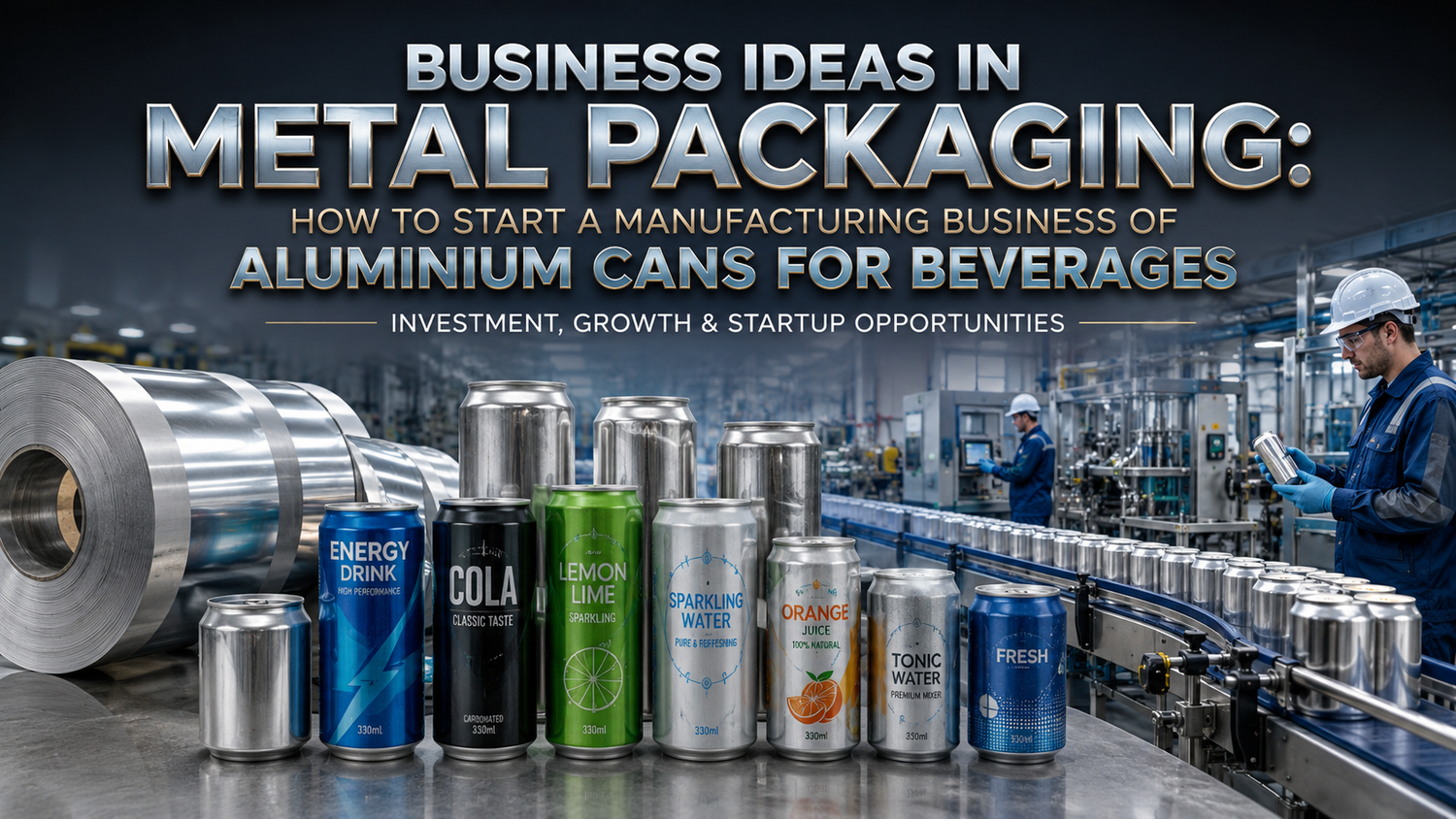

Aluminium Can Manufacturing Business
India’s beverage and packaging industry is growing at a fast pace and aluminium beverage cans are becoming one of the most preferred packaging solutions in various segments. Can makers be turning to aluminium packaging due to its sustainability, portability and high-end look, and are making it a more popular option for soft drinks, energy drinks, sparkling water, canned coffee and ready-to-drink juices.
It is now a growing focus on recyclable packaging, beverage consumption and environmental awareness that are providing good opportunities for entrepreneurs and industrial investors. While India continues to import a significant volume of beverage cans, domestic manufacturing firms have a great potential to secure the market share and gain from the industry’s expansion in the future.
As per the industry reports, the Indian Aluminium Beverage Can market will be expected to grow steadily in the coming years owing to the rising urbanization rate, transformation of consumer preferences and expansion of beverage brands.
Why Aluminium Can Manufacturing Is Growing Rapidly
The Indian drink market is growing rapidly, with the consumers demanding easy-to-swallow and ready-to-drink drinks. The change towards green packaging is also being driven by beverage companies, as they become more concerned about sustainability and environmental laws.(Aluminium Can Manufacturing Business)
The main reasons for the growth of aluminium beverage cans are:
- A growing demand for energy drinks and carbonated drinks.
- Growth of ready-to-drink beverage brands
- Raising awareness of packaging that is suitable for recycling
- Increased exports of drinks.
- Printed cans for premium pricing opportunities
- Government focus on sustainable manufacturing
Aluminium is regarded as one of the most recyclable packaging materials in the world. In recent years, there have been considerable developments in the global industry that are actively contributing to a circular economy and environmental protection by increasing aluminium can recycling rates. International Aluminium Institute Recycling Report
The Government of India also has several programmes for promoting sustainable Industrial manufacturing and development. Press Release from the Government of India Industrial Manufacturing Press Release
Market Opportunity in India
Compared to the developed markets where canned beverages have taken the place, India’s beverage packaging market is still huge room to grow.
As more and more people participate in:
- Carbonated drinks
- Energy beverages
- Alcoholic beverages
- Packaged water
- Functional beverages
- Ready-to-drink tea and coffee
is directly increasing the demand for aluminium beverage cans.
The Indian beverage can market is growing at a robust CAGR as per market research studies and also has a potential growth in the manufacturing capacity. India Beverage Can Market Research
The rising investment opportunities in aluminium packaging are also noted, as a result of the growth of beverage demand in Asia-Pacific markets and sustainability trends. Aluminium Beverage Cans Market Report
Aluminium beverage cans market in India is also expected to experience robust growth in the future as prospects for import substitution and domestic demand are promising. India Aluminium Beverage Can Industry Analysis
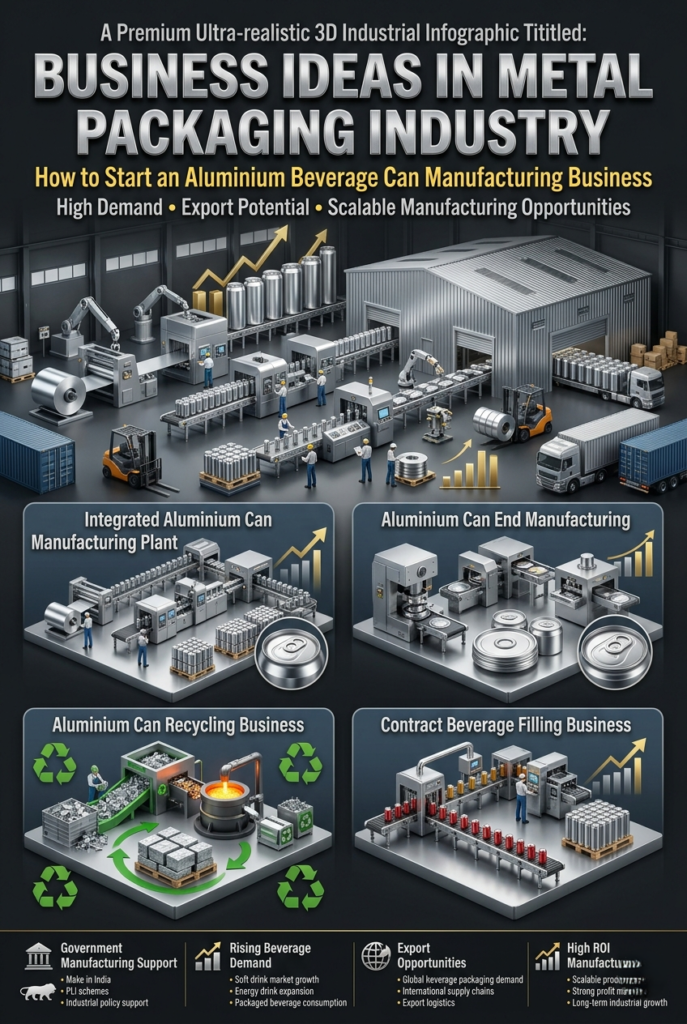
Business Models in Aluminium Packaging Industry
There are different business models that can be adopted by entrepreneurs in this industry, based on their investment ability and expertise.(Aluminium Can Manufacturing Business)
1. Integrated Aluminium Can Manufacturing Plant
The full industrial assembly line with aluminium coils being made into finished cans of beverage.
The manufacturing process consists of the following steps in general:
- Cup forming
- Wall ironing
- Trimming
- Washing and coating
- Printing and decoration
- Necking and flanging
- Inspection and packaging
Typically, large-scale plants will sell directly to beverage companies, via long-term commercial contracts.
2. Aluminium Can End Manufacturing
The lids are made separately and sold to the beverage packaging companies, in a process called can lidding. This line of business demands less capital to be invested as compared to a complete integrated plant.
Get Detailed Project Report (DPR): Aluminium Cans for Brewery Industry Report
3. Aluminium Can Recycling Business
Another fast-emerging area of the aluminium packaging industry is recycling. There is a scope for the entrepreneurs to form an organisation engaged in collection, sorting and processing used aluminium cans.
The recycling value of aluminium is high, which means that the sector has long-term growth potential.
4. Contract Beverage Filling Business
A great number of beverage start-ups rely on outsourced filling and sealing services. Beverage filling businesses can be set up to fill and package beverages for beverage brands without owning or producing beverages.
Investment and Infrastructure Requirements
The manufacture of aluminium is a capital-intensive industrial process which requires advanced technology and scale and infrastructure.
Related Article: India Aluminium Industry Outlook 2030: Market Size, Demand Growth & Business Opportunities
Estimated Project Requirements
| Requirement | Estimated Range |
| Land Requirement | 2–5 Acres |
| Project Cost | ₹40–120 Crore |
| Plant Capacity | 150–500 million Cans/Year |
| Power Requirement | High Industrial Load |
| Payback Period | 5–8 Years |
The investment will depend on the following:
- Production capacity
- Automation level
- Imported machinery
- Utility infrastructure
- Plant location
- Outline the company’s sourcing of raw materials.
The large-scale plants are usually more profitable because they benefit from greater economies of scale and efficiency of the plant.
Raw Materials Used in Manufacturing
Aluminium Coil Stock is the main raw material for producing beverage cans. Based on technical specifications, manufacturers use various grades of aluminium for can bodies and can ends.(Aluminium Can Manufacturing Business)
There are key raw material factors to consider:
- Aluminium price fluctuations
- Import dependency
- Supplier agreements
- Currency exchange risk
- Transportation cost
- Inventory management
Placing orders for raw materials is of great importance as aluminium constitutes a significant production cost.
Machinery and Technology Requirements
The modern plants for making beverages cans have to be equipped with highly automated machines, which are essential for quality uniformity and speed of production.
Major machinery includes:
- Cupper machines
- Body makers
- Trimming machines
- Male and female washers and dryers.
- Lines for printing and coating.
- There are various machines including necking and flanging machines.
- Leak testing equipment
- Packaging and palletising systems
Most of the big manufacturers import machinery from Europe, China or USA due to advanced automation technology.
Get Detailed Insights from This Book: Electroplating, Anodizing & Metal Treatment Handbook
Government Support and MSME Benefits
The Indian government offers various schemes and financial aids for MSMEs and manufacturing enterprises.
Entrepreneurs can gain from:
- The Government of India is promoting Make in India initiative
- MSME support schemes
- SIDBI manufacturing finance
- State industrial subsidies
- Capital investment incentives
- Electricity duty exemptions
The Ministry of MSME offers several support programs to industrial businesses and entrepreneurs. MSME Ministry Official Website.
There can be credit guarantee and financing support for businesses under MSME lending schemes too. MSME Credit Guarantee Scheme Guide
Challenges in Aluminium Can Manufacturing
While there is considerable room for growth, entrepreneurs need to be aware of the challenges that lie in the way of them.
Major Challenges Include:
- High capital investment
- Technical manufacturing complexity
- Commodity price volatility
- Dependence on large-volume customers
- Strict quality requirements
- Energy-intensive operations
- Import competition
Quality control and production efficiency are a high priority for the beverage industry since it has tough demands for packaging.
Manufacturers need to invest heavily in:
- Quality assurance systems
- Skilled manpower
- Automation technology
- Maintenance systems
- Manufacturing with effective supply chain management.
Build a profitable business with the right idea
Profitability and Future Growth Potential
The prospects for the production of aluminium beverage cans in India look promising. Long-term industry growth will likely increase as consumers buy more canned beverages and show greater interest in sustainable packaging solutions.(Aluminium Can Manufacturing Business)
Some of the key growth drivers are:
- Growth of drinks companies
- Growth of energy drink market
- Reduced use of plastic packaging
- Export opportunities
- Increasing recycling awareness
- Premium beverage packaging demand
If managed properly and run at a high-capacity utilization, industry experts say, plants can be profitable in the long term.
Being successful in this business is greatly influenced by:
- Production efficiency
- Product quality
- Customer relationships
- Long-term supply contracts
- Cost management
- Operational scalability
Business owners who are able to develop an efficient manufacturing process in the early stages can develop their enterprise as a very scalable business for the coming decade.
How NPCS Helps Entrepreneurs
To start up an aluminium can manufacturing business, technical and financial planning are required. The entrepreneurs should assess the feasibility of a project, selection of machines, raw material availability, and profitability before investing.
Niir Project Consultancy Services is one of the best industrial consultancy firms in India for the establishment of a successful manufacturing business.
They offer consultancy services, such as:
- Detailed Project Reports (DPR)
- Techno-Economic Feasibility Reports
- Market Research Studies
- Financial Projections
- Machinery Selection Guidance
- Plant Layout Planning
- Profitability Analysis
- Raw Material Assessment
For more information, please visit the NPCS Official Website.
Conclusion
India’s demand for aluminium cans is driven by growing consumption of drinking water, environmental concerns about sustainability, and the growing need for recycled packaging. The aluminium can manufacturing industry in India has promising future prospects due to the increased consumption of drinks, sustainability, and the requirement for recycled packaging.
The industry has a high capital requirement and requires technical skills, but provides enough scalability and growth potential. Business owners who specialize in making quality products, run their businesses efficiently, and build long-term customer relationships will be able to create very profitable manufacturing businesses in this growing industry.(Aluminium Can Manufacturing Business
“Aluminium beverage cans will likely become one of the key packaging products in the future because India’s packaging industry is upgrading rapidly, and world-class beverage brands are increasingly focusing on environmental sustainability.
References and Useful Government / Institutional Links
The following official government and institutional resources are recommended for further reading and for direct application to the schemes discussed in this article.
- Startup India – Official Portal –https://www.startupindia.gov.in/
- Ministry of Micro, Small & Medium Enterprises (MSME) –https://msme.gov.in/
- Udyam Registration Portal –https://udyamregistration.gov.in/
- Department for Promotion of Industry and Internal Trade (DPIIT) –https://dpiit.gov.in/
- Small Industries Development Bank of India (SIDBI) –https://www.sidbi.in/
- MUDRA / PMMY Official Portal – https://www.mudra.org.in/
- CGTMSE Official Portal –https://www.cgtmse.in/
- Ministry of Micro, Small & Medium Enterprises –https://msme.gov.in/
- JanSamarth Portal (Government Loan Schemes) –https://www.jansamarth.in/
- Niir Project Consultancy Services (NPCS) –https://www.niir.org/