Adhesive Manufacturing Business
In the era of MSMEs, the adhesive industry in India is one such sector which is rapidly expanding but untapped. The uses of the adhesives in construction, furniture, packaging, footwear, vehicle and industrial applications are significant. India is actively promoting manufacturing and there are ample opportunities for new entrepreneurs in this sector as well.
Initiatives that the Government supports to foster growth in the manufacturing sector:
- MSME India Official Portal
- Startup India Initiative
- Make in India Program
- NICDC Industrial Development
- FICCI Industry Network
Efforts are made to actively promote the growth of MSMEs, access to funding, and policy guidance on these platforms.
Get Detailed Project Report (DPR): Fevicol-Type Adhesive Manufacturing Plant Report
Why Adhesive Manufacturing is a Profitable Business
The construction and infrastructure industry in India is booming and is a growing need for modern bonding materials. The conventional fastening methods are slowly being replaced by high strength, long life and efficient advanced fasteners.
The furniture industry is another sector which is a leading contributor to growth. Wood glue usage has greatly grown with the advent of plywood, MDF and modular furniture. Likewise, the e-commerce revolution has resulted in a huge growth demand for adhesive packaging.
One of the major benefits of this type of business is repeat demand. Adhesives are consumables that are necessary in the production cycles and provide consistent revenue.
The government’s initiative for manufacturing through MSME India (https://msme.gov.in/) and policy advocacy by FICCI (https://www.ficci.in/) further bolsters the manufacturing industry’s outlook.
Types of Adhesive Manufacturing Businesses
1. PVA (White Glue) Adhesives
PVA adhesives are commonly used in furniture, carpentry and packaging industries. They are easily made, cheap and water-based.
2. Construction Adhesives
These include polymer-modified cement for new construction projects, wall putty and tile adhesives.
3. Rubber & Contact Adhesives
These adhesives can be used in footwear, leather, and automotive products and are used in higher margins; however, they do need technical expertise.
4. Epoxy Adhesives
Adhesives for electronics, marine and metal repair that perform well in high-performance industrial applications.
Get Detailed Insights from This Book: The Complete Book on Adhesives, Glues & Resins Technology (with Process & Formulations) 2nd Revised Edition
Investment Required
The amount of investment will be determined by scale and product type:
- The price of the PVA White Adhesive Unit is in the range of ₹25 to 40 lakh.
- Construction Adhesive Unit: ₹40-70 lakh
- Rubber Adhesive Unit: ₹50-80 lakh
- Apart from the above, other parts of the epoxy adhesive unit range from ₹60 to ₹90 lakh.
The entrepreneurial can expand their production units’ step by step from small to medium unit with proper planning and the support of the government in implementing MSME initiatives.
Raw Materials Used in Adhesive Manufacturing
Raw materials are different for various product categories:
- PVA adhesives consist of Vinyl Acetate Monomer (VAM), stabilizers and plasticizers.
- Fillers, white cement, and polymer powders are all types of construction adhesives.
- The composition of rubber adhesives includes synthetic rubber compounds, solvents, etc.
- Epoxy adhesives: resin and hardener systems
These materials are readily available from industrial chemical hubs of Gujarat, Maharashtra and Delhi NCR.
Machinery and Plant Setup
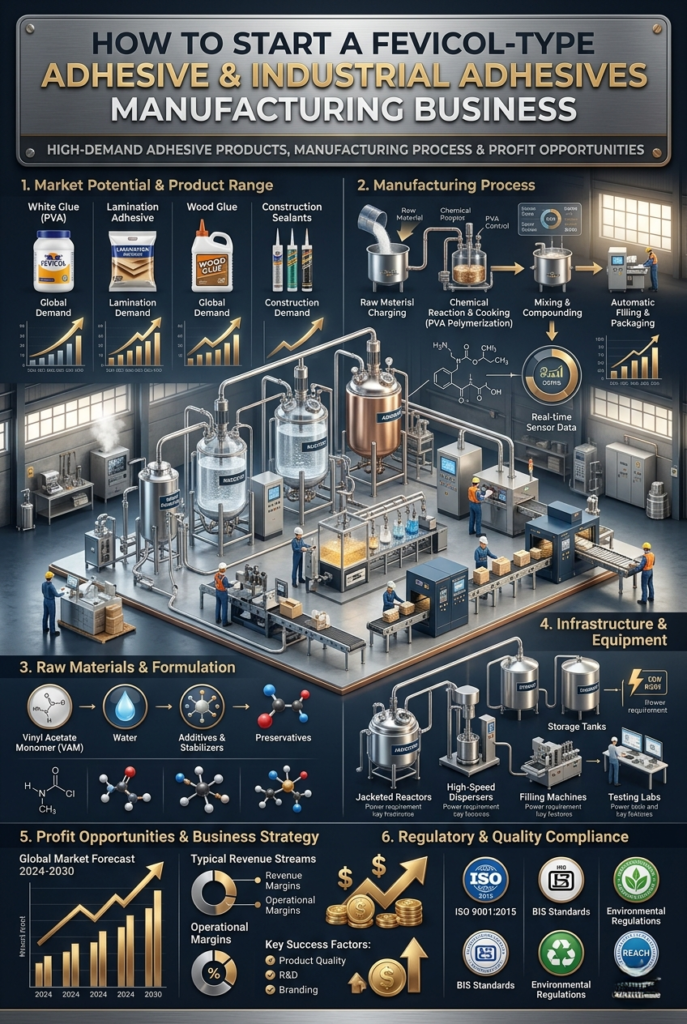
The basic plant for the manufacture of adhesives consists of:
- Reactor or mixing tanks
- High-speed stirrers
- Storage tanks
- Filling and packaging machines
- Quality testing equipment
Dry mixers and automated packaging systems are also needed with construction adhesives.
Build a profitable business with the right idea
Manufacturing Process Overview
This manufacturing process involves a chemical mixing process, and operators control the parameters. Operators mix raw materials in reactors and then use high-speed mixing to ensure uniform consistency of the raw materials.
After production, the manufacturer performs quality testing on the adhesive to check its viscosity, bonding strength, and stability before packaging and distribution.
Licenses and Legal Requirements
The following registrations are required to get started on this business in India:
- MSME Udyam Registration (https://msme.gov.in/)
- GST Registration
- Factory License
- The pollution control board has approved this.
- Fire Safety Clearance
- Trade License
- Import Export Code (for exports)
There are also government platforms like Startup India (https://www.startupindia.gov.in/) which can guide in compliance and investment avenues.
Profit Margin and Business Potential
The adhesive business is profitable:
- PVA adhesives: 35%–45% margin
- Construction adhesives are moderate but high-volume margins.
- The industrial margins of rubber adhesives are higher.
- Epoxy adhesives: premium margins
The key to success is to control costs, have a strong distribution system and maintain uniformity in product.
There are industrial development bodies such as NICDC (https://nicdc.in/) that can help in the development of manufacturing clusters for further enhancement of scalability.
Marketing Strategy for Growth
B2B networks are the primary source of most sales in this industry as opposed to digital marketing.
Key strategies include:
- Establishing dealer network in Tier-2 and Tier-3 cities
- The direct supply to furniture manufacturers.
- Partnerships with contractors and carpenters
- Consistency of branding and packaging across the region
- Product demonstrations and sampling programmes
In this business, it’s all about relationships.
Related Article: 3 High Growth Manufacturing Opportunities: Synthetic Rubber Adhesives, Zinc Sulphate, and Dehydrated Produce
Government Support for MSME Entrepreneurs
India is robust in its support of manufacturing startups through:
- Loans without collateral (CGTMSE scheme)
- Reward schemes for industrial policies under the state’s
- Startup India tax benefits
- Encourage export through incentives for international trade
- Industrial cluster development programs
This type of work lowers risk when starting a business and will increase the profits.
More information can be accessed through:
Challenges in the Adhesive Business
- Strong competition from established brands
- Need for consistent quality control
- Raw material price fluctuations
- Technical formulation expertise required
- Distribution network development takes time
With appropriate planning and support from MSME, these can be effectively handled.
Role of NPCS in Business Setup
Niir Project Consultancy Services (NPCS) is a premier consultancy firm to assist entrepreneurs in establishing manufacturing units in India.
NPCS will assist with creating detailed project reports, feasibility studies, market analysis, machinery selection advice and financial planning. Their reports enable investors to get a complete picture of the project before investing money.
Their consultancy services will be helpful particularly for the first-generation entrepreneurs who require technical and financial transparency prior to establish the adhesive manufacturing units.
Conclusion
The adhesive manufacturing industry is one of the most lucrative MSME business ventures in India that has immense scope for growth in the future. This is an industry that provides steady earnings and growth potential, especially in the areas of construction, furniture, packaging and industrial applications.
PVA white adhesives are the first products that someone can introduce to the market as an entrepreneur, and then they can go on to make construction products, rubber products and epoxy. Good outcomes depend not only on advertising but also on quality, distribution, and cost-effectiveness.
This business has a bright future with the help of the government schemes such as MSME India, Startup India, Make in India, and various industry organizations like FICCI.
Frequently Asked Questions
Q1. What is the minimum investment for the business?
For a small-scale unit, it is 25-40 lakh.
Q2. Is the adhesive manufacturing business profitable?
The profit margins for the product vary from 35%-60% depending on the product.
Q3. What product should a novice begin with?
PVA white adhesive would be the easiest to start with.
Q4. Do I need technical knowledge?
Basic knowledge of chemistry or help of an expert is advised.
Q5. Can I export adhesive products?
Yes, India is exporting adhesives to countries in Asia, Africa and Middle East.