
One of the most robust and underutilized possibilities in India’s industrial landscape is within a steel box. The steel cargo container sector, a quiet backbone of global trade and domestic transport, is suddenly attracting first-generation entrepreneurs as a high-yield business opportunity. With multiple entry points, real scalability, growing strong domestic demand and government support, whatever you are considering, the container business can offer you plenty of opportunity.
In the timing it is never been better. India is spending huge resources on developing logistic infrastructure, export corridors and port-led industrialisation. But, comparatively less MSME entrepreneurs have entered this field; leaving the field open for the early movers.
Why Steel Cargo Containers Are a Serious Business Opportunity
Over the past decade, the trade volume of containers has steadily increased in India. Mercerise trade, development of specific freight corridors and e-commerce and cold chain created more demands for containers increased the volume of containers. Data from Indian Ports Association indicates that volumes of containers have been growing at the major ports, consistently year after year.
Meanwhile, the PM Gati Shakti National Master Plan is addressing India’s logistics costs—which are significantly higher than the level ideal for the country’s GDP—in a direct, head-on manner. This effort is pushing billions of dollars into infrastructure for which containers are first products of demand.
The container industry is worth hundreds of billions of dollars around the world. India continues to import a significant number of its container vessels – a clear import-substitution opportunity. The standard 20-foot dry cargo container has a weight of around 2,200kg. The FOB cost of steel varies from USD 2,500 to USD 5,500, depending on the global steel cycles. The difference between cost of inputs and selling price is significant for an Indian fabricator – and reflects as India’s demand for fabrics grows.
Related Article: India’s ₹59,000-Crore Container Revolution: The Business Opportunity Every MSME Manufacturer Must Know
Government Policies and Incentives Supporting This Sector
Logistics and Shipping infrastructure is considered as a strategic sector by the Government of India. There are several policy instruments that directly benefit entrepreneurs that enter the steel cargo container space.
- MSME Credit Guarantee Fund Trust Scheme (CGTMSE): Credit up to ₹2 crore without any collateral requirement – Best suited for small fabrication workshops to become a part of container repair or modification business.
- Credit Linked Capital Subsidy Scheme (CLCSS): 15% capital subsidy on machinery upgradation, which can be directly used for sheet metal processing and welding machines.
- PLI Scheme for Specialty Steel: Provides indirect benefits (faster development of competitively priced steel inputs for container manufacturers).
- Udyam Registration: Streamlines MSME formalisation, providing access to government tenders, export benefits under RoDTEP, and priority sector lending.
The Ministry of MSME has been actively promoting the skill development in metal fabrication through the Technology Centres and Tool Rooms providing subsidised training on welding, tool room CNC cutting and structural fabrication. These skills are directly applicable to the manufacturing of containers. It is also important that entrepreneurs make use of the DPIIT (Department for Promotion of Industry and Internal Trade) to avail recognition, tax benefits (Section 80-IAC) and regulatory fast-tracking (Start-up India) under the Start-up India initiative.
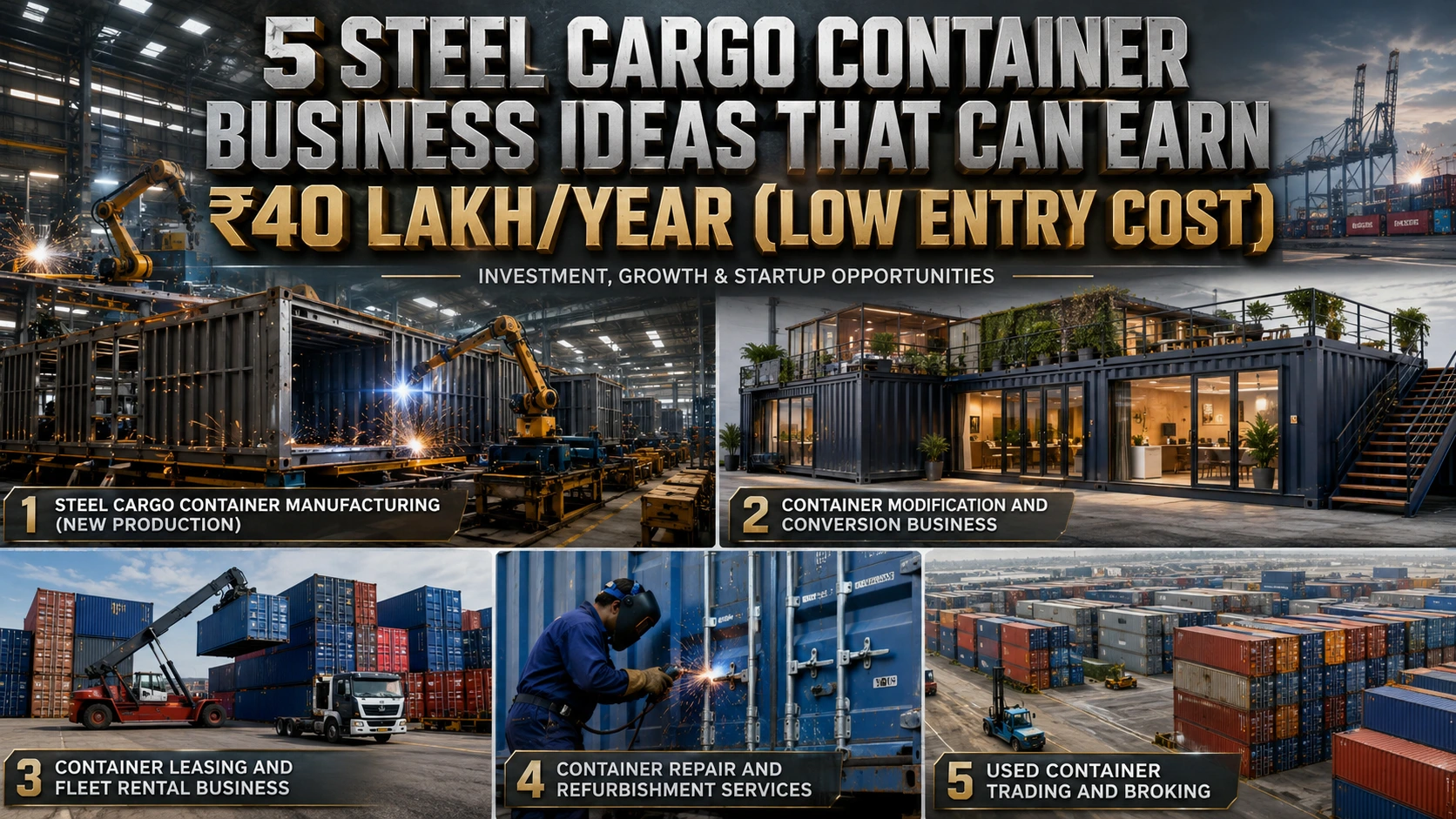
5 Business Ideas in the Steel Cargo Container Sector
1. Steel Cargo Container Manufacturing (New Production)
The capital-intensive way to start a greenfield operation is to build a steel cargo container fabrication facility, but this option has the potential for the largest margin ceiling. It takes about 2 tonnes of Corten steel, CNC precision cut, MIG/MAG welded, treated floors and paint finishing to create a standard 20′ dry cargo container.
A plant can break even at production volumes of 100-200 containers per month within 24-30 months at the current domestic prices. Competitive advantage is speedy delivery and the possibility of customisation, either flat racks or open tops, or a refrigerated unit, both selling for 30-50% more than a standard ISO.
It is advisable for the entrepreneurs in this segment to look for the convenience of steel mills in Jharkhand, Odisha or Chhattisgarh which will help to minimize the logistics cost of raw materials. International acceptance requires a certificate of conformance from ISO 1496-1. India is actively moving towards building its own logistics base and a well-capitalized manufacturer has local port operators and EXIM trade as customers.
Read the Complete Book Here: Steel and Iron Handbook
2. Container Modification and Conversion Business
In all business ideas in this space, there are some of the highest margin percentages and the lowest entry costs for modifying containers. It starts with a regular shipping container and ends with a specialised building – from modular offices to site cabins, cold storage boxes to prefabricated homes, pop-up retail stores to even data centre enclosures.
A small shop (5,000 – 8,000 sq.ft.) with simple CNC cutting tools, welding equipment and interior fitting equipment can service a large customer base. Some real estate developers, construction firms, defence contractors, and even PM Awas Yojana rural projects have started buying converted containers.
The per-unit value addition in conversion can be ranging from ₹1.5 lakh to ₹8 lakh as per the complexity. With the appropriate workflow, a 5–8-person unit can process 10–15 containers per month. Plus, this niche is receptive to digital marketing and all the elements of it work exceptionally well for this audience, with Instagram, LinkedIn and B2B targeting working surprisingly well with architects and site managers.
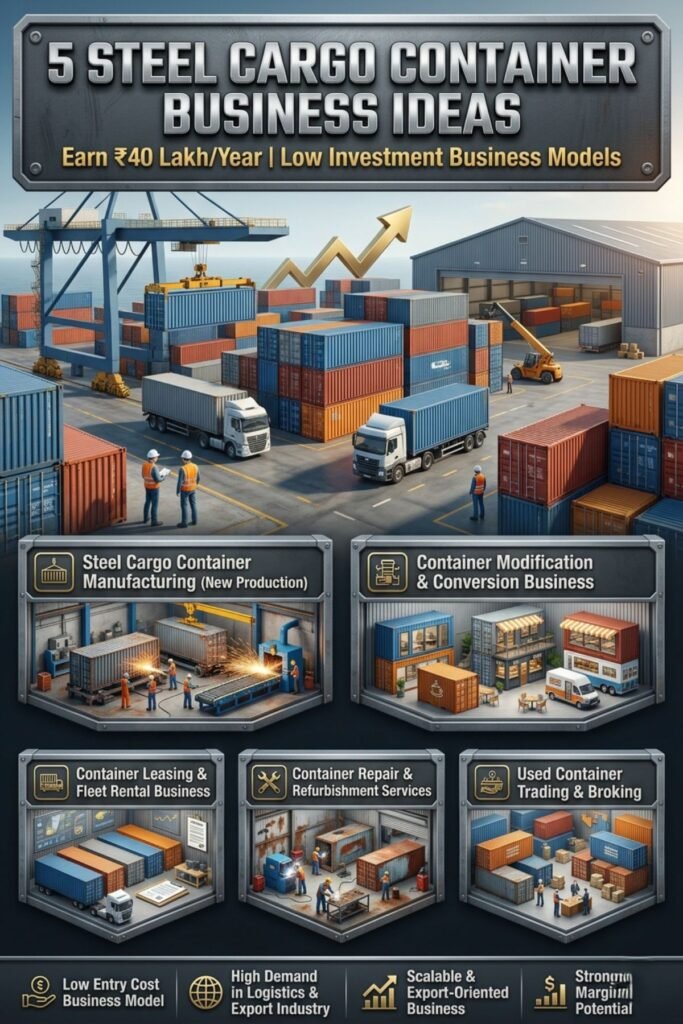
3. Container Leasing and Fleet Rental Business
Container leasing is basically a real estate model that can be used for steel containers. Rent containers, either to logistics companies, exporters or cold-chain enterprises, and enjoy regular monthly rentals. The initial capital investment is primarily in the containers, new or used, and their proper care.
The price of used containers ranges from auctions held by shipping lines at ₹80,000–₹1.5 lakh per unit. These can be hired for Rs. 3000 to Rs. 8000 per month and this price varies with their age, condition and specification. With relatively low operating expenses, a fleet of 50–75 containers can earn ₹2–5 lakh per month from leasing. So, with relatively low operating cost, one single fleet of 50–75 containers can earn ₹2–5 lakh per month from leasing.
This model is more viable for entrepreneurs who have connections within the port communities, logistics parks or Container Freight Station (CFS). Platforms are also beginning to appear online for leasing management, improving the booking and payment collection process.
4. Container Repair and Refurbishment Services
All shipping containers experience wear and tear over time. This includes corrosion, structural damage, floor damage, and seal failure. It is a non-discretionary demand stream. Shipping lines must ensure fleet certifications to remain in international service. This creates a recurring market for repair and refurbishment.
The cost of setting up a repair depot is ₹15,000 to ₹40,000. It can handle structural welding work, anti-corrosive treatment, sand blasting, and repainting. The business is very lucrative around port clusters like JNPT, Mundra, Chennai and Visakhapatnam where more containers are moving. The repair costs can vary from ₹8,000 to ₹60,000 per container based on the degree of the damage. Working capital management is relatively easy because turnover cycles are 2-4 days.
Get Detailed Project Report (DPR): Start Manufacturing of Steel Containers (Cargo Containers)
5. Used Container Trading and Broking
There is a surprisingly active used shipping container market and it’s a very profitable market for traders who know how to grade the containers. The price differences are up to 40-50% with the IICL-5 (Near New) being the highest grade and the As-Is being the lowest.
A container trader buys from shipping line depots, port auction pools, and overseas sellers. They then sell to end users such as construction companies, farmers, and small businesses. Construction companies use them as site offices. Farmers use them for grain storage. Small businesses use them as warehouses. The brokerage model is low on fixed cost, only a network, industry knowledge and an inland logistics arrangement. Typically, gross margin transaction ranges from ₹15000 to ₹60000 and a small team can work on 25–50 transactions per month with an active broker.(Steel Cargo Container Business)
Import–Export Opportunity Analysis
Historically, India has faced restrictions on exporting containers. China dominates over 80% of the global container manufacturing market. Companies like CIMC and Dong Fang International are leading the industry. This concentration has created a strategic weakness in global supply chains. As a result, companies are increasingly considering Indian manufacturers as alternative suppliers.
Steel Containers and Material Handling Equipment’s are recognized as export categories with high growth potential by both the FIEO (Federation of Indian Export Organisations) and the Engineering Export Promotion Council (EEPC India).
Indian logistics companies in the emerging cold-chain and the pharmaceutical sectors import refrigerated containers (reefers) regularly from Europe and East Asia at high costs. There is a large market size for a domestic manufacturer that can create reefer containers at 60-70 percent of landed import price. Besides, the RoDTEP scheme’s rebates help make Indian-made containers more competitive in Southeast Asian and African markets, where fabricated containers are exported. In addition, the RoDTEP scheme rebates will help bring down the costs of exporting fabricated containers, making them more competitive with other countries in Southeast Asian and African markets.
Indian MSME Success Stories in This Sector
CIMC-Allied Indian Fabricators — Pune and Bhiwandi
In the CIMC supply chain there are multiple Indian-origin MSMEs who have emerged from small workshops to become multi-crore enterprises. In Pune and Bhiwandi, entrepreneurs established successful repair and modification businesses of containers, providing services to big container yards in Maharashtra, and came up with a huge profit. Annual maintenance contracts with logistics parks and CFS operators provide steady and predictable cash flow — that’s their success model. The lesson here: a business based on contracts becomes a predictable and scalable enterprise, rather than a commodity-based manufacturing business.
Vijay Containers — Ahmedabad
Vijay Containers started with simple repair and refurbishment work and progressed up the value chain to convert containers for site cabins and modular structures. As the promoter realised early the need for rapid deployment site offices in the construction sector which was booming in Tier-2 cities. A converted container was found to be more cost effective than a temporary brick and mortar structure. The firm expanded its operations to meet the needs of big infrastructure firms in the west of India within five years. The take-home message: It’s not about what you can fabricate, but about what the end-user can afford.(Steel Cargo Container Business)
Eastern Containers and Logistics — Kolkata
From a 20-container operation, Eastern Containers expanded to become a multi-faceted container services company, providing leasing, repair and inland haulage solutions. The promoter has the advantage of being close to Kolkata port and the contacts of the Bangladeshi exporters and therefore used to create a niche in cross border container movement under the trade corridor of BIMSTEC. In this case, it shows how geography and knowledge about the trade routes is as important as capital or manufacturing skills.
Business Segment Overview: Investment and Revenue Comparison
| Segment | Entry Investment (₹) | Monthly Revenue Potential (₹) | Gross Margin |
| Container Manufacturing (20 ft) | ₹1.2 Cr – ₹2.5 Cr | ₹18 L – ₹35 L | 22%–28% |
| Modification & Conversion | ₹30 L – ₹80 L | ₹8 L – ₹18 L | 35%–45% |
| Leasing & Rental | ₹50 L – ₹1.5 Cr | ₹6 L – ₹14 L | 55%–65% |
| Repair & Refurbishment | ₹15 L – ₹40 L | ₹4 L – ₹10 L | 40%–50% |
| Used Container Trading | ₹20 L – ₹60 L | ₹5 L – ₹12 L | 18%–25% |
| Export of Fabricated Containers | ₹1.5 Cr – ₹3 Cr | ₹25 L – ₹50 L | 20%–30% |
Note: Figures are indicative ranges based on industry analysis. Actual financials depend on location, scale, steel price cycles, and operational efficiency. A detailed DPR from NPCS provides project-specific financial modelling.
Find high-return business ideas based on your budget & ROI
How NPCS Can Help You Evaluate This Business
At Niir Project Consultancy Services (NPCS), we are in touch with entrepreneurs, industrial project investors and MSME planners who are just at this level – thrilled with a new opportunity but require the discipline of a structured feasibility study before putting their money.(Steel Cargo Container Business)
Our team does Market Survey cum Detailed Techno-Economic Feasibility Reports (DPRs) on various industries such as steel container manufacturing and conversion. These reports include everything related to business planning: Manufacturing process flows; Plant layout advices; Machinery and raw material sourcing; Market and demand analysis; Full financial projections (Profitability analysis, Payback period, Internal rate of return etc.).
An NPCS feasibility report will provide you and your lenders with an evidence-based basis for making the investment decision with confidence, whether you are considering a ₹30 lakh container repair depot or a ₹2.5 crore container manufacturing plant. The goal is not to sell enthusiasm: it’s to test your business idea against actual market, cost and business realities, to ensure that what you create will be profitable over time and not just for a quick start.
FAQs: Starting a Steel Cargo Container Business in India
Q1. How much investment is required to start a container modification business?
Setting up a small container modification facility can cost between Rs. 30-80 lakhs which will include expenses such as workshop rent/purchase, welding machines, CNC cutting machines, etc and the initial capital. It will depend on the size of the production capability and the nature of modifications, if they range from a simple site cabin to temperature-controlled modular constructions.
Q2. Do I need certifications to manufacture or sell steel cargo containers?
If the cargo container is to be used for international transportation, ISO 1496-1 compliance and CSC (Convention for Safe Containers) certification are mandatory. For container units which are domestically used, for instance for storage or as on-site office units, the compliance is not that stringent. However, the business would reach much wider potential with an ISO certification.
Q3. What is the best raw material for container manufacturing?
Corten steel is the most standard for manufacturing the outer body of the cargo containers due to its durability and resistance to rust. The flooring material would primarily be tropical wood (apitong/keruing) as is customary for sea shipping cargo containers. Bamboo composite is also coming into fashion. SAIL or Tata Steel can be looked upon as the sources for the raw material in India, which will prove to be more economical than imported materials.
Q4. Can I start a container business under MSME registration?
Yes, units engaged in the manufacturing, modification, repair, or trading of containers qualify for MSME registration under the Udyam classification provided their investment is within the stipulated limits. They also get benefit of CGTMSE loan guarantee, CLCSS capital subsidy, preferential purchase rights, and in several Indian states subsidized power tariff.
Q5. Where can I find government support for this business?
The Make in India portal will help you with comprehensive information about sector specific subsidies. Invest India platform also guide industrial project investors on individual basis whereas state-level industrial development corporations (SIDC) can assist with land allotment and plug-and-play facilities for setting up small manufacturing unit at subsidised rates in selected locations.
Q6. Is the container leasing business profitable in India?
Container leasing is a very lucrative business as gross yield in the used cargo container fleet (which would be well-maintained with decent quality) would be 18-30% annually. This is especially the case near major ports or logistic hubs. Important success factors include good utilisation of fleet (ideally above 85%), regular maintenance of the fleet for minimizing downtime, good client profile (borrowers) and electronic tracing for ease of business and operational profits.
Conclusion
The Indian steel cargo container industry is not an entirely new industry – but it is an emerging one for Indian entrepreneurs. A combination of infrastructure development, an increasing trade volume and government backing in the form of MSME support and logistics programs provides an excellent entry window for Indian players. Whether you focus on container trading, develop a repair depot near an established port cluster, or invest in a full-scale fabrication unit, you can build a fundamentally strong business here.
The point is not just to understand the business case, but to be methodical about executing it. A comprehensive feasibility study – including market demand, cost structure, regulations and projections – will distinguish a winning idea from a profitable venture.
The five business ideas discussed in this article present different risk–return equations, but together they reveal an emerging and perhaps underestimated business opportunity in India over the coming decade. (Steel Cargo Container Business)


This is the perfect blog for everyone who would like to find out about this topic.
You understand so much its almost tough to argue with you (not that I actually would want to…HaHa).
You certainly put a brand new spin on a topic that’s been discussed for years.
Excellent stuff, just excellent!