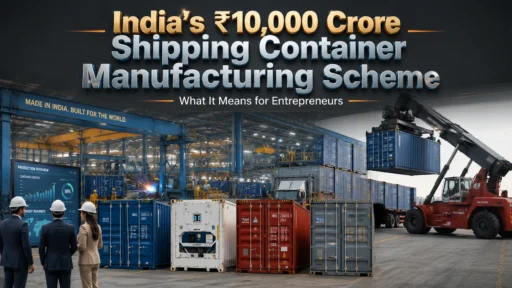


India Container Manufacturing Scheme
A Nation That Handles 14 million Containers a Year — But Builds Almost None
India has an annual containerised throughput of approximately 14 million TEUs. This is increasing by almost 8-10% per year. But despite this, India produced almost no containers here till the announcement of the Container Manufacturing Assistance Scheme (CMAS) in the Union Budget 2026-27. In fact, if an exporter from Ludhiana, Tirupur or Surat had loaded any box, it was most likely Chinese-made.
The digits speak for themselves. More than 95% of the world’s dry shipping containers are produced in China. Even as one of the fastest-growing export economies, India was just a buyer. That dependency is not only a trade oddity; it causes real business pain. During the global freight market paralysis and container scarcity, Indian exporters had to pay 3–5 times the usual freight charges and faced weeks of shipping delays.
The government has now allocated ₹10,000 crore to establish a domestic unit manufacturing industry for containers. The Ministry of Ports, Shipping and Waterways states that it has set a target of 1 million TEUs per year for Indian domestic manufacturing in the coming ten years. The multiplier effect estimated: Total value of the market generated is approximately eight times the amount of expenditure by the government (₹1.07 lakh crore).
Get Detailed Project Report (DPR): Steel Container Manufacturing Guide
The Gap: 100% Import Dependence on a Box That Runs the World
The country is totally dependent on imports of dry freight containers. The cost of a standard container of 20 feet ISO dry container ranges from ₹1.2–1.6 lakh from the Chinese manufacturers. The Indian Ports Association estimates that the replacement value of the container fleet in Indian trade, in terms of manufacturing value, is several lakh crore rupees, and India has no share in it as far as manufacturing is concerned.(India Container Manufacturing Scheme)
The problem is structural. India has steel. The capacity to fabricate. India has low labour wage rates. It was missing a policy framework, home-grown demand aggregation, and financial backing to ensure local manufacturing would be economically competitive with China’s factories that churn out millions of units each year, built up over many years of supply chain efficiencies.
The Container Corporation of India (CONCOR) has traditionally imported containers from abroad by sea. CONCOR has its own fleet of lakhs of boxes. A more cost competitive domestic sourcing option will dramatically reduce procurement costs.
On the ports front, the impact remains limited to India’s largest container ports. These include Jawaharlal Nehru Port Authority (JNPA) near Mumbai, which handles about 5.5 million TEUs annually, Mundra Port with close to 7 million TEU capacity, and V.O. Chidambaram Port Authority (Tuticorin Port), which is emerging as a hub for South and Southeast Asian trade. These logical natural clusters should guide the development of container manufacturing clusters.
Table 1: India’s Major Container Port Clusters and Throughput
| Port / Cluster | State | Annual TEU Throughput | Proximity Advantage | CMAS Opportunity |
| Jawaharlal Nehru Port (JNPA) | Maharashtra | ~5.5 million TEUs | Nearest to Pune-Mumbai industrial belt | High – gateway to western exports |
| Mundra Port (APSEZ) | Gujarat | ~7 million TEUs | Adjacent to Ahmedabad, Surat MSME clusters | Very High – largest container port in India |
| Chennai Port | Tamil Nadu | ~1.8 million TEUs | Automotive & electronics export corridor | High – backed by BCSL MoU signatories |
| V.O. Chidambaranar Port (Tuticorin) | Tamil Nadu | ~1 million TEUs | South India & Sri Lanka gateway | High – Outer Harbour expansion underway |
| Kolkata/Haldia | West Bengal | ~0.8 million TEUs | Northeast India, Bangladesh trade | Moderate – inland waterway integration potential |
| Cochin Port | Kerala | ~0.7 million TEUs | Spices, seafood, rubber exports | Moderate – green container potential |
Source: Indian Ports Association (indianports.gov.in), MoPSW Annual Report, PIB release PRID 2222805
Get Detailed Insights from This Book: Steel and Iron Handbook
The Opportunity: Five Tailwinds Converging at Once
It’s not just a coincidence. In the previous reporting year, India’s merchandise exports reached ₹35 lakh crore. Export growth is forecast to be at 8–12% per annum by Directorate General of Foreign Trade (DGFT). Each additional container export must be a physical container. Domestic production that replaces an empty box, instead of importing a box that is empty — alters the entire trade logistical economics of India.
The CMAS is part of a wider maritime initiative. The foundational MoU signed in February between SCI, CONCOR, JNPA, Chennai Port and Tuticorin Port is for Bharat Container Shipping Line (BCSL) which will use the products indigenous to India. That ensures a constant base customer for the new container makers – the national shipping line, India.
The scheme also dovetails into PM Gati Shakti, which includes the integration of railways, ports, waterways and road logistics. Near-rail container freight stations (CFSs) can easily access CONCOR’s logistics network. It is NOT a speculative export play — the domestic pool of demand is already established.
Some of the government schemes available to a container manufacturing startup or MSME are:
- CMAS (Container Manufacturing Assistance Scheme): Financial assistance of ₹10,000 crore for 5 years for domestic manufacturers based on production milestones.
- PLI for Steel and Advanced Manufacturing: production linked incentives of 4-6% on incremental sales for eligible manufacturers.
- CGTMSE (Credit Guarantee Fund Trust for MSEs): collateral-free loans up to ₹5 crore for MSME manufacturers; higher limits under enhanced scheme.
- Eligible for ancillary component manufacturers:
- Make in India for Defence and Infrastructure — specialized containers (ISO tank containers, refrigerated reefers) qualify for defence logistics manufacturing incentives.
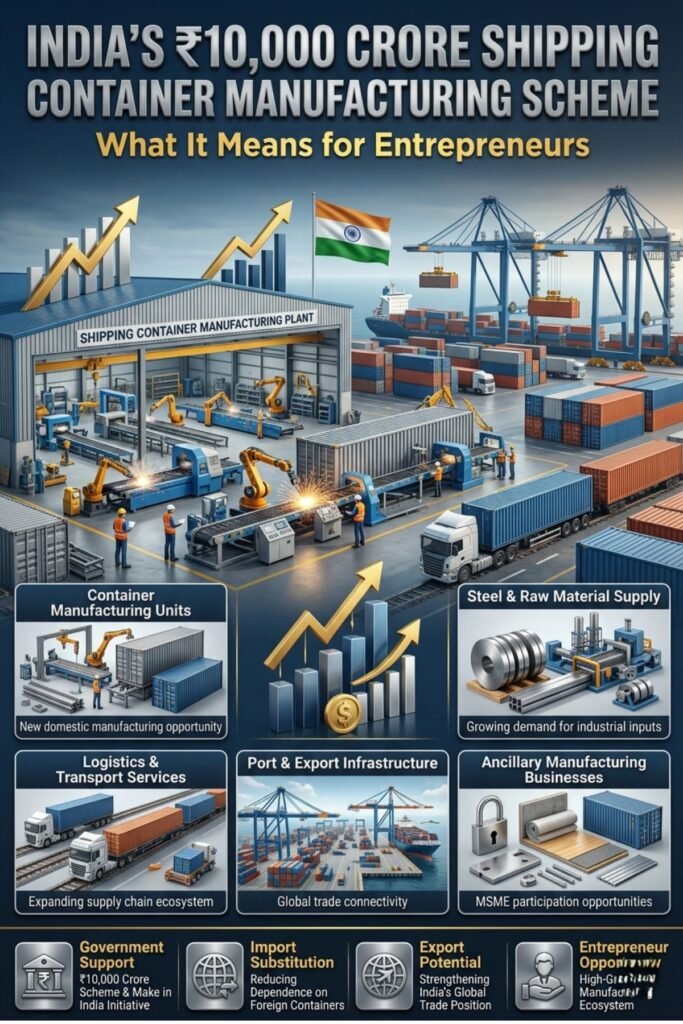
How to Set Up a Container Manufacturing Unit in India
The capital cost of establishing a container manufacturing plant is high, but the structure is simple. This is a step-by-step process for a first-time entrepreneur going into this arena.
Step 1: Choose Your Container Type and Scale
The market entry points are standard dry freight containers (20-ft and 40-ft ISO), refrigerated reefer containers (cold chain/perishables/pharma) and specialised containers (flat racks, open top, ISO tank container). The 20-ft dry freight container is the recommended entry point for a first plant due to its most popular size, most standardized, and the most incentive covered.
Step 2: Land and Location
The minimum size for a greenfield plant is 5–10 acres. Be within 50 km of a major port or rail-connected CFS to reduce logistics costs. Industrial area in Gujarat (Mundra, Hazira), Maharashtra (Nhava Sheva corridor) and Tamil Nadu (Chennai-Tuticorin belt) has pre-approved industrial land, existing port connectivity, and supply chains for steel. There are two industrial development corporations that provide cheap plot allotments in both Gujarat and Tamil Nadu, known as Gujarat Industrial Development Corporation (GIDC) and Tamil Nadu Industrial Development Corporation (TIDCO).(India Container Manufacturing Scheme)
Step 3: Core Machinery and Equipment
The main machines to invest are CNC plasma cutting and profiling machines (Corten steel panels), automatic welding lines (MIG/MAG), shot blasting units, epoxy painting line, anti-corrosion coating line and assembly jigs for containers. The flooring machinery of bamboo or hardwood floorboards is also needed. There are some reputed suppliers of welding product in India like Ador Welding, Messer Cutting Systems India and ESAB India etc. in Mumbai, Pune and Chennai. The Advance Authorisation Scheme allows the import of German and Korean CNC cutting systems duty-free, with a 15–20% benefit.
Step 4: Raw Material Sourcing
The main raw material is Corten steel (weathering steel) which makes up 60–65% of the production cost. Corten-grade steel is available from domestic sources like JSW Steel (Karnataka/Maharashtra), Tata Steel (Jharkhand) and SAIL (Multiple Plants). There are Pune and Rajkot based foundry for sourcing locking hardware and CSC certified corner castings. Bamboo planks for use as flooring are coming from Assam and Tripura.
Step 5: Licences and Regulatory Approvals
- Factory Licence — issued by the Factories Inspectorate, State under the Factories Act, 1948.
- Udyam Registration — to be done online at udyamregistration.gov.in for eligibility of MSME benefits.
- GST Registration – steel fabrication firms are liable to pay 18% GST, while input tax credit is available on raw materials.
- Pollution Control NOC — shot blasting and painting operations (Orange Category) will need State Pollution Control Board (PCB) Consent to Establish and Consent to Operate.
- ISO/CSC Certification — containers must comply with ISO 1496 series and carry a CSC (Convention for Safe Containers) plate. Certification is done through RINA, Bureau Veritas, or Lloyd’s Register — all operational in India.
- BIS Licence (for structural steel products for containers).
Step 6: Timeline and Staffing
Thereafter, allow 12-18 months for a greenfield plant for registration for Udyam and first production (land acquisition, civil construction, equipment procurement and commissioning). The need for skilled workers (welders/fabricators/painters) and supervisory/engineering workers in a 10,000 per-year plant is about 120 to 150 and 25 to 30, respectively. The preferred group of welders from the Gujarat, Tamil Nadu and Odisha polytechnics are ITI trained.
Related Article: India’s ₹59,000-Crore Container Revolution: The Business Opportunity Every MSME Manufacturer Must Know
Table 2: Investment Breakdown for a 10,000-Unit/Year Container Plant
| Cost Head | Small Unit (5,000 units/yr) | Medium Unit (10,000 units/yr) | Large Unit (25,000 units/yr) |
| Land (leased industrial plot, 5–10 acres) | ₹60–80 lakh | ₹1.2–1.5 crore | ₹2.5–3.5 crore |
| Civil Construction & Factory Shed | ₹80 lakh–1 crore | ₹1.5–2 crore | ₹3.5–5 crore |
| Core Machinery (cutting, welding, blasting, painting) | ₹2–2.5 crore | ₹4–5 crore | ₹9–12 crore |
| Auxiliary Equipment & Utilities | ₹40–60 lakh | ₹80 lakh–1 crore | ₹1.5–2 crore |
| Working Capital (3 months raw material) | ₹1–1.2 crore | ₹2–2.5 crore | ₹5–6 crore |
| Pre-operative & Contingency (8%) | ₹35–40 lakh | ₹70–80 lakh | ₹1.5–2 crore |
| TOTAL PROJECT COST (Approx.) | ₹5–6 crore | ₹10–12 crore | ₹23–30 crore |
Note: Land costs vary significantly by state and MIDC/GIDC/TIDCO allotment vs. open market. Equipment costs include imported CNC machinery at prevailing import duty rates. Source: NPCS techno-economic estimates, 2025; Market benchmarks from KPMG MSME Budget Analysis 2026.
Financial Snapshot: What the Numbers Look Like
The financial summary for the medium scale plant of capacity 10,000 standard 20′ dry freight containers annually is:
- Capital Expenditure: ₹10 to ₹12 crore (as mentioned in Table 2 above).
- Monthly Operating Cost: ₹2.8–3.2 crore (steel and materials: 65%, labour: 12%, utilities and overheads: 10%, finance and depreciation: 13%).
- Selling Price per Container (ex-factory): ₹1.2–1.5 lakh for a standard 20′ dry container, and ₹2.5–3 lakh for a 40′ HC unit.
- Revenue at 60% Capacity (6,000 units/yr): ₹7.2–9 crore per annum.
- Revenue at 100% Capacity (10,000 units/yr): ₹12–15 crore per annum.
- Gross Margin: 22–28% at full capacity (steel price volatility is the primary risk variable; Corten steel is priced at ₹65,000–75,000 per tonne).
- Net Margin: 14–18% at 80%+ utilisation (post CMAS incentive accrual, which reduces effective capex cost).
- Payback Period: 4.5-6 years based on the total capex; based on the cape subsidy from CMAS, 3-4 years. They have reached break-even at 55-60% capacity utilisation.
A reefer container plant has significantly higher margins of 28–35% net and higher capital investment of an additional ₹3–5 crore in refrigeration assembly and testing equipment as well as a more niche segment of buyers.
Startup Business Ideas Riding the CMAS Wave
It isn’t necessary to make the entire container. The CMAS generates a link in the business chain throughout the container supply chain. Below are eight startup plays to consider:
1. Corten Steel Slitting and Processing Units
Container manufacturers buy pre-slit and pre-formed Corten panels. There is a definite captive market for the steel service centre in Mundra, Hazira and Nhava Sheva, which will provide slit coils and profiled sheets to the container plants. Investment: ₹3–5 crore.
2. Container Slops
Slops for containers should be bamboo or hardwood treated. The bamboo-rich northeast region of India like Assam, Tripura and Mizoram is a perfect place to establish a bamboo container flooring unit to supply treated planks to the bamboo floor manufacturers. Financial support from SFURTI Clusters and National Bamboo Mission.
3.Corner Casting and Hardware Foundries
ISO corner castings are safety-critical components that currently face import dependence. A precision foundry in Rajkot (Gujarat), Coimbatore (Tamil Nadu), or Howrah (West Bengal) making CSC-certified corner castings serves every container OEM in the country. Investment: ₹1.5–3 crore.
4. Container Repair and Refurbishment Depots
Approximately 15-20% of the container fleet in service will need to be repaired periodically. A Lloyd’s Register or Bureau Veritas certified depot placed in proximity of the major ports can earn a revenue of ₹80 lakh – 1.5 crore per year with an investment of ₹60 lakh – 80 lakhs.
5. Anti-Corrosion Coating Compounds
Marine grade epoxy, anti-corrosion coatings are heavily used during container making. A speciality coatings unit catering to container plants and repair depots, may be in collaboration with CIPET (Central Institute of Petrochemicals Engineering & Technology) for R&D, is an appropriate MSME game.
6. Container Conversion and Modular Units
Re-using old containers as offices, accommodation, pop-ups, or cold storage is common. A conversion workshop located in rural areas or outskirts of city clusters or SEZ will cater to corporate customers or rural cold chain customers. MUDRA loans, up to the Tarun and Kishor segments, finance investment of 10 lakh to 1 crore.
7. Reefer Container Cold Chain Integration
According to the National Centre for Cold-Chain Development (NCCD), India’s cold chain gap is 37% of the requirement. The startup builds and leases reefer containers on an operating lease to exporters of perishables (grapes from Nashik, mangoes from Ratnagiri, seafood from Kerala & Andhra Pradesh), and earns through both manufacturing and logistics.
8. Container Tracking and IoT Solutions
BCSL & CONCOR, working with thousands of containers need a real time tracking for each of them. A tech startup building GPS+IoT sensors, container condition monitors, and last-mile visibility platforms for the BCSL fleet operates at the intersection of maritime logistics and hardware manufacturing — a Startup India and DPIIT-recognised segment.
Identify high-growth industries before others do
Table 3: Applicable Government Schemes, Eligibility, and Benefits
| Scheme | Administering Body | Eligibility | Key Benefit | Benefit Quantum |
| CMAS (Container Mfg Assistance) | MoPSW / MoF | Container manufacturers in India | Production-linked financial assistance | Part of ₹10,000 cr over 5 years |
| PLI – Specialty Steel / Advanced Mfg | Ministry of Steel / DPIIT | Min. threshold investment & sales | 4–6% incentive on incremental sales | ₹6,322 cr scheme (Steel PLI) |
| CGTMSE | Ministry of MSME / SIDBI | MSEs with turnover up to ₹250 cr | Collateral-free credit guarantee | Up to ₹5 crore (enhanced ₹10 cr) |
| Sagarmala Grant | MoPSW / Port Trusts | Port-proximate industries | Infrastructure capex grant support | Up to 40% of project cost (infra) |
| MUDRA – Tarun/Kishor | MUDRA / banks | Manufacturing MSMEs | Concessional term loan | ₹10 lakh to ₹1 crore |
| Maritime Development Fund (MDF) | MoPSW | Shipbuilding, containers, port equipment | Long-term equity/debt at concessional rate | ₹25,000 cr corpus (49% GoI equity) |
| Startup India / DPIIT Recognition | DPIIT | Startups under 10 yrs, <₹100 cr turnover | Tax exemption, easier compliance | 3-year income tax holiday, 80-IAC |
Sources: MoPSW (shipmin.gov.in), PIB PRID 2222805, Ministry of MSME (msme.gov.in), MUDRA (mudra.org.in), DPIIT (dpiit.gov.in), KPMG Union Budget MSME POV 2026-27.
Entrepreneur Spotlight
Rajendra Kothari | Gujarat | Scale: ~8,000 containers/year
Business Model: – Rajendra Kothari of steel fabrication in Rajkot started catering to the body panels to CVOEMs. During the global freight crisis when the container imports were no longer economically feasible, he turned over 40% of his capacity into making components for containers- floor frames and end walls to an assembly line setup in Mumbai. His revenue increased from 4.2 crore to 9.8 crore in 3 years without any greenfield expansion. His takeaway: ‘Margins are relatively low in container business than what people assume, but order volumes are humungous. If you gain one large client and your plant gets fully occupied.’ CMAS proposes to establish a standalone 5,000 units per annum capacity container plant near Mundra.(India Container Manufacturing Scheme)
Planning Your Container Manufacturing Project
Entrepreneurs desiring to make a concrete business case for setting up a container manufacturing plant – whether approaching financial institutions for loans, obtaining benefits of CMAS or drawing equity investors, invariably require a credible and data-driven Detailed Project Report (DPR). NIIR Project Consultancy Services (NPCS), a well-established industrial consultant with more than four and a half decades of experience in techno-economic feasibility work is engaged in preparing DPRs for capital-intensive projects, which includes steel fabrication, containers and port related units, for the Indian manufacturing sector. NPCS assists in plant layout, guiding the purchase of machinery, creating financial models, and conduct market surveys specific to Indian requirements. The reports published by NIIR are relied upon by commercial banks, SIDBI, NABARD and the various state industrial development corporations. Entrepreneurs can view their project directory at niir.org and industry-wise articles at entrepreneurindia.co.
The Decision Window Is Now
We never had any reliable domestic manufacturer of containers in India. However, CMAS now completely alters the policy arithmetic- A domestic manufacturer can now compete with China on price while enjoying the benefits of CMAS and a guaranteed off take with BCSL and CONCOR.
These kinds of policy windows never last forever. First-movers secure the premium industrial sites, initial CMAS incentive tranches, and the anchor supply contracts. Late-comers struggle for the remains in a commoditized market.
So here is one thing you can do right away. Get a Detailed Project Report for a container manufacturing unit of whatever scale your capital can support. This will specify the land, machines, working capital and clearances you need as well as the subsidies you are eligible for under CMAS. You can check out niir.org or get in touch with NPCS.
Key Sources & Citations
- PIB Press Release — BCSL MoU & CMAS (PRID 2222805)
- Ministry of Ports, Shipping and Waterways (MoPSW)
- Container Corporation of India (CONCOR)
- Indian Ports Association — Port Traffic Statistics
- Directorate General of Foreign Trade (DGFT)
- National Centre for Cold-Chain Development (NCCD)
- KPMG — Union Budget 2026-27 MSME POV (PDF)
FAQ: Container Manufacturing in India Under CMAS
Q1. What is the minimum investment to start a container manufacturing unit in India?
To produce about 5,000 standard 20 ft dry containers annually, a small-scale unit would cost nearly 5 to 6 crores in total project cost comprising of land, factory shed, core machinery and working capital. A competitive mid-scale plant at the rate of 10,000 units per annum will cost around 10-12 crore. Equity burden can be considerably lowered by the CMAS assistance as well as the collateral-free loans that are backed by the CGTMSE.
Q2. What licences and certifications does a container manufacturer need?
The essential requirements are: Factory License, Udyam Registration, GST Registration and consent from the State Pollution Control Board for operation (Consent to Operate). The MOST important requirement is for a CSC (Convention for Safe Containers) plate on the container. The certificate for the plate is issued by RINA, Bureau Veritas or Lloyd’s Register (all these are active in India). Containers without CSC certification cannot be used for international transit.
Q3. Where does the raw material — Corten steel — come from?
India produces Corten-grade (weathering) steel domestically. JSW Steel’s plants in Karnataka and Maharashtra, Tata Steel in Jharkhand, and SAIL’s Bhilai and Bokaro units supply this material. Current market pricing for Corten steel runs ₹65,000–75,000 per tonne. For a standard 20-ft container requiring approximately 2.2 tonnes of steel, raw material cost per unit is ₹1.43–1.65 lakh, which is the dominant cost variable. DGFT updates on steel tariffs are available at dgft.gov.in.
Q4. Is container manufacturing profitable given competition from Chinese manufacturers?
Chinese dominance is a cost challenge, not an insurmountable barrier. Chinese manufacturers benefit from scale — producing 2–3 million units annually — and a highly subsidised steel supply chain. CMAS is specifically designed to bridge this gap through production-linked financial assistance. At 80%+ capacity utilisation, an Indian plant targeting domestic buyers (CONCOR, BCSL, private logistics companies) can achieve net margins of 14–18%. The freight cost advantage of local supply — no ocean freight for empty boxes — gives domestic manufacturers a structural edge for Indian buyers.(India Container Manufacturing Scheme)
Q5. How do I apply for benefits under the Container Manufacturing Assistance Scheme?
CMAS is being implemented by the Ministry of Ports, Shipping and Waterways. Application format, eligibility conditions and milestone-based release mechanisms will be laid out by the MoPSW in detail. Registered manufacturing entity, committed funding either as bank loan or confirmed equity, and the project report containing the details for compliance with ISO/CSC standard are necessary. The application should be submitted on the portal of MoPSW. Keep an eye on shipmin.gov.in and PIB press release archive for notification.
Q6. Can NPCS help with a Detailed Project Report for container manufacturing?
Yes. NPCS prepares DPRs for capital-intensive manufacturing projects, including steel fabrication and container manufacturing. A NPCS DPR covers techno-economic feasibility, plant layout, machinery specifications, raw material sourcing, financial projections, and government scheme mapping — in a format accepted by banks and financial institutions. Access the NPCS project library at niir.org or contact their New Delhi office at 106-E, Kamla Nagar, New Delhi.