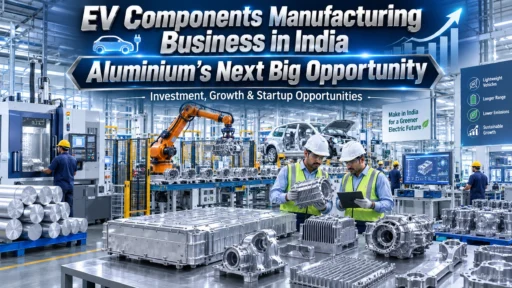


EV Components Manufacturing Business: Aluminium Opportunity
The vision of the electric vehicle has always been synonymous with batteries and charging stations in India. However, a more subtle change is taking place within the motor: copper is now giving way to aluminium for its windings in the stator and rotor. It’s a trend that MSMEs and project consultants—let alone first-generation entrepreneurs looking for a real white space opportunity in the EV component space—isn’t paying sufficient attention to.
It is a simple matter of economic and geopolitical considerations that make this happen. As the demand for EVs, renewables and grid infrastructure grow, copper — the metal that has long been crucial to electric motors — is facing a structural supply gap in India. Aluminium, on the other hand, has a domestic base that is not only good but truly surplus oriented. New manufacturing opportunity will tend to focus on that asymmetry.
Why Motor Manufacturers Are Reconsidering Copper
Copper has been the go-to material for winding due to its high conductivity, which enables automakers to use high-torque-density motors that are compact and capable of achieving long range in EVs as they battle for space and power. The aluminium is about 61% as conductive as copper, but has only about 1/3 the density, which means that a larger cross-section and more winding turns is needed to achieve the same electromagnetic performance. In the past this would make aluminium a bargain material and not the right choice for a high-performance traction motor.
That is because three concurrent forces are bringing a calculus change.
The first is the change in economics of raw materials. By weight, the cost of aluminium is 30-50% less than copper, and even with the larger wire gauge required to achieve the same performance, aluminium windings can still provide a significant net cost savings when manufacturing motors. This is no frivolous consideration for OEMs under constant pressure to reduce the cost of EV bill of materials.
Secondly, weight is a very critical factor in the design of EVs. Apart from upsizing to match the output, each kilogram saved on an aluminium winding assembly equates to twice the range or half the battery requirement in a vehicle class where each kg saved equates to twice the range or half the battery requirement.(EV Components Manufacturing Business: Aluminium Opportunity)
Get Detailed Insights from This Book: Handbook on Electric Vehicles Manufacturing
Third, and more importantly for India, copper is no longer a safe bet to be a part of the supply chain. Copper is a very concentrated industry, and some of the industry analyses recently have identified copper as a strategic-risk material in automotive supply chains. Motor technology companies building traction motors without the use of rare earth elements are now designing them as less a cost play than a strategy to manage the supply chain – lessening dependence on the few main geographies where rare earths are mined and the international market prices.
This is already being done by Indian motor technology companies. The Aluminium Association of India (AAI) has been speaking about the strategic benefits of using aluminium in the electrification of automobiles, while Indian technology developers have been working to develop aluminium-winding motor designs that better meet Indian needs, and are aggressively localizing their supplier base to ensure that the value chain remains geopolitically protected. This is an early but telling indicator: India’s EV component industry is at the pilot/early-commercialisation stage of the substitution trend.
The Copper Squeeze: India’s Widening Demand–Supply Gap
A look at the fundamentals of copper in India will help explain why aluminium substitution is not a laboratory curiosity anymore, but is actually becoming a reality.
| Parameter | Current Position |
| Domestic mining contribution to copper requirement | Roughly 3–5% of total national need |
| Import dependence on copper concentrate | Over 90%, projected to rise toward 97% by 2047 |
| FY25 domestic copper demand | Close to 1.87 million tonnes, up over 9% year-on-year |
| FY25 domestic copper production | Roughly 600,000 tonnes |
| Projected demand by FY30 (conventional sectors) | Around 3.24 million tonnes |
| Projected demand by 2047 | 8.9–9.8 million tonnes |
| Additional refining capacity needed | Approximately 500,000 tonnes every five years |
Though India boasts of copper reserves, it is still a net importer of copper mostly because of low exploration success, old mine infrastructure, ineffective mineral auctions and inadequate private sector investment in copper, says a landmark policy report by Centre for Social and Economic Progress (CSEP). Unfortunately, the shutdown of a big copper smelter in 2018 brought national cathode production down by about 40%, thereby further increasing the country’s dependence on refined copper imports.
India is currently importing less than 50% of its primary copper sources and is relying on recycled scrap, an unorganised and inefficient system, for copper requirements in semi-processed and finished goods production, the assessment published by the International Institute for Sustainable Development (IISD) reveals. Again, this is the sort of structural constraint which project consultants have been sounding over and over in techno-economic feasibility studies: a domestic industry growing up on the back of import dependency, without any prospect of a near-term solution in the form of expansion of mining production.(EV Components Manufacturing Business: Aluminium Opportunity)
Get Detailed Project Report (DPR): Aluminium and Aluminium Downstream Projects
In particular, the Ministry of Mines, Government of India, listed copper as one of the 30 critical minerals for India, marking its significance and vulnerability of its domestic supply, which has influenced investment decisions and import security planning in the industrial sector.
This has also been reflected in trade statistics. India’s copper import bill has now reached the ₹1 trillion mark, a level which has been described by experts at Policy Circle as a real strategic weakness as opposed to being routine imports as this is caused by the disproportionate control China has over the world’s copper processing capacity.
This is the most critical data point for any entrepreneur looking at component manufacturing in the EV motor business: The copper constraint is structural, not cyclical. It will not get better with a good monsoon or a brief drop in price. It’s in that kind of atmosphere that innovation with substitutes for materials takes root.
Import–Export Trends: Where the Trade Imbalance Really Sits
Trade statistics tell the same tale from another perspective. According to industry watchers, copper imports into the Indian market surged past the $11–12 billion threshold, with total import volumes anticipated to reach 1.25–1.3 million metric tons, bolstered by robust demand across sectors such as renewable energy, EV production, and infrastructure. Even the prices of imported refined copper have been on a steady increase — the import price for refined copper in India has increased by 15% YOY to more than $9,164 per tonne, whereas the export prices have been consistently lower since India is a net importer and is competing to buy refined copper from overseas.(EV Components Manufacturing Business: Aluminium Opportunity)
Additional exposures through sourcing patterns. Japan still dominates India’s refined copper imports, while Middle Eastern countries remain the leading suppliers of copper scrap. This pattern shows that India relies on a narrow set of external relationships rather than a diversified domestic base to ensure its copper security. However, the International Energy Agency (IEA) forecasts almost a twenty percent shortfall in global copper supply by 2030 under its Net Zero Emissions scenario, indicating that the import stress India is experiencing is not a one-off occurrence but is part of a worldwide structural tightening.
Related Article: Top Electric Vehicle Industry Consultants in India: A Complete Guide for Entrepreneurs and Investors
Compare this to aluminium, where India is a net exporter of primary metal to Asian, European and Middle Eastern markets, and where aluminium bauxite reserves are not only enough to offset the need for imports on the upstream side entirely, but the domestic industry relies on the same bauxite deposits. It is not the engineering argument that matters here, but the trade implication of this asymmetry — copper as a trade liability, aluminium as a trade asset — which is the core of the pure import dependency point of view of the substitution argument.
In terms of implications for MSMEs looking at a fresh manufacturing plant, this trade information means that any copper-based component business will have the same exposure to the volatility of import prices and currency of India. A similar enterprise around aluminium, however, does not, as the raw material travels a very short supply chain, largely in the domestic industrial cluster, from bauxite mine to alumina refinery to smelter.
This paper examines the contrast of the aluminium industry in the UK: facing surplus capacity yet enjoying good domestic strength.
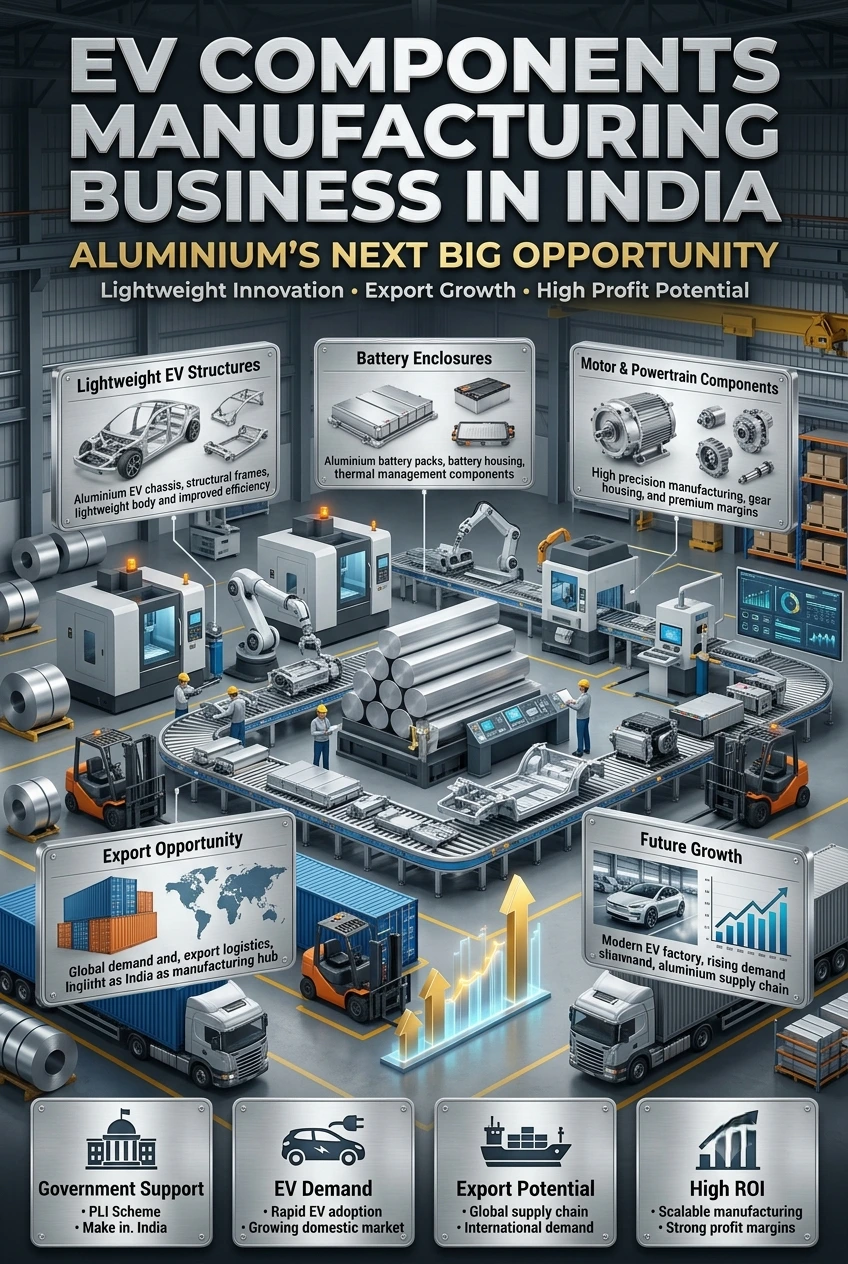
Aluminium’s Contrasting Position: Surplus Capacity, Domestic Strength
The four leading integrated producers in the country maintained steady production, keeping primary aluminium output at around 4.15 million tonnes, relatively unchanged from a year ago. Industry estimates suggest that the country’s total aluminium production capacity could increase to 6–6.5 million tonnes per annum once companies complete their planned capacity expansions. This increase will help India become a metal-secure economy, reducing its dependence on imports.
As per the industry analysis conducted by industry bodies and trade associations, India is the 2nd largest producer of aluminium in the world, contributing almost 6% of the world production, supported by 5th largest bauxite reserves in the world. According to the National Mineral Inventory released by the Ministry of Mines, India has one of the biggest bauxite resource base in Asia, with the production concentrated in Odisha, Jharkhand and Chhattisgarh. This is exactly the structural benefit of the backward integration of the bauxite mining, alumina refining, smelting process which copper does not have in the Indian context.
Importantly, India’s aluminium producers aren’t idle when it comes to downstream applications that are specific to EVs. Hindalco has already started to invest in lightweight aluminium products for automobiles and continues to invest in value added rolled and extruded products, such as EV battery enclosures. The Aluminium Association of India has also suggested an increase in import duty on primary and secondary aluminium products to promote the self-reliance of the industry, signaling a shift from short-term to long-term strategies.
Major Indian Players Anchoring the Aluminium and Motor-Tech Ecosystem
The three integrated producers form the backbone of any aluminium-winding or motor-component venture that ultimately connects to India’s primary aluminium chain:
- Hindalco Industries is a member of the Aditya Birla Group and has an integrated alumina to downstream business spread across Odisha, Uttar Pradesh, Maharashtra and Karnataka with a focus on value-added rolled products and automotive grade aluminium solutions such as EV battery foils.
- Vedanta Aluminium — The largest single capacity player in the country with integrated bauxite, alumina and smelting business in the state of Odisha and Chhattisgarh, and announced a $15.4 billion project to expand alumina refining and smelting capacity based in Odisha.
- National Aluminium Company (NALCO), a public sector integrated producer, expanding brownfield smelting capacity, with international technology providers in the planned 500,000 tonne project.
At the motor-technology end, the more interesting sign of the times for entrepreneurs is from new, tech-heavy entrants, not from the established giants. Domestic motor-technology developers are adopting aluminium-winding architectures (including rare-earth permanent magnet (PM) and copper-winding replacement designs) while localising almost the entire component supply chain to minimise geopolitical risk. Indian companies working on rare-earth-free motor platforms have also been getting funding for their early-stage projects, indicating that there is real and not speculative investor interest in this segment.(EV Components Manufacturing Business: Aluminium Opportunity)
Startup Opportunity: Where MSMEs and First-Generation Entrepreneurs Fit In
The opportunity does not involve entrepreneurs and MSMEs buying into Hindalco and Vedanta smelters — large integrated players dominate that game. The realistic entry points are further downstream where there are still obvious and documented gaps in the Indian EV component ecosystem.
- According to a sector commentary on India’s EV component supply chain, the manufacturing of aluminium winding wire and Litz-wire for traction motors is a narrow and specialised category, where there is not much work done in India in the field of high efficiency motors.
- Localisation pressure from India’s PLI and FAME policies is creating a push for Tier-1s to engage local suppliers for the manufacture of aluminium-wound motor sub-assemblies and stators for two and three-wheelers OEMs.
- Precision aluminium die casting and stamping of motor housings, battery enclosures and structured components — where India’s existing metal-fabrication base is proved and has the potential to respond with moderate capital investment.
- Aluminium scrap recycling and secondary-aluminium processing, feeding cost-efficient input material into downstream motor and EV component units, addressing both cost and sustainability priorities simultaneously.
The timing argument matters as much as the technical one. Sector analysts tracking India’s EV component landscape note that OEM supplier lists tend to lock in once vendors have demonstrated a few consecutive quarters of defect-free supply — after which entry becomes structurally harder. The window for new entrants to establish themselves as qualified vendors is realistically a matter of a few years, not indefinite.
Identify high-growth industries before others do
There is also a geographic dimension worth factoring into any project location decision. Supply-chain gap analyses of India’s EV component sector point to Tamil Nadu and Maharashtra as the states with the most concentrated EV OEM clusters, and correspondingly the highest unmet demand for locally manufactured motor and electronics components. A new manufacturing unit sited within reasonable logistics distance of these clusters — or of the aluminium production hubs of Odisha, Chhattisgarh, and Jharkhand for raw material access — carries a structural advantage over one located purely on the basis of incentive arbitrage.
It is also worth being candid about the limits of this opportunity. Aluminium winding is not a wholesale replacement for copper across every EV motor category — premium passenger vehicle traction motors, where volumetric performance and range are paramount, are likely to remain copper-dominant for years to come. The near-term opportunity centers on two- and three-wheeler EVs, auxiliary and accessory motors, and emerging rare-earth-free motor platforms, where cost and weight trade-offs favor aluminium more decisively. A sound feasibility study should size the addressable segment accurately rather than assuming universal substitution.
Government support materially de-risks this entry point. The PLI Scheme for Automobile and Auto Components — with an outlay of ₹25,938 crore administered through the Ministry of Heavy Industries — is aimed squarely at localising EV manufacturing and reducing import dependence in advanced automotive technologies. Additional support routes — including collateral-free MSME credit guarantees under the CGTMSE scheme, capital subsidies for new units under PMEGP, and income-tax holidays for DPIIT-recognised startups — further improve project viability for first-generation entrepreneurs entering this space. Entrepreneurs can review current EV scheme details directly through Invest India, the national investment promotion agency’s portal, which tracks policy updates, investment trends, and component localisation priorities in real time.(EV Components Manufacturing Business: Aluminium Opportunity)
Market Insight
India’s copper demand is compounding at a structural pace even as domestic mining supplies barely 3–5% of national requirement, forcing ever-deeper import reliance for a metal central to EV motor manufacturing. Aluminium, meanwhile, sits on nearly 4.2 million tonnes of stable domestic production with capacity expansion underway toward 6–6.5 million tonnes — a rare instance in India’s critical-minerals landscape where the substitute material is domestically abundant rather than import-dependent.(EV Components Manufacturing Business: Aluminium Opportunity)
Demand–Supply Gap
Copper concentrate import dependence exceeding 90% — projected to approach 97% by 2047 — stands in sharp contrast to aluminium’s backward-integrated, largely self-sufficient domestic supply chain, creating a durable substitution incentive for EV motor manufacturers.
Major Indian Players
Hindalco Industries, Vedanta Aluminium, and National Aluminium Company (NALCO) anchor primary aluminium supply, while emerging motor-technology developers are pioneering aluminium-wound, rare-earth-free EV motor designs specifically engineered around India’s supply-chain realities.
Startup Opportunity Justification
Entrepreneurs who enter aluminium winding wire manufacturing, motor sub-assembly, or precision die-casting for EV motor components can capitalize on the convergence of a widening copper shortage, an abundant aluminium base, and strong government localisation incentives—a combination that rarely remains this favourable in an established industrial sector.
About Niir Project Consultancy Services (NPCS)
Niir Project Consultancy Services (NPCS) — www.niir.org — provides professional consulting services for preparing Market Survey cum Detailed Techno-Economic Feasibility Reports (DPRs) for entrepreneurs, MSMEs, and industrial investors. Our reports typically cover detailed manufacturing processes, market research and demand analysis, Process Flow Diagrams (PFD/BFD), product mix and capacity planning, machinery and raw material specifications, import–export dependency analysis, and full project financials and profitability evaluation.(EV Components Manufacturing Business: Aluminium Opportunity)
Our objective is to help entrepreneurs evaluate the technical feasibility, financial viability, market demand, and scalability potential of new industrial and manufacturing projects before committing capital.
Frequently Asked Questions
Q1. Why is aluminium being considered as a replacement for copper in EV motor windings?
Aluminium costs significantly less than copper by weight, weighs roughly half as much for equivalent output, and — critically for India — draws on a domestically abundant, backward-integrated supply chain, unlike copper, which India imports in overwhelming proportion.
Q2. Can aluminium fully replace copper in high-performance EV traction motors?
Not universally. Copper retains a clear performance edge in compact, high-torque-density applications. Currently, aluminium substitution plays the most significant role in the low-cost segments of 2- and 3-wheeler EV motors. Manufacturers are also developing new rare-earth-free motor architectures around aluminium motor windings.
Q3. What is driving India’s copper supply constraint?
Lack of domestic mining (about 3-5% of country requirements); aging reserves; closure of old smelters; high dependence on the import of concentrate. Dependency is predicted to be even greater in coming years.
Q4. Which companies are leading India’s aluminium production base?
Three large integrated producers—Hindalco Industries, Vedanta Aluminium, and National Aluminium Company (NALCO)—lead the market, supported by a robust secondary aluminum and downstream extrusion sector.
Q5. What is the realistic entry point for a new manufacturing unit in this space?
Lower End Applications Downstream applications – Aluminium Winding Wire, Motor Sub-Assembly, Precision Die Casting (for motor housings, battery enclosures), Aluminium scrap recycling are the most approachable ones for MSME and 1st generation entrepreneurs with support from PLI, FAME, MSME-based govt schemes.
Q6. How can entrepreneurs assess feasibility before investing?
Before committing capital to a new manufacturing unit in this sector, entrepreneurs should prepare a detailed Techno-Economic Feasibility Report (DPR) covering market demand analysis, machinery and raw material planning, and project financials.
References
- Centre for Social and Economic Progress (CSEP) — The India Copper Report
- International Institute for Sustainable Development (IISD) — Securing India’s Copper Supply
- Ministry of Mines, Government of India — Critical Minerals List
- International Energy Agency (IEA) — Global Critical Minerals Outlook
- Ministry of Heavy Industries, Government of India — FAME India Scheme
- Invest India — India’s EV Manufacturing Ecosystem
- Credit Guarantee Fund Trust for Micro and Small Enterprises (CGTMSE)
- Policy Circle — Copper Import Surge and India’s Mineral Policy