

Hing manufacturing business in India
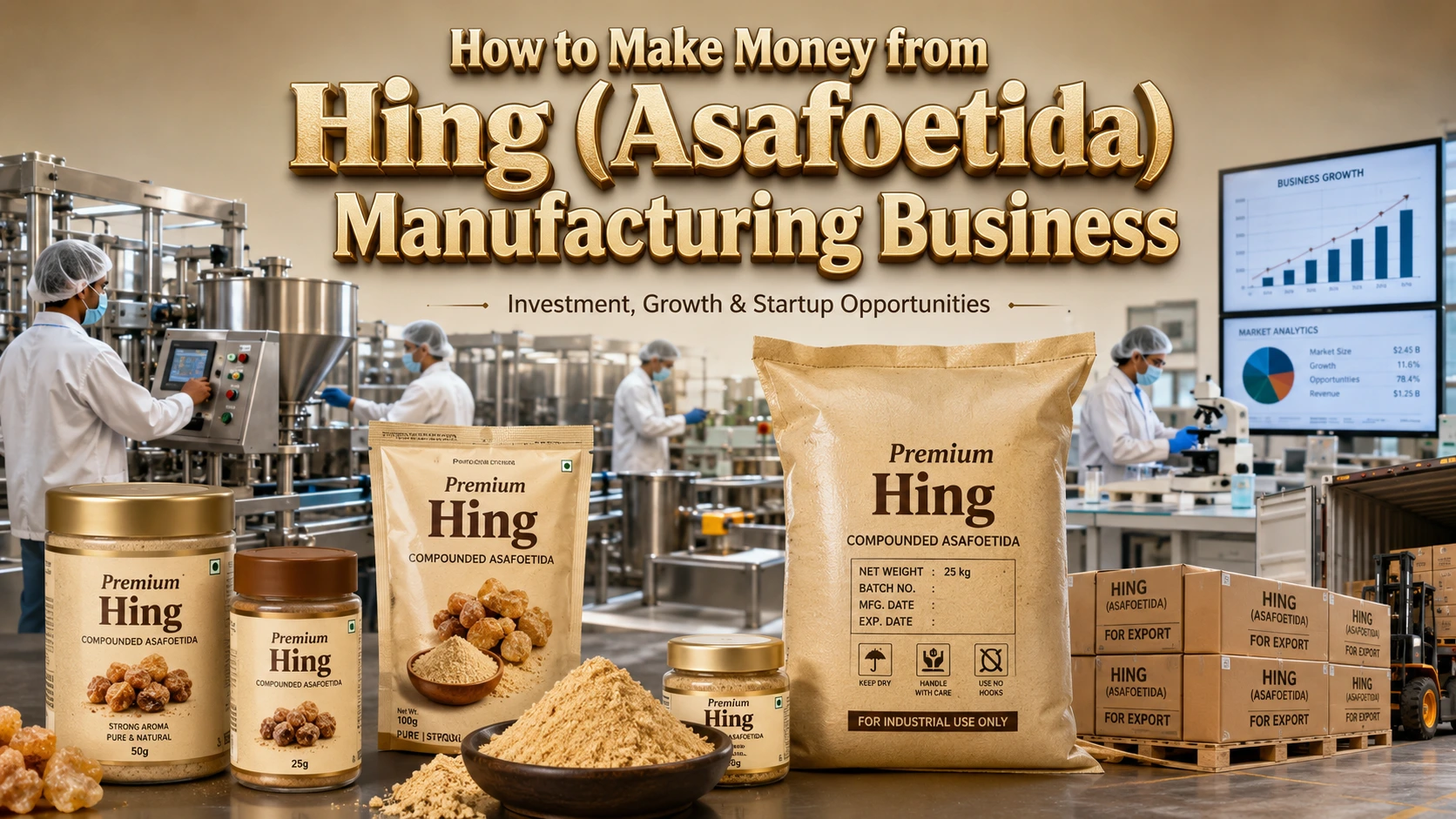
There are not many spices in the Indian kitchen that have the cultural significance as hing does. A flavourful and spicy resin product, asafoetida is indispensable in Indian cuisine, especially in tadkas or traditional remedies. However, the business opportunities which revolve round hing manufacturing have not been so explored by the mainstream entrepreneurs. India is a huge consumer of hing and yet, 90% of the raw gum resin is imported from Afghanistan and Iran. It’s in that space from raw material to finished product where the commercial opportunity is going to be. Hing manufacturing provides a high-margin entry point to any foundational thinking about food processing, spice blending or nutraceuticals.
Why the Hing Industry Deserves Your Attention
Indian spices market is among the biggest markets in the world. Hing is especially in high demand for premium retail and institutional prices. India, which is the most dependent country, imports raw ferula gum—the main component of asafoetida—from Central Asia and Middle East. The value addition happens, however, at home, a blend of raw gum with starch, edible gum and flour are used to create compounded hing in different grades. This domestic processing gives an additional 3X to 5X value to the raw material. In addition, hing has developed the market in pharmaceuticals (antiflatulent and digestive aid) and food exporters. Indian processed hing is exported to North America, UAE, UK and Southeast Asia countries with good demand.
The Spices Board of India reports that hing continues to be one of the most expensive spices according to the unit value in the domestic market. Branded processed hing costs ₹300 to ₹2000 per 100gpa and it can earn a decent income even for small producers as per its purity.
Get Detailed Project Report (DPR): Asafoetida (Hing)
Government Policies and Incentives That Support Hing Manufacturers
Government of India has established a robust policy framework for food processing and spice sector. The Government of India, Ministry of Food Processing Industries (MoFPI) provides a capital subsidy and credit linked back-end support through Pradhan Mantri Kisan Sampada Yojana (PMKSY). Based on this scheme, up to 35% subsidy (35% for general areas and 50% for hilly or Scheduled Areas) is provided on the project cost.
The small-scale hing processors are being assisted by Ministry of MSME under the Credit Guarantee Fund Trust for Micro and Small Enterprises (CGTMSE) which offers collateral free loan of up to ₹2 crore. Besides, the Ministry of Food Processing Industries (MoFPI) runs the Food Processing Industry PLI Scheme, which supports ready-to-eat and food ingredient manufacturers. Compounders can also leverage this scheme by adopting an appropriate product structure.(Hing manufacturing business in India)
It is also important to note that in the case of Startups, organisations registered as a startup under the Startup India initiative of the DPIIT can avail of tax holiday, simplified compliance process and expedited support for IP. Make in India is particularly looking to encourage the processing of imported raw material in India, which is what hing compounding does.
Business Ideas for Entrepreneurs: Multiple Entry Points in Hing Manufacturing
1. Compounded Hing Blending and Packaging Unit
This is the easiest and most profitable approach to the hing manufacturing industry. Manufacturers import raw Ferula gum resin and then mix it with starch (usually wheat flour, rice flour, or edible gum arabic) to form the familiar compound hing. The final product is graded according to purity—the purest is hing and the compounded is cheaper, available to the mass market. We can establish a small-scale blending unit using basic milling, mixing, and packing equipment. A significant margin exists for branded and premium grade hinges. A modern, well-positioned brand, with a distribution strategy that includes e-commerce, modern trade and the institutional route (HoReCa) can establish a good business by investing in capital of around ₹15 lakh to ₹40 lakh for a starter unit. The main factors that set this apart are purity certification and FSSAI compliances along with packaging innovation for domestic consumers and export to the diaspora market.
2. Organic and Premium Hing Manufacturing
There has been a tremendous growth in consumer demand for clean label, organic and additive-free food products. Among the spices, organic hing without starch fillers and artificial flow agents is a rapidly emerging niche. The entrepreneurs who get certified organic ferula gum resin and manufacture pure asafoetida in the name of a premium brand can get the prices in the range of 3x-4x higher than the regular compound hing. The model works best for founders that have a brand-building mentality and are aware of digital commerce.
There are a number of organic food startups in India that have managed to turn a profit in the premium grocery segment both domestically and internationally, with Amazon Global or specialty shops in the UK and USA. Margins are higher than the investment required for an organic hing unit, as premiums and certification costs are somewhat greater with a premium product. Moreover, export opportunities are provided through the Organic Products Programme of APEDA with Organic certification from APEDA or other organic certification bodies.(Hing manufacturing business in India)
Discover business ideas that actually make money

3. Hing-Based Nutraceutical and Herbal Extract Manufacturing
The therapeutic effects of asafoetida are well established. It is commonly used in Ayurvedic and Unani medicines for digestive disorders, respiratory ailments and is an antispasmodic. Pharmaceutical or nutraceutical entrepreneurs are able to produce a range of herbal extracts, standardised powder capsules and proprietary blends of herbs for traditional medicine companies. It is a vertical that needs to comply with the Drugs and Cosmetics Act and the AYUSH licensing. However, the margins are much higher than food-grade hing, and the customer base is stable and ‘sticky’, consisting of pharmaceutical companies, Ayurvedic manufacturers, and direct-to-consumer wellness brands. Entrepreneurs in Tier 2 and Tier 3 cities have created extraction companies, providing them regular supply of standardised asafoetida extract to existing AYUSH licensed manufacturing companies. The Ministry of AYUSH is actively promoting such units under its National AYUSH Mission.
4. Hing Flavour Oil and Food Ingredient Supply for Processed Food Industry
The food packing industry (namkeen mixes, instant noodles, ready to cook gravies, papad masala etc.) are reliant on stable inputs which must be food safe and have hing flavour. The entrepreneurs need not sell end-consumer products since they can manufacture hing oleoresin or flavour concentrates for distribution to the food companies. This B2B model provides long term purchase contract, volume predictability, and reduced marketing expenses. Technical barrier consists of moderate, requiring basic extraction and distillation equipment, and the acquisition of customers is cleaner than consumer retail. As soon as a supplier is qualified for a FMCG company’s supplier list, the retention of the food flavour ingredient companies is quite high. It works for entrepreneurs who are “manufacturing first” and have experience in industrial supply chains.
5. Export-Oriented Hing Packaging and Branding for Indian Diaspora Markets
There are around 32 million Indians abroad. In this diaspora, hing is a staple food, and a product that is hard to find in many countries of the world. Entrepreneurs, who develop export-ready hing brands having multi-language labelling, tamper-proof packaging and FSSAI plus import-country regulatory compliance, can construct a profitable export business by producing comparatively smaller quantities. A number of popular ethnic food startups in India began with a niche product offering for the overseas population and later expanded to the mainstream market. The margin for exported hing to UK, USA, Canada and UAE is usually between 40%–60% above the domestic sale prices, because freight absorption and positioning for retail are higher. To avail export incentives under RoDTEP scheme, the founders should register with DGFT (Directorate General of Foreign Trade).
Get Detailed Insights from This Book: The Complete Book on Spices & Condiments (with Cultivation, Processing & Uses) 2nd Revised Edition
Import–Export Opportunity Analysis
The situation of India in the hing trade is unique: India is a major consumer of asafoetida but its production is negligible in the country. Ferula gum is a plant-based gum which is imported from all parts of world mainly from Afghanistan and Iran. This imparts structural dependence on import that the Government is keen to resolve by promoting cultivation of Ferula in the area of Himachal Pradesh and Jammu under the Council of Scientific and Industrial Research (CSIR) programme etc. This presents two challenges to entrepreneurs:
- Import sourcing and processing: Companies with good sourcing relationships with Central Asian gum suppliers and that add value with their own processing may profit from the fact that the access to raw materials may become a competitive moat.
- Export of finished goods: From all over the world, Indian compounded hing is a product that is recognised. Other countries including more than 50 countries export processed and branded Indian hing. India’s export of spice-based products is steadily increasing and processed hing is a part of it.
Entrepreneurs can have a vertically integrated business with greater resilience if they integrate both cost-efficient import sourcing and value-added export packaging into their business. Furthermore, if the cultivation effort—already underway in the country—succeeds, domestic ferula production could turn India into an exporter of raw materials. This would also add another dimension to long-term business planning. (Hing manufacturing business in India)
Indian MSME Success Stories in the Hing Business
LG Hing – L.G. Industries, Bhopal
One of the most known brand names in Indian hing market is LG Industries. The company, based in Bhopal, created a brand with consistent product quality, availability in the Central Indian market and early introduction of the branded packaging in the market, whereas all other companies were selling loose hinges. Their promoters were aware early on that the end user was willing to pay a premium for purity assurance. Nowadays, LG Hing can be found in both grocery stores and Kirana stores. The lesson to new entrepreneurs: it is not just about a price war—it is about purity and packaging consistency that helps build the trust in the brand.
Vandevi Hing – Vadilal Group (Heritage Brand)
Vadilal Group is a leading ice cream brand, but it started with spice and food ingredients production. Vandevi Hing of the Vadilal family gained fame in Gujarat. The keys to success were an overwhelming domination of hyperlocal distribution, quality control in-house, and regional brand loyalty. The story highlights the importance of regional MSME players to create sustainable businesses in commoditised spice categories by controlling their supply chain and distribution. For a new entrepreneur, the lesson is simple: take advantage of the region’s dominance, and don’t rush the national conquest in the hing business.
Catch Spices (DS Foods) – Quality-Driven National Scaling
From a regional spice blender, DS Foods’ Catch has grown to become a spice company with nationwide distribution. The quality certifications, updated packaging, and strategic growth in retailing highlight how the Indian spice industry celebrates consistency and professionalism. Catch’s model is the blueprint for the hing manufacturers: begin with a quality story that is defensible, obtain institutional customers in the early stages, and gain retail distribution gradually.
Related Article: Indian Spice Industry Growth 2026–2030: Market Size, Export Data & Business Opportunities
How NPCS Can Help You Set Up a Hing Manufacturing Business
Niir Project Consultancy Services specializes in preparing market surveys and detailed techno-economic feasibility reports (DPRs) for entrepreneurs in the food processing and spice manufacturing sectors who want to start new businesses in the food processing industry. Our hing manufacturing feasibility reports include end to end project planning: Manufacturing processes and PFT, raw material sourcing, machinery specification and costing, product mix and capacity planning, regulatory compliance roadmap, Market research and demand analysis, complete financials projection – revenue, profitability and break-even. We’re just looking to get founders to make educated investment decisions before spending money. From analysing a blending unit worth of ₹15 lakh to a integrated hing processing unit of ₹1 crore, our DPRs offer the analytical strength that your project deserves.(Hing manufacturing business in India)
Hing Manufacturing Business: Key Parameters at a Glance
| Parameter | Small Unit | Medium Unit |
| Estimated Project Cost | ₹15–25 Lakh | ₹50–100 Lakh |
| Installed Capacity | 200–500 kg/day | 1,000–3,000 kg/day |
| Key Raw Material | Ferula Gum Resin (Imported) | Ferula Gum Resin (Imported) |
| Avg. Retail Price Range (Branded) | ₹300–₹800 / 100g | ₹200–₹600 / 100g |
| Margin Range (Net) | 30%–45% | 25%–40% |
| Primary Certifications Required | FSSAI, BIS | FSSAI, BIS, ISO 22000 |
| Key Sales Channels | Retail, E-commerce | Retail, HoReCa, Export |
| Break-Even Period (Approx.) | 18–24 Months | 24–36 Months |
Frequently Asked Questions (FAQs)
1. What is the minimum investment for starting a hing manufacturing business in India?
The unit of small scale compounded hing blending and packaging can be setup with around 15 lakh- 25 lakh and with the include of small milling & mixing machinery and packaging machines, FSSAI Registration and first stock of raw material. Large units with imported level processing could cost between 50lakh- 1crore or more.
2. Where can I procure the raw ferula gum resin for hing manufacturing?
Afghanistan and Iran are the major sources of the raw ferula gum resin, the material used to manufacture hing. In India, it is handled by existing importers and commodity merchants, concentrated mainly in Gujarat, Rajasthan, and Maharashtra, with raw ferula gum being imported in large quantities. Entrepreneurs may approach the Spices Board of India to obtain the name of accredited importers.
3. Which are the necessary licenses and registrations for a hing manufacturing business in India?
All minimum requirements: FSSAI Registration or License, GST registration and Shop & Establishment license. If focused on export:Import Export code (IEC) from DGFT, APEDA registration for organic certified hing and making sure the products are conforming to importing countries regulation.
4. Is there any Government subsidy available for starting hing manufacturing units?
Yes. Financial assistance is provided in the form of capital subsidy ranging from 35 to 50 per cent of the project cost to food processing units including spice manufacturing units, under the PMKSY by MoFPI. Collateral free loan is also provided up to Rs 2 crore to MSME-registered units under the CGTMSE.
5. What are the highest profitable product formats in hing business?
The highest profit margins come from the point of sale in retailing superior organic hing (pure asafoetida). AYUSH sectors that use hing-derived nutraceuticals and extracts could also generate profitable margins. High-volume turnover could also come from supplying hing flavour concentrate in bulk to food manufacturing industries, which would create a stable and repeatable business with low marketing costs.
6. Can I export hing from India? What are the opportunities?
Absolutely. There are over 50 countries that purchase processed and branded Indian hing from India with substantial market opportunity, particularly in the US, Canada, UAE, Australia and the UK, with the Indian Diaspora. Exporters must have IEC registration, FSSAI export compliance labelling and the destination country’s import regulations compliance; export units also benefit from duty drawback benefits through the RoDTEP scheme.
Conclusion: A Market That Rewards Early Movers
The Hing business stands at an interesting intersection-a business driven by a demand-side story, reliant on imports, on a premiumisation path, backed by governmental intervention. In such a sector, a business owner cannot look at a simple commodity game. This is a brand, quality, supply-chain game, where early entrants with strong product, convincing certification and a distribution approach can establish an unassailable position. The door is still open for a brand to take leadership in this category, while it is not yet saturated with serious players. A business owner who proceeds with an adequate plan for a feasibility study may indeed reap the rewards.