
Amul Bengal Dairy Project
The dairy industry in India has just been given its biggest infrastructure boost in decades. Union Home Minister Amit Shah on July 20, 2026, laid the foundation stone of the world’s largest curd manufacturing plant under the
Amul Bengal Dairy Project at Sankrail, Howrah Food Park. As DD News
If its production capacity is brought into full swing, the facility, which has been reported to be worth ₹700-crore, will process up to 30 lakh litres of milk daily and will directly benefit 1.2 lakh West Bengal dairy farmers.
This is much more than a government infrastructure project for entrepreneurs, MSME founders and investors. It indicates a paradigm shift in eastern dairy belt production, processing and distribution of milk and milk products. The impact of the ripple effect is large and immediate in the cold-chain logistics sector and in the supply of dairy ingredients, packaging, equipment manufacturing and branded dairy retail sector.
This article explains what all this means for your upcoming business decision.
Related Article: Amul Success Story and Dairy Business Opportunities in India: A Practical Guide for Entrepreneurs
What the DD News Report Actually Means for Business
This is no ordinary state dairy project, the original DD News report said. It is the biggest investment in dairy sector in eastern India and is done by Amul, the largest dairy cooperative of India and is connected to PM Modi’s vision of White Revolution 2.0.
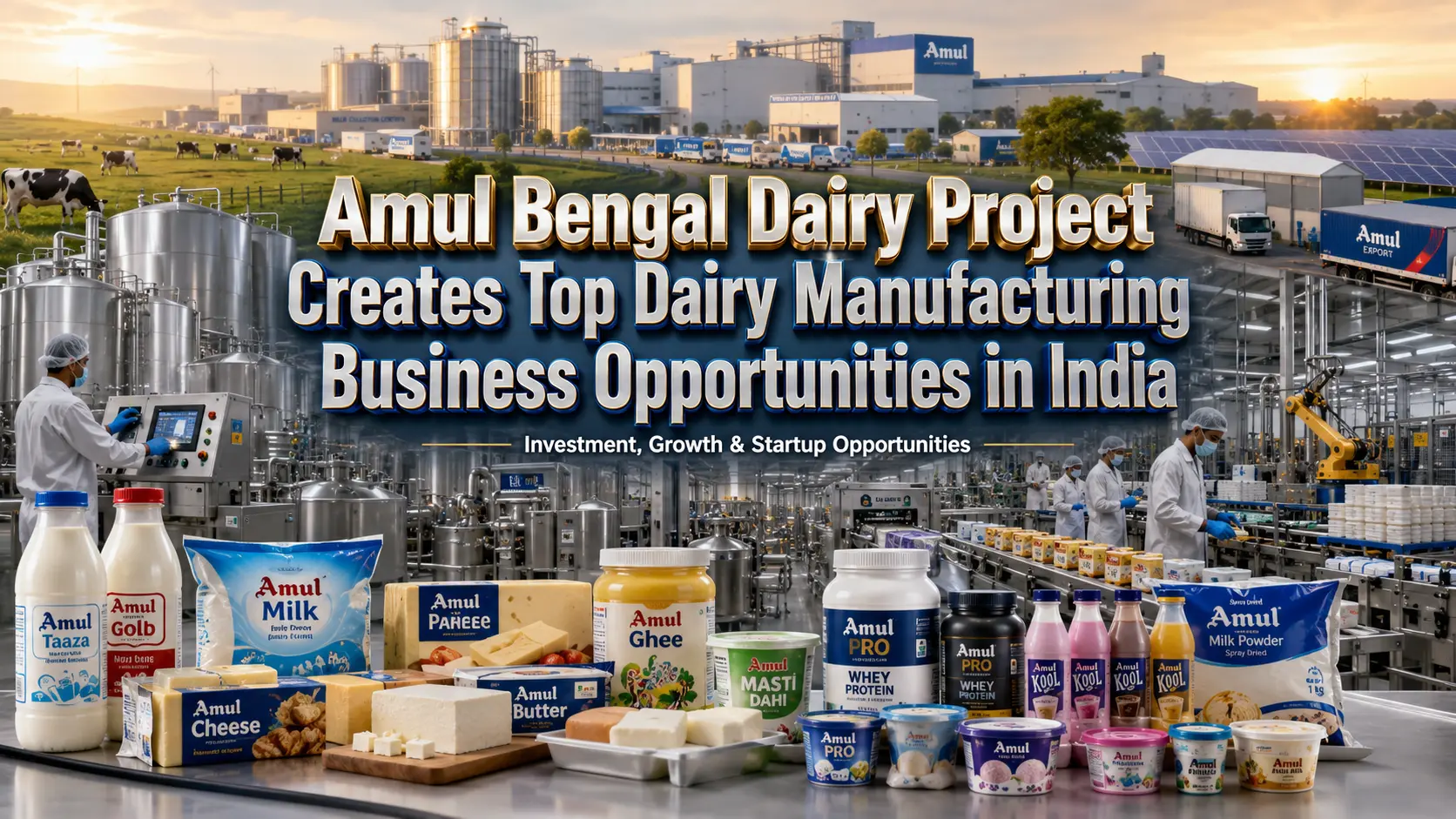
The phase one will milk 10 lakh litres of milk. Full capacity will process 30 lakh litres of milk every day, including nearly 10 lakh kg of curd, 10 lakh litres of packaged milk, 2 lakh litres of UHT milk, 20 metric tonnes of paneer, 10 metric tonnes of ghee, 10 metric tonnes of sweets and 2.5 lakh packs of flavored milk.
That volume generates a huge upstream and downstream business ecosystem. The entrepreneurs don’t have to face competition from Amul. They must provide it, maintain it and harvest the ancillary markets it generates.
Why India’s Dairy Industry Is Growing Rapidly
While India is already the biggest producer of milk in the world with over 230 million tonnes produced every year, it may surprise you that at almost 9 lakh litres Amul draws supplies from nearly 1.25 lakh farmers each day only from West Bengal alone – 30,000 of these are women farmers.
The Amul Bengal Dairy Project, which the DD News extensively reported, directly addresses two structural bottlenecks, the lack of a large-scale organised processing capacity in eastern India and lack of a national market for Bengal’s iconic mishti doi and other cultured dairy products.
The establishment of this plant will make West Bengal a raw milk supplier to a value-added dairy processing centre. That transition opens up a whole new dimension of business activity.
Key Market Drivers
Increased packaged dairy product consumption in cities. Increasing the cold chain in Tier 2 and Tier 3 cities. Promotion of dairy cooperatives and farmer linkages supply chains by the government. Farmers benefit from White Revolution 2.0 and PM Sahkar Se Samriddhi scheme. Milk production boosters come to the fore with the launch of the ‘Sex-Sorted Semen programme’.
Government Policies and Incentives
There are several existing Govt of India and Govt of Rajasthan schemes available for benefit of MSMEs engaged in dairy/farm value addition, in the present context.
PM Formalisation of Micro Food Processing Enterprises (PM FME): Credit linked subsidy for individual food processing enterprises of ₹10 lakh.
Animal Husbandry Infrastructure Development Fund (AHIDF): a fund of ₹15,000 crore for investments in the dairy processing and value addition.
MSME Credit Guarantee Scheme: Collateral-free credit up to ₹2 crore for eligible MSMEs through SIDBI.
Startup India: All tax exemption, simplified compliance and access to funding for start-ups in agri-food sector. Sign up with Startup India.
Marketing Support, Technology upgradation, Cluster Development, etc. available under Ministry of MSME.
The Home Minister stated that the state has already proved to be investment washer, by giving Amul 30 acres of land free of cost, which has resulted in almost 100 big investment proposals for the state.
Get Detailed Insights from This Book: The Complete Technology Book on Cocoa, Chocolate, Ice cream and other Milk Products
Six Manufacturing and Business Opportunities This Project Creates
1. Dairy Packaging and Container Manufacturing
Products: Specialised curd containers, pouches, PET bottles and modified atmosphere packaging.
Market Demand: 10 lakh kg per day curd need millions of containers per day for food grade.
Investment: From ₹40 lakh to ₹3 crore on the basis of the scale and material.
Target Customers: Amul and other Dairy Processor Companies in Howrah Food Park.
Profit Potential: 8–14% profit potential in packaging at high volume.
Why now: Amul Bengal Dairy Project will generate immediate and long-term demand of packaging in Eastern India.
2. Cold Chain Logistics and Refrigerated Transport
Application: Reefer vehicle operations, cold storage warehouses and last mile dairy distribution.
Market Demand: Milk, curd, paneer, and ghee all require temperature-controlled supply chains. Processing 30 lakh litres daily generates enormous cold-chain demand.
Investment Size: ₹25,00,000 to ₹5 crore.
Key Customers: Amul distribution system, retail outlets and quick commerce.
Profit Potential: Organised Cold chain operation creates a profit margin of 12-18% net.
Why Now: DD news pointed out that the project targets to increase the cold-chain infrastructure across West Bengal, forming a logistics demand chain.
3. Dairy Equipment Maintenance and Engineering Services
Service: Dairy processing equipment on site service, parts replacement, and preventive maintenance contracts.
Market Demand: A ₹700-crore plant producing 30 lakh-litre per day requires constant mechanical and engineering assistance.
Investment Range: ₹10 lakh to ₹80 lakh.
Target Customers: Amul Bengal plant & food park co-tenants.
Profit Potential: The margins for annual service contracts are generally 15-22%.
Why Now: 100 major investment commitments expected in food park, all of which are related to engineering.

4. Mishti Doi and Artisanal Cultured Dairy Products (Branded)
Product: High quality branded mishti doi, yogurt, shrikhand and probiotic curd variants.
Market Demand: Amit Shah named the project will take Bengal’s mishti doi to the national market. Artisanal premiums of 3-5 times the standard price can be expected for premium variants.
Investment: ₹15 lakh to ₹1.5 crore.
Industry: Urban consumer, Ecommerce, Premium grocery chains.
Profitability: Gross margins of 20-35% for dairy that is branded and in the premium range.
Why now: At the highest level of the government, visibility is being created for the national brand of Bengal dairy products.
5. Animal Feed and Livestock Nutrition Products
Product: Scientific cattle feed, mineral supplements, and TMR (total mixed ration) for dairy cows.
Market Demand: 1.2 lakh dairy farmers linked to the project need superior nutrition inputs to meet Amul’s milk procurement quality and quantity requirements.
Investment Range: ₹30 lakh to ₹2 crore.
Target Customers: Dairy cooperative members across West Bengal.
Profit Potential: 10–16% net margins, with stable recurring demand.
Why Now: The government-announced Sex-Sorted Semen and breed improvement programme will expand the productive cattle base — driving sustained feed demand.
6. Dairy Testing, Quality Control, and Laboratory Services
Product: Accredited milk and dairy product testing labs (fat, SNF, adulteration, microbial count, protein).
Market Demand: Large-scale processing mandates rigorous quality checks at sourcing, processing, and dispatch stages.
Investment Range: ₹20 lakh to ₹1.2 crore.
Target Customers: Amul, other dairy processors, food park tenants.
Profit Potential: 18–25% EBITDA margins for certified labs with consistent client contracts.
Why Now: FSSAI compliance requirements and Amul’s quality standards create mandatory recurring demand for testing.
Import–Export Opportunity Analysis
The Amul Bengal Dairy Project, as highlighted by DD News, positions West Bengal as a national dairy-processing powerhouse. This has clear international trade implications.
Get Detailed Project Report (DPR): Complete Guide to Milk & Dairy Products Manufacturing
Export Opportunities
Ghee: India is already the world’s largest ghee exporter. West Bengal processing capacity can supply premium ghee to the GCC, Southeast Asia, and UK diaspora markets. APEDA supports dairy export development — visit APEDA.
UHT Milk and Long-Life Dairy: Two lakh litres of UHT milk daily from the new plant creates direct export potential. Southeast Asian and Middle Eastern markets are large importers.
Mishti Doi and Ethnic Dairy Products: The global Indian diaspora across the US, UK, Canada, and Australia creates premium demand for authentic Bengali dairy products.
Import Substitution
India currently imports significant dairy processing equipment and cultures (starter culture sachets for curd and yogurt production). Entrepreneurs can establish local manufacturing of these inputs — replacing imported alternatives and directly supplying the Bengal dairy cluster.
Indian MSME and Startup Success Stories in Dairy
Parag Milk Foods, Pune
From being a regional supply arm of a cooperative based dairy producer, Parag Milk Foods grew into a ₹3000 crore+ listed business by setting up branded value-added products such as ghee, cheese, and whey protein. Their journey demonstrates exactly how proximity to organised dairy processing creates MSME growth pathways.
Sid’s Farm, Hyderabad
A tech-enabled dairy startup that built its business on quality assurance, farm-to-home delivery, and premium positioning. Sid’s Farm showed that branded differentiation — not commodity milk selling — is where real dairy margins exist.
Srikhand and Bengali Sweets Cooperatives, West Bengal
Several artisanal dairy cooperatives in West Bengal have already begun supplying Amul’s procurement network. The new plant will allow these producers to scale from local supply to national distribution — a ready-made MSME growth engine.
Choose the right startup backed by real market demand
About NPCS – Niir Project Consultancy Services
For such an examination of a company in any form of the industry like dairy processing, cold chain, dairy packing or cultured dairy foods, NPCS (Niir Project Consultancy Services) offers:
Detailed Projects Report (DPR), Plant Layout and Machinery Schedule, Project Financials and economics. Market surveys, Need assessment of dairy and food processing units. Bankable / feasibility study for projects in investment in dairy machinery, packaging and cold chain enterprises. Technology consultancy for projects in Curd and paneer plant, Ghee making project and UHT milk production project. MSME registration support and government scheme identification.
NPCS reports are trusted by thousands of entrepreneurs, banks, and financial institutions across India as the starting point for serious dairy business investment.
Industry Data Snapshot
| Parameter | Details |
| Industry | Dairy Processing & Value-Added Products |
| Market Driver | Amul Bengal Dairy Project – ₹700 Crore Investment, 30 Lakh Litres/Day Capacity |
| Investment Range | ₹10 Lakh (Testing Lab) to ₹5 Crore (Cold Chain / Packaging) |
| MSME Opportunity | Packaging, Cold Chain, Equipment Services, Artisanal Dairy, Animal Feed, QC Labs |
| Export Potential | Ghee, UHT Milk, Mishti Doi – GCC, UK, Southeast Asia, North America |
| Government Support | PM FME, AHIDF, MSME Schemes, Startup India, Animal Husbandry Fund |
| Risk Level | Low-to-Medium (Cooperative-backed demand, government-supported supply chain) |
| Growth Outlook | Strong — White Revolution 2.0, 100+ investments expected at Howrah Food Park |
Frequently Asked Questions
1. Do I need to be a dairy farmer to benefit from the Amul Bengal Dairy Project?
No. The largest opportunities are for entrepreneurs supplying services and products to the dairy ecosystem — packaging manufacturers, cold-chain operators, equipment service providers, and branded dairy food businesses.
2. What is the minimum investment to start a dairy-adjacent MSME?
Dairy testing labs and small-batch artisanal dairy product units can be started with ₹15–25 lakh. Cold-chain logistics require ₹25 lakh and above. Packaging manufacturing typically needs ₹40 lakh minimum.
3. How can I supply to Amul’s Bengal operations?
Amul has a registered vendor development process. Entrepreneurs can approach the Amul Federation’s procurement team. The Howrah Food Park also has a dedicated investor facilitation cell managed by the West Bengal government.
4. Are there government subsidies available for dairy processing MSMEs?
Yes. The PM FME Scheme provides up to ₹10 lakh in credit-linked subsidies. The AHIDF supports larger dairy infrastructure investments. SIDBI provides collateral-free loans up to ₹2 crore under the Credit Guarantee scheme.
5. What is the export market potential for West Bengal dairy products?
Ghee, UHT milk, and speciality products including mishti doi enjoy ready demand within the Indian diaspora in the GCC, UK, Southeast Asia and the North America. APEDA offers an export promotion and market linkages to dairy exporters.
6. Where can I get a detailed project report for a dairy packaging or cold-chain business?
Niir Project Consultancy Services (NPCS) provides detailed project reports including financial modelling, equipment information and govt. Scheme eligibility, for Dairy food Processing Projects.
Conclusion: Act Before the Ecosystem Matures
According to DD News, AMUL Bengal Dairy Project is the highest ever individual dairy infra investment by any one for dairy infra investment in eastern India to process 30 lakh litres of milk per day, manufactured about 10 lakh kg of curd every day besides making available to 1.2 lakh milk producers with organised market.
For entrepreneurs, this creates a rare first-mover window. The Howrah Food Park ecosystem is forming now. Vendor contracts will be established now. Cold-chain infrastructure gaps will be filled now. Artisanal dairy brands positioning for national distribution need to launch now.
The businesses that establish themselves in the next 12–24 months — as suppliers, service providers, and branded dairy entrepreneurs — will ride the cooperative ecosystem that Amul and the Indian government are building. Those who wait will find a more competitive, more expensive entry point.
India’s White Revolution 2.0 is no rhetoric, but a project worth 700-crores where the first stone has already been placed. Here’s your chance to be a part of India’s success story. Starts today!