Introduction: Green chemical manufacturing India
The Indian chemical manufacturing industry is in a process of structural transformation. What used to be fuelled mainly by scale and cost efficiency and proximity to raw materials is being driven more and more by sustainability performance and environmental compliance.
Large domestic industrial groups, multinational OEMs and export buyers now no longer assess suppliers on price and capacity alone. Parameters like effluent discharge standards, solvent recovery efficiency, energy consumption, waste management practices, etc. along with ESG have become deciding factors in vendor approval.
As such, environmental compliance is no longer an afterthought – it is a precondition for market access.
For MSMEs and first-generation entrepreneurs, this change is a strategic opportunity. Instead of modifying existing plants at high cost, new manufacturing units can be engineered to be green-compliant from the start, and support long-term competitiveness, easier regulatory compliances and stronger customer retention.
One of the most important enablers for this transition in India is the development of Petroleum, Chemical and Petrochemical Investment Regions (PCPIRs).
Read More: Industrial Manufacturing Opportunities in Agricultural Chemicals and Metal Inputs
Why PCPIR Regions Are Becoming the Top Choice Locations for Green Chemical Projects
PCPIRs are large, integrated industrial ecosystems that are specifically designed for chemical and petrochemical production. Unlike the conventional industrial estates, PCPIRs are designed with long-term environmental, logistics and utilities planning in their master plans.
Major operational and upcoming PCPIRs are Dahej PCPIR, Visakhapatnam – Kakinada PCPIR and Pradeep PCPIR.
These regions are typically hundreds of square kilometres in area and provide the infrastructure that individual MSMEs would find it hard to develop on their own.
Important Benefits of PCPIRs in Green Manufacturing
- Common Effluent Treatment Plants (CETPs) & hazardous waste management facilities
- Shared utilities for power, steam, industrial water and compressed air
- Port connectivity that reduces the logistics cost and carbon footprint
- Pre-zoned industrial land having environmental clearances at cluster level
- Feedstock and utilities pipeline networks in targeted regions
Because environmental infrastructure is shared, compliance-related capital expenditure is greatly reduced for individual units. In effect, the cluster bears part of the sustainability cost and makes the project more viable for MSMEs.
Read More: Our Books
The Financial Sense of Green Chemical Manufacturing Projects
One of the issues of concern for any new promoter is whether green manufacturing is compromising on profitability. In the real world, good green chemical projects often provide more stable and defensible margins than their conventional counterparts.
This is driven off by three factors of structure:
- Price Premium and Buyer preference
Compliance-sensitive buyers are willing to pay a premium for minimising downstream environmental risk and audit exposure.
- Higher Vendor Retention
Once approved, green-compliant suppliers are rarely changed because of re-audit costs and testing cycles, as well as regulatory scrutiny.
- Lower Operational Risk
Strong compliance reduces shutdowns, penalties, consent renewals and production disruptions.
India’s chemical sector has witnessed a healthy capacity utilization in specialty and downstream segments. When sustainability is incorporated into process design, the addressable customer base is extended to include ESG-driven customers and Europe-linked supply chains.(Green chemical manufacturing India)
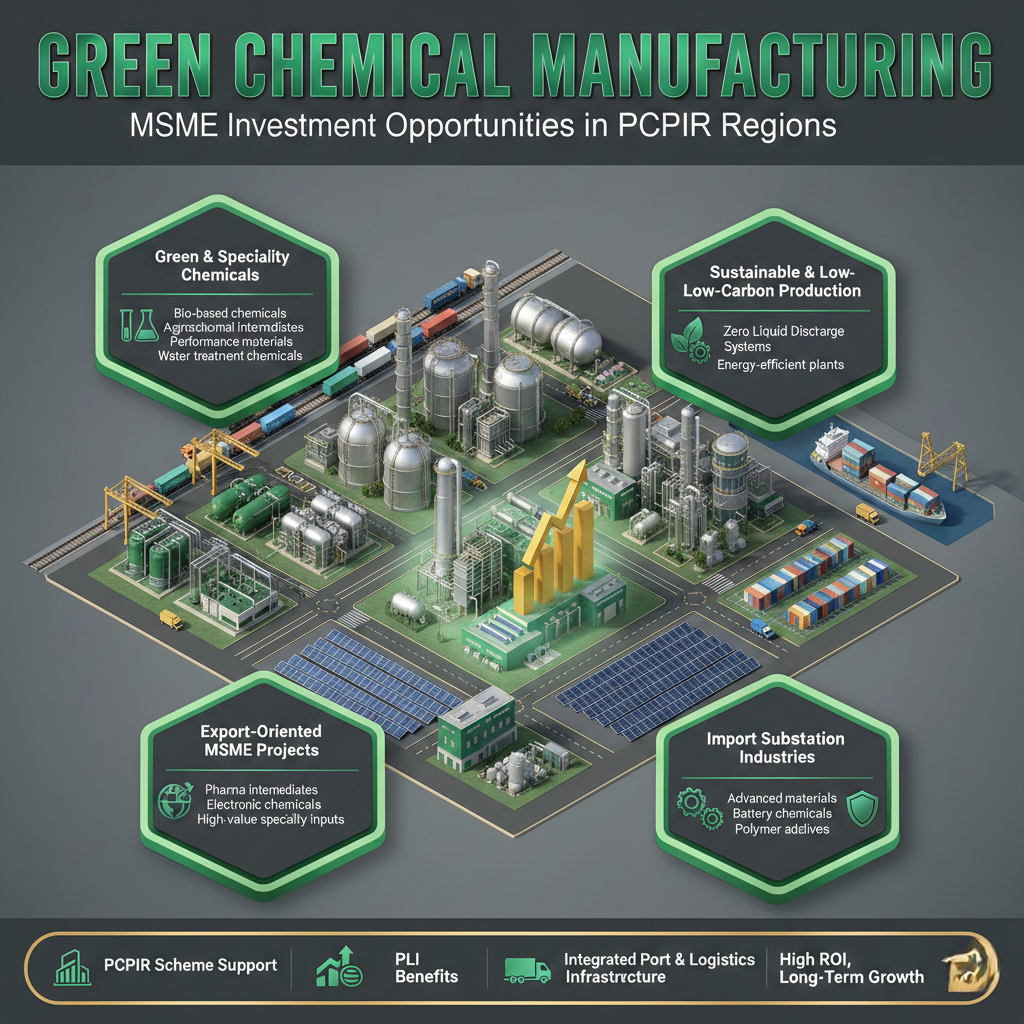
Green Chemical Manufacturing Segments having High MSME Potential
Read More: Project Reports & Profiles
1. Water Treatment and Effluent Management Chemicals
Water treatment chemicals like coagulants, flocculants, scale inhibitors, corrosion inhibitors and pH correction agents are one of the most stable demand segments.
Demand is regulation driven, so therefore it is recurring and predictable. Raw materials are mostly available domestically and most manufacturing processes are batch-based – ideal for MSME scale plants.
2. Bio Based Solvents and Low VOC Additives
With the tightening of global regulations on volatile organic compounds, industries such as paints, coatings, adhesives and flexible packaging are switching over to bio-based and low-VOC formulations.
MSMEs can get into this segment by modular, batch-scale production with capacity growth. Export potential is good, especially for buyers to regulated markets.
3. Specialty Polymers and Compounds for Sustainable Packaging
Instead of capital-intensive polymerization, MSMEs can specialize in compounding, blending and masterbatch production for recyclable or biodegradable packaging applications.
This positioning downstream helps with higher value addition with relatively lower capital investment and it makes it attractive for new entrants.(Green chemical manufacturing India)
Read More: Business Plans / Project Profiles
4. Agrochemical Formulations Having Low Residue Profiles
Export-oriented agriculture and organized farming networks are increasingly demanding low residue and compliance-oriented agrochemical formulations.
Formulation-based manufacturing allows for the customization of crops and regions while maintaining manageable capex. In the case of this part, compliance credibility and branding have a direct effect on margins.
5. Industrial Enzyme Based Cleaning and Processing Chemicals
Enzyme based formulations are being adopted by factories, hospitals, food processors and logistics facilities to reduce chemical discharge loads.
These products are often provided under contract or long-term supply models, and it is evident that there are predictable cash flows. Infrastructure requirements mostly blend based, which goes well along with MSME operations.
Read More: How to Start a Profitable Vermicompost Business
Export Benefits of PCPIR Based Green Chemical Units
PCPIR regions are strategically adjacent to ports and industrial logistics corridors. This provides MSMEs with:
- Lower freight costs
- Faster export turn around times
- Easier access to containerised and bulk shipping
Green-compliant units also find it easier to attract international certifications and buyer approvals that help them integrate into global value chains across automotive, textiles, packaging and industrial sanitation sectors with greater speed.
How Entrepreneur Should Assess the Feasibility of a Project
Green chemical projects need to be measured by more than the typical cost and revenue projections. Key technical and financial parameters are:
- Energy consumption and optimization potential
- Solvent recovery efficiency
- Waste to value opportunities
- Compliance costs (long term regulatory)
- Expansion flexibility at the layout and process design stage
A structured techno-economic feasibility study is an important step to identify risks at an early stage and to match investment choices with long-term sustainability and profitability.
Final Perspective: Building for the Next Decade
Green chemical manufacturing has evolved from its previous status as a niche operational method to become the essential standard which chemical companies must now adopt.
Businesses that design their facilities according to sustainable practices from the start achieve better results since they can obtain extended contracts while their operations remain within regulatory limits and they gain access to international markets.
MSMEs can enter the field of chemical manufacturing through PCPIR regions which provide them with complete environmental systems and transportation solutions and industrial development areas.
The manufacturing industry will advance toward its future through organizations that demonstrate both technical expertise and ecological accountability which PCPIRs work to establish in the present day.(Green chemical manufacturing India)
Frequently Asked Questions (FAQ)
Is green chemical manufacturing suitable for first-time entrepreneurs?
Yes. Formulation, blending, and compounding-based units within PCPIRs are well suited for new promoters due to shared infrastructure and lower compliance complexity.
What is the typical investment range?
Most MSME green chemical projects fall between ₹1 crore and ₹10 crore, depending on product type and capacity.
Are export opportunities realistic for MSMEs?
Yes. Eco-compliant formulations are increasingly preferred in regulated international markets, particularly Europe-linked supply chains.
What are the key risks?
Regulatory compliance management, raw material price volatility, and solvent recovery efficiency. These risks can be mitigated through proper planning and process design.
Is capacity expansion difficult?
No. Most green chemical plants scale modularly by adding reactors, blending lines, or downstream equipment.