A single gazette notification is creating an opportunity of Rs. thousands of crores in the paper, tin and glass packaging business for the MSMEs in India.
India’s Most Stubborn Plastic Habit Just Met Its Legal Deadline
In India, pan shops sell about 4.5 lakh pan masala and gutkha plastic sachets every minute, and no one can recycle them because Indian law banned these sachets in 2016. However, the business continued to move forward. That 10-year gap was filled on 10th August 2026. FSSAI has issued the Food Safety and Standards (Packaging) Amendment Regulations, 2026 in the Gazette of India, excluding plastic, plastic laminated packaging, aluminium foil and metallised layers from all pan masala products from today itself.
The regulation is not a consultation paper or future deadline. It came into force the moment it was published. Now, only three categories of packaging—paper/paperboard/cellulose, tin and glass—are available for use by pan masala manufacturers in Uttar Pradesh, Madhya Pradesh, Rajasthan and Maharashtra, which has a combined share of more than 60% in the domestic pan masala market of ₹48,456 crore. A total transformation of an industry that has been on cheap, multi-layer plastic sachets for decades. For packaging manufacturers, paper converters, tin container companies and glass bottle companies, it’s a supply-demand situation worth pursuing now.
A ₹48,000 Crore Industry Without Compliant Packaging — The Scale of the Gap
In India, the pan masala industry is very much dependent on a packaging format, which is now banned outright. The multipurpose plastic sachet proved cheaper to make at under ₹0.10 per unit, offered waterproof packaging and supported high-speed printing. Manufacturers adopted it as the common packaging format to keep the product’s retail price between ₹1 and ₹2. It has been a great format!
On August 11, 2026, the food safety commissioners in all the States and UTs received a directive from the FSSAI allowing them to conduct market inspections, recall of the food product at the manufacturer’s cost, seizure or withdrawal of stocks and suspension or cancellation of food licenses. This is not a warning, it’s a compliance deadline that’s already passed.
This leaves a structural and immediate supply gap. The pan masala market needs food-grade paper packaging with a moisture barrier and printable surfaces, so buyers cannot source it as a commodity from a general paper mill. Tin containers for masala products require internal lacquering that is food safe and tolerances for optimal fit of lids. Glass jars need tamper evident closures and label stick on to a product that will be sold on open shelves in the kirana stores. India has in place the capacity in all the three segments which cater to other end-users like pharma, food processing and export. In most states where pan masala is sold in large quantities, the supply chain has limited or no compliance with pan masala packaging requirements.
Get Detailed Insights from This Book: Modern Technology of Pulp, Paper and Paper Conversion Industries
Take into account the demand concentration. According to IMARC Group data, the region of Madhya Pradesh, Uttar Pradesh, Bihar, Rajasthan and Maharashtra is responsible for almost 70% of pan masala consumption. The vast majority of manufacturing in states is micro-scale, price-sensitive and utterly not ready to order compliant alternatives at the quantity and velocity required by the new regulation. The draft notification published on 28th April, 2026 provided 60 days of public consultation which many brands have utilized for lobbying instead of changing their supplier. Now the final rule is valid and the time is up.
TABLE 1: State-wise Pan Masala Demand Concentration and Compliant Packaging Supply Gap
| State | Est. Market Share (%) | Key Districts / Clusters | Permitted Packaging Need | Supply Gap Status |
| Uttar Pradesh | 22–25% | Kanpur, Lucknow, Varanasi, Agra, Gorakhpur | Paper pouches, tin boxes | High — few local food-grade converters |
| Madhya Pradesh | 18–20% | Indore, Bhopal, Gwalior, Rewa | Tin containers, glass jars | Severe — nearest tin suppliers in Maharashtra |
| Maharashtra | 12–14% | Nagpur, Pune, Nashik, Mumbai (distribution) | Paper laminate, tin | Moderate — some existing converters |
| Rajasthan | 8–10% | Jaipur, Jodhpur, Bikaner, Kota | Paperboard, tin cans | High — minimal certified packaging base |
| Bihar | 7–9% | Patna, Muzaffarpur, Bhagalpur, Darbhanga | Paper pouches, glass | Very High — virtually no local compliant capacity |
| West Bengal | 5–7% | Kolkata, Howrah, Durgapur | Tin containers, paper | Moderate — packaging corridor emerging |
| Gujarat | 4–6% | Ahmedabad, Surat, Rajkot, Vadodara | Glass jars, tin | Low — strong existing packaging base |
| Karnataka | 3–5% | Bengaluru, Hubli, Mysuru | Paper, glass | Moderate — pharma-grade glass available |
Source: IMARC Group India Pan Masala Market Report 2026; FSSAI enforcement directive August 2026; industry estimates.
Three Categories, One Massive Window: The Timing Is Not Negotiable
A regulator forcing such a switch, and with ‘immediate effect’ words, creates a procurement emergency for all pan masala brands in the country. For a packaging manufacturer who is in a position to respond in 60-90 days, that emergency is your sales pipeline.
The paper and paperboard packaging industry in India was already estimated to be worth of ₹1.62 lakh crore (USD 19.4 billion) and expanding by 6.1% each year prior to this regulatory jolt. The pan masala mandate has thrown an extra layer of requirement on top of that trend. As per IBEF, India’s per capita paper consumption stands at 15–16 kg, compared with the global average of 57 kg. This gap highlights significant opportunities to expand the country’s paper supply chain and achieve higher margins before demand reaches its ceiling.
DPIIT’s Make in India program: Food packaging is an import substitution sector that is explicitly included in Make in India’s framework. Based on the sector-specific PLI frameworks, domestic manufacturing of tin containers and speciality paper are eligible for capex incentives.
Micro and small units: PMEGP for micro and small manufacturing units provides Rs. 50 lakh maximum project support and subsidy of 15-35% of the project cost. It can be a paper pouch converting unit, a tin container fabrication unit or a glass jar filling and closure unit.
Tax exemptions, patents assistance, and access to fast-track procurement under Startup India scheme are some of the benefits available to a registered packaging startup. Moisture barrier paper coatings and tin container automation are recognised verticals of innovation by DPIIT.
Access Complete Business Plan: Paper Industry & Paper Products Manufacturing
Sachets containing plastic for pan masala were already banned 10 years ago under the Plastic Waste Management Rules 2016. The gazette notification of the FSSAI dated 10th August 2026 is in full force of the Food Safety and Standards Act, 2006 with the license suspended. Compliance window is measured in weeks. Brands that can’t afford to shut down their production lines will sign multi-year contracts with packaging manufacturers who can provide verified food-safe options.
Setting Up a Compliant Packaging Unit: From Registration to First Batch
The FSSAI amendment allows three types of packaging, all of which demand different types of manufacturing facilities. The following is the set-up guide for the most easy-to-access and popular format – food-grade paper pouch and paperboard carton converting, which accounts for the greatest market replacement share.
Step 1 — Udyam Registration and Legal Entity
Get registered as an MSME on udyamregistration.gov.in and register your business as a private limited company or LLP. Pan masala brands need a stable legal structure to sign long-term sourcing contracts with suppliers. Registration of Company through MCA V3 Portal will take 3-7 working days.
Step 2 — Land, Shed and Utilities
A paper converting unit needs 3,000–5,000 sq ft of covered space, with 3-phase power supply at 60–80 KVA load and dry, humidity-controlled storage. States like Madhya Pradesh and Uttar Pradesh offer industrial shed-in-shed schemes at MSME industrial estates in Mandideep (Bhopal), Malanpur (Gwalior) and Noida Extension for ₹12,000–18,000/month rental.
Step 3 — Machinery
Core equipment for a paper pouch and carton converting unit: (a) Flexographic printing machine (4-colour) — ₹12–18 lakh; (b) Slitting-rewinding machine — ₹5–8 lakh; (c) Aqueous barrier lamination unit — ₹8–15 lakh; (d) Pouch-making or carton gluing machine — ₹6–10 lakh; (e) Cutting and creasing machine — ₹3–5 lakh. Total machinery for 500 kg/day output unit: ₹34–56 lakh.
Step 4 — Raw Material Sourcing
Base paper (kraft, duplex board, food-grade): BILT, JK Paper, Century Pulp and Paper (Uttarakhand) and ITC’s Paperboards division supply pan-India. Food-safe barrier coatings (aqueous PLA/starch): Gujarat-based specialty chemical suppliers. For tin container units, tinplate coils from Tata Steel’s TCIL division (Jamshedpur) and JSW Platina grade (Salem). For glass jars, Hindusthan National Glass (HNG, Rishra, West Bengal) and AGI Glaspac (Hyderabad).
Step 5 — Licences and Regulatory Approvals
Required: (a) GST registration; (b) Udyam MSME certificate; (c) Factory licence under Factories Act; (d) Pollution Control Board consent (Green/Orange category); (e) ISO 22000 (food safety management) strongly advised for brand contracts; (f) For tin containers: FSSAI Schedule IV compliance — material test reports from NABL-accredited lab confirming no restricted coatings.
Step 6 — Team and Timeline
Minimum team: 1 production supervisor, 4–6 machine operators, 2 QC staff, 1 sales/procurement executive (8–10 persons). From Udyam registration to first production batch: 90–120 days (machinery procurement: 45–60 days; pollution clearance: 30–45 days).
TABLE 2: Investment Breakdown — Food-Grade Paper Pouch Converting Unit (500 kg/day capacity)
| Item | Specification | Cost (INR) |
| Land / Shed (3-yr lease prepay) | 3,500 sq ft, MSME estate, UP/MP | ₹5,40,000 |
| Flexographic printing machine (4-colour) | Semi-automatic, domestic or imported | ₹14,00,000 |
| Aqueous barrier lamination unit | Water-based coating, FDA-grade | ₹10,00,000 |
| Slitting-rewinding machine | 1,000 mm width, servo-controlled | ₹6,00,000 |
| Pouch-making machine | Side-seal, 3-side seal capable | ₹8,00,000 |
| Cutting, creasing, finishing | Flatbed creasing-cutting press | ₹3,50,000 |
| Utilities (power, fire system) | 80 KVA 3-phase, fire sprinkler | ₹3,00,000 |
| Raw material stock (first 45 days) | Kraft paper, duplex board, coatings | ₹8,00,000 |
| Licensing and certifications | Factory licence, PCB NOC, GST, ISO 22000 | ₹1,50,000 |
| Working capital (3 months) | Salaries, utilities, transport | ₹7,00,000 |
| Contingency (8%) | ₹4,84,000 | |
| TOTAL PROJECT COST | ₹71,24,000 |
PMEGP subsidy (25% for general/urban): up to ₹17.81 lakh deductible. Effective founder outlay: 10% promoter contribution + subsidy + bank term loan.
The Numbers: What a Paper Packaging Unit Can Actually Earn
Capital Expenditure: ₹65–75 lakh total project cost for 500 kg/day paper pouch converting unit.
Monthly Operating Cost: ₹7.5–9.5 lakh/month (raw materials ₹4.8 lakh; salaries ₹1.8 lakh; power and consumables ₹1.2 lakh; transport and overhead ₹1.7 lakh).
Revenue at 60% Capacity: Output ~9,000 kg/month × ₹140–180/kg = ₹12.6–16.2 lakh/month.
Revenue at 100% Capacity: Output ~15,000 kg/month = ₹21–27 lakh/month.
Gross Margin: 28–34% at 80%+ capacity utilisation after raw materials and direct costs.
Net Margin: 16–22% at 80% utilisation after overheads, EMI and salaries.
Payback Period: 26–36 months at 70–80% utilisation. Tin container unit: higher capex (₹1.2–1.8 crore) but net margin 20–26%, payback 36–48 months.
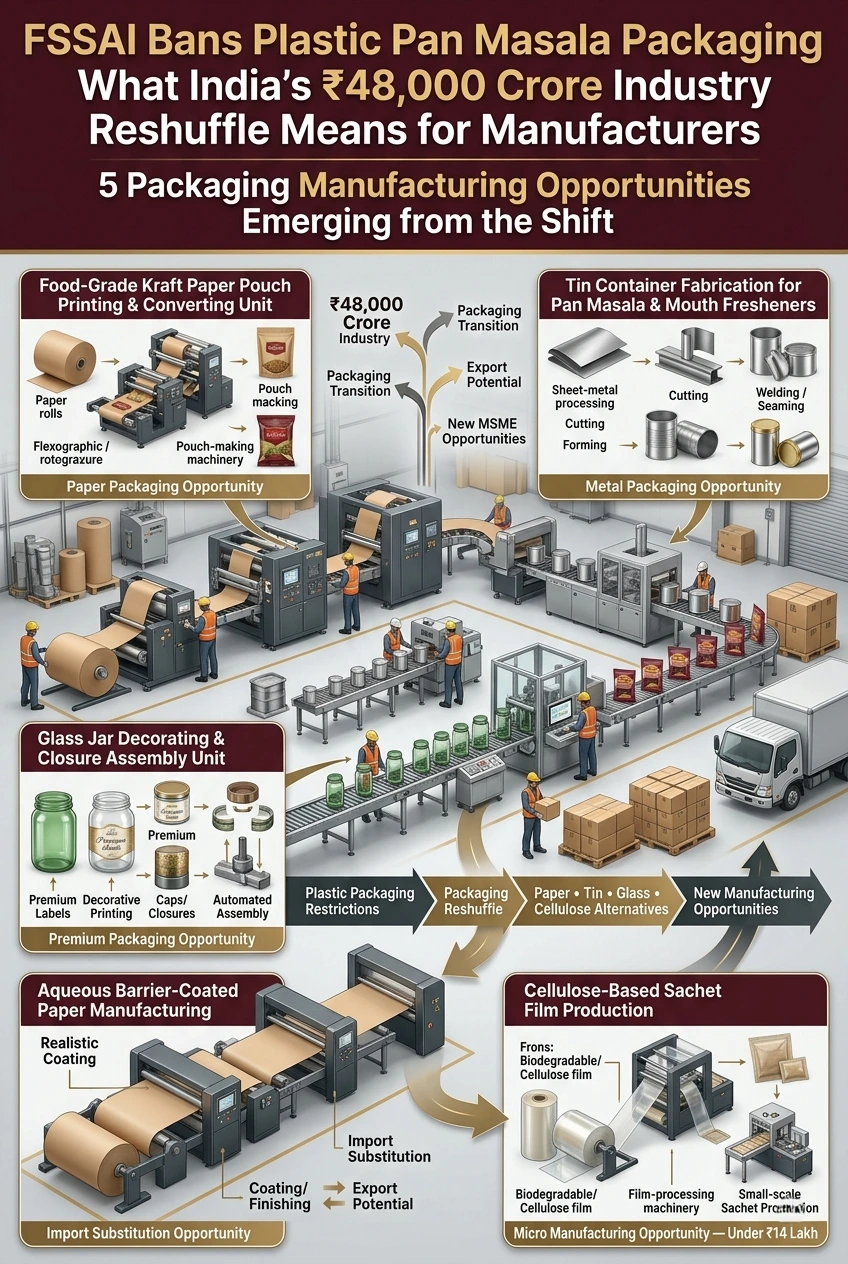
Five Manufacturing Business Ideas Unlocked by the FSSAI Packaging Mandate
Food-Grade Kraft Paper Pouch Printing and Converting Unit
The FSSAI amendment primarily allows small and mid-scale pan masala brands to use paper-based pouches because they are simple, printable, and the cheapest permitted alternative to plastic sachets. A kraft paper pouch printing and converting unit requires an investment of ₹50–75 lakh for semi-automated flexographic printing and pouch-making equipment, and can serve brands selling 5g, 10g, and 20g pan masala units. The real advantage for a first-time founder is proximity to demand: set up in Kanpur, Indore, or Varanasi — within 100 km of the pan masala manufacturing clusters — and offer 15-day turnaround on customised printed pouches. Buyers are the 3,000-plus registered pan masala manufacturers in UP and MP alone. Entry point: start with contract printing for two or three anchor brands, build ISO 22000 certification in the first year, and expand to private label in year two.
Related Article: How to Start a Kraft Paper Manufacturing Business from Waste Cartons
Tin Container Fabrication for Pan Masala and Mouth Fresheners
Tin is the premium compliance format under the FSSAI order — and demand has already been moving in this direction even before the mandate, with the cans segment of the pan masala market growing at 4.1% CAGR driven by the premium urban consumer. A tin container fabrication unit making round and rectangular tins in the 5g–100g range requires ₹1.2–1.8 crore in investment for tinplate coil cutting, body forming, seaming and lacquering lines. Raw material (tinplate coils) comes from Tata Steel’s Tinplate Company of India in Jamshedpur. The critical differentiator is food-safe interior lacquering — an area where most smaller fabricators currently underinvest. Set up in Maharashtra or Gujarat (near both tinplate supply and pan masala distribution hubs in Pune, Nashik, Surat). Net margins of 20–26% are achievable at 70%+ capacity, with payback in 36–48 months.
Glass Jar Decorating and Closure Assembly Unit for Premium Pan Masala
Glass is the third permitted format and the fastest-growing segment in gifting and premium pan masala. Direct glass manufacturing requires ₹5–20 crore for a small furnace — not suitable for first-generation founders. The accessible model is a glass jar decorating, filling-line and closure assembly unit: source clear glass blanks from Hindusthan National Glass (HNG, Rishra, West Bengal) or AGI Glaspac (Hyderabad) at ₹8–15 per jar, apply shrink-sleeving or pressure-sensitive labelling, fill and apply tamper-evident closures, and supply to premium pan masala brands wanting ₹30–100 SKUs. This model requires only ₹35–55 lakh in investment and is particularly suited to founders near HNG’s or AGI’s facilities. Profit margins: 22–28% at 70% capacity, with a payback period of 28–38 months.
Aqueous Barrier-Coated Paper Manufacturing (Import Substitution Play)
Almost all food-grade moisture-barrier paper used in India comes from imports or three or four large domestic mills. Aqueous barrier-coated kraft paper — treated with water-based PLA, starch or silicone coatings to provide moisture resistance without plastic lamination — is exactly what the pan masala industry needs to replace plastic sachets. Adding a coating machine line to an existing paper converting operation costs ₹80 lakh–1.2 crore; a standalone greenfield unit costs ₹1.8–2.5 crore. This is a micro-import-substitution play: India imports significant volumes of specialty barrier papers from Finland and South Korea. Set up in Uttarakhand or Himachal Pradesh, where state industrial subsidies apply, and supply directly to pan masala pouch printers. Margins: 24–30% net at scale, with long-term contracts from pouch converters as the sales base.
Cellulose-Based Sachet Film Production (Micro Unit Under ₹14 Lakh)
FSSAI’s amendment specifically permits cellulose and other naturally derived materials as alternatives to plastic packaging. Cellulose-based sachet films — derived from wood pulp, fully compostable, printable by flexo — are still rare in the Indian market. A micro-unit can process cellulose film into sachet-ready rolls with ₹8–14 lakh in equipment and operate from a 1,000–1,500 sq ft leased space. This is the lowest capital entry point in the sector. Target buyers are pan masala micro-brands and herbal mouth freshener manufacturers who need small minimum order quantities (10,000–50,000 sachets per run). First-mover advantage is significant: no large player in India currently focuses on sub-5 crore cellulose sachet roll supply for FMCG. Register under Udyam, apply for PMEGP, and target food exhibitions in Lucknow and Indore to build initial customer relationships.
Identify high-growth industries before others do
TABLE 3: Government Schemes for Pan Masala Compliant Packaging Manufacturing
| Scheme | Nodal Ministry / Agency | Eligibility | Maximum Benefit | How to Apply |
| PMEGP | Ministry of MSME / KVIC | Individual 18+, new manufacturing unit | Subsidy 15–35% of project cost up to ₹50L | Online at pmegp.kvic.org.in; submit via DIC or KVIC |
| CGTMSE (Credit Guarantee) | Ministry of MSME / SIDBI | MSMEs seeking collateral-free loans | Guarantee up to ₹5 crore (75–85%) | Through participating scheduled commercial banks |
| MUDRA — Tarun Loan | Ministry of Finance / MUDRA | Micro and small enterprises | Loans up to ₹10 lakh | Via PSU banks, RRBs, MFIs; apply at udyamimitra.in |
| Make in India / PLI (Packaging) | DPIIT | Packaging manufacturers with capex commitment | Production-linked incentive on incremental sales | Application via dpiit.gov.in/make-in-india |
| Startup India Recognition | DPIIT / MeitY | Innovative packaging tech startups | Tax holidays 3/7 years, patent support, fast procurement | Register at startupindia.gov.in |
| PM Vishwakarma | Ministry of MSME | Craftsperson / traditional packaging artisans | Toolkit grant ₹15,000 + training + credit ₹3L | Via CSCs or pmvishwakarma.gov.in |
| State Packaging Cluster Schemes | State MSME / Industries departments | MSMEs in notified packaging clusters | Capital subsidy 15–30% (varies by state) | Via District Industries Centres (DICs) |
Entrepreneur SpotlightPradeep Mehta | Nashik, Maharashtra | ₹2.8 crore annual turnoverPradeep Mehta started a tin container fabrication unit in Nashik’s Satpur MIDC in a 2,200 sq ft shed, initially supplying ghee manufacturers and masala brands. When FSSAI’s draft notification appeared in April 2026, he pivoted production to food-safe pan masala tins within 60 days — reconfiguring his seaming line and adding interior lacquering. Within three months of the gazette notification, he had supply contracts with four mid-sized pan masala brands across Maharashtra and MP. His key lesson: “Don’t wait for the order — have the sample ready before the brand even knows it needs you.” (Representative profile based on industry operator patterns; MIDC Nashik, Maharashtra.) |
Project Feasibility and Technical Support
Entrepreneurs and MSMEs planning to set up paper, tin or glass packaging units in response to the FSSAI mandate would benefit from detailed project reports before committing capital. Niir Project Consultancy Services (NPCS) — India’s leading industrial project consultancy — provides techno-economic feasibility studies, plant layout designs, machinery specifications, raw material sourcing maps, and financial models for food packaging manufacturing projects including paper pouch converting, tin container fabrication and glass jar processing. Their reports help first-generation founders present projects to banks for PMEGP- and CGTMSE-backed loans. Entrepreneur India — NPCS’s associated publication — regularly publishes sector-specific investment guides, machinery buyer’s guides and manufacturing opportunity analyses for the packaging and FMCG supply chain space.
What You Should Do in the Next 30 Days
The FSSAI packaging amendment of August 10, 2026 is a hard mandate, not a phased transition. Hundreds of pan masala manufacturers are scrambling for compliant packaging suppliers right now. The opportunity window is narrow — those who establish supply contracts in the next 60–90 days will be the preferred vendors for the next three to five years as the industry restructures.
The one action to take this week: identify three to five pan masala manufacturers within 200 km of your proposed production location — search SMEStreet, IndiaMart or visit the local kirana supply bazaar — and call on them with a sample and a price quote for a food-grade paper pouch or tin container. You do not need a running factory to get a letter of intent. A committed buyer is your first asset; the machinery follows. Then take that LOI to a PMEGP application at your nearest District Industries Centre. The subsidy, the demand and the regulatory mandate are all aligned. The only variable is whether you move before someone else in your district does.