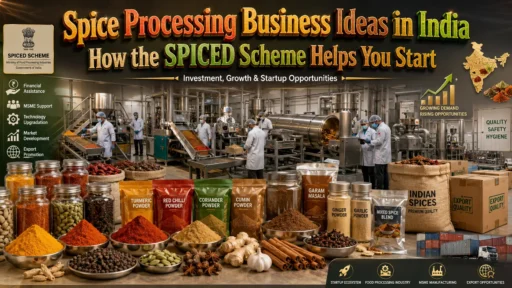

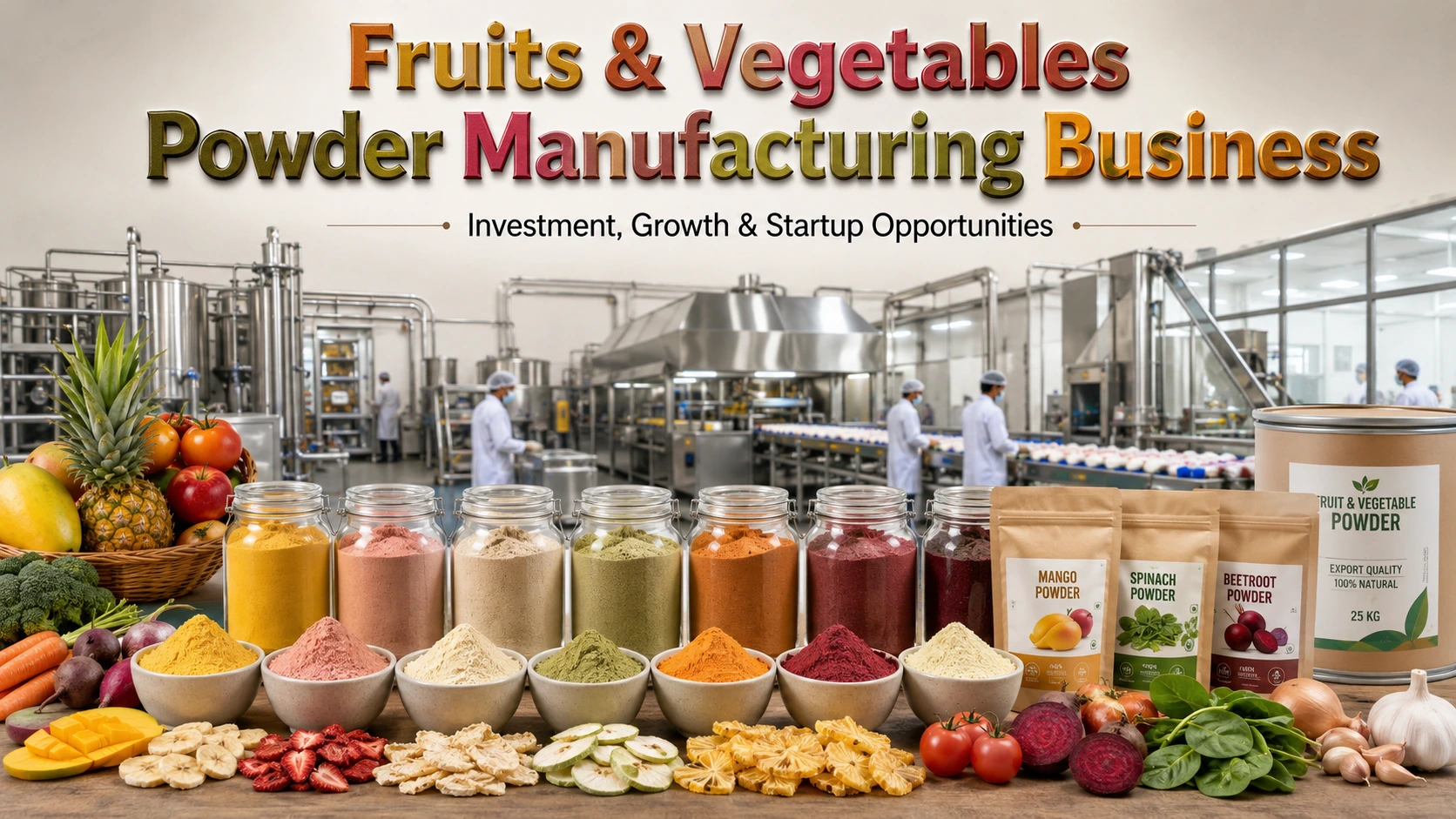

The food processing industry is one of the most promising business ventures for MSMEs and first-time entrepreneurs in India. In this area, fruits and vegetables powder manufacturing business is an interesting and unexploited opportunity. Consumer lifestyles, the growth of the packaged/processed food and convenience food markets, the need of pharmaceutical companies for natural ingredients and the rapid expansion of the nutraceutical industry are creating an increasing demand for dehydrated and powdered produce.
Besides, India generates more than 300 million tonnes of fruits and vegetables annually, but it still experiences substantial post-harvest losses. The inefficiency is directly addressed by powder manufacturing. In this segment now, the entrepreneur isn’t just establishing a factory, he or she is creating a business where agriculture meets food technology and export opportunity.
Why the Fruits & Vegetables Powder Sector Is Growing Fast
The global dehydrated food market is growing steadily at a CAGR and India is one of the key suppliers. Demand is from various sources. Tomato powder, onion powder, spinach powder and ginger powder are the base ingredients for food manufacturers in soups, seasoning, sauces and ready-to-eat foods. Pharmaceutical and nutraceutical companies use amla powder, moringa powder, and beetroot powder as functional health ingredients. Restaurants, hotels, and institutional kitchens prefer powders because they provide consistent flavour and offer a long shelf life.
What’s more, the export direction is very attractive. Indian spice and vegetable powders are sold in the Middle East, Europe, U.S. and Southeast Asia. APEDA keeps on sharing the positive reports on the international demand for dehydrated Indian produce. This opens the doors for the fruits and vegetable powder manufacturing business to be an import substitution and export business at the same time.
As per data from Agricultural and Processed Food Products Export Development Authority (APEDA), the exports of processed food have seen consistent year-on-year growth with dehydrated vegetables and spice powders being one of the largest categories.
Get Detailed Project Report (DPR): Fruits & Vegetables Powder (Tomato, Onion, Mango, Pomegranate and Papaya Powder)
Government Policies and Incentives Supporting This Business
The Government of India has intentionally structured a policy framework that will promote food processing MSMEs. Numerous incentives are available to the entrepreneurs to launch a fruits and vegetables powder manufacturing factory at both the central and state level.
Production Linked Incentive (PLI) Scheme for Food Processing provides financial incentives to the food manufacturers who increase their sales and increase their capacity utilization. While the PLI is more of a scheme for mid to large food business enterprise, the impact of the scheme is and should be to build robust institutional demand for raw ingredients like dehydrated powders from smaller MSMEs.
The Pradhan Mantri Formalisation of Micro Food Processing Enterprises (PM FME) Scheme provides credit linked subsidy of up to ₹10 lakh to individual micro enterprises for upgrading their plant and machinery. This directly translates to a positive impact on a cottage and small-scale powder manufacturing startups.
The Credit Guarantee Fund Trust for Micro and Small Enterprises (CGTMSE) scheme by the Ministry of MSME provides collateral-free loans up to ₹2 crore for eligible startups. Further, under the Food Safety and Standards Authority of India (FSSAI) regulations, MSME manufacturers have streamlined registration processes and assistance to ensure compliance. Other States such as Andhra Pradesh, Maharashtra, Gujarat and Karnataka provide subsidies to land, power tariff and capital investment via their State Industrial Development Corporations.
Entrepreneurs may check the official portal of the Ministry of Food Processing Industries for detailed scheme information and assistance towards the start-up process.

Multiple Business Ideas Within the Fruits & Vegetables Powder Segment
Idea 1: Onion and Garlic Powder Manufacturing Unit
One of the most commercially proven and scalable business ideas in this sector is the making of onion and garlic powder. India is the second-largest producer of onions and garlic; however, many entrepreneurs overlook the importance of securing a reliable supply of these raw materials. The process consists of washing, peeling, slicing, drying in a hot-air or a spray-drying system and milling into fine powder. The company transfers the final product to spice companies, food producers, restaurant chains, and FMCG brands. A mid-scale unit with a production capacity of 200–500 kg/day typically costs ₹20–35 lakh, including machinery, civil work, and working capital. The margins in this segment have been healthy as onion powder and garlic powder have short shelf life of 12–18 months, so the companies are able to accumulate stockpile during the peak season and can sell it at premium prices during the off season.
Related Article: Fruit Powder Market in India: Investment, Growth & Startup Opportunities (2026–2031)
Idea 2: Tomato Powder and Tomato Flakes Production
Tomato powder is one of the speediest of processed items in India. Moreover, It is an essential component of instant soup mixes, pizza sauces, ketchup blends, seasoning sachets and ready-to-eat meal kits. Manufactured using blanching, pulping, spray or drum drying and fine milling. Tomatoes are a highly seasonal and perishable crop, so domestic production cannot meet demand throughout the year. In the peak season, entrepreneurs can develop procurement agreements with farmers in Maharashtra, Andhra Pradesh or Madhya Pradesh, and then process a large number of farmers’ crops for storage and sell throughout the year. A tomato powder unit processing 1–2 tonnes of fresh tomatoes daily requires an investment of about ₹30–50 lakh and can generate gross revenue of ₹80 lakh–₹1.2 crore at optimum utilisation. Thus, this is one of the most viable business ideas in the dehydrated food industry.
Idea 3: Moringa, Amla, and Functional Greens Powder for Nutraceuticals
The nutraceutical and health supplement industry is booming and the powder form of moringa, amla, wheatgrass and spirulina are some of the most popular ingredients on demand. We sell the powders to supplement manufacturers, organic food companies, Ayurvedic companies, health startups, and directly to consumers. The attractive part of this is that moringa powder sells for ₹400–₹800 per kg while vegetable powders sell for ₹80–₹150 per kg. This means entrepreneurs who are targeting their unit to produce organic and functional foods stand to enjoy better margins. Indian moringa and amla are in high demand in Germany, the UK and the USA and certification under the FSSAI organic category, along with ISO 22000, opens up the doors for export to these countries.
Idea 4: Mixed Vegetable Powder Blends for Institutional and HoReCa Markets
The customised vegetable powder blends are a large and neglected B2B market in the hotel, restaurant, catering sector and the airline kitchens. Moreover, Blended products have higher perceived value, lower substitutability and better price realisations, compared to commodity powders. In addition, A private-label agreement allows a private entrepreneur to develop his own proprietary mixes, in partnership with the hotel’s procurement or food service departments. As a result, This model minimizes reliance on commodity pricing on the open market and creates recurring revenue over time. Furthermore, The investment needs are comparable to a regular powder unit, but the margin may be 25–40% higher. Furthermore, the HoReCa market is based on annual or semi-annual purchase orders, which will lead to more predictable revenue.
Idea 5: Export-Grade Spice and Vegetable Powder Unit
If the startup is directly targeting export markets, it can build a purpose-built facility and replicate it according to international standards. Furthermore, For export-grade production in Middle Eastern and European markets, manufacturers must obtain HACCP certification and ISO 22000 certification. In addition, Some markets also require halal or kosher certification. The payoff, however, is great. In fact, Prices of exporting the vegetable and spice powders are usually 30–60% dearer as compared to the domestic market. Moreover, Countries in the Middle East, Southeast Asia, and Africa import dehydrated Indian produce on a large scale every year. As a result, An export-oriented unit of 500-1,000kg per day will be able to get profit of ₹2-4 crore per year. Additionally, It is also advisable for the entrepreneurs in this segment to register with APEDA and avail the Market Development Assistance (MDA) scheme to defray costs incurred on promotion abroad.
Get Detailed Insights from This Book: The Complete Book on Fruits, Vegetables and Food Processing
Import–Export Opportunity Analysis
Indian startups can find promising opportunity in the import-export market of the fruit and vegetable powders. However, Indian produce has a good quality reputation in the export market, particularly turmeric, ginger, amla, tomato and onion. The organic and premium segment is less competitive for Indian exporters as compared to Chinese manufacturers, in part due to concerns about traceability in China’s supply chain in Europe and North America.
The Spices Board of India extends all type of assistance to the exporters of spice powder and arranges schemes like participation in international trade fairs, buyer-seller meets etc. Entrepreneurs must sign up with the Board to be able to avail of the promotional tools.
In the import substitution side, India is importing various speciality fruit powders from the Southeast Asia namely bael fruit powder, kokum powder, exotic tropical fruit concentrates etc. Meanwhile, The demand of FMCG, Ayurvedic and beverage companies is increasing but the domestic production is not sufficient to meet the demand. Therefore, there is a potential for developing a small batch, quality production facility for these underutilized ingredients in a non-competitive strategy.
Entrepreneurs are advised to refer to India Trade Portal by FIEO for the latest statistics of India’s trade, tariff details, market access information etc. for HS code analysis.
Indian MSME Success Stories in This Sector
Everest Food Products Pvt. Ltd.
The late Vadilal Hemani founded Everest Spices, one of the leading success stories in India’s spice and powder processing industry, in Gujarat. Moreover, It has grown to become a truly national and international brand with steady investment in processing facilities, brand building and product range explanations, starting it off as a small family business. Therefore, The lesson that new entrepreneurs must learn is that consistency over many years is worth a lot more than quality over a short time. Furthermore, Everest was not a price winner: it was a standardisation, trust and distribution depth winner.
Natureland Organics
Anil Verma started Natureland Organics with a successful model of certified organic processing of agricultural produce. The company procures certified organic raw materials from cooperatives of farmers and transforms them into added value products such as organic vegetable powders. Moreover, They show how supply chain integration is key to their success and they benefit from maintaining quality control and from premium pricing for their raw material as they work directly with certified farmers. The farmer-integration model is highly replicable and it helps to reduce commodity price risk to a considerable extent for the new entrepreneurs.
24 Mantra Organic
24 Mantra Organic was one of the leading organic food brands in India promoted by Hyderabad based Sresta Natural Bioproducts. They have a wide array of organic powders and dried ingredients. A combination of activities has fuelled its expansion, including establishing a presence in the domestic market through modern trade outlets and building vigorous export collaborations. The journey shows that a higher price point strategy from the start — not a commodity supplier — is a viable and sometimes more effective way for startups to become profitable with a good approach to sourcing.
Discover business ideas that actually make money
How NPCS Can Help You Evaluate and Launch This Business
Niir Project Consultancy Services (NPCS) prepares detailed Market Survey cum Detailed Techno-Economic Feasibility Reports (DPRs) for entrepreneurs who are considering entering the fruits and vegetables powder manufacturing industry. Our report features details of manufacturing processes, specifications of equipment, raw material sourcing strategies, market research and demand analysis, product mix and capacity planning, complete financial projections (break even and IRR analysis) and profitability forecasts.
We want to make it our goal to help entrepreneurs make educated investments before putting any money into their projects. We can apply our DPR methodology to your ₹15 lakh micro-unit project or your ₹1 crore export-class project. For more information, visit NPCS Project Reports.
Key Business Parameters at a Glance
Table 1: Indicative Business Parameters for Fruits & Vegetables Powder Manufacturing Units
| Parameter | Micro Unit | Small Unit | Mid-Scale Unit |
| Investment Required | ₹10–20 Lakh | ₹25–50 Lakh | ₹75 Lakh–1.5 Cr |
| Daily Capacity | 50–100 kg | 200–500 kg | 500 kg–2 MT |
| Manpower Required | 3–5 persons | 8–15 persons | 20–40 persons |
| Approx. Gross Revenue/Year | ₹20–35 Lakh | ₹60 L–1.2 Cr | ₹2–4 Crore |
| EBITDA Margin | 22–28% | 25–32% | 28–38% |
| Typical Payback Period | 2.5–3.5 years | 2–3 years | 1.5–2.5 years |
| Key Certifications Needed | FSSAI | FSSAI + ISO | FSSAI + ISO + HACCP |
Frequently Asked Questions (FAQs)
Q1. What is the investment required to start a fruits and vegetables powder manufacturing business in India?
A micro scale unit can be established in the range of 10-20 lakhs which include basic drying machineries, pulveriser, packing machineries, working capital and other setup. A small-scale manufacturing unit costs between 25-50 lakhs. The amount of investment will vary depending on the product category, production capacity and type of automation in a unit.
Q2. Which fruits and vegetables powders are most in demand in the Indian market?
Onion powder, garlic powder, tomato powder, ginger powder, turmeric powder and green chilli powder always rank on the top in domestic demand. In the premium health food sector, moringa powder, amla powder, beetroot powder are some of the fastest growing product categories due to ever-increasing interest of consumers for functional foods and nutraceuticals.
Q3. Which government schemes can be accessed by a new startup to fund the business?
Relevant schemes are PM FME scheme (credit linked subsidy up to 10 lakh), CGTMSE scheme (collateral free loan up to 2 crore), MUDRA loan in Kishor and Tarun category, and state level capital subsidy provided by State Industrial Development corporations. APEDA support the export-oriented units in terms of funding.
Q4. Which quality certification would be required for exports?
At a bare minimum, export grade units should be an FSSAI licenced unit with APEDA registration. It also needs ISO 22000 (food safety management) and HACCP certification, halal and kosher (if market require), organic certification (if required by market) and pesticide residual documents for EU market.
Q5. How can a new entrepreneur choose the right product to start with?
A new entrepreneur can start with product that have high local availability of raw materials, good demand and easy processing requirements. Onion powder, garlic powder and tomato powder make very good product starting points. With growth and operational maturity entrepreneurs can foray into higher margin health powders or develop in house blends for B2B markets.
Q6. Is a feasibility report compulsory before starting this business?
Yes. An entrepreneur is required to undertake a techno-economic feasibility report before undertaking a business to be aware of the demand, pricing from competitors, required machineries and their cost, break-even point of the business and the fund requirements for project funding. A capital of 30,000 -1.5 lakh for the preparation of quality DPR may be worthwhile for a 25-150 lakh business.
Conclusion: The Time to Enter Is Now
The business of fruits & vegetables powder manufacturing is a nexus of the primary agricultural competencies of India and the growing demand both domestic & international for ready-to-eat, shelf-stable food ingredients. Moreover, The increasing government focus along with upgrading food processing infrastructure and growing FMCG & nutraceutical markets offer an environment for potential investors that is indeed attractive to a new business player.(Fruits and Vegetables Powder Manufacturing Business in India)
But passion is not all that will make one successful in this sector. In addition, The correct choice of products, high standards of quality controls, use of appropriate processing technologies and a clear Go-to-Market strategy-whether domestic, export, or both-will indeed matter. Furthermore, Entrepreneurs who address product economics, certifications, and placement early are better positioned to build stable and profitable enterprises.
To obtain more market information and trade data of this industry entrepreneurs may further look at the CII (Confederation of Indian Industry) Food Processing Division, the National Institute of Food Technology Entrepreneurship and Management (NIFTEM) at NIFTEM for technical guidance and startup incubation support.
Large market, right time and good business case. The difference between the success and failures will depend on the preparations made before the first machine has been installed.