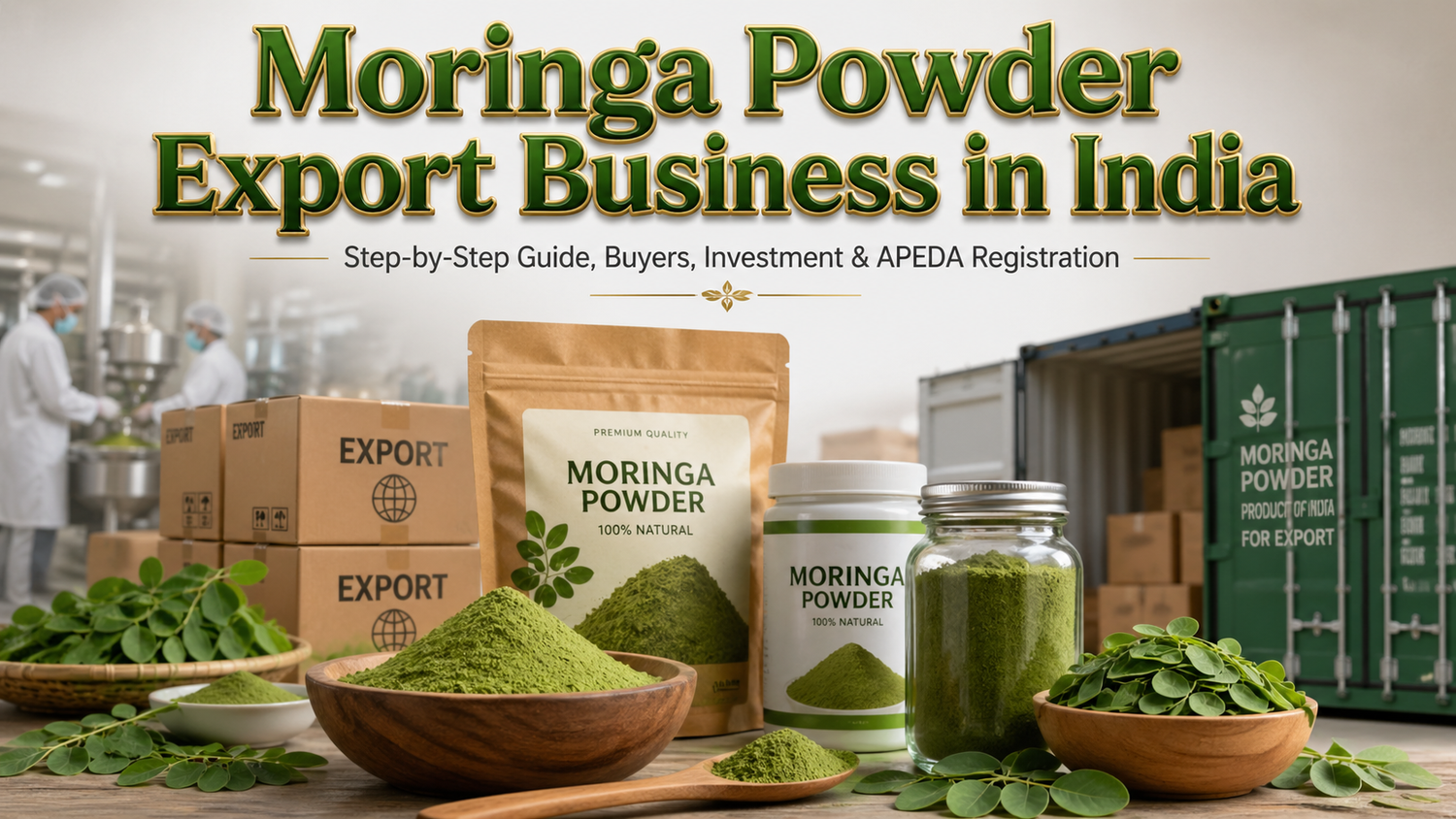

Introduction: Moringa Powder Export Business
The exporting of moringa powder is considered to be one of India’s fastest growing markets in nutraceuticals and herb export sectors. Known as the ‘miracle tree’ moringa is found naturally in the Indian states of Tamil Nadu, Andhra Pradesh, Karnataka, and Rajasthan. In the past it has played an important role in India’s traditional food, folk remedies and traditional Indian medicine, but now moringa is the highly sought after global commodity owing to its different beneficial and nutritional value.
This particular exporting business can yield good returns as production is cheaper in India compared to its higher prices in the international markets. The market is particularly large in USA, Germany, Japan and UAE for dietary supplements, drinks for healthiness, protein powders and organic food which seems a viable export opportunity to Indian entrepreneurs who comply with quality standards and regulations.
Get Detailed Insights from This Book: Handbook on Agro Based Industries (3rd Edition)
Global Demand and Market Growth
The demand for alternative based diet and preventive healthcare are being driven worldwide with growth of the moringa market. The market is increasingly preferring organic and chemical-free nutritional supplements, and moringa is a great fit.
The key importing countries are North America, Europe, East Asia and the Middle East. Though demand varies in each region, a preference for organic, clean-label, and certified herbal products is common.
Global demand is spurred by factors such as:
- Growth in nutraceutical and dietary supplement industry
- Growth of the vegan and vegetarian lifestyle
- Growing need for natural immunity enhancers
- Growth of organic supermarkets globally
India is ideally positioned to benefit from this trend because it is the world’s largest supplier of moringa crops, and the primary source of international markets.
Why Moringa Powder Export Is a Strong Business Opportunity
The Moringa export trade has structural backing rather than just a fashion for it. It is a tree species, tolerant of harsh weather, and easy to cultivate under the tropical conditions. Also it is non-resource intensive tree species and is also harvested multiple times in a year.
In terms of processing, the manufacturing process is less complicated than many other agro-industries. This typically includes washing, drying, milling and bagging of the powder in clean conditions.(Moringa Powder Export Business)
But grading and certification for quality is vital to its profitability. Export and organic quality moringa powder is highly valued and priced, so value addition is critical.
Another strength is customer loyalty. In order to provide a stable income source to exporters, the buyers have a tendency to repeat their contracts once satisfied with the supplier’s quality standards and paper works.
Get Detailed Project Report (DPR): Moringa Oleifera Powder. Formulation and Processing of Moringa Oleifera
International Buyers and Market Requirements
Buyers in the international markets who want moringa powder have very clearly been established and demand high quality for their products. Each country is unique and has individual expectation.
United States
The United States has a strong presence of nutraceutical brands, supplement manufacturers and private label manufacturers. Here buyers demand compliance to FDA regulations, organic and non-GMO certification.
Europe (Germany, UK, France)
Pesticide residues and organic status are very important for European buyers. Documentation and traceability are essential for maintaining business.
Japan and South Korea
These are high-end markets with a focus on purity, safety and science. Subtle variations can affect product acceptance.
Middle East (UAE, Saudi Arabia)
It’s also relatively easy to start exporting to and growing rapidly due to the growing awareness of health benefits and interest by big stores.
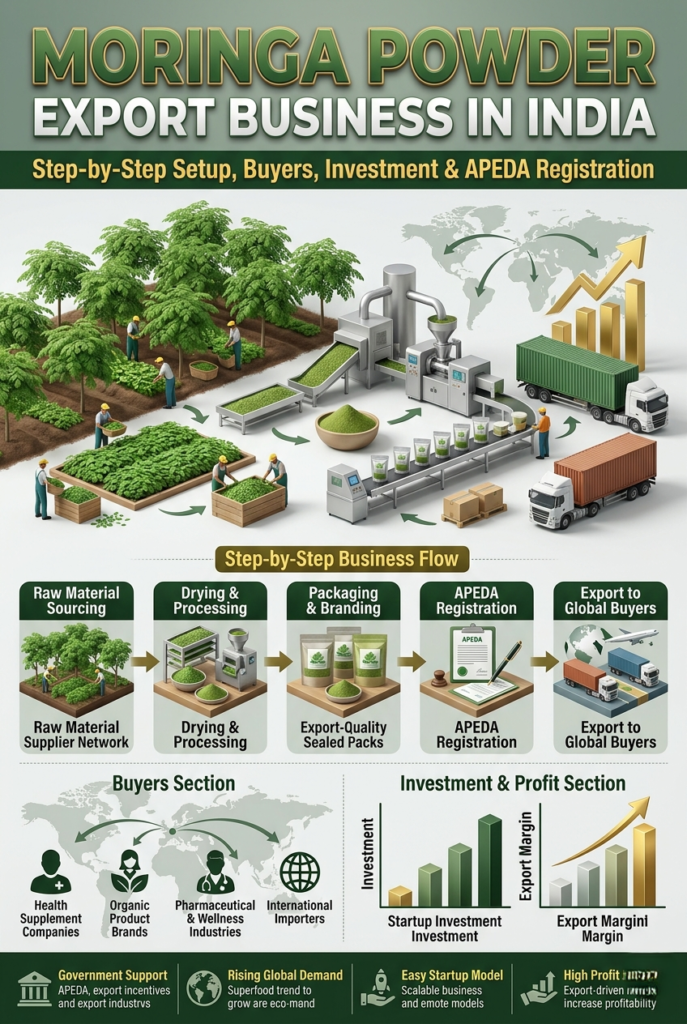
APEDA Registration and Export Compliance
For anyone wishing to pursue moringa exports from India, registration under APEDA is a necessity. The Agricultural and Processed Food Products Export Development Authority (APEDA) is an organisation established under the Ministry of Commerce, Government of India for promotion and development of export of agricultural prodMinistry of Commerce, Government of India ne Agricultural and Processed Food Products Export Development Authority (APEDA) ka gathan kiya hai taaki krishi utpado ke niryat ko badhava aur vikas diya ja sakeucts.
The process to register involves an initial application to the DGFT for the Import Export Code (IEC) followed by an online application to APEDA for a Registration-cum-Membership Certificate (RCMC). You can generally complete this within 7–15 days, and it is quite straightforward.
The most important benefit of having the APEDA Registration is that it gives legitimacy to your business as well as ensures that exporters would get some support from the government.
APEDA registration is beneficial because it:
- Access to export subsidies and grants
- Exposure at international exhibitions and buyer-seller meets
- Assistance for quality certification and packaging upgrade
- Market development assistance programs
Moringa powder exporters must also follow FSSAI norms in addition to APEDA and set up lab testing for pesticides residue, heavy metals and microbial.
Build a profitable business with the right idea
Investment Required and Business Models
The capital outlay for an export business is dependent on scale, certification and capacity.
At a low scale, one can establish a simple production unit with drying, milling and packaging equipment. It typically targets the local market and exports.
With medium scale businesses you typically already have an infrastructure that supports export markets with quality assurance and certification such as ISO 22000 and organic which opens up opportunities to gain higher profits in export.
With a higher scale business, the opportunities can go as far as manufacturing the moringa extract or to backward integrate as far as producing the crop itself. This farming to export practice is often the most profitable as quality can be ensured and greater profits obtained.
Major Certifications Required
Certification is vital for trading in global markets. Failure to comply can even result in rejection of quality products.
Important certifications include:
- FSSAI License for food safety
- APEDA Registration for exports
- Organic certification for high value markets
- ISO 22000 for food safety management
- Lab tests for pesticides, heavy metals, microbial contamination
These accreditations are used to build confidence with the overseas buyer and are part of the basis for negotiations of price and longer-term contracts.
Role of NPCS in Moringa Export Business Setup
To set up a moringa export business, it is important to plan, analyse the market and finances. Here, Niir Project Consultancy Services (NPCS) helps.
NPCS offers Project Reports (DPRs) for agro-processing and export industries. The reports cover all aspects of the business model to help entrepreneurs make informed decisions.
NPCS project reports include:
- Market demand and export analysis
- Detailed of machinery/ process of production
- Capital and operating costs
- Profit and return on investment
- Export compliance roadmap
- Documentation assistance
This helps mitigate the risk and ensures that the entrepreneurs do not take a gamble without knowing.
Related Article: Moringa Processing Plant in Ghana: A High-Value Export Business Opportunity
Conclusion
The export of moringa powder from India has a good mix of low cost of raw materials, growing global demand and export incentives. Through certification, quality management and business development planning, entrepreneurs can develop a sustainable export business.
Focus on quality production, buyer needs of the importer and also export standards like APEDA & FSSAI for successful export. The trend is on for natural products and health-food in all over the world, hence Moringa might be a very successful crop for many years in export.
Frequently Asked Questions (FAQ)
Q1. Is export of moringa powder a profitable business in India?
Yes, it is aprofitable business because of the very less production cost in India and the worldwide demand for organic and natural products is quite high as people arehealth conscious.
Q2. Do I need APEDA registration?
Yes, for the moringa powder export to the abroad countries APEDA registration is necessary for farm products.
Q3. What is the initial investment?
You can start with moderate investment for a small unit, while export quality units may require more investment (depending on the certifications and machinery).
Q4. Where to export moringa?
The USA, Europe, Japan and UAE are the key markets.
Q5. What does NPCS do for entrepreneurs?
NPCS offers project reports, feasibility studies and business plans for establishing agro-processing and export businesses.