Food Processing Unit Setup Cost in India
The Number That Should Stop You Cold
India loses almost 40% of its fruits and vegetables crop, valued at more than ₹92,000 crore, before reaching the consumer’s plate annually.
The figure has been quoted again and again by the Ministry of Food Processing Industries (MoFPI), and verified by the Indian Council of Food and Agriculture (ICFA), and it’s not a rounding. It’s a design error. Failure or breakdown of cold chain. Failure to adequately process. The failure isn’t a tragedy for an alert entrepreneur; it’s a map of the market.
Data from the Ministry of Food Processing Industries indicates that India’s value addition of agricultural produce is around 10% of the total production, whereas other countries such as Malaysia and Thailand process 65-70%. The dividing point is not a matter of will. It is one of the installed capacities. And that is the ability to sort, grade, dry, package and value-add — that’s a food processing unit.
This article represents a work in progress. Costs, machines, licenses, financial projections — all of it, written for someone who’s thinking about starting a food processing unit, rather than reading about it.
Get Detailed Insights from This Book: Handbook on Fruits, Vegetables & Food Processing with Canning & Preservation (3rd Edition)
The Gap: Supply Exists. Processing Does Not.
India is the second largest agricultural country in the world with more than 330 million metric tonnes of food production each year. However, according to its data on trade, over ₹35,000 crore worth of processed foods and food ingredients are imported into the country annually DGFT trade data. Though the domestic food processing sector has been expanding at the rate of 8-10% per year during the last decade, less than 15% of the total food handling activities are the formal processing units that have FSSAI food processing licence and factory registration and have organised cold chains.
This gap is not evenly distributed across the geography. The states such as Uttar Pradesh, Maharashtra and Andhra Pradesh grow huge number of perishables and yet the processing facilities are woefully inadequate. Consequences: Tomato farmers sell the tomatoes at ₹2 per kg when harvest, and ₹80-120 per kg in Mumbai supermarkets 6 months later after being processed and packaged.(Food Processing Unit Setup Cost in India)
National Horticulture Board Projects Indian market demand for processed and convenience foods to increase by 12-15% per year resulting from urbanisation, dual income families, and changing food habits. At the same time, the organised food processing industry (turnover of over ₹1 crore per year) is meeting only 30% of this requirement. The rest of the 70% comes from players that are not organised, of poor quality or comes from imports.
Table 1: State-Wise Raw Material Availability & Key Processing Clusters
| State / Region | Key Crop / Commodity | Processing Cluster | Approx. Annual Raw Material (MT) | Primary Market |
| Punjab & Haryana | Wheat, Rice | Ludhiana, Karnal | 8,00,000+ | North India, Export |
| Maharashtra | Fruits, Vegetables | Pune, Nashik, Aurangabad | 12,00,000+ | West India, Gulf |
| Andhra Pradesh & Telangana | Chillies, Spices | Guntur, Warangal | 5,50,000+ | South India, Export |
| Uttar Pradesh | Sugarcane, Potato | Agra, Lucknow, Varanasi | 10,00,000+ | Pan India |
| Gujarat | Groundnut, Dairy | Anand, Rajkot, Surat | 6,00,000+ | Domestic, Export |
| Karnataka | Spices, Coffee, Maize | Mysuru, Hubli, Davangere | 4,50,000+ | South India, Export |
Source: Ministry of Agriculture & Farmers Welfare, National Horticulture Board
The Opportunity: Policy, Demographics, and Export Pull
Three forces are coming together. First, the government, through the Ministry of Food Processing Industries (MoFPI)’s Pradhan Mantri Kisan Sampada Yojana (PMKSY), has already disbursed more than ₹4,600 crore in grants for cluster development, cold chain infrastructure, and food park initiatives since launching these programs. It is also inviting applications from various states at present.
Second, demographics. India’s working-age population (more than 900 million) is changing its eating habits. It is no longer a luxury in the city to have ready-to-cook meals, shelf-stable snacks, packaged spices or fortified foods. Industry estimates indicate that tier-2 and tier-3 towns now consume almost 40% of packaged food. First generation entrepreneurs in small towns are better suited to serve these markets than big FMCGs.
Third, exports. APEDA (Agricultural & Processed Food Products Export Development Authority) reports that food exports in the previous fiscal year reached a record ₹3.7 lakh crore in India. Value-added categories, such as frozen vegetables, fruit pulp, pickles, spice extracts and dairy derivatives, are expanding at a greater rate than raw commodity exports. With basic export documentation and a registration from APEDA, a well operated food processing unit can tap into the markets in the Gulf, Southeast Asian and diaspora markets in UK, US and Canada.(Food Processing Unit Setup Cost in India)
Key schemes to tap:
- PMEGP (Prime Minister’s Employment Generation Programme): Subsidy is given for PMEGP up to ₹50 lakh on project outlay for the rural entrepreneurs up to 35%. Submit your Application to KVIC or District Industries Centre.
- PM Kisan Sampada Yojana: Food Processing Infrastructure Grants, Cold Chain Grants, Primary Processing Centres. Agro clusters receive a 50% grant for the project cost where eligible.
- Mudra Loans (Tarun category): Loans of up to ₹10 lakh without any collateral from the scheduled banks and NBFCs to finance micro food businesses.
- CGTMSE cover for loans up to ₹2 crore without taking out any property — a very critical enabler for asset-light first-generation founders.
- For units with minimum investment of ₹10 crore, incentives of 4-10% on incremental sales for six years in PLI Scheme for Food Processing. For ready to eat, millet-based products and processed fruits and vegetables.
Get Detailed Project Report (DPR): Food Processing and Agriculture-Based Projects
How to Set It Up: Step-by-Step
Investment Required
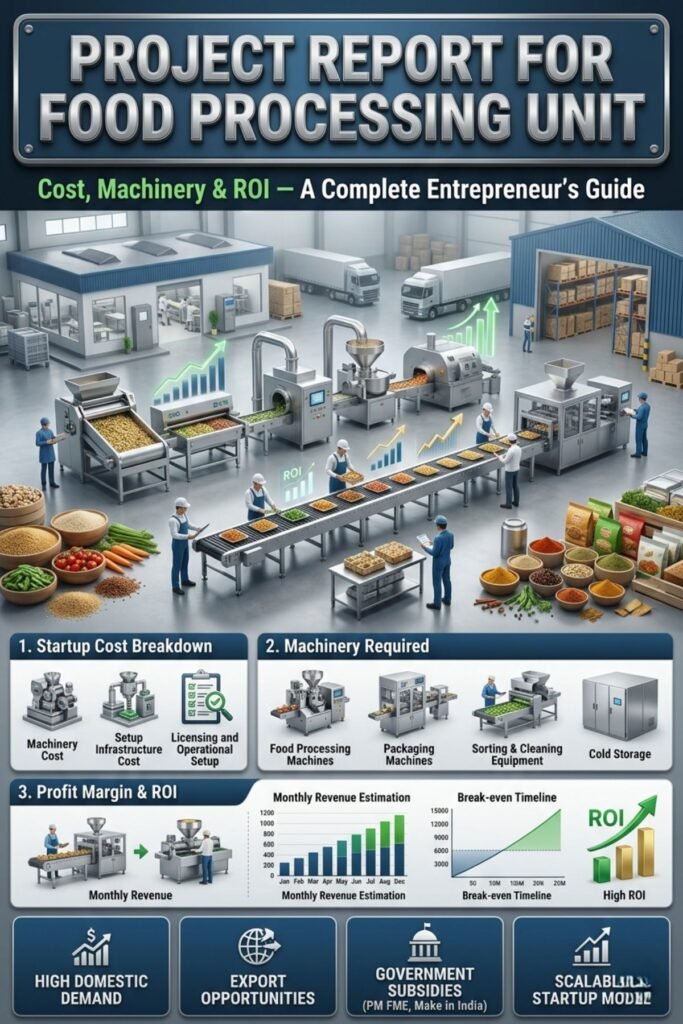
A small-scale food processing unit (SMF) with capacity for processing fruits, vegetables, spices or grains can be setup for ₹40–55 lakh. The cost for a medium scale unit (with cold chain, secondary processing & packaging facility) is ₹1.2-1.6 crore. It varies widely from product to product — perishable or shelf-stable, and depends on automation and leased or purchased land.
Space and Infrastructure
A minimum of 2,000 sq ft covered processing area is required for a small unit plus 500 sq ft of storage and utilities. Proximity of raw material sources is more important than proximity to markets — minimize input logistics cost first. In most states, lessees can rent industrial sheds in designated food parks under the PM Kisan Sampada Yojana for ₹8–15 per sq ft per month.
Key Machinery
- Sorting and grading line (electronic colour sorter + mechanical grader): ₹4-8 lakh
- Washing and blanching unit: ₹ 2- 4 lakh
- Cutting, slicing or pulping machine (stainless steel): ₹2-5 lakh
- Tunnel dryer or tray dryer (for dehydrated products): ₹5 – 12 lakhs
- Multi-head weigher + pouch packaging machine: ₹4-8 Lakh
- Cold room (10 MT capacity): ₹4–6 lakh
- Boiler (for cooking/sterilisation lines): ₹ 3-5 lakhs
The Coimbatore (TN), Rajkot (GJ) and Pune (MS) are the places with the reliable domestic machinery suppliers. For normal food processing machinery, Indian OEMs like Nilma Engineering, Bajaj Process pack and Kamdhenu Industries provide 12–24-month warranties along with local service networks.
Raw Material Sourcing
Find procurement groups within 100-150 km of your unit. For spice processing: Guntur, AP and Coimbatore. Fruit processing: Nashik and Solapur (Maharashtra) for tomato and mango. For grain milling: Karnal, Ludhiana (Punjab and Haryana). Direct FPO (Farmer Producer Organization) tie-ups bring down raw material cost by 12-18% as compared to open market procurement.(Food Processing Unit Setup Cost in India)
Licences and Approvals
- FSSAI Central or State Licence: Mandatory. Apply through the FoSCoS portal. State licence (turnover under ₹20 crore): ₹3,000–5,000 per year. Central licence (above ₹20 crore): ₹7,500 per year.
- MSME scheme benefits are available for free, online and free registration in Udyam.
- Employing 10+ workers doing power work requires a Factory Licence. Apply to the respective State Labour Department.
- GST Registration: compulsory if the turnover is more than ₹20 lakh (₹10 lakh in special category states).
- Pollution Control NOC: Consent to Establish (CTE) and Consent to Operate (CTO) from the State Pollution Control Board. Food units fall in the Green/Orange category and face minimal compliance burden.
- Packed commodities (atta, maida, suji) are covered under BIS Certification, it is mandatory for those commodities. Commercial, export-oriented units – voluntary supply.
Timeline and Team
Registration of Udyam till first production: 4-6 months. Registration and licences: 6-8 weeks. Douglas fir: 12-14 weeks. For Douglas fir, the time is 12-14 weeks. Trial production and calibration: 2-3 weeks. The initial number of workers needed for a small unit is 8-12 workers, which includes a production supervisor, 2 machine operators, 4-6 processing/sorting workers, and 1-2 packaging workers. A medium unit requires 18-25 staff members.
Table 2: Investment Breakdown — Small vs. Medium Food Processing Unit
| Cost Head | Small Unit (₹) | Medium Unit (₹) | Notes |
| Land & Civil Construction | 8,00,000 | 25,00,000 | Lease preferred; 2,000–5,000 sq ft |
| Primary Processing Machinery | 12,00,000 | 35,00,000 | Sorting, grading, washing line |
| Secondary Processing Equipment | 8,00,000 | 20,00,000 | Cutting, blending, cooking units |
| Packaging Machinery | 4,00,000 | 12,00,000 | Pouch/tray sealer, labeller |
| Cold Storage / Refrigeration | 5,00,000 | 15,00,000 | Essential for perishables |
| Utilities (Power, Water, ETP) | 2,00,000 | 6,00,000 | 3-phase connection mandatory |
| Working Capital (3 months) | 6,00,000 | 18,00,000 | Raw material, wages, packaging |
| Contingency (10%) | 4,50,000 | 13,10,000 | 10% of total project cost |
| TOTAL | 49,50,000 | 1,44,10,000 |
Source: NIIR Project Consultancy Services (niir.org); MoFPI project cost benchmarks
Find high-return business ideas based on your budget & ROI
Financial Snapshot
The capital expenditure is ₹40-55 lakh for small unit and ₹1.2-1.6 crore for medium unit.
Monthly Operating Cost: For a small unit with 60% utilization: ₹5-6 lakhs per month. This includes raw material (55–60% of cost), wages (12–15%), packaging (8–10%), power (5–7%), and overheads (balance).(Food Processing Unit Setup Cost in India)
Revenue Projections: A small unit, capable of processing 200 MT per month of raw material can produce:
- At 60% capacity: ₹7.5–9 lakh/month (₹90–108 lakh annually)
- At 100% capacity: ₹13–16 lakh/month (₹156–192 lakh annually)
Gross Margin: 28-35 per cent depending on product mix. Higher value products – such as dehydrated spices, fruit pulp, RTE foods – have a gross margin of 35-45%.
Net Margin: 18-24% after depreciation and after interest post-capacity. If capacity is 60%, the net margins will be 10-14%.
Payback: 3.5-5 years for small unit with 70-75% average capacity utilisation. Better economies of scale of medium units allow for payback in 4-6 years. Payback for units at food parks is reduced by 12 to 18 months due to reduced lease cost and subsidised utilities.
Table 3: Government Schemes — Eligibility, Benefit, and Access for Food Processing Units
| Scheme | Nodal Ministry / Body | Maximum Benefit | Eligibility | How It Helps |
| PMEGP | KVIC / MSME Ministry | 35% subsidy (rural) | New units, max project ₹50L (mfg) | Reduces capex burden for first-time entrepreneurs |
| PLI – Food Processing | MoFPI | Up to 10% incentive on incremental sales | Min investment ₹10 Cr | Boosts competitiveness for mid-to-large units |
| MUDRA Loan (Tarun) | SIDBI / Banks | Loan up to ₹10 Lakh | Micro enterprises | Collateral-free working capital |
| CGTMSE | SIDBI / MoMSME | Guarantee cover up to ₹2 Cr | MSME units without collateral | Enables credit access without property mortgage |
| PM Kisan Sampada Yojana | MoFPI | Upto 50% grant on project cost | Agro-processing clusters | Infrastructure & cold chain funding |
| Udyam Registration | MSME Ministry | Free registration | All MSME units | Mandatory gateway to all MSME scheme benefits |
Source: Ministry of MSME (msme.gov.in), MoFPI (mofpi.gov.in), SIDBI (sidbi.in)
Expert Project Planning: A Resource Worth Knowing
Niir Project Consultancy Services (NPCS) provides entrepreneurs with detailed project reports of food processing units that include the technical and financial details of the plants, such as the machinery specifications, plant layout designs, raw material requirement charts and techno-economic feasibility studies, prior to the decision to invest in the business. Their reports are cited by first generation entrepreneurs, bank loan officers and even by government scheme evaluators which appear regularly in entrepreneurindia.co. NPCS also provides end-to-end consultancy services for setting up a unit from site selection, regulatory approvals to production line commissioning. Structured NPCS feasibility report is an important document for any business person who is preparing a proposal for bank financing or a government grant.(Food Processing Unit Setup Cost in India)
Related Article: How to Prepare a DPR for Food Processing Unit in India (Project Cost, Profit & Bank Loan Guide)
ENTREPRENEUR SPOTLIGHT
Kavita Reddy is the Founder of SunDry Agrifoods, Kurnool, Andhra Pradesh.
Kavita Reddy established a project for chilli dehydration from the farmers in Guntur belt of ₹42 lakh with the help of PMEGP. Her unit was processing 18 MT of dried chilli in a month and exporting it to South Korea and UAE within three years of its establishment. The unit now has 22 employees—18 women. The one thing she has to share with everyone is that: “Buy directly from farmers and sell it directly to exporters, it does not matter, 8-12% margin will be taken by every middle man.
The Next Step Is Specific, Not Conceptual
Most of the entrepreneurs spend half a year thinking about the setting up of a food processing unit and 6 days for the setting up. It’s true that there is an informational imbalance — but it’s not impossible to overcome. The FSSAI licence portal is now available. PMEGP applications go through the Udyam portal and your District Industries Centre. Coimbatore or Pune machinery suppliers will provide you with a proforma invoice via email within 48 hours.(Food Processing Unit Setup Cost in India)
This week do just one thing. Choose the product you will process — not 5! Next obtain a techno-economic feasibility report from NPCS (niir.org) or hire project consultant in the local area. Then visit your local bank branch or District Industries Centre to inquire about the eligibility for PMEGP. The window to develop the manufacturing of such a processing unit where supply is greater than capacity is open — and it will not remain open indefinitely.
For more sector-specific project reports and entrepreneur case studies, visit entrepreneurindia.co.
Frequently Asked Questions
1. What’s the minimum investment required for a food processing unit in India?
A medium scale, single-product (e.g. Fruit, vegetable, spice, grain) food processing unit would require an outlay of approximately 40-55 lakh covering expenditure on plant & machinery, a minimum facility infrastructure, working capital and provision for contingencies. Medium-scale units requiring cold chain and packaging lines need between 1.2 – 1.6 crore. Government subsidy for projects in rural areas under the PMEGP scheme stands at 25-35% of the project cost thereby significantly reducing promoter’s equity investment required.
2. Which are the mandatory licenses to obtain before commencement of production?
Non-negotiable licenses are: FSSAI State or Central Licence (available through FoSCoS portal), Udyam Registration (udyamregistration.gov.in), GST Registration (when turnover is above 20 lakh), and a Consent to Establish (CTE) for pollution control, from the State Pollution Control Board. For an industrial unit, Factory License is an additional requirement when employing 10+ people with power. BIS certification is applicable only for specific packaged foods, e.g., flour products.
3. Where should raw materials be sourced from?
Locate the unit within 100-150 km from the major production zone of the commodity, for spices it’s the Guntur belt (AP) or Idukki (Kerala); for tomatoes, Nashik, Solapur or Chittoor; for wheat and rice, the Punjab-Haryana belt. Directly contract with farmer Producer Organizations (FPO) registered with NABARD or SFAC, who supply consistently in guaranteed grades at 10-18% less than market rates.
4. Is the business genuinely profitable?
Yes, provided the scale is appropriate, and the product mix right. Gross margins of 28-35% are realizable from vegetables, fruits, and spice products. Net margins of 18-24% are possible on optimal utilization of plant capacity. For direct retail or export, net margins are higher (>28%), skipping intermediaries. Poor raw material supply chains (chaotic) and low plant usage (<55%) kill profitability.
5. What are the ongoing government schemes applicable to food processing units?
Some of the active government schemes include: PMEGP providing 25-35% capital subsidy for new units, PM Kisan Sampada Yojana for cold chains and processing clusters (50% grant), PLI Scheme for Food Processing with sales-linked incentives from 4-10% for large units and MUDRA (Tarun) for working capital up to 10 lakhs without collateral. Consult the websites of Ministry of Food Processing Industries and MSME Ministry for details on scheme parameters.
6. How does NPCS assist in establishing food processing units?
Niir Project Consultancy Services (NPCS) are providing detailed project reports for over 500 categories of products which covers machinery details, plant layout, capital cost estimates, projections and license information that are accepted by banks, PMEGP appraisal bodies. Offer paid consultancy services for tailored feasibility studies. Visit niir.org or entrepreneurindia.co for their sectoral articles and project report schemes.