Introduction: Food Processing Business in India
The food processing industry in India is also in a robust growth cycle with government incentives, increased demand and high export potential. The government has already garnered over ₹9,207 crore investment under the Production Linked Incentive Scheme for Food Processing Industry (PLISFPI), and this sector is growing rapidly.
This has not changed much as India continues to process about 10 percent of its entire agricultural produce, whereas developed nations process 60 percent-80 percent. This gap is a clear indication that the industry is underdeveloped and is full of opportunities.
Meanwhile, the consumer habits are evolving very fast. The urban India is moving towards:
- Ready-to-eat meals
- Ready-to-cook products
- Packaged snacks and health food.
- Millet-based nutritious foods
This demand growth combined with supply gap is turning food processing into one of the most lucrative MSME business opportunities in India today.
Why Food Processing Is a High-Growth Business in India
India is able to produce huge agricultural production annually, but much of it is lost through poor storage and inadequate cold chain facilities. Heavy post-harvest losses are incurred on fruits, vegetables and perishable goods.
Urban consumers are on the other end with a sharp rise in demand. Over 500 million workforce is seeking convenient and hygienic and ready-to-eat food.
It is particularly growing in:
- Tier 1, and Tier 2 cities.
- Packaged food segment
- Frozen and processed food markets.
- Export-oriented food products
The increase in exports is also growing steadily, particularly to the Gulf countries, Europe and the USA, where Indian food products are gaining popularity.
This renders food processing to be one of the few industries in which both the domestic demand and export demand are increasing together.
Get Detailed Insights from This Book: Handbook on Fruits, Vegetables & Food Processing with Canning & Preservation (3rd Edition)
Government Schemes Supporting Food Processing Entrepreneurs
To support this sector, the government is implementing several schemes. The greatest among them is the PLI scheme, which offers financial benefits to the performance of business.
Key Government Support Programs
The following are the key plans that assist entrepreneurs to ease the pressure of investments:
- PLISFPI Scheme: -Incremental sales in approved categories attract an incentive of up to 10% on incremental sales.
- PMEGP Scheme – 15 percent to 35 percent capital subsidy on new units of MSME.
- PM Kisan Sampada Yojana- cold storage, food parks, and infrastructure support.
- MUDRA Loan Scheme Collateral free loans to 10 lakhs.
- Startup India Initiative – Tax incentives and access to funds to innovative startups.
A combination of these schemes helps in providing a lot of financial risk to the new entrepreneurs.
How to Start a Food Processing Business in India
It takes proper planning to start a food processing unit, yet the process is organized and can be handled step by step.
The initial is the choice of only one product category. Novices are not to attempt to deal with a variety of products at first. Focus areas include:
- Ready-to-eat meals
- Processing of fruits and vegetables.
- Millet-based products
- Frozen or packaged foods.
The machinery, raw materials, and requirements of the market are different in each category.
Place is also a significant factor. The unit must be ideally near sources of raw materials to minimise the cost and wastage of transport. For example:
- Maharashtra – fruits and vegetables.
- Andhra Pradesh – seafood
- Gujarat – marine and dairy products.
- Madhya Pradesh -millet products.
Investment Requirement
The business of food processing is both capital intensive yet scalable:
- Small unit: ₹80 lakh to ₹1.4 crore
- Medium unit: ₹2 crore to ₹3.1 crore
These are machinery, land or industrial shed, working capital, packaging and basic infrastructure.
Get Detailed Project Report (DPR): Fruits and Vegetables Value Addition and Food Processing Guide
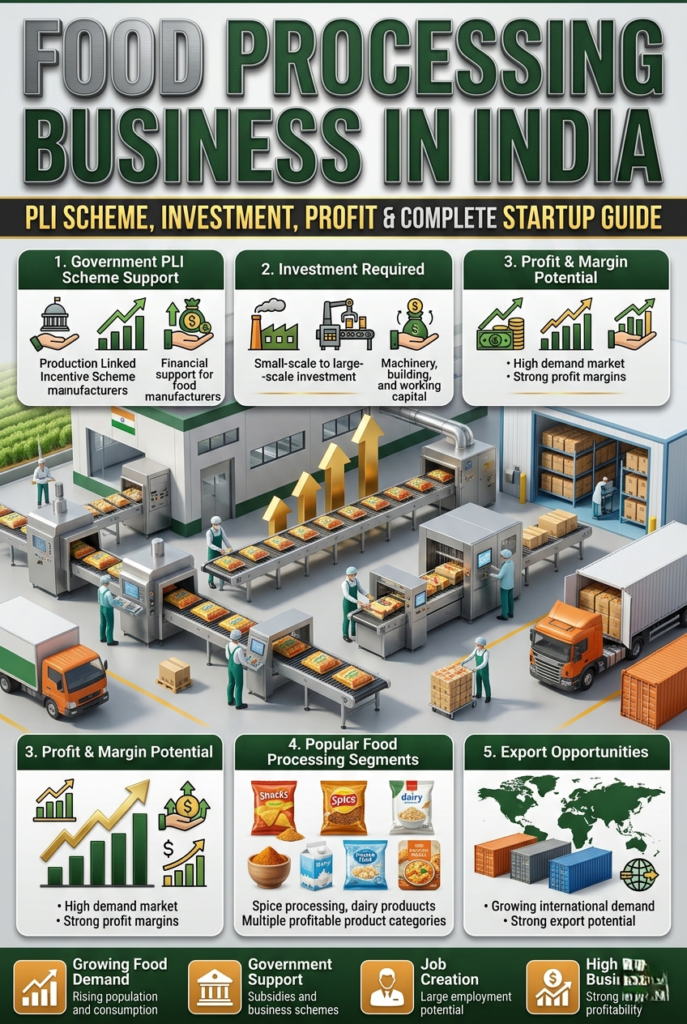
Key Machinery Required
A common system consists of:
- Washing and sorting machines.
- Processing equipment and cutting equipment.
- Drying systems or freezing systems.
- Packaging units
- Cold storage facilities
In the case of ready-made food, more cooking and mixing systems should be provided.
Licenses Required to Start the Business
Legal compliance is required before the production commences. The primary licenses are:
- FSSAI License (food safety approval)
- Udyam Registration (MSME status)
- GST Registration
- License of the Factory (when the number of workers is over the limit)
- Pollution NOC
- Registration at APEDA (in exports)
All approvals may be done simultaneously and therefore planning is crucial to prevent delays.
Build a profitable business with the right idea
Profitability of Food Processing Business
The food processing industry is a stable and scalable industry since the demand does not vary significantly across the year.
An intelligent mid-scale unit is able to produce:
- Revenue monthly: 18-40 lakh.
- Gross margin: 28% to 38%
- Net profit margin: 14% to 22%
- Payback period: 3.5 to 5.5 years
Government incentives available under the PLI scheme enhance the profitability even further, as it may contribute extra income to incremental sales.
Why This Is the Right Time to Enter the Market
There are three good reasons why 2026 is the right moment to start food processing in India:
To start with, government assistance is at an all-time high and there are several running subsidy programs.
Second, the consumption demand is increasing at a high rate because of the changes in lifestyles and urbanization.
Third, India is emerging as an export center of processed foods.
This duopoly forms a rare early mover advantage to new entrepreneurs.
Related Article: How to Start a Profitable Food Processing Business in India (₹10 Lakh to ₹1 Crore Ideas + Government Schemes)
Role of NPCS (NIIR Project Consultancy Services)
Any business that deals with food processing must be planned and this is where NPCS (NIIR Project Consultancy Services) comes in very handy.
NPCS is among the most reputable project consultancy organizations in India that has more than 45 years of experience in planning industrial and developing MSME.
What NPCS Provides
- Detailed Project Reports (DPRs).
- Techno-economic feasibility studies
- Machinery selection guidance
- Plant layout planning
- Cost analysis and financial projections.
- Regulatory advice and licensing.
Banks and other financial institutions also accept these reports highly in order to give loans.
Why NPCS is Important
- Eliminates possibility of making erroneous investments.
- Helps raises bank funds without difficulty.
- Presents entire business roadmap.
- Saves time on planning and implementation.
Reports and advice are available to entrepreneurs on niir.org and entrepreneurindia.co.
Conclusion
Food processing is among the greatest opportunities of MSMEs in India in 2026. The industry is expanding at a high rate as 9,207 crores has already been invested under the PLI scheme, consumer demand is high, and the export potential is high.
Early entrants that plan well can create very lucrative and expandable enterprises. Government assistance eliminates financial risk, and expert advice from organizations such as NPCS guarantees the success of decisions and projects.
Simply put, the opportunity has already been made- execution is now left to entrepreneurs.
Frequently Asked Questions (FAQ)
Q1. What is the investment that is needed in the food processing business in India?
Depending on the scale and machinery, a small unit will require approximately ₹80 lakh to 1.4 crore.
Q2. Is it a good business to process food?
Yes, net margins are between 14 and 22 percent and there are more government incentives that enhance returns.
Q3. What is the PLI scheme of food processing?
It is a government incentive plan where financial incentives are given in terms of incremental sales growth.
Q4. What is the most suitable food processing area to start with?
Ready-to-eat and ready-to-cook food segmentation is ideal because of the high demand and less difficult set up.
Q5. What is NPCS?
NPCS (NIIR Project Consultancy Services) offers Detailed Project Reporting, feasibility studies and full business planning support of MSMEs.