
The Delhi government’s far-reaching policy is poised to transform the startup ecosystem in one of India’s most prime locations. The Delhi Start-Up and Incubation Policy 2026 is one of the most significant state-level initiatives towards entrepreneurship in the national capital in decades, with a financial commitment of more than ₹400 crore and an aspiration to support over 10,000 startups, creating four lakh jobs.
Gone are the days of narrow technology sectors where the policy was focused on, this policy is institution first, with incubation infrastructure being built within the institutions such as universities, aided colleges, polytechnic and Industrial Training Institutes (ITIs). The first phase will roll out to 11 state institutes of universities and 13 government-aided institutes of colleges, thereby establishing a distributed network of launchpads for student entrepreneurs, researchers, and first-generation entrepreneurs.
This isn’t just a government notification for entrepreneurs, manufacturers, investors, service providers, and MSMEs. It’s a commercial signal: Delhi is set to create a demand for incubation infrastructure, mentorship services, technology products, institutional consulting and entrepreneurial support services that will have public funding and structured support. The benefit of having woken up at the right time is that those who did have a lot to gain from a startup culture that policy drives in India’s political and commercial hub.
What This Development Means for Indian Businesses
Commercial core of the Delhi Startup and Incubation Policy 2026 is the creation of a structured and time-bound institutional market which most government schemes do not do. When the Government dedicates a specific budget of ₹400 crore to establish and maintain incubation centres in educational institutions, a chain of demands arises immediately.
Institutions need to be equipped — physically and operationally. This includes office furniture, co-working space facilities, audio-visual technology, broadband connections, software tools and security systems. In addition to infrastructure, there is a need for qualified mentors, program managers, legal advisors, accounting support, HR consultants, IP professionals, and marketing experts for each of the incubation centres.
The opportunity for manufacturers and MSMEs is multi-faceted. Product manufacturers of office equipment, modular furniture, computer hardware, networking infrastructure and software will become immediate institutional buyers. Legal tech, fintech, education tech and management consulting service providers will find a government backed stream of small businesses looking for their help.
Related Article: Top 10 Industrialists of Delhi NCT: Success Stories, Business Ideas, and Future Vision
By design, startups in this ecosystem will be buyers as well. As they progress from proof-of-concept to prototypes and prototypes to market, they will require raw materials, packaging, logistics, manufacturing partners, marketing agencies and technology services. With this policy, the Delhi government is basically assuring the creation of a new set of such buyers in a systematic manner in the coming five years.
Deal flow is a benefit to investors and angel networks as well. Once the startups can reach the market validation stage, they will need seed investment, experienced entrepreneurs’ guidance and access to institutional investors. The policy is complimentary to the Startup India initiative and is likely to offer a great opportunity to early-stage investors in the city in terms of deals. The policy is also aligned with the Startup India initiative and is likely to bring a lot of opportunities for deals for early-stage investors in the city.
Why This Industry Could See Stronger Growth
The startup ecosystem in Delhi has not excelled historically, compared to its institutional advantages. It is home to some of India’s most esteemed universities and research institutions, a vibrant professional services sector, a close proximity to the central government decision makers as well as more than 32 million consumers. However, even with these assets, the city of Delhi did not show the growth of the number of registered startups as compared with Bengaluru, Mumbai, and Hyderabad in the last decade.
The structural gap is directly addressed by the 2026 policy.
It puts startup support within educational institutions, targeting the most critical phase of the entrepreneurial process: the student and recent-graduate.It places the startup support within the educational institutions, addressing the initial phase of the entrepreneurial process, where most of the ideas fail due to the lack of infrastructure and guidance. The policy provides a structured journey from idea to viable business with milestone-based financial support that covers proof of concept, prototype development, product development, market validation and commercialisation.
This policy has a number of macro-level factors that magnify its commercial effects. India has seen a 570-fold rise in startups from about 350 during 2014 to more than 2 lakh today. With its talent pool size, Delhi is now poised to grab a much bigger portion of this growth. Further, the growing digital economy in India, the various policy initiatives such as PLI schemes in different sectors and Startup India by the central government provide a positive structural background.
The National Education Policy 2020 gives greater focus to experiential learning and nurturing an entrepreneurial culture, further reinforcing its long-term influence. With NEP changing the way students interact with knowledge and industry, the incubation centre is the ideal link that connects education with entrepreneurship, which is already present within academic institutions.
Government Policies and Incentives
The Delhi Startup and Incubation Policy 2026 sits within a broader ecosystem of central and state government support that entrepreneurs and investors can leverage.
At the central level, the Startup India initiative led by DPIIT offers recognised startups benefits including income tax exemptions for three consecutive years, relaxation of labour and environmental law compliance, access to ₹10,000 crore in Fund of Funds, and a simplified winding-up process. Delhi-based startups that emerge from incubation centres will be well-positioned to qualify for DPIIT recognition.
The Ministry of MSME offers several complementary schemes, including the Prime Minister’s Employment Generation Programme (PMEGP), the MSME Credit Guarantee Scheme, and the Technology Upgradation schemes under the Credit Linked Capital Subsidy Scheme (CLCSS), which are directly relevant to manufacturing-oriented startups emerging from incubation centres.
The Department for Promotion of Industry and Internal Trade (DPIIT) administers the Production Linked Incentive (PLI) schemes that benefit startups expanding into manufacturing, and manages the Industrial Park Rating System that could benefit incubation-linked industrial clusters in Delhi.
At the state level, the Delhi Government Department of Training and Technical Education is the nodal department implementing the 2026 policy, managing fund disbursement to institutions, overseeing incubation centre establishment, and coordinating mentorship programmes across polytechnics and ITIs.
Get Detailed Insights from This Book: Our Books
The Delhi State Industrial and Infrastructure Development Corporation (DSIIDC) plays a crucial role for manufacturing-oriented startups in Delhi, offering industrial plot allocation, common facility centres, and cluster development support that complement the incubation policy.
Entrepreneurs can further explore the Udyam Registration Portal to formally register as MSMEs and unlock the full suite of central government benefits including priority sector lending, government procurement preferences, and protection against delayed payments.
The National Science and Technology Entrepreneurship Development Board (NSTEDB) under the Department of Science and Technology supports science-based incubation through its TIDE 2.0 and NIDHI (National Initiative for Developing and Harnessing Innovations) programmes, which align closely with what Delhi’s campus incubation centres aim to achieve.
For export-oriented businesses emerging from Delhi’s startup ecosystem, the Export Promotion Council for EOUs and SEZs (EPCES) and the broader network of APEDA, MPEDA, and other commodity-specific export promotion councils offer market access, trade fair support, and export credit guarantees.
Finally, the Atal Innovation Mission (AIM), NITI Aayog operates one of the world’s largest school innovation programmes through Atal Tinkering Labs and supports incubators through the Atal Incubation Centre network, which can complement Delhi’s institution-level incubation push and provide national-level visibility to startups emerging from Delhi’s campuses.
Manufacturing Business Opportunities Emerging From This Development
With the advent of a large-scale Start-up and Incubation ecosystem that the government supports in Delhi, the opportunities for setting up a manufacturing business are different, and mainstream investors have still not explored many of them.
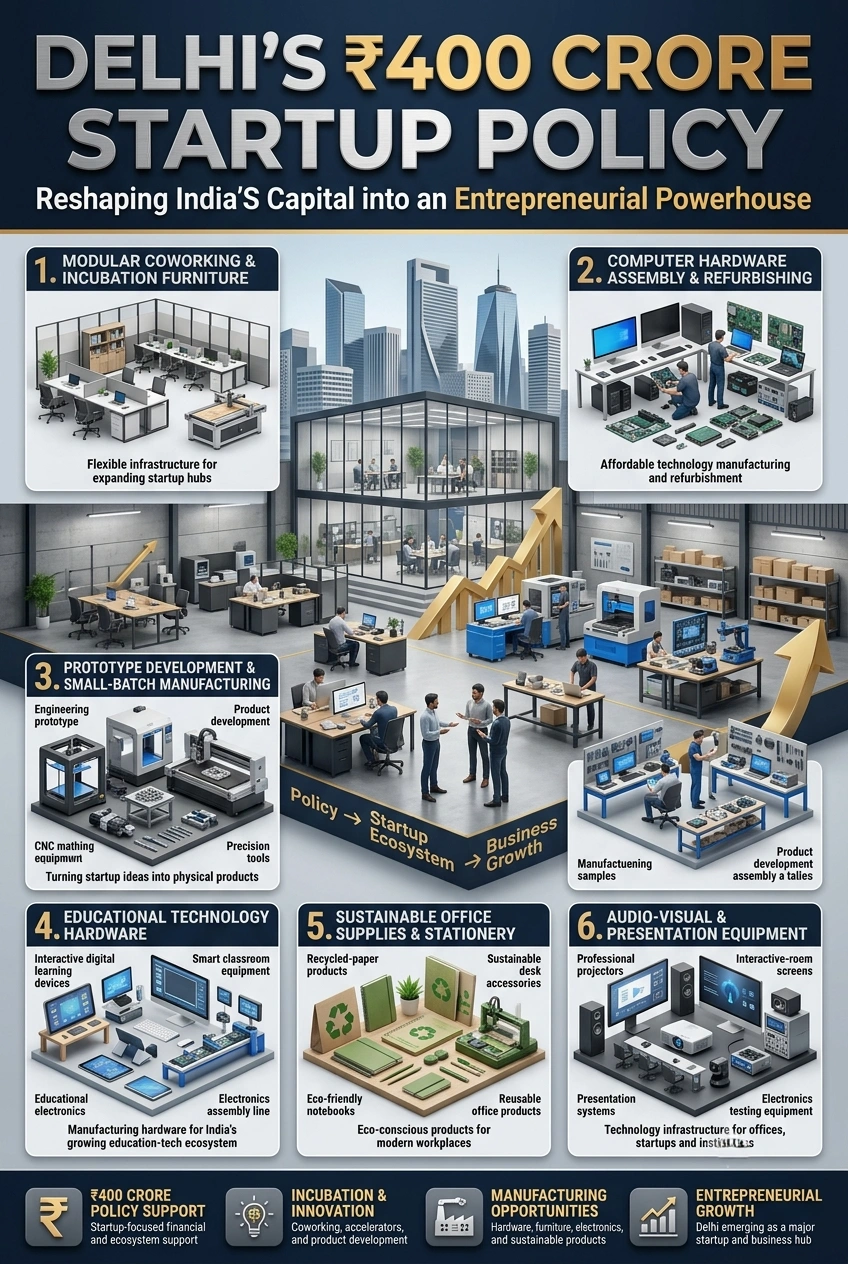
1. Modular Coworking and Incubation Furniture Manufacturing
With the opening of 24-plus institutions that have created or enhanced incubation centres, these institutions now have an immediate demand for purpose-built, modular office furniture for flexible workstations, collaboration pods, standing desks, locker systems, and movable partition panels. The strategic location of Delhi-NCR, especially with respect to its furniture manufacturing hubs at Okhla, Noida and Faridabad, is putting local players in a strong position to bid for the institutional supply of furniture. MSMEs that are quality checked and have competitive prices can avail government procurement opportunities on the GeM portal. There are export opportunities to the similar incubation ecosystems in Southeast Asia and Africa. The capital investment in this segment can be moderate, and medium to high scalable.
2. Computer Hardware Assembly and Refurbishing Units
New incubation centres need computers, servers, networking devices and peripherals. Multinational brands still rule new hardware but refurbished and assembled budget hardware units, especially in early-stage startups, offer a good opportunity for MSMEs to make some value-added products and make a profit. The electronics clusters in the Delhi region can focus on anchor customers like incubation centres, ITIs and polytechnics. There is also local procurement under the Government Electronics and IT Application Centre (GeITAP) framework. There is a high potential for scaling, raw material supply chains are in place and export to developing markets is feasible.
View Full Project Details: Computer Assembling Unit – Detailed Project Report & Business Plan
3. Prototype Development and Small-Batch Manufacturing Services
A very business-friendly opportunity is the creation of rapid prototypes and small-scale production of start-ups coming out of incubation. As hundreds of student-started businesses try to bring their concepts to the real world, they require access to 3D printing, CNC Machining, PCB manufacturing, injection moulding and small run electronics assembly. MSMEs would have their own regular client base as soon as they set up prototype manufacturing service units close to the major university incubation clusters in the city of Delhi, where the client base would be growing, and hence policy-oriented. This segment could be a good export opportunity for providing service to global startups for cost-effective prototyping.
4. Educational Technology Hardware Manufacturing
For innovation programme, Incubation centres (IC) in Schools, Polytechnics and ITIs will need IoT kits, Robotics kits, Raspberry Pi based learning kits, sensor kits, and electronics tinkering equipment. However, there are currently Chinese imports that dominate this space and to compete with those imports, the country has to have domestic manufacturers producing these items. An institutionalized demand for the Delhi policy emerges, and Indian manufacturers can tap it through dedicated supply agreements and government procurement. Raw materials are mostly importable, and value addition and assembly is possible locally at low capital expense.
5. Sustainable Office Supplies and Stationery Manufacturing
As incubation centres are by nature a high-consumption area of stationery, notebooks, folders, whiteboards, markers and packaging for start-up activities are all consumed in the centre. MSME manufacturers, who make environmentally friendly stationery products, recycled papers, and biodegradable office supplies, can benefit from the rising trend of sustainable procurement as outlined by the green public procurement guidelines that India has adopted. The number of institutional buyers in a small geographical area in Delhi lowers the logistics cost and allows for easy reordering contracts.
6. Audio-Visual and Presentation Equipment Assembly
Projectors, interactive display panels, audio systems, video conferencing equipment and digital signage support seminar halls, mentorship rooms and startup pitch spaces in incubation centres. Brands are winning in high-end market, assembly and value-added manufacturing of mid-range AV systems provide opportunity for domestic brands. Natural support in electronics and IT hardware manufacturing cluster of Delhi-NCR in NOIDA and Greater NOIDA. Government bulk purchasing contracts of institutions can ensure revenue visibility.
Import-Export and International Market Opportunity
Export Opportunity
Delhi’s Startup policy sets up a government-recognised and recognised startup ecosystem, thereby making the city an investor-friendly and partner-friendly entrepreneurial hub. This has spillover benefits in terms of export. It is easier to imagine that startups developing software products, digital platforms or technology-driven services will naturally go for the global market. The software services export market in India is already worth over USD 150 billion per year and student startups in sectors such as edtech, fintech, healthtech and agritech are always coming up with products that are globally scalable.
Further, in the case of physical products making (such as hardware, speciality materials, sustainable products and niche industrial products) various startups will be eyeing nations such as Southeast Asia, Middle East and Africa where the Indian SME exporters will have competitive price advantages. With the milestone funding scheme of the policy, there will be more startups that receive funding to the prototype and commercialisation stages, and will have enough time to consider export as a strategic option.
Import Substitution
Presently, there is much reliance on imported infrastructure for the incubation ecosystem. The major providers of 3D printers, CNC machines, printing and fabrication of PCBs, robotics kits, and IoT development boards for innovation labs are mostly from China, the United States, and Germany. The electronics and capital goods manufacturing PLI schemes in India, together with the policy signal in Delhi, makes a strong case for domestic manufacturers to invest in these products and/or components in India. Likewise, every educational technology originating in the hardware space such as a drone kit, sensor arrays, etc. is a huge opportunity for Indian manufacturers to substitute imports from international vendors, especiall’y in the start-up and innovation sector.
Indian MSMEs and Startups in Related Industries
Skillate (Now Skilio) – AI-Powered HR Tech
Skillate started with the support of various institutions and the network of IIT’s, and emerged as one of the reputed AI-powered recruitment technology companies in India, and later progressed to the Skilio platform on skill-based hiring. The story of how it went from an idea on campus to an institutional product illustrates a possible route for startups based in Delhi that incubators support. AI-driven SaaS products tackling problems within the institutional HR space can reach commercialization quickly with structured incubation, which entrepreneurs can learn about.
Dozee – Healthcare Monitoring Innovation
Dozee is a India based startup, which came up with a patient monitoring system for non-contact patients in a research and academic environment. The company showcased the potential of a hardware-software integrated health technology product that structured support helped develop to meet the real need of an institution and scale up and commercialize. The Delhi story of the incubators is a testament to the power of institutional innovation, when paired with milestone funding and mentorship, and especially in the context of university incubators with medical or engineering schools.
Infollion Research Services – B2B Expert Network
Infollion, based in the Delhi NCR, constructed a B2B domain expert network that facilitated institutional clients to connect with domain experts. It highlights the business opportunity of organizations providing the institutional knowledge economy – the very ecosystem Delhi’s policy will enable, on a larger scale. With the increasing number of incubation centres, there will be a demand for the creation of expert networks, research services, mentorship platforms, and advisory marketplaces. If you’re an entrepreneur creating services that support the start-up community in the city of Delhi, then you can refer to Infollion’s model.
What Entrepreneurs Should Evaluate Before Investing
The rise of a big policy driven startup ecosystem in Delhi is an opportunity, but needs to be assessed carefully for feasibility prior to investing.
- Market Demand: Locate existing institutions in the first rollout and pinpoint supply or service gaps. Never take it on faith that there is generic demand; check specific procurement needs by institutional outreach.
- Raw Materials: For manufacturing opportunities relating to the infrastructure of the incubator, consider whether it is easier to get raw materials from home or from abroad and whether the supply chains are reliable, especially those for electronics components.
- For technology and machinery: decide if necessary, production technology is available in the country, can be imported by existing trade frameworks or needs technology transfer agreements to be made.
- Delhi-NCR has logistical benefits for institutional supply, however, the cost of land available for industries is high. Compare and scrutinize Noida, Greater Noida, Ghaziabad and Faridabad as production centres with Delhi institutional buyers.
- Manpower: Skilled technicians for prototyping, electronics assembly and AV systems are available in Delhi-NCR but there is competition for retention. Plan for training and higher than market wages for skilled positions.
- Working Capital: Government institutional supply typically involves 30–90 day payment cycles. Working capital planning must account for this lag, particularly for early-stage suppliers.
Your investment deserves the right opportunity
- Quality Standards: Institutional government procurement may require BIS certification, ISO compliance, or specific quality documentation. Ensure product quality systems are investment-ready before targeting government buyers.
- Regulatory Requirements: MSME registration, GST compliance, GeM portal registration, and sector-specific approvals must be in place before targeting institutional procurement.
- Competition and Pricing: Established suppliers with existing government contracts will compete for incubation centre supply. Differentiate through quality, customisation, or green credentials rather than pure price.
- Scalability: Delhi’s policy covers Phase 1 institutions — but if the model succeeds, replication across all Delhi institutions and potentially other states will expand the market significantly.
- Risk Management: Policy implementation timelines in India can shift. Build conservative revenue projections and do not over-invest in fixed assets until procurement orders are confirmed.
How NPCS Can Help Entrepreneurs Evaluate the Opportunity
NPCS – Niir Project Consultancy Services is one of the leading industrial project consultants in India, and serving entrepreneurs, investors, and institutions with their complex feasibility decision-making processes in manufacturing, services, and emerging industries.
Furthermore, NPCS provides detailed project feasibility reports, market research, DPR (Detailed Project Report) Preparation, Plant & Machinery assessment, technology sourcing and manufacturing project planning supports for businesses looking at evaluating opportunities in the startup and incubation ecosystem in Delhi as infrastructure supplier, service provider, technology manufacturer and investment partner.
Moreover, with structured knowledge of parameters like capital requirement, operational viability, market positioning, regulatory compliance and risk parameters, NPCS’ consultancy approach assists entrepreneurs in progressing from opportunity identification to investment decision. Therefore, this type of specialized feasibility assistance can mean the difference between a well-informed and successful entry into the institutional supply chain, and a costly miscalculation, for MSME manufacturers seeking such opportunities.
Business Opportunity Snapshot
| Industry | Startup Ecosystem, Incubation Infrastructure, EdTech, Manufacturing Support |
| Market Driver | Delhi Startup and Incubation Policy 2026 — ₹400 crore government allocation over five years |
| Key Development | Government-funded incubation centres across 11 universities, 13 colleges, ITIs, polytechnics, and schools in Delhi |
| MSME Opportunity | Institutional supply of furniture, hardware, AV systems, stationery; prototype manufacturing services; EdTech hardware |
| Manufacturing Potential | Modular furniture, computer hardware assembly, IoT and robotics kits, sustainable stationery, AV equipment assembly, small-batch manufacturing |
| Export Potential | Technology products, software services, and hardware developed by incubated startups targeting global markets; manufacturing MSMEs exporting to Southeast Asia, Middle East, and Africa |
| Import Substitution | 3D printers, PCB equipment, IoT boards, robotics kits, innovation lab tools currently imported from China, USA, Germany |
| Government Support | Delhi Startup Policy 2026, Startup India (DPIIT), MSME schemes, AIM-NITI Aayog, NSTEDB, GeM procurement, DSIIDC |
| Investment Consideration | Moderate to medium capital for manufacturing; low to moderate for services; working capital buffer required for institutional payment cycles |
| Risk Level | Moderate — policy implementation timelines may vary; competition from established institutional suppliers; regulatory compliance essential |
| Growth Outlook | Strong — 10,000+ startups targeted; institutional demand over 5 years; potential policy expansion to additional states |
Conclusion
Delhi’s Startup and Incubation Policy 2026 is not just an administrative policy; rather, it is a policy rooted in institutions, a signal that is ₹400 crore. Similarly, Delhi’s Startup and Incubation Policy 2026 is not just an administrative document, it’s a policy with a strong structural dimension and a cost of ₹400 crore, a signal that Delhi is preparing for a wave of entrepreneurship in a systematic manner, that comes from institutions. Furthermore, the policy offers practical, measurable and timebound commercial demand across different industries, with 10,000 startups targeted, 4 lakh jobs envisioned, with a distributed incubation network in place across universities, colleges, polytechnic and ITI and schools.
Moreover, manufacturers can benefit from specialized incubation infrastructure, hardware provision and prototype manufacturing services. In addition, there is an increasing number of early-stage start-ups that need legal, financial, technical, and marketing assistance from service providers, and the policy meets their needs. As a result, the ecosystem is a curated pipeline of government-validated, mentor-supported ventures which will hit a fundable stage at a predictable timeframe for investors.
Therefore, now is the time to get ready for this demand.
The entrepreneurs who have already done the mapping of procurement requirements, setting criteria for suppliers and registering their entrepreneurship on GeM portal will have the first preference for supply contracts and service relationship in the process of establishing the incubation centres in the institutions.
First, structured market research is the first step, to find the most commercially viable opportunities; second, the second step is a professional feasibility study, third, the third is to compile detailed project reports and finally, the fourth is to plan investments systematically. Overall, it’s one of the more notable business opportunity signals from the Indian capital in recent years, due to a mix of government policy support, institutional demand and the larger startup boom in India.