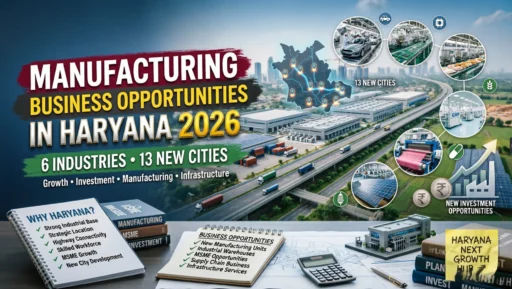
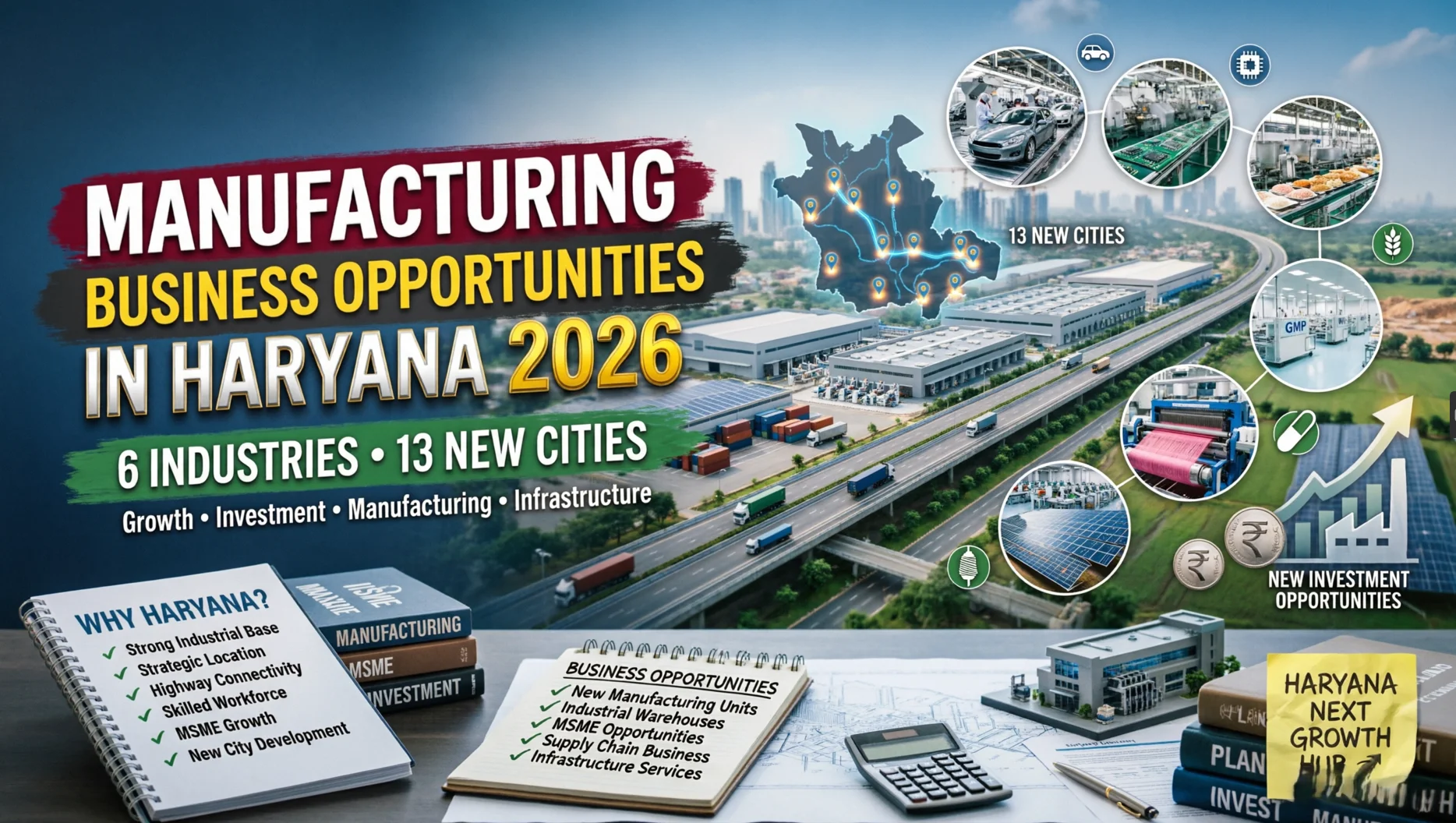

India has been undergoing a rapid urbanization, and it is being driven by Haryana. The Haryana government, in a first of its kind move, has started the process of developing new sectors in 13 cities with the acquisition of about 33,000 acres of land. The Haryana Shahari Vikas Pradhikaran (HSVP) is leading this initiative, which aims to be implemented in various cities, such as Gurugram, Faridabad, Panchkula, Hisar, Panipat, Sonipat, and Yamunanagar.
This is not some nebulous policy statement. The process of land procurement is already underway at HSVP’s e-Bhoomi platform in a phased manner and the first new sectors will go live in the coming years by 2026/27. For entrepreneurs, MSMEs, manufacturers and investors, it’s easy to see that India’s fastest growing state is undergoing a construction supercycle of sorts, which experts expect to last for several years.
In the new sectors, there is new road, new house, new commercial, new industrial pockets, all of which demand raw materials, manufactured products, skilled services and infrastructure products. This is a window of opportunity that is invaluable to the founders who know how to leverage it.
What This Urban Development Plan Means for Business
The scale of Haryana’s ambition is reflected in its land acquisition plan. HSVP is buying around 33,000 acres in 13 cities in the first major urban development initiative in almost 20 years by the government. The move comes after the merger of the Haryana Housing Board with HSVP, marking a departure from the state’s previous approach of growth by private developers.
What Happened
The government of Haryana has initiated a land procurement process in phases via its digital platform “e-Bhoomi”, which is a land sale platform based on consent. In Phase 1, around 17,300 acres were covered in Gurugram in 51 new sectors. The following phases include Sohna, Pataudi, Faridabad, Panchkula, Hisar, Panipat and further.
Why It Matters
For the past about 20 years, no noteworthy government backed residential and commercial complexes have been built in Haryana. A policy change on this scale instantly generates demand for construction materials, prefab components, finishing materials, municipal hardware, urban furniture, dozens of other manufactured products and more.
Who Should Pay Attention
- Entrepreneurs: First-mover advantage in supply chains to new urban clusters
- MSMEs: Local preference for construction inputs and civic goods
- Cement Adjacent: Captive demand for steel goods, pipes, tiles, wiring and other products.
- Investors: Real assets that have a government-backed demand, and linked to infrastructure.
- Exporters: Export capacity generated in Haryana will be absorbed by the existing industrial corridors.
- Smart Solutions: Startup Founders from PropTech, ConTech and FaciliTech: new sectors in Haryana needs smart solutions.
NPCS Insight
Increased urbanization on this scale creates a demand cycle for construction-related industries of 5-7 years. Early movers who invest now (when land acquisition is still in Phase 1) will be making at full capacity by the time peak construction demand hits in 2027-2029.
Why the Construction & Urban Infrastructure Sector Is Surging
In India, the urban population is estimated to be 600 million by 2031. Haryana lies between Delhi and some of the most industrialised routes of the country and is at the heart of this transition. The state is looking into starting new industries not only in the NCR satellite cities but also in Tier 2 cities like Hisar, Yamunanagar and Rohtak where the cost of land and the manufacturing setup is much lower.
This growth is being driven by multiple structural forces at the same time. The Central government is pouring billions into Haryana’s urban infrastructure projects through ministries under PM Awas Yojana Urban 2.0, AMRUT 2.0 and Smart Cities Mission. On top of this, comes the state’s self-written ‘Make in Haryana Industrial Policy 2026′ which is business friendly. These all indicate that there will be a construction and urban materials boom that will continue beyond 2030.
It will cover residential, commercial, institutional and industrial areas, thus benefiting manufacturers serving any of these areas.
Government Policies & Incentives Powering This Opportunity
Haryana has assembled one of India’s most comprehensive incentive stacks for new industrial entrants. Understanding these policies is half the battle for entrepreneurs considering a manufacturing unit in the state.
Make in Haryana Industrial Policy 2026
Launched in 2026 and detailed on the Haryana Industries & Commerce Department website, this policy offers capital subsidies of 5–20%, 100% electricity duty exemption for 10 years, net SGST reimbursement for 7 years, and employment generation subsidies up to ₹1 lakh per employee per year. Large units with Fixed Capital Investment above ₹125 crore qualify for enhanced benefits.
Haryana Progressive MSME and Export Promotion Policy 2026
Complementing the large-industry policy, MSME units receive capital subsidies of 15–30%, export freight assistance up to ₹30 lakh per year, and interest subvention of 3% on export credit. This makes Haryana one of the most MSME-friendly states for manufacturing startups.
HSIIDC Plug-and-Play Factories
The Haryana State Industrial and Infrastructure Development Corporation (HSIIDC) is developing ready-built factory sheds with pre-approved utilities across key industrial estates. New entrepreneurs can start operations almost immediately, drastically cutting project gestation time.
HSVP e-Bhoomi Portal
The HSVP’s e-Bhoomi portal enables consent-based land transactions, reducing dispute risk and accelerating sector development timelines.
PM Awas Yojana Urban & AMRUT 2.0
Central government schemes accessed via Ministry of Housing and Urban Affairs funnel additional capital into housing, sanitation, water, and road infrastructure — all driving demand for manufactured inputs.
National MSME Support
Entrepreneurs can access technology upgradation support, cluster development funds, and credit guarantee coverage through the Ministry of MSME. Combined with Haryana’s state incentives, this substantially reduces the cost and risk of entering manufacturing.
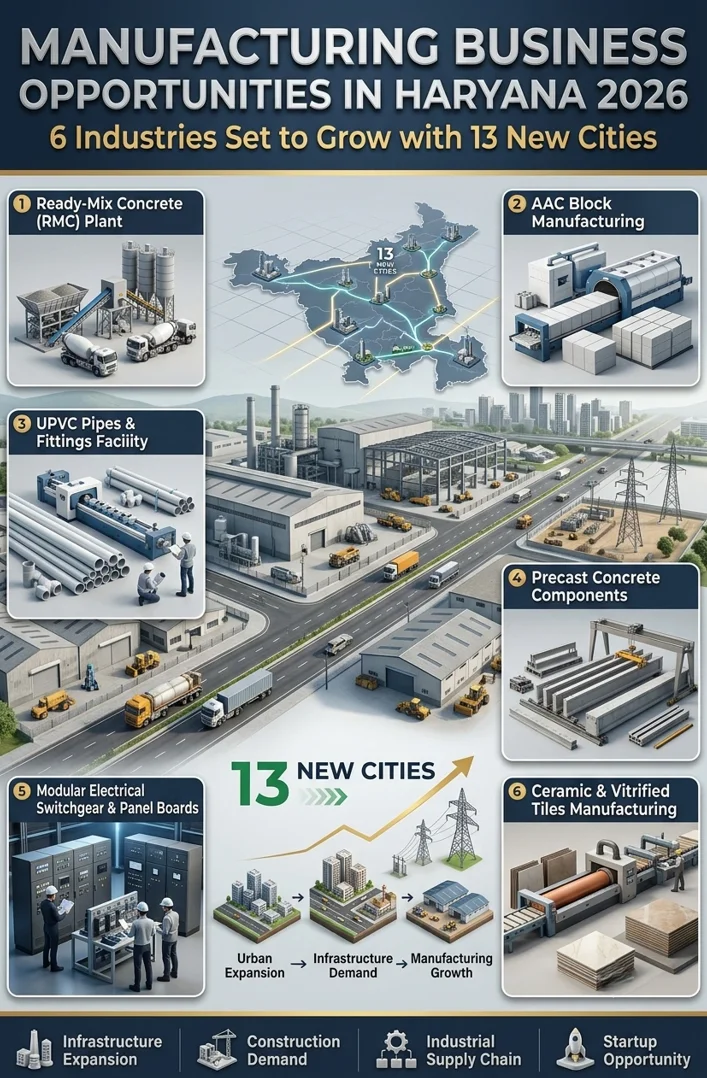
6 High-Potential Manufacturing Business Ideas Emerging from This Development
All the following opportunities directly respond to the demand that new sector development will create in each of the 13 cities in Haryana. These ideas are not generic; they address supply-chain gaps that will emerge as developers clear land, lay roads, and build structures.
1. Ready-Mix Concrete (RMC) Plant
There is a need for vast quantities of concrete for roads, foundations, boundary walls and civic structures in the developing of new sectors. The RMC plant operates near growth corridors in Gurugram, Sohna, Faridabad, or Hisar, and it can provide premium rates for RMC to developers, HSVP contractors, and private builders. For the setups, the cost is in between ₹2–5 crore based on the capacity. Demand is regular and contract dependent in peak construction time.
Related Article: Read the Complete Guide to Ready Mix Concrete Business
2. AAC Block (Autoclaved Aerated Concrete) Manufacturing
Today, AAC blocks have replaced the traditional red brick walling material in India for their high performance in various aspects such as their lightweight, rapid installation, insulation capabilities and adherence to contemporary construction codes. A mid-scale AAC plant (100,000 – 300,000 m³/year) set up in Haryana can serve AAC producers in the NCR-Haryana area.There are dozens of new residential sectors in 13 cities, a mid-scale AAC plant located at Haryana can support the builders in the NCR-Haryana area. The possibility of import substitution becomes high when the demand increases more than their supply.
View Full Project Details: AAC Blocks Manufacturing: Complete Project Report & Business Guide
3. UPVC Pipes and Fittings Facility
A whole system of water supply pipes, drainage pipes, sewage main and rain water pipes is needed in each new project in the ground. The pipes used in HSVP projects are standard, usually UPVC pipes. A pipes manufacturing unit of 2,000 to 5,000 MT caters to a market that can be reasonably expected to be met by the governments tenders and the private sector of building construction. The existing industrial estates of Haryana, located at Bawal, Kundli and Faridabad are appropriate sites.
Get Detailed Project Report (DPR): UPVC Pipes Manufacturing: Complete Project Report & Business Guide
4. Precast Concrete Components Manufacturing
The urgency to establish new sectors rapidly is a positive factor for HSVP in favour of precast structures, which factories make and deliver as components such as slabs, staircases, boundary panels, utility chambers and much more — components which save on-site labour and construction time. A precast site located near an active development corridor can serve both HSVP projects and private developments. This segment is under served in Haryana as compared to Gujarat and Maharashtra, thus there exists a real opportunity for well capitalised players to come into the market.
Read the Complete Book Here: The Complete Book on Cement & Concrete Products Manufacturing
5. Modular Electrical Switchgear and Panel Boards
Distribution boards, MCB, MCCB, bus bars and switchgear are required for every new residential and commercial building. Electrical wiring devices and panel boards will be closely following construction, with thousands of new units expected to appear in 13 cities. A switchgear assembly unit for institutional and builder procurement is an entry that is less capital heavy with higher repeat demand. The ‘Make in India’ focus on locally made electrical products will also bring export relevance for the Gulf countries and Africa.
Access Complete Business Plan: Explore the Modular Electrical Switches Manufacturing Guide
6. Ceramic and Vitrified Tiles Manufacturing
The flooring and wall tile are important inputs per residential unit with a high value. Haryana is presently reliant on Gujarat for tiles. A medium scale vitrified tile plant in the vicinity of Bawal, Rewari or Hisar where Gas connectivity and industrial facilities are available can directly serve the Haryana, Delhi and western up markets. New sectors being developed need thousands of apartments and commercial units and this will keep the demand of tiles going for years.
View Full Project Details: Read the Complete Book Here
Import–Export Opportunity Analysis
Export Opportunities
The state is also well connected to the port of JNPT and Mundra port through NH-48 and is on the Delhi–Mumbai Industrial Corridor (DMIC), which makes it a better export hub for the state. The manufacturing of construction materials, electrical components and prefab structures in Haryana can supply the East African market, Saudi Arabia and the UAE, all of which are in the throes of massive urban development. The demand for AAC blocks and precast components in particular is increasing abroad.
Import Substitution
India today imports considerable quantities of high-specification building hardware. It also imports high-grade ceramic tiles from China and Spain. Some electrical switchgear components are also imported. New manufacturing units in Haryana can target these imports directly. These units can benefit from PLI incentives and MSME credit facilities. In government procurement, preference is given to locally produced goods. This provides an immediate market in public projects.
International Demand Context
With Saudi Vision 2030, Expo City Dubai’s rapid growth, and Qatar’s infrastructure development after the World Cup, the GCC is driving demand for India’s construction inputs. This is creating large-scale opportunities for Indian suppliers.
Under the new MSME & Export Promotion Policy 2026, MSMEs across Haryana can benefit from export incentives. Businesses exporting UPVC pipes, electrical panels, and prefabricated components can avail export freight assistance and credit incentives.
Indian MSME Success Stories in Related Sectors
1. Nuvoco Vistas Corporation – Cement and RMC
Nuvoco, which started off as a medium-scale cement business in Rajasthan, expanded its operations to Ready-Mix Concrete (RMC) business in NCR and Haryana by catching the demand for infrastructure projects early. The company’s RMC division now provides support to NHAI projects, metro construction and private developers. Their course is a template for the MSMEs addressing urban expansion in Haryana.
2. Hind Rectifiers Ltd & Small Switchgear MSMEs – Faridabad Cluster
There is a strong cluster of electrical panel board and switchgear manufacturing industry in Faridabad both for domestic and export market. Some of the MSMEs of this cluster have received supply contracts from government for projects related to housing boards. The new developments being announced in the HSVP sector are a great growth in their market size.
3. Tiles India Group – UPVC and Building Materials
A few building material distributors of Haryana have been able to backward integrate successfully in the light manufacturing of UPVC fittings, bathroom accessories and ceramic products by taking the first step and then scaling up based on the assured demand of the region. The manufacturing, selling to developers, tendering for HSVP supply cycle they used can be replicated in the present cycle.
Your investment deserves the right opportunity
About NPCS – Niir Project Consultancy Services
Expert Consultancy for Your New Manufacturing Venture
Since 1984, Niir Project Consultancy Services (NPCS) has been assisting more than 50,000 entrepreneurs, MSMEs and industrial investors. Our practice covers Detailed Project Reports (DPR), Feasibility studies, Market Research, Technology Consultancy and Project Financing Advisory. If you are planning to start in any of the manufacturing sector mentioned in this article, NPCS can prepare a complete bankable project report to facilitate MSME loans and state subsidy and institutional finance.
Services include: DPR Preparation, Manufacturing Process Consultancy, Market Feasibility Studies, Technology Transfer Advisory, Plant Layout and Equipment Sourcing. Please visit NPCS at www.niir.org
Industry Data at a Glance
| Parameter | Details |
| Industry | Construction Materials, Urban Infrastructure, Building Components |
| Primary Market Driver | HSVP land acquisition across 13 Haryana cities (~33,000 acres) |
| Target Cities | Gurugram, Faridabad, Panchkula, Hisar, Panipat, Sonipat, Yamunanagar + 6 more |
| MSME Opportunity | High — capital subsidy 15–30%, SGST reimbursement, plug-and-play factories |
| Export Potential | Strong — GCC, East Africa, Southeast Asia for construction inputs |
| Government Support | Make in Haryana 2026, MSME & Export Policy 2026, HSIIDC estates |
| Key Policy Body | HSVP, HSIIDC, Haryana Industries & Commerce Department |
| Risk Level | Low-to-Medium (government-backed demand, 5–7 year cycle) |
| Growth Outlook | High — first major state-led sector launches in ~20 years |
| Investment Range (MSME) | ₹50 lakh – ₹10 crore depending on product segment |
Conclusion: Haryana Is Building — Are You Ready to Supply?
The launch of plans to develop new sectors in 13 cities with the inclusion of 33,000 acres is no ordinary government statement for the State of Haryana. Instead, It is a market structural event. Meanwhile, HSVP is in the process of implementing this plan in real time and the process of procurement of land through e-Bhoomi has been initiated.
Furthermore, It is a five-to-seven-year demand cycle that has started today for manufacturers, MSMEs and startup founders. For example, Roads need concrete. Similarly, People require tiles, pipes and wiring. Moreover, Switchgear is required in commercial areas. In addition, Precast civic furniture is needed for public amenities. Eventually, there would be something that your factory could produce for every square metre of the 33,000 acres.
Therefore, This is one of the most lucrative times to invest in the manufacturing sector in Haryana’s history with the government incentive framework Make in Haryana 2026, Progressive MSME & Export Policy, plug and play infrastructure provided by HSIIDC and various central schemes.
In fact, Business is a matter of the moment. Specifically, It’s in the window between the policy announcement and peak construction demand that smart founders build their factories, win their supply contracts, and position themselves in the market. Therefore, This window is open now!..