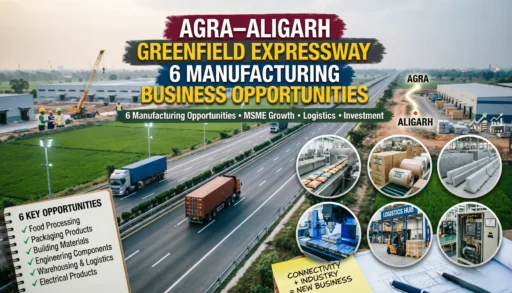
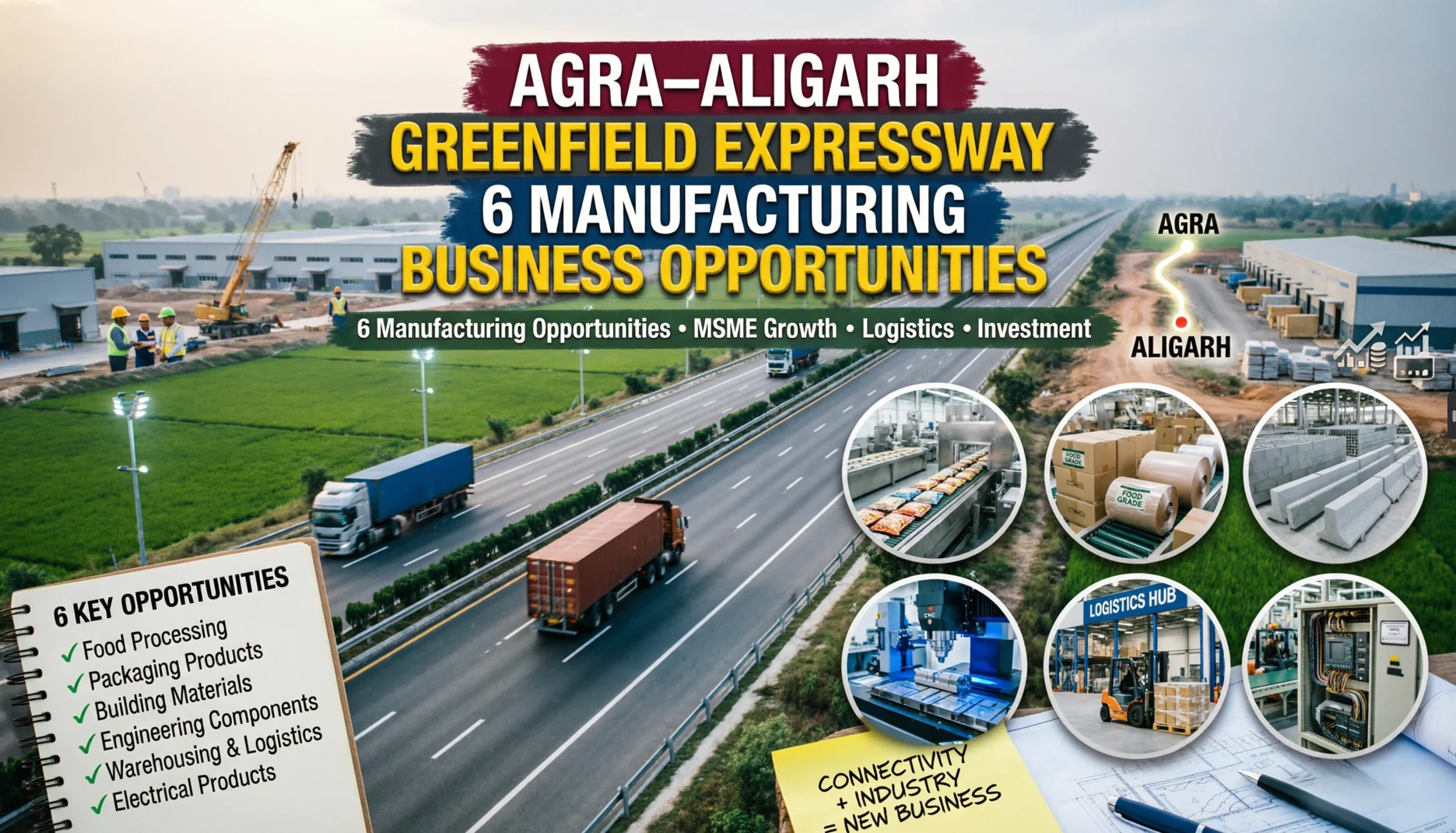

UP’s transformation into a high-speed infrastructure state is in progress. More than just the construction of the road, the Agra–Aligarh Greenfield Expressway will reduce the journey time between Agra and Aligarh from two and a half hours to 60 minutes.
The 65 km four-lane expressway (which can be expanded to six lanes) forms part of Bharatmala Pariyojana, and the project will cost an estimated ₹1,536.9 crore. The expressway directly connects to the Yamuna Expressway, one of the most important arteries connecting the Delhi-NCR area, and the Aligarh Defence Corridor, one of the most strategically significant Industrial Corridors of India today.
This is no news to the entrepreneurs, manufacturers, MSMEs and investors. It is an indicator of the market. The government is spending over ₹1500 crore to join a heritage tourism hub (Agra) with an upcoming defence manufacturing hotspot (Aligarh) and this change is affecting entire supply chains. Home prices increase. Logistics costs fall. Tourism volumes grow. And dozens of manufacturing and service opportunities open up for those who move early.
This article looks at all these aspects of opportunity – ranging from factory setups to logistics parks, handicraft exports to defence component manufacturing.
What This Infrastructure Development Means for Business
What Happened
Agra-Aligarh Greenfield Expressway has received a huge boost after the completion of the land survey work, and construction work has now commenced. The National Highways Authority of India (NHAI) has awarded the project to KRC Infra Project Private Limited. The project comprises two phases: Phase 1 covers 28 km between Aligarh (NH509) and Asroi (near the Hathras border), while Phase 2 covers 36.9 km between Khandauli (Agra) and the Yamuna Expressway.
Why It Matters
This level of infrastructural development brings about multiplier effects in the various sectors. Travel time has been reduced from 2.5 hours to 60 minutes, unleashing three strong economic forces:
- Labour mobility increase, workers from Aligarh, Hathras and surrounding areas can easily reach the industrial areas of Agra and opposite.
- Production chain velocity increases — raw materials and finished goods flow faster through the production chain, lowering inventory expenses for the manufacturers.
- Tourism catchment increases as now those who visit the Taj Mahal in Agra from Delhi or Noida can also easily visit Aligarh in the same day, thereby creating day tours and multi-destination tourism possibilities.
The expressway also has a long-term strategic significance where it is part of the Yamuna Expressway – Delhi-NCR to Agra to Aligarh Defence Corridor – a logistics corridor which will be in use for decades to come, both for civilians industrial and also for defence manufacturing.
Why Founders Should Pay Attention Now
The prices of this expressway’s routes, Hathras, are already on the rise. Multiple infrastructure analysts said the 322 hectares under acquisition in 48 villages would spur development in hitherto underdeveloped talukas. Those who move in ahead of anyone else and set up warehousing, processing or manufacturing facilities on this stretch today will be able to take advantage of lower land acquisition costs, and preferential location in what will be an industrial belt.
Why This Infrastructure-Linked Business Ecosystem Is Growing
The Agra–Aligarh expressway is not an independent entity. It is a tie-up in India’s greenfield expressway program of a mega ₹6 lakh crore to create 10,000 km of new roads to lower logistics costs to less than 9% of the nation’s GDP from 16%. Industrial development waves are formed by each expressway node.
In the Agra – Aligarh area in particular, there are three major economic clusters:
- The leather, footwear, marble handicraft and tourism economy in Agra has a huge export potential having value of ₹2000+ crore.
- Aligarh is the largest City of India for manufacture of Locks and is the main hub of the Drones, Loitering Munitions and Electronic Warfare sector in the Uttar Pradesh Defence Industrial Corridor (UPDIC).
- Hathras as an agri-processing and packaging hub is linked to Mathura-Bareilly supply chain.
This expressway connects all three zones together in a single economic corridor, an unheard-of alignment that is a greenfield business opportunity for entrepreneurs.
Government Policies & Incentives Supporting This Corridor
Multiple government programs directly support businesses establishing themselves along and around this corridor:
1. Bharatmala Pariyojana (National Highways Authority of India)
→ NHAI – Bharatmala Project Portal: The overarching national highway program funding this expressway. Businesses near Bharatmala corridors qualify for accelerated land approvals and environmental clearances.
2. UP Defence Industrial Corridor (UPDIC)
→ UPEIDA – UP Defence Corridor: Aligarh is one of six designated nodes of UPDIC. The corridor has received investment proposals worth ₹33,896 crore. Investors in Aligarh enjoy 100% stamp duty exemption and up to 25% additional benefits for anchor units.
3. UP One District One Product (ODOP) Scheme
→ UP ODOP Portal: Agra’s marble inlay (Parchin Kari) and leather goods are ODOP-designated products. MSME units producing these receive capital subsidies, branding support, and e-commerce marketplace access.
4. MSME Development Institute – Agra
→ MSME-DI Agra: Provides project reports, feasibility studies, and startup advisory for Agra-region MSME entrepreneurs.
5. Invest UP – State Investment Portal
→ Invest UP Portal: Single-window clearances, land bank access, and fiscal incentives for investors setting up manufacturing along the expressway corridor.
6. PM Vishwakarma Yojana
→ PM Vishwakarma Scheme: Artisans and craftspeople in Agra’s marble, leather, and carpet clusters can access ₹15,000 skill training grants plus ₹3 lakh collateral-free loans.
7. NIDC – National Investment & Infrastructure Fund
→ NIIFL Infrastructure Fund: Infrastructure-linked businesses (logistics parks, warehousing, cold chains) can access long-tenure financing linked to corridor projects.
8. Ministry of Road Transport & Highways – NH Development
→ MoRTH – Ministry of Road Transport: Provides the regulatory framework and approval pathways for businesses seeking ROW (right-of-way) adjacencies for commercial development.
9. UP Tourism – Heritage & Adventure Tourism Promotion
→ UP Tourism Portal: Tourism-related businesses (hotels, resorts, experience centres) near Agra and along the corridor can access subsidised loans and marketing support from this department.
Manufacturing Business Ideas Directly Linked to This Expressway
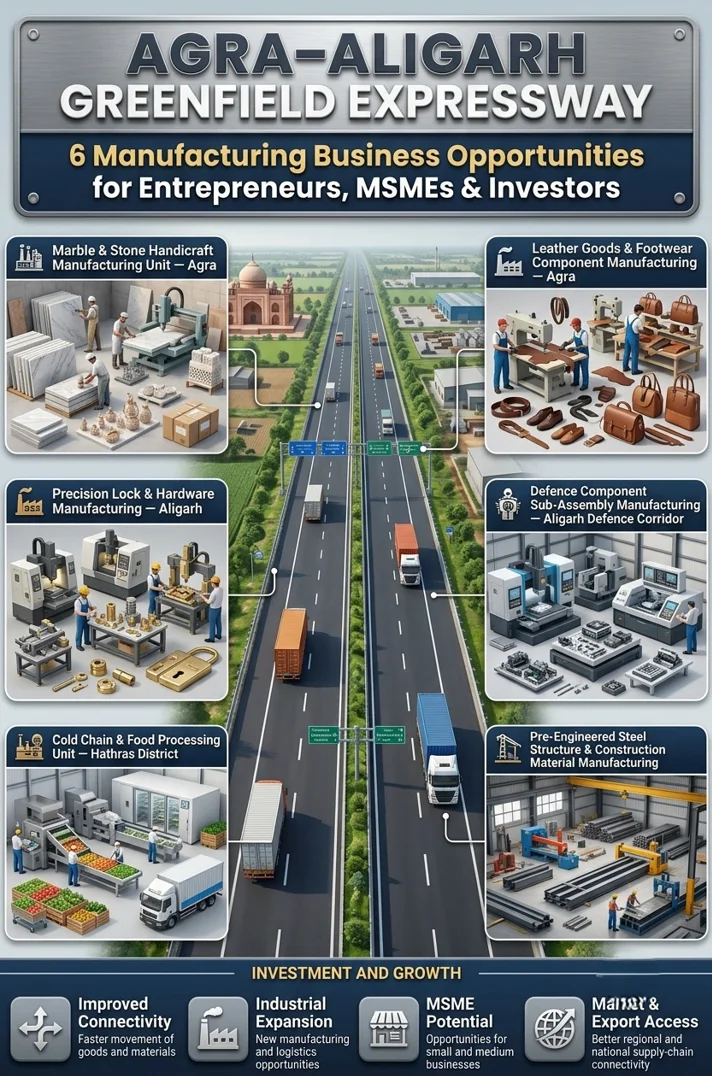
This development of infrastructure creates the following manufacturing opportunities:
1. Marble & Stone Handicraft Manufacturing Unit (Agra)
The Agra–Aligarh expressway is a huge improvement for the marble industry at Agra, which exports to all parts of the country. The expressway connects Agra to Aligarh, and it is a great improvement in the outward traffic of Agra’s marble industry. Presently more than 5000 small-scale craftsmen work in Agra to manufacture Pietra dura (marble inlay) articles. Most of them, however, are micro-scale and lack formal packaging, branding and export infrastructure. Entrepreneurs who establish a vertically integrated unit of marble handicrafts industry from raw Makrana marble to final product packaging can integrate the artisan production with modern export standards.
Get Detailed Project Report (DPR): Minerals, Marble, Granite, Gypsum, Quartz, Talc, Mica Projects
2. Leather Goods & Footwear Component Manufacturing (Agra)
Agra is the footwear hub of India that contributes around 30% to India’s shoe production. The majority of the current facilities are primary assembler. The business potential is in the leather industry value added leather products like insoles, outsoles, buckles and specialty leather uppers for export brands. The enhanced connectivity through the Agra-Aligarh expressway which is connected to the Yamuna Expressway and onwards to the Delhi-NCR logistics hubs, makes just in time component supply possible.
Read the Complete Book Here: Leather Processing & Tanning Technology Handbook
3. Precision Lock & Hardware Manufacturing (Aligarh)
The market for locks is satisfied by Aligarh which provides about 80% of the country’s locks. The new expressway will reduce logistics time for the assembly buyers and importers in Delhi-NCR from JNPT through the Yamuna Expressway. A new manufacturer of a precision engineered lock and hardware part for the construction, safe and automotive hardware industries is at the perfect position in the supply chain.
4. Defence Component Sub-Assembly Manufacturing (Aligarh Defence Corridor)
Companies that produce electronic warfare systems, drones, loitering munitions and small arms are already located at the Aligarh node of UPDIC. The government data shows that, only in the Aligarh node, where 24 companies are operating on 64 hectares, ₹1,921 crore is being invested. The supply chain gap: Sub-assembly Components. The local supply chain is severely under-served for sheet metal fabrication, precision CNC-machined parts and electronic PCB assembly, as well as special packaging for defence equipment.
Related Article: India’s Defence Manufacturing Boom: A $15 Billion Opportunity for MSMEs and Startups
5. Cold Chain & Food Processing Unit (Hathras District)
This expressway is passing through the district of Hathras and the district is an important producer of wheat, mustard and vegetables. The expressway renders the area of Hathras an apt site for setting up a cold chain processing & distribution centre to cater to the markets of Delhi NCR and Agra. The processing of mustard oil, the storage of grains and packaged vegetable units in Hathras would now be at its fingertips, both from Delhi-NCR (via Yamuna Expressway) and Lucknow (via Agra–Lucknow Expressway).
Explore This Book: Handbook on Fruits, Vegetables & Food Processing with Canning & Preservation
6. Pre-Engineered Steel Structure & Construction Material Manufacturing
Every expressway triggers a construction boom: petrol stations, dhabas, truck parks, warehouses, logistics centres, and factories. Pre-engineered steel structures, prefabricated concrete elements, and modular construction material factories positioned near the expressway alignment will service this construction wave over the next 5–7 years.
Access Complete Business Plan: Steel Structure Manufacturing Plant – Detailed Project Report & Business Plan
Import–Export Opportunity Analysis
Export Opportunities
Once the expressway is in operation, the Agra–Aligarh route becomes the export ready manufacturing belt with three distinct product streams:
- Specialty products made out of marble or stone (HS Code 6802): USD 450 million per annum export from India; Agra is one of the leading exporters. Better connectivity with Delhi-NCR airports (IGI and upcoming Jewar) will cut down the time to market of high-value export consignment.
- India is the 2nd largest producer of footwear and leather goods (HS Code 6401 – 6405) in the world. Sea freight on the Yamuna Expressway (YEW) via NH58 will now reach the Agra factories exporting to the EU and USA in a faster time.
- With defence export opportunities offered to MSME companies through UPDIC, this enables Aligarh-based MSMEs to access defence export markets in ASEAN, Middle East and Africa.
Import Substitution Opportunity
The Aligarh Defence Corridor is seeing a swift expansion with a target of import substitution of electronic systems worth of ₹30,000+ crore, radar systems and drone components are all a part of the import substitution target. MSME manufacturers located along this expressway corridor are best suited to become certified domestic suppliers.
International Demand
The international demand for handicrafts and traditional techniques of stone crafting has been on the increase, especially for the high-end gifting, interior decorations and luxury hospitality industry in Europe, USA and UAE. The expressway eliminates logistics bottlenecks for Agra’s craft industry, which is mostly engaged in exports, in order to deliver the goods to international buyers within shorter lead time.
Indian MSME Success Stories by the Corridor Region
1. Amitec Electronics Ltd. – Aligarh
The company headquartered in Aligarh gave a whirlwind of investments in UPDIC Aligarh node for the production of sophisticated electronic warfare and satellite technologies worth of ₹330 crore. Amitec, a defence electronics supplier, is a good example of the size that a precision electronics company can achieve in the Aligarh ecosystem.
2. Werywin Defence Pvt Ltd. – Aligarh
Werywin Defence, a startup, invested ₹65 crore to set up small arms manufacturing in Aligarh. It shows how private companies, apart from the big guns, can support India’s defence manufacturing boom. One of the key assets was the skilled metalworking workforce in the Aligarh node. The lock manufacturing industry helped create this skilled workforce.
3. Carpet & Marble Export Cooperatives – Agra
The artisans of Agra have undertaken scaling-up initiatives with the help of ODOP and UNESCO programmes. These initiatives support their export business in marble inlay. They have also strengthened several artisan cooperatives in Agra. These cooperatives are now present on GeM and other B2B platforms. They provide a replicable model for entrepreneur-led export clusters.
Choose the right startup backed by real market demand
About Niir Project Consultancy Services (NPCS)
Niir Project Consultancy Services (NPCS) is India’s pioneer industrial project consultancy and feasibility report preparing company with more than 5 decades experience catering to entrepreneurs, MSMEs, investors and financial institutions.
NPCS provides:
- Nationwide detailed project reports (DPRs) for bank financing and government approval.
- Feasibility studies for new manufacturing opportunities
- Technological assistance for establishing factories in the MSME, food processing, chemicals and defence sub-sector
- Identification reports that outline the business opportunities of corridor-connected industrial projects.
- Investment analysis and cost benefit evaluation of greenfield and brownfield plants.
Entrepreneurs planning to set up units in the Agra–Aligarh corridor can access NPCS’s project report library and consultancy services at: Visit NPCS at niir.org
Industry Opportunity Data Table
| Parameter | Details |
| Industry | Agra–Aligarh Corridor Manufacturing, Logistics & Tourism |
| Market Driver | ₹1,536.9 crore Greenfield Expressway cutting travel time from 2.5 hrs to 1 hr |
| Key Sectors | Defence components, marble handicrafts, leather goods, lock manufacturing, cold chain |
| MSME Opportunity | High — sub-assembly components for UPDIC, artisan export clusters, agri-processing |
| Export Potential | USD 450M+ in stone/marble exports; defence component exports under Make in India |
| Aligarh UPDIC Investment | ₹1,921 crore at Aligarh node; 24 companies; 5,618 jobs targeted |
| Government Support | Bharatmala, UPDIC (100% stamp duty exemption), ODOP, PM Vishwakarma, Invest UP |
| Land Opportunity | 322 hectares across 48 villages in Hathras district — prices rising |
| Risk Level | Low to Medium — strong government backing and multi-sector demand |
| Completion Target | December 2027 (Phase 1 expected sooner) |
| Growth Outlook | High — expressway creates industrial belt linking Delhi-NCR, Agra, Aligarh & Hathras |
Conclusion: The Corridor Is Open — Are You Ready?
There is more to the Agra–Aligarh Greenfield Expressway than meets the eye. It is the infrastructural lifeline of what may well be the most promising and varied multi-sector industrial corridor in Uttar Pradesh — one that brings together an ecosystem of defence manufacturing with a centuries-old economy of artisans committed to exporting, as well as an emerging agri-processing zone in Hathras.
The numbers tell an interesting story – ₹1,536.9 crore investment in the expressway; 65 km of new road; 60-minute travel time; a direct link to the Yamuna Expressway and Delhi-NCR. However, for entrepreneurs the lie of the land lies beyond that: the gaps in the supply chain, the logistics parks, sub-assembly factories, export clusters and the tourism services that the expressway has made economically viable.
Since the post-liberalisation days, India is building infrastructure at a scale and speed not witnessed since that period, which is bringing industrial opportunities. This expressway is one among 25 greenfield highways being built in India, covering 10,000 km in all. All of these are maps of business opportunities. The Agra–Aligarh route is one of the most unique ones as it is situated at the crossroads of defence, heritage, tourism and agriculture.