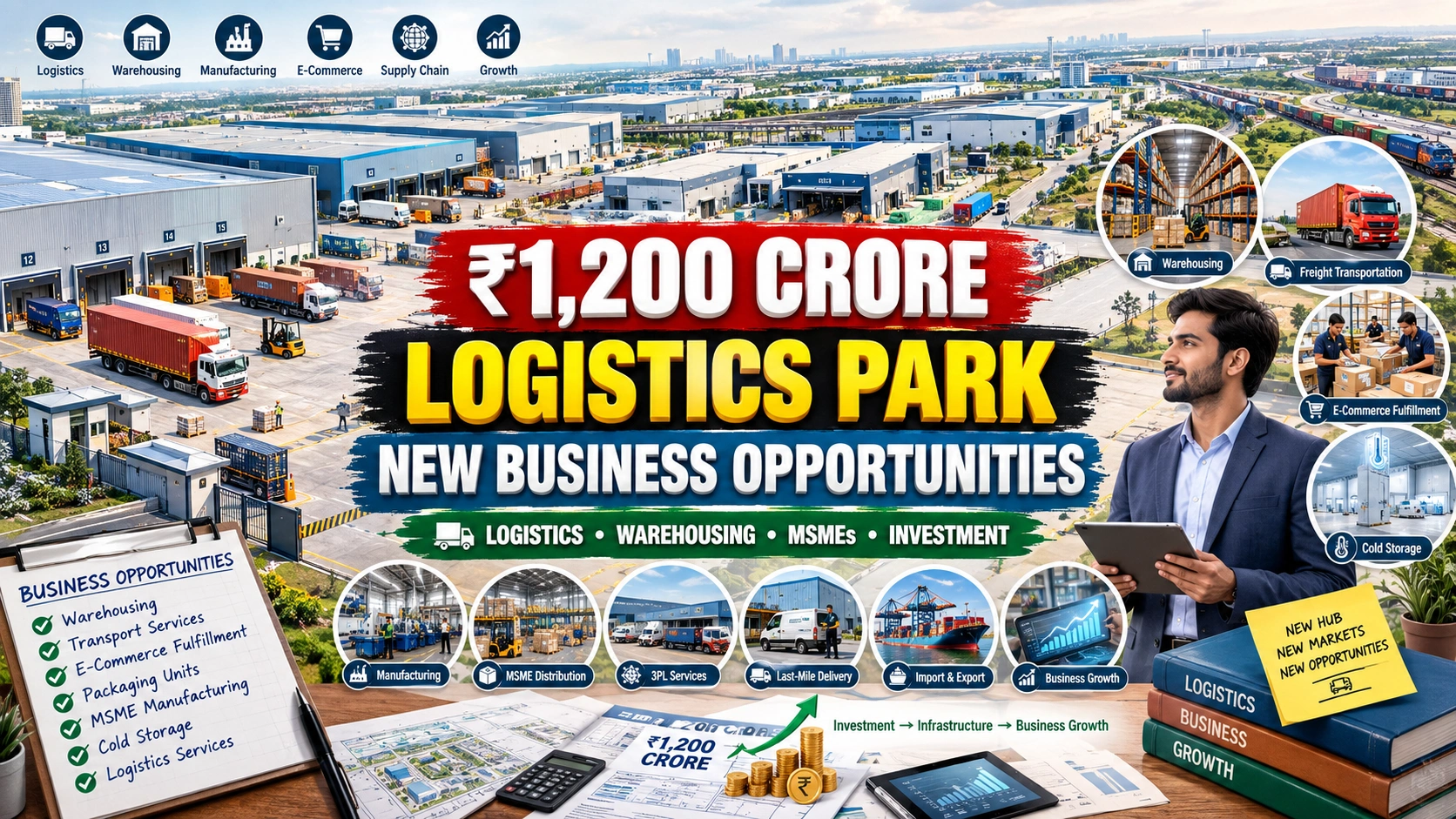

A once-in-a-generation infrastructure investment in the National Capital Region will be a gamechanger for the movement, storage and management of goods in India. A Kemp-2 sector in Greater Noida, which a Logistics major known for its business acumen in the field backed by bidding for the land in a much-talked-about land auction, plans to develop as a multi-modal logistics park with more than ₹1,200 crore private investment and an estimated 5,000 direct and indirect employment opportunities. The park will bring together world-class warehousing facilities, cold storage, handling of containers, mechanised processing of cargo and customs clearance under one roof, while linking these facilities to both the road and rail network and ideally locating the park to maximise access to the upcoming Noida International Airport.
This is not just a real estate story for entrepreneurs, MSMEs, manufacturers, logistics service providers. The NCR logistics corridor is in a new cycle of industrial maturity, and anyone who is positioned well in the market to meet the demands of this project will reap significant rewards.
The article discusses the commercial aspects of the development, the manufacturing and service opportunities it creates, and how Indian entrepreneurs can assess and react to the potential opportunity.
What This Development Means for Indian Businesses
With an investment of more than ₹1200 crore to set up a world-class multi-modal logistics hub in a competitively auctioned location in one of India’s busiest industrial corridors, the impact of the project extends beyond the amount of investment. The park provides a comprehensive logistics ecosystem with coordinated and technology-driven logistics processes for warehousing, cold chain storage, containerised freight movement, mechanised logistics processes for freight and customs clearance.
This will bring about a structural change in the way the supply chain will function in the NCR and industrial belt along the Yamuna Expressway for Indian businesses. Manufacturers who used to have to store products in their own warehouses, having to manage separate cold storage contracts and coordinate split transport will be able to benefit from integrated logistics solutions from one premium facility.
This change creates the need for many ancillary sectors. There will be improved interest in packaging material suppliers for industrial protective packaging. Modern warehouse fitouts are where there’s a growing market for pallet and racking manufacturers. The refrigeration unit manufacturers, temperature monitoring system suppliers, and other providers of cold chain equipment will have a strong customer base. New business models will be appearing to transport fleet operators and logistics technology companies around the park.
Opportunities are direct and indirect for MSMEs and startups. The logistics park’s operation may be part of the services of some of them. Other businesses could establish ancillary manufacturing or service businesses around the edge. Others still can use the park’s excellent connectivity infrastructure to reach larger markets for their products at reduced logistics costs.
Why This Industry Could See Stronger Growth
Logistics has been plagued by fragmentation, inadequate infrastructure, and costliness as a percentage of GDP in India for a long time. Things are quickly evolving. The government’s programmes, private investment and foreign capital are all coming together to create the organised logistics infrastructure that the country requires to support its manufacturing goals.
The NCR region is in the heart of this change. Greater Noida is becoming a logical logistics consolidation centre due to its strategic location, which lies somewhere between the huge consumer markets of Delhi and the manufacturing hubs of the Industrial Development Authority of the Yamuna Expressway and Zone. The proposed Noida International Airport (NIA), which could become one of the largest in Asia, will provide further connectivity, enhancing the strategic value of the corridor for both domestic and international cargo traffic.
There are various structural factors which are fueling the demand for organised warehousing and logistics in India. The ecommerce industry is generating a steady demand for technology-driven, large-scale fulfilment centres in major urban markets. A growth in organised retail chains, fast moving consumer goods, pharmaceutical distribution and food processing that requires cold-chain logistics is creating demand for specialist storage and handling facilities. In parallel, the trend for export-driven manufacturing in such areas as electronics, pharmaceuticals and industrial components necessitates world-class logistics capabilities to be competitive in terms of delivery reliability and cost in the global market.
This aligns with the government’s initiative for the development of multimodal connectivity under PM Gati Shakti National master plan. With a 174-acre logistics park bridging the road, rail and air freight corridors, this approach cuts the time and cost of goods movement in half compared to India’s traditional logistics model.
Government Policies and Incentives
The business environment supporting logistics and manufacturing investment in India is more favourable today than at any point in recent history. Therefore, Entrepreneurs looking to build businesses linked to the logistics value chain can access a range of government programmes at both the central and state levels.
In particular, the PM Gati Shakti National Master Plan is the most significant central government initiative in this space. It integrates planning across ministries to remove infrastructure bottlenecks, improve multimodal connectivity, and create a seamless logistics ecosystem. Moreover, projects aligned with Gati Shakti nodes—which include multimodal logistics parks—benefit from coordinated infrastructure development and policy support.
Similarly, The National Logistics Policy (NLP) is the government’s comprehensive framework for reducing India’s logistics cost from approximately 13–14% of GDP toward the global benchmark of 8%. Furthermore, The NLP creates incentives for investment in logistics parks, cold chain infrastructure, warehousing technology, and skill development in the logistics sector.
In addition, Manufacturers who supply to logistics parks or set up units in proximity can access MSME support through the Ministry of MSME’s credit-linked capital subsidy and other schemes. Additionally, The ministry offers capital subsidy, technology upgrade assistance, and credit facilitation for small and medium manufacturers.
Discover scalable startups tailored to your goals
Meanwhile, Startups in logistics technology, warehouse management systems, cold chain monitoring, and supply chain analytics can access funding and incubation support through the Startup India initiative, which provides tax exemptions, easier compliance, and access to investor networks.
The Uttar Pradesh Industrial Development Authority (UIDA) oversees industrial development in the Greater Noida corridor. Entrepreneurs looking to establish manufacturing or logistics-linked service units in Uttar Pradesh can benefit from the state’s investment-friendly policies, which include land allotment support, single-window clearance, and incentives under the UP Investors Summit framework.
The Greater Noida Industrial Development Authority (GNIDA) directly manages industrial and commercial land allocation in the project area. Entrepreneurs interested in setting up ancillary units in proximity to the proposed logistics park should engage with GNIDA’s industrial plot allocation programme.
Export-oriented manufacturers who plan to use the logistics park’s container terminal and customs facilities should connect with the Agricultural and Processed Food Products Export Development Authority (APEDA) for cold-chain export support, and with the Directorate General of Foreign Trade (DGFT) for export licences and trade facilitation.
The Warehousing Development and Regulatory Authority (WDRA) provides the regulatory framework for warehousing businesses in India. Entrepreneurs planning to offer third-party warehousing services should familiarise themselves with WDRA’s registration, accreditation, and negotiable warehouse receipt system.
Manufacturing Business Opportunities Emerging From This Development
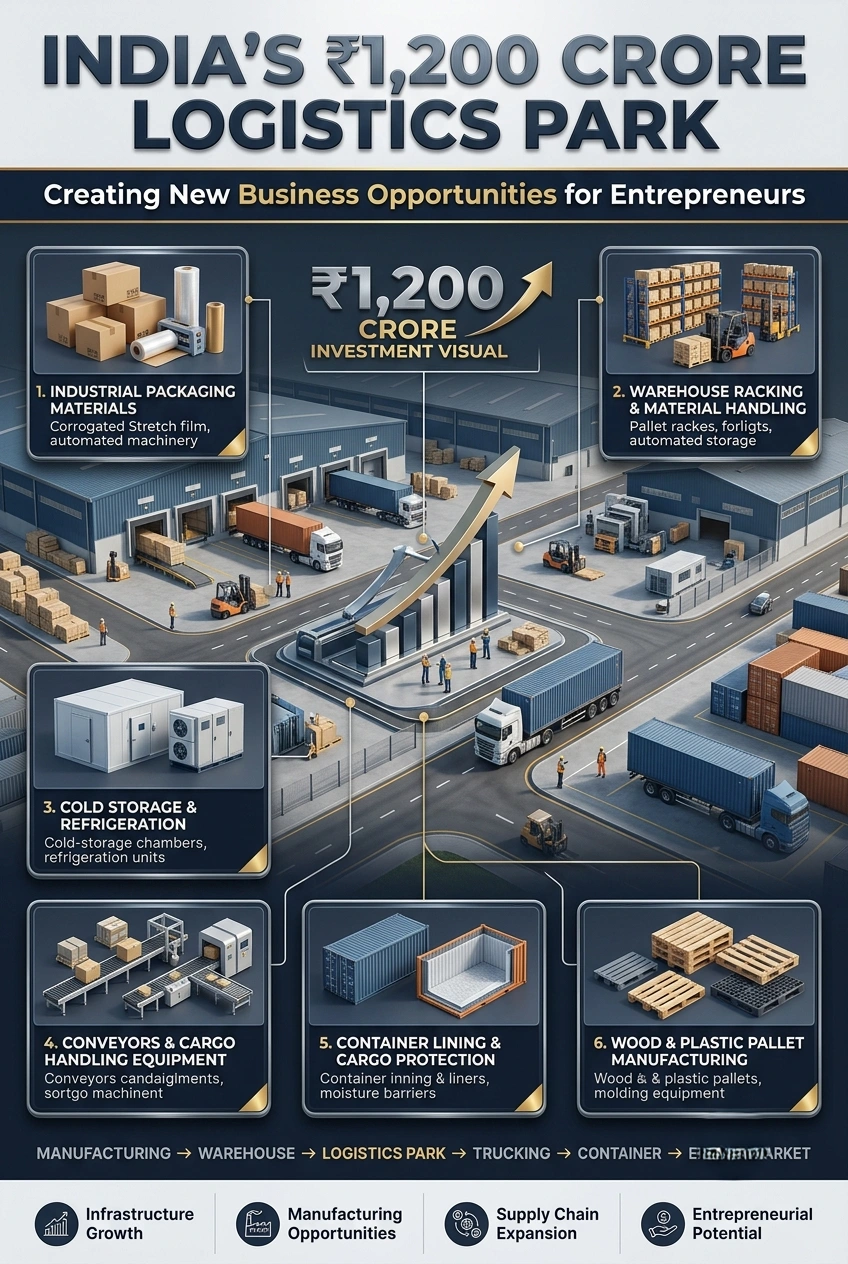
There are several manufacturing opportunities directly related to the demand that will be generated in this logistics park:
1. Industrial Packaging Materials Manufacturing
From pharmaceuticals to consumer electronics, all products going through any modern logistics hub need the necessary industrial packaging. At this size, huge amounts of corrugated boxes and stretch wrap films, bubble wrap, foam inserts, edge protectors and palletised packaging are used. The logistics park with thousands of consignments a day can become an anchor customer for the packaging manufacturers in the area.
This is especially beneficial for MSMEs. For example, corrugated box making places relatively low demands on capital investment, the raw materials used are available locally, and there is a market for the product. Businesses that are able to provide a steady and dependable supply to the logistics park and its tenants (manufacturers, online retailers, FMCG companies) will have a strong and sustainable business. Export quality containers for containers make an additional premium opportunity layer.
Explore This Book: Handbook on Modern Packaging Industries
2. Warehouse Racking and Material Handling Equipment Manufacturing
Sophisticated internal infrastructure is required in modern warehouses: multi-tier racking systems, mezzanine floors, conveyor systems, hydraulic dock levellers, pallet jacks and forklift trucks. The 174-acre logistics park will need thousands of racking units, which is nothing but a pressing demand and an immediate opportunity for the domestic manufacturing companies.
India is currently importing a considerable amount of warehouse rack, and there is a great opportunity to produce warehouse rack in India, which are reasonably precise, and have a competitive advantage in terms of reducing import cost. The ability to make to international standards, such as load-rated racking for heavy storage, has enabled companies to provide the solutions to the project and to the all-encompassing wave of modern warehouses being constructed throughout India. The investment is medium and the market has developed from time to time with the establishment of each new logistics hub.
Get Detailed Project Report (DPR): Explore the Complete Warehouse Project Report
3. Cold Storage Equipment and Refrigeration System Manufacturing
The presence of cold storage in the proposed logistics park indicates a trend towards the organisation of cold chain infrastructure in the country. The cold chain capacity is considerably short of expectations in India, and is inadequate for post-harvest loss abatement and for pharmaceutical distribution. A standalone cold storage area within a multimodal logistics center fuels demand for refrigeration compressors, insulated panels, temperature control systems, and monitoring devices.
It is a growing market for manufacturers of refrigeration parts, insulated panel systems (filled with polyurethane or polystyrene) and temperature data loggers. The pharmaceutical cold chain is especially valuable, because of the demands for exact, validated storage environments and continuous monitoring. There is a ready and growing market for MSMEs that are able to produce or assemble cold storage panels according to the BIS standards and also incorporate monitoring systems with them.
Related Article: India’s Mandatory Battery Storage Mandate: A Major Manufacturing Opportunity Is Opening Up Across the Renewable Energy Sector
4. Industrial Conveyor and Cargo Handling Equipment Manufacturing
Conveyor belt, roller system, sortation, loading bay equipment are all part of the mechanised cargo handling, which would be provided by the proposed logistics park and which demands a constant supply. These are not installed once-for-good assets, but they do need to be serviced with parts over time and occasionally upgraded.
Indian industrial conveyor manufacturers, rubber belting manufacturers, roller assembly manufacturers and electro-mechanical handling equipment manufacturers can provide products for use in the park’s development phase as well as for the park’s operational needs. The manufacturing of conveyor belts is also exportable to Southeast Asia and Africa, where the logistics infrastructure is being developed at a good pace.
5. Container Lining and Cargo Protection Products
A key aspect of multimodal logistics is the use of containers to transport goods, which calls for specialised materials with cargo protection capabilities. Meanwhile, container terminals use high volumes of desiccants to prevent moisture damage; container lining materials, lashing straps, cargo nets and cushioning systems. The market is expanding with the growth of container-based trade, and a small number of organised manufacturers in India currently manufacture these products.
MSMEs with a limited polymer or textile processing facilities can be able to venture into the market of desiccant and lashing products with moderate investment. The products are easy to produce using the correct technology input, but they must be of a consistent quality to meet freight carrier standards.
Access Complete Business Plan: Explore the Complete Cargo & Steel Containers Manufacturing Guide
6. Pallet Manufacturing (Wood and Plastic)
Wooden pallets and plastic pallets are generated in large quantities and are continuously needed in modern warehouses following the palletised storage concept. A big logistics park can use thousands of pallets, and the replacing process is ongoing. Manufacture of wooden pallets is one of the most entry-level MSME manufacturing opportunities, which involves using basic woodworking machinery, as well as having access to timber and meeting the phytosanitary treatment standards (ISPM-15) for wooden pallets intended for export.
The production of plastic pallets is more expensive but the resultant product is more durable and washable, and is preferred by logistics companies involved in the pharmaceutical and food industries. The two options are profitable for entrepreneurs who are close to timber supply areas or who have access to recycled polymer.
Import-Export and International Market Opportunity
Export Opportunity
The multimodal connectivity of the proposed park, which includes road, rail and air freight connectivity, offers a platform to the export-oriented manufacturers to gain better access to international markets than the existing logistics infrastructure in NCR. Moreover, Customs clearance in the park allows manufacturers to clear exports in and out of the park in one place, instead of having to go through various agencies.
Similarly, Greater Noida and Yamuna Expressway industrial nodes, such as electronics components, auto parts, specialty chemicals, textiles and processed foods, can benefit from container terminals and air freight connections without having to pay for time and money spent transporting goods to other ports or cargo hubs. Therefore, this will be a relevant advantage for export-oriented MSMEs who faced challenges in delivering the last-mile logistics to the international market.
Furthermore, in the cold chain segment of the pharmaceuticals industry, perishable agricultural products and export of frozen goods, the world class cold storage node in a multimodal hub opens the door to markets in the Gulf, Southeast Asia and Europe which were previously not easily accessible from the NCR region.
Import Substitution
There are a number of categories of logistics equipment and consumables that are imported in large numbers to India. Domestic manufacturing can replace imports in areas such as warehouse management system hardware, automated storage and retrieval system parts, high specification racking, special pallet systems, and advanced cargo surveillance tools.
As the order book of the organised logistics sector expands, with investments such as this, there is enough demand for logistics equipment made in India to warrant a dedicated facility for its production. The logistics equipment sector is getting more interesting for entrepreneurs who come at it from an engineering background and have an interest in import substitution manufacturing.
Indian MSMEs and Startups in Related Industries
Mahindra Logistics
The Mahindra Group listed logistics firm, Mahindra Logistics has been one of the early movers in creating an organised third-party logistics (3PL) business in India. It is not a typical MSME, but its business model, which is offering integrated warehousing, distribution and last-mile services as a service to manufacturers and e-commerce companies, represents a larger ecosystem of logistics services companies. SMEs can learn how it has developed a service delivery model that is integrated, which can be adapted as a model for creating specialised segments in the logistics value chain.
Delhivery
Delhivery, a listed company, started as a startup in the express parcel delivery segment and expanded to become one of India’s biggest integrated logistics players. Its journey has proven that the logistics landscape in India is sufficiently large to accommodate a multiple level of players, starting from the big integrated players and all the way to the niche ancillary service providers. Delhivery’s journey underscores the importance of scalable technology from the ground up for startup founders.
Indo Arya Central Transport
Indo Arya Central Transport is a typical example of the mid-scale Indian logistics firm which has established a sustainable business of LTL (less-than-truckload) transport, linking companies in industrial corridors with distribution centres. In addition, companies with such profiles tend to become anchor customers for new logistics parks because they require a sense of security and support from logistics hubs that can offer them a good geographical location for organizing their network. This is an excellent example of how industrial producers connect to the logistics infrastructure and can serve as a model for building a transport and freight brokerage business.
What Entrepreneurs Should Evaluate Before Investing
Entrepreneurs should carefully examine market and feasibility before investing in any business opportunity that involves this development in the following dimensions:
Market demand
Carry out an analysis to determine whether the product/service under discussion has a specific demand that clearly relates to the logistics park’s operations. Packaging manufacturers should try to make estimates of the annual consumption volume of their possible anchor clients. Equipment manufacturers need to determine whether the development and fitout of the park is a one-off or a continuous need.
Logistics-linked manufacturing
Packaging, racking, pallets or cold storage panels, all of these require a reliable supply of raw materials. Consider distance from kraft paper mills, steel service centres, timber yards or polymer processors when choosing a manufacturing site.
Proximity
When a business directly serves the logistics park, the location is important. Businesses should take the distance from the park, road connectivity and access to skilled labour into consideration when selecting industrial plots in the Greater Noida and Yamuna Expressway belt.
Technology and Machinery
modern logistics equipment manufacturing needs the CNC fabricating, precision welding and quality testing system. The entrepreneurs should decide whether Indian machinery suppliers can fulfill their machine needs or whether they need to import machinery.
Quality Standards and Certifications
Clients of logistics suppliers and their partners around the world expect logistics suppliers to be ISO quality management compliant and for some products, BIS, FSSAI or international freight standards. Plan for certification and quality infrastructure at the beginning.
Working Capital
Payments usually take 30-90 days with large-scale contracts for logistics parks and their tenants. Ensuring proper working capital finance (which may include MSME schemes) is crucial to allow businesses to continue to grow in early stages.
Competition
evaluate the number of suppliers already in the target market and the fact that there is an actual unmet demand that can be met by a new supplier. An opportunity for import substitution is especially appealing when the imported product has a high price premium over the domestically produced product.
Manufacturing companies with substantial fixed investment, like warehouse racking and cold storage equipment, simulate the volume at which the company reaches the break-even point. Getting anchor supply contracts in hand before scaling capacity will significantly mitigate this risk.
How NPCS Can Help Entrepreneurs Evaluate the Opportunity
For decades, NPCS – Niir Project Consultancy Services has been assisting Indian entrepreneurs, industrial project developers, investors and manufacturers with independent, research based advice and information on business opportunities, project planning and investment evaluation.
NPCS offers entrepreneurs a deep understanding of the opportunities associated with this logistics park development in the form of:
Detailed Project Reports (DPR): These are comprehensive bankable project reports for specific manufacturing businesses with all the necessary elements of market analysis, plant layout, selection of the machines, raw material plan, financial projections, and regulatory compliance requirements.
Feasibility Studies: An independent evaluation of the feasibility of a planned manufacturing or service operation from a technical, commercial and financial standpoint under existing market conditions.
Market Research: Research of demand, market landscape, and market price for the products and services that a business will provide.
Technology & Machinery Assessment: Selection of suitable manufacturing technologies, evaluation of machinery suppliers and recommendations for the optimum configuration of the plant for a given scale of operation.
Investment Evaluation: To complete both for the entrepreneur when deciding whether or not to invest and for the lender when carrying out due diligence on capital requirements, return expectations, payback period and financial risk factors of projects.
Startups utilize NPCS reports for project finance approaches with banks, due diligence with investors, and evaluation of MSME grant and subsidy applications by government agencies.
Business Opportunity Snapshot
| Parameter | Details |
| Industry | Logistics, Warehousing, Cold Chain, Supply Chain Infrastructure |
| Market Driver | ₹1,200 Crore+ MMLP at Greater Noida; PM Gati Shakti; Noida International Airport |
| Key Development | 174-acre Multi-Modal Logistics Park with warehousing, cold storage, container terminal & customs |
| MSME Opportunity | Packaging, pallets, racking, cold storage equipment, cargo protection products |
| Manufacturing Potential | High — multiple product categories with strong recurring demand |
| Export Potential | Medium-High — industrial packaging, conveyor belts, cargo protection products |
| Import Substitution | Warehouse racking, automated handling equipment, temperature monitoring systems |
| Government Support | PM Gati Shakti, National Logistics Policy, UP MSME incentives, Startup India |
| Investment Consideration | Moderate to High depending on segment; working capital planning essential |
| Risk Level | Moderate — dependent on project execution timeline and anchor client agreements |
| Growth Outlook | Strong — NCR logistics infrastructure expansion projected to continue over 5–10 years |
Conclusion
The multi-modal logistics park, which the Greater Noida development is pushing for at an estimated cost of ₹1,200 crore, is not just a headline-grabbing infrastructure initiative. Moreover, It is an indicator to the market that the value chain transformation of logistics in India is now in a new phase of execution with a combination of government investments, capital inflows from the global markets and growing domestic demand. Furthermore, A commercial ecosystem of hundreds of supply and service categories emerges when developers transform 174 acres of strategically located land into a hub for world-class warehousing and freight services with road, rail and air connectivity.
Therefore, The opportunity window is real and time sensitive for the entrepreneurs and MSME manufacturers in India. For example, Early movers, such as packaging suppliers, racking manufacturers, cold chain equipment manufacturers, and logistics technology providers, will be able to benefit from entering into positioning relationships with the park operators and tenants early on. However, When the park is in operation, the market will already be served by existing suppliers.
In addition, Supported by government policy, global investments, a strong demand from the domestic market and the infrastructure all set to improve, the logistics corridor in NCR is one of the most commercially alluring industrial opportunity zones in India today. Therefore, Entrepreneurs who are doing right market research, realistic feasibility check and have disciplined investment planning will be in a good position to create sustainable and scalable businesses which will grow in pace with the progress of logistics infrastructure in India.
Finally, Now it’s your turn: do proper market research, order a professional feasibility study and Detailed Project Report, study government incentive programmes and utilize experienced consultants to help you convert this opportunity into a viable and fundable investment plan.