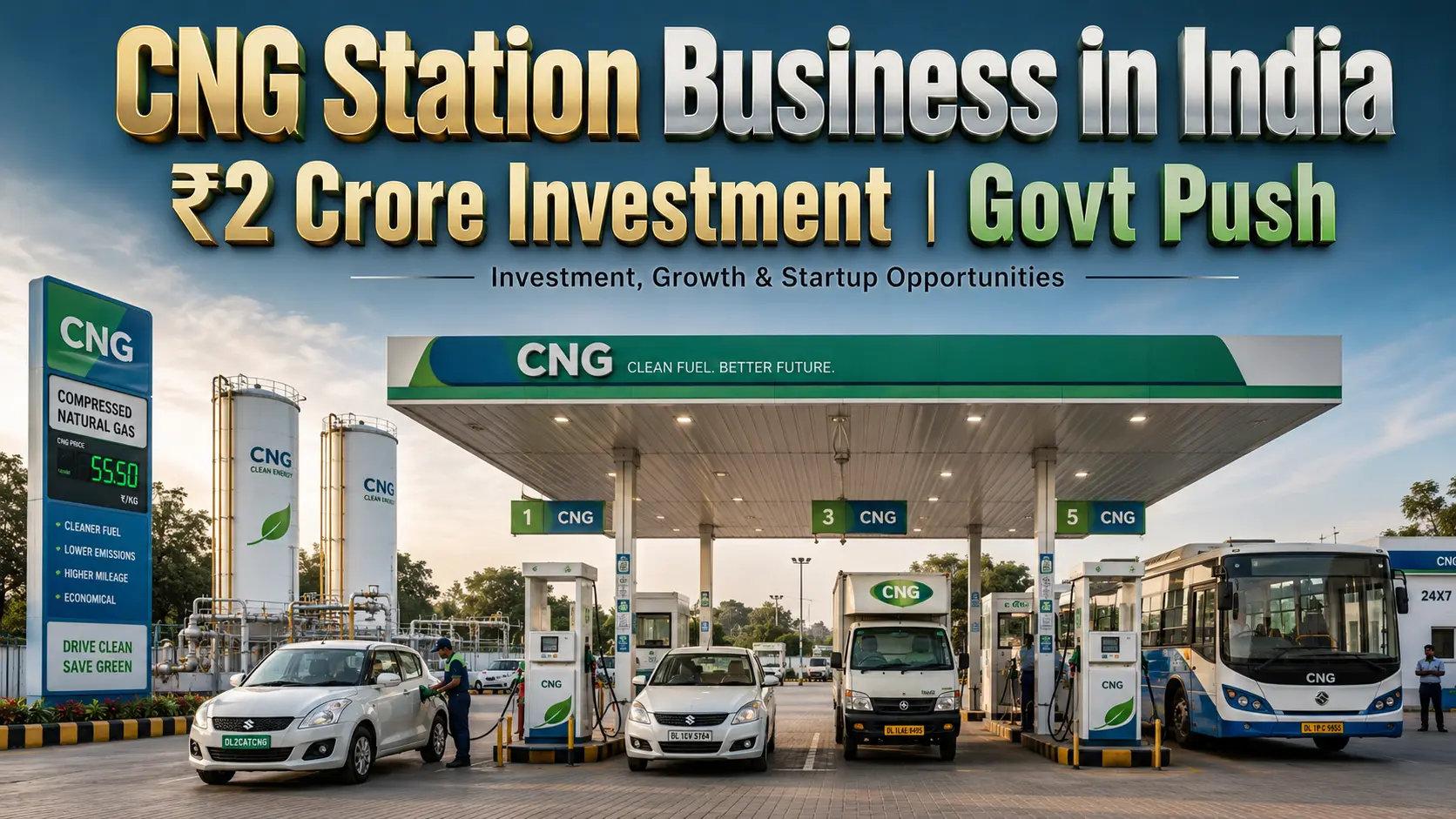

CNG Station Business in India
The fuel retail business in India is going through a subtle, but significant transformation. Entrepreneurs looking to play in a government-controlled, regulated environment have found a viable path with compressed natural gas. The facts are indisputable. As per the Annual Report 2024-25 by Ministry of Petroleum and Natural Gas, Government of India, currently 8,067 CNG stations are operational throughout the country with about 55 lakh CNG vehicles existing across the country. More than 1.5 crore household connections have been achieved in PNG. The City Gas Distribution network spans all the main land of India with 307 Geographical Areas. That is a lot of demand, but it’s still going unmet in dozens of Tiers-2 and Tier-3 cities. The business of CNG station is one of the more bankable energy retail businesses for a first-generation business man who has the right land parcel and working capital discipline.
Get Detailed Project Report (DPR): CNG Cylinders Manufacturing Plant Report
Why CNG Retail Is a Strong Startup Opportunity
The government of India has stated its goal of increasing the contribution of natural gas from around 6.5% of its energy consumption mix to 15% by 2030. The target requires infrastructure – and CNG retail outlets are at the core of this. This expansion has been spearheaded by the Ministry of Petroleum and Natural Gas, which has given PNGRB the green light to establish CGD networks in all the districts of mainland India.
Previously (prior to 2014), only 53 districts had CGD networks. Today, PNGRB has finalised authorisations for 307 Geographical Areas. Once CGD companies operationalize a new network, they set up CNG stations and actively seek qualified retail partners to expand outlet density.
The CNG Station business in India runs under a regulated margin framework under the PNGRB, giving it the one advantage that it has over all other fuel retail business – price visibility and downside protection. It is rare in an energy project that is at the MSME level.
There are real entry barriers yet they are not insurmountable. Capital spent varies between ₹75 lakh and ₹2.5 crore depending on the status of land, number of dispensing units, compression capacity, and the type of infrastructure (standalone outlet or addition of CNG in OMC retail outlet). Land ownership or long term lease is the only option — most CGD entities require 500-800 sqm’s minimum. TDPIIT has issued new guidelines explicitly stating that existing petrol pumps can dispense CNG with lower capex, giving fuel retailers a more cost-effective option.
The CGD Framework: How Licensing Actually Works
This is where most entrepreneurs fall short of capital — it’s where they fall short of the process.
CNG Station is not a standalone entity. It operates under a City Gas Distribution network licensed by PNGRB to an authorised CGD entity – companies like Indraprastha Gas Limited (IGL), Mahanagar Gas Limited (MGL), Gujarat Gas, Adani Total Gas Limited or GAIL Gas, depending on the Geographical Area. The entrepreneur does not directly enter into a deal with PNGRB. The relationship is with the authorised CGD entity in that GA.
CGD offers the Dealer Model, where the entrepreneur constructs and manages a CNG outlet under a contract. The entity provides compressed gas, establishes technical requirements, and can also handle equipment procurement. The PNGRB determines the dealer’s margin per kg, which currently ranges from ₹1.5 to ₹3.5 per kg based on the operational category and geographic location.
The licensing process follows a clear sequence. First, you locate the CGD entity authorized by PNGRB on the public GA map. Next, you submit the land documents and apply for NOCs. After that, you conduct technical checks for the compressor room and dispenser installation in line with PESO and PNGRB guidelines. Finally, you commission the setup once the dealer agreement is signed. The process of application to commissioning takes 6-12 months.
Related Article: Biogas and Compressed Biogas (CBG) Production Handbook (from Waste & Renewable Resources)
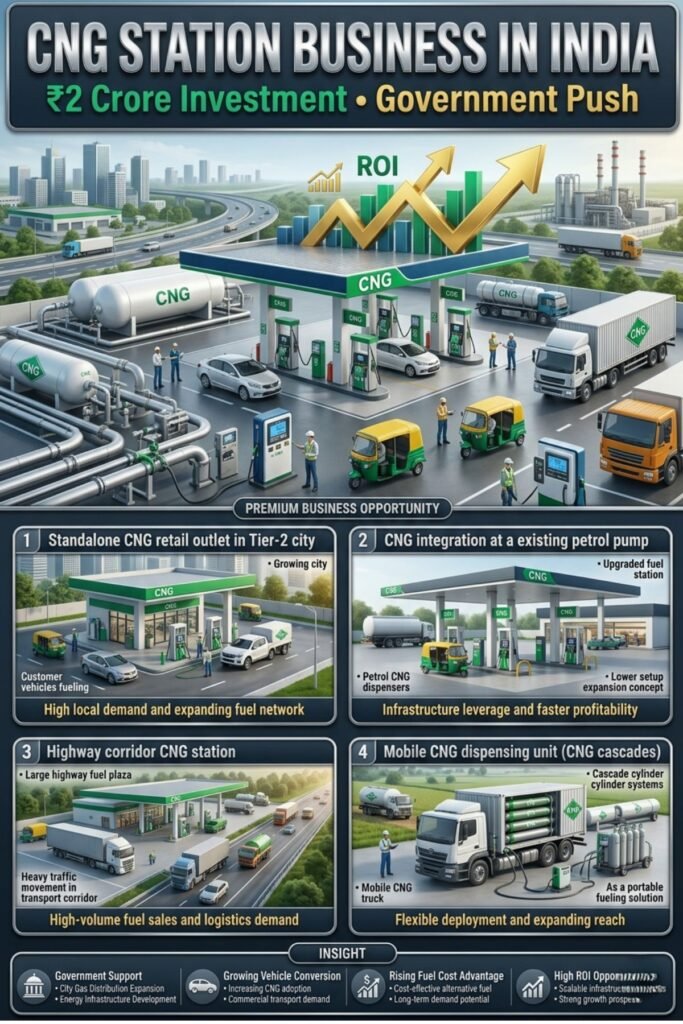
Project Opportunities Under the CNG Station Business Model
1. Standalone CNG Retail Outlet in a Tier-2 City
In cities with low retail density where authorities have recently permitted CGD networks, such as Gorakhpur, Nashik, and Vijayawada, operators can achieve 400–800 kg per day within 18 months after commissioning. That means it costs the retail margin ₹2.5 per kg, which translates to ₹1,000-₹2,000 per day for the retailer, before operating expenses. Capex in the form is between ₹1.2–2 crore. The target buyer is the CGD entity which is looking for outlet partners. The break-even horizon is estimated at 3 to 5 years for debt-funded, and at less time with owned land.
2. CNG Integration at Existing Petrol Pump
To existing fuel retailers, it is the least risky option to install CNG dispensing station at a licensed OMC outlet. The incremental capex varies from ₹40–₱80 lakh, depending on the type of compressor. The Department for Promotion of Industry and Internal Trade (DPIIT) has issued new guidelines that streamline and specify this route further. Although the per-unit margins are narrower, the existing outlet shares the infrastructure overhead, which is not set up separately. This shared setup enables faster payback, often in less than thirty months.
Get Detailed Insights from This Book: Handbook on Biogas and Its Applications
3. Highway Corridor CNG Station
With the expansion of highways under Bharatmala and Golden Quadrilateral development, there is a steady demand for CNG stations along the highways on freight and bus routes in the country.The consistent expansion of highways in Bharatmala and Golden Quadrilateral development is creating a steady demand for CNG stations along highways of freight and bus routes in the country. A high compression capacity CNG station (2,000+ kg/day potential) will have a higher capex initially, which is in the range of ₹2 crore to ₹2.5 crore, but will have a volume that a city outlet will not have. Long-haul CNG buses and commercial fleet operators are the major customers. According to the Ministry, OMCs have already been installing 4,000 Energy Stations in the highway network over the last five years – CNG retail operators set up along these corridors can take advantage of the captive traffic in the fleet.
4. Mobile CNG Dispensing Unit (CNG Cascades)
A new solution is the “mobile CNG cascade unit(s),” which transport gaseous fuel from a mother station to daughter outlets using high-pressure cylinders, especially in districts where pipeline infrastructure is not yet complete. Initial capex ranges between ₹25 lakh to ₹60 lakh. Although margins may be lower, this format allows an entrepreneur to join a GA early and start building a pipeline toward a fixed outlet. AG&P Pratham and a few CGD organizations in UP and Maharashtra have adopted this model for market seeding.
Indian Entrepreneur Case References
Praful Patel, IGL Dealer Operator in Noida, has operated CNG stations in India since the early days of IGL’s expansion in the NCR region. His reasoning was straightforward — CNG vehicles were expanding at a higher rate than the number of outlets and IGL’s regulated margin structure was providing him with income visibility which petrol retailing wasn’t. Within four years he went from one to three outlets set up on leased land in high traffic corridors. The lesson: tough negotiators on land lease agreements for CNG stations in the long term.
Adani Total Gas Dealer, Ahmedabad, Suresh Nair: Nair had a past experience in LPG distributorship. He applied the knowledge he gained from Adani Total Gas in Gujarat GA to CNG retail. He emphasised fleet tie-ups, in which he would directly negotiate with the unions of the autorickshaws and the commercial vehicle operators for assured daily volume. That reduced his break-even from five years to less than three years. The lesson is that retail volume is not passive! It’s the operator’s responsibility to demand activate the fleet, never the CGD’s.
Anjali Kulkarni, MGL Dealer, Pune: “We have converted an existing petrol pump to CNG and implemented the process with the assistance of DPIIT. Cost of the margin per kg is less than that of a standalone outlet, but the capex recovered in a span of 28 months. The insight: The CNG station business in India remains largely untapped by existing fuel retailers, especially those operating petrol pump premises in urban areas with high user density.
Find the most profitable startup for your investment range
Import-Export Angle and Technology Supply Chain
Traditionally, European and American manufacturers such as Galileo, Atlas Copco, and Parker Hannifin have supplied CNG compressors, cascade cylinders, and dispensing equipment. Meanwhile, Indian alternatives are cropping up with companies such as Atmos Power and EKC Industries, although so far there is no end of reliance on imported high-capacity compression equipment. This spread is something a manufacturer or equipment trader should be aiming at. A domestic compressor eco-system for catering the consumption of CGD in India is a true industrial opportunity with definite logic of import substitution.
Techno-Economic Feasibility: A Necessary First Step
Before investing money in a CNG station business in India any serious promoter should run a formal feasibility model and then consider the project variables, such as land configuration, density of fleet within the catchment area, terms of the CGD entity, capex timing etc. Niir Project Consultancy Services (NPCS) provides techno-economic feasibility reports based on market surveys for entrepreneurs who want to get into the business of fuel retailing and energy distribution. The pre-investment testing in their DPRs includes process specifications, finances, capacity and profitability analysis, and structured testing to distinguish informed promoters from those that uncover deal-breakers during the construction process.
Conclusion
The CNG station business is not one based on speculation in India. It has a regulated margin structure, with a target for gas expansion by the government with a track record, and supported by CGD entities that require retail density partners in 307 authorized Geographical Areas. Since the onset of CGD expansion in India, the country has installed more than 7,000 CNG stations. New entrants can find opportunities in Tier-2 and Tier-3 cities as well as along highway corridors where white spaces exist.
The capital investment is the real one, which varies by format ranging from ₹75 lakhs to ₹2.5 crore. Regulatory process requires patience. Even though 1.5 crore PNG households and 55 lakh CNG vehicles are already in the system, the government has set an ambitious target of 15% natural gas in the energy mix. However, the required infrastructure to meet this demand is still being constructed. Fleet owners who are aware of the CGD licensing model, have got the right land position and have successfully created the demand for CNG stations will get a steady and regulated return on investment for operating the stations, if they do it proactively.
The period of low competition entry for newly authorised GAs won’t be everlasting. Good locations fill up quickly as established CGD players add more players to their network. This could be the most structurally sound entry point into energy at this point for a first-generation entrepreneur.
CNG Station Business in India — Format Comparison Table
| Format | Approx. Capex | Daily Volume | Margin/kg | Break-Even | Primary Buyer |
| Standalone City Outlet | ₹1.2–₹2 Cr | 400–800 kg | ₹2–₹3.5 | 3–5 years | CGD dealer contract |
| OMC Pump CNG Add-on | ₹40–₹80 lakh | 200–500 kg | ₹1.5–₹2.5 | 2–3 years | Existing fuel retailer |
| Highway Corridor Station | ₹2–₹2.5 Cr | 1,500–3,000 kg | ₹2–₹3 | 3–4 years | Fleet ops, bus routes |
| Mobile Cascade Unit | ₹25–₹60 lakh | 100–300 kg | ₹1–₹2 | 2–4 years | Pre-pipeline districts |
| Multi-outlet Franchise | ₹5–₹8 Cr | 3,000+ kg | ₹2–₹3.5 | 4–6 years | CGD growth partners |
FAQ — Founder’s Perspective
Q1. What will be the minimum investment required for setting up CNG Station in India?
The cost of a standalone CNG station setup ranges between ₹75 lakh to ₹2.5 crore based on the land use, dispenser size and compressor size. The cost of establishing CNG in an already established petrol pump is ₹40-₹80lakh. Developers recover capital much faster in own-land projects than in leased-land projects.
Q2. Should I contact PNGRB for a CNG Station License?
No, individual operators are not in touch with PNGRB. You go to the authorised CGD company in your area, like IGL, MGL, Gujarat Gas or Adani Total Gas and sign a dealer agreement with them. PNGRB sets the margin and technical standards, while the CGD entity manages retail partnerships.
Q3. What is the monthly income from a CNG station?
Gross retail margin is in the range of ₹30,000-₹52,500 per day for a regulated margin of ₹2-₹3.5 per kg and 500 kg daily dispensing. The monthly gross is in between ₹9 – ₹15 lakh. Typically, the net operating profit after staff, electricity and maintenance is in the range of ₹1.5 – ₹3.5 lakh per month at mid-scale volume.
Q4. What are the major challenges in the CNG station industry in India?
Key risk factors include delays in commissioning pipelines in new GAs, land disputes during permit approvals, and slow adoption of CNG vehicles in newly opened areas. In these regions, CNG vehicle volumes do not increase until developers fully develop the pipeline infrastructure. This minimises the risk of the demand side if locations are selected where the CNG vehicle density is already established.
Q5. Is there any government support for the CNG retailer, which can be accessed by the woman entrepreneur / MSME promoter?
Yes. Dealer selection programmes are conducted by public sector OMCs with an emphasis on SC/ST and women entrepreneurs in certain categories. Dealer onboarding also involves the assistance of CGD entities with technical and equipment support. In the case of banks under any MSME lending scheme, a formal DPR by a consultancy adds significant strength to the financing application.