

Slovenia Export Market
Why Slovenia Deserves a Place on Every Indian Exporter’s Radar
Most people don’t talk about Slovenia when it comes to European export markets. It is small, it is often confused with Slovakia, and it isn’t as economically powerful as Germany, France or Italy. However, the trade statistics between India and Slovenia should put serious exporters on their toes.
In five years, the bilateral trade between the two countries has increased by 16 times. India has become the second biggest non-European exporter to Slovenia, after China. It is not incremental progress – it is structural market penetration and an understanding that was realised early on by Indian engineering manufacturers; Slovenia punches well above its weight.(Slovenia Export Market)
This report will provide an explanation as to why that growth is occurring, which sectors are providing the impetus, what resources are available to the Slovenian government and trade to enable incoming suppliers to participate, and why Indian manufacturers who are not yet participating in this market are missing out on significant business.
India–Slovenia Trade: The Numbers at a Glance
16× Growth in bilateral trade over five years
2nd Largest non-European supplier to Slovenia (after China)
Bilateral trade in recent fiscal years (USD 900M)
80% Export quotas for Slovenia—highest in the EU —
3rd Most industrialised economy in the European Union
440M+ EU consumers in the single market available via Slovenia.
The Port of Koper handled 1.27M TEU of containers in 2025, which is 12% more than the previous year.
Choose the right startup backed by real market demand
Why Slovenia Is Emerging as a High-Priority Export Market for India
A Small Country with an Outsized Economic Role
The population of Slovenia is slightly over 2 million. However, its GDP is very closely linked to the European industrial economy. The nation exports about 80% of its GDP, which is indicative of an economy which is dependent on value addition or manufacturing and processing, not only for domestic consumption.
For Indian exporters, this is an important aspect. Slovenian consumers aren’t just buying for home use. They supply feed chains that link to the German, Austrian, Italian and EU markets. In fact, in the majority of cases, a relationship with an industrial buyer from Slovenia is a relationship with the European supply chains that he or she serves.
In detail, the Statistical Office of the Republic of Slovenia reports on the import-export volume, and it shows that India’s trade footprint has steadily expanded in various product groups. Exporters can use trade flow information at HS code level to identify the specific trade streams that are increasing at the fastest rate.(Slovenia Export Market)
The Geography That Makes Slovenia Strategic
Slovenia is bordered by Austria to the north, Italy to the west, Hungary to the east, and Croatia to the south. It is also located at the border of East-West and North-South trade routes, which connect the Adriatic to the European continent.
Moreover, and of major importance to Indian exporters, the Port of Koper d.d. is one of the largest and fastest growing container terminals on the Adriatic Sea. In 2025 the port received 1.27 million TEUs, which is an increase of 12% compared to 2024. Koper is better connected to South Asia than to Central Europe, and is also better connected to South Asia than are northern European ports, such as Hamburg or Rotterdam, from which cargo originates from India, and has shorter transit times.
The Port of Koper is particularly interesting to Indian exporters of machinery, automotive components, chemicals, steel products and industrial products. Having the expertise of freight forwarders who are familiar with the India – Adriatic Sea route can help optimise lead times.(Slovenia Export Market)
The EU Gateway Advantage
Slovenia is a full member of the EU. Products with a European Union mark that pass Slovenian customs duties can move freely across the 27 EU member states under the single market scheme. It is as if Indian manufacturers invest in CE marking and compliance to the EU, then Slovenia is the gateway to a market with 440 million consumers.
This is a structural benefit, which will accumulate over time. An Indian manufacturer that establishes a distribution relationship in Slovenia today is not only developing an infrastructure for the city of Ljubljana, but for Vienna, Milan, Budapest, and Zagreb, as well.
SPIRIT Slovenia: The Official Gateway for Incoming Suppliers
Indian companies entering the Slovenian market for the first time have a lot of assistance at their fingertips: the official public agency for entrepreneurship, internationalization, foreign investments, and technology – SPIRIT Slovenia Business Development Agency. The Ministry of Economy, Tourism and Sport of Slovenia supports SPIRIT, which serves as a single point of contact for companies wishing to access or supply the Slovenian market.(Slovenia Export Market)
SPIRIT Slovenia provides Indian exporters three services for free: to look for suitable Slovenian buyers and distributors from its database of importers; to offer market-specific information and intelligence; and to introduce them to the relevant Slovenian companies. SPIRIT also operates sloexport.si — a searchable database of Slovenian exporters, providing an immediate access to Slovenian market participants to Indian buyers and partners. The best free tool for any Indian company is to get in touch with SPIRIT before taking the plunge on their first market entry move.
Slovenia Government Investment Support
The Slovenian Government’s investment promotion system is operated by the Ministry of Economy, Tourism and Sport and offers equal treatment for foreign and local investors in particular with a view to manufacturing and R&D and technology intensive industries. Investment incentives include tax relief, subsidised training, support for strategic investments. This framework addresses FDI in general and shows the industries where Slovenian companies focus their procurement activities. As a result, it gives Indian exporters a clear indication of where supply demand will increase.
The India–EU FTA: A Coming Tailwind
The talks for India-EU Free Trade Agreement are also going on with vigor. By the end of the deal, the EU should significantly lower tariffs on engineering goods, machinery, car components, and industrial equipment. The Directorate General of Foreign Trade (DGFT) is the platform where Indian manufacturers can find information about India’s trade policy and export incentives. Companies that establish market relations in Slovenia before the entry into force of the FTA will be in a strong position to grow quickly when tariff conditions improve.(Slovenia Export Market)
Credit Stability and Business Environment
Slovenia has the highest credit rating of the Central and Eastern European countries. Contracts are regulated by EU commercial law. Payment reliability is good. For Indian MSMEs who are new to export market, these are a key factor which lower the risk profile for dealing with Slovenian buyers.
Compare this to some emerging markets with rapid growth where Indian companies tend to look first, like currency volatility, delayed payments, and uncertainty in the law. Most of those concerns are taken away at Slovenia.
India’s Existing Market Presence Is an Advantage
The Slovenian buyers are already well acquainted with the Indian suppliers in some categories as the trade has grown by 16-fold over five years. Market relationships exist. Freight lanes are set up. The faith of Indian manufacturing quality has been established (albeit in certain industries where Indian companies already compete).(Slovenia Export Market)
Indian companies do not venture into unknown ground in the Slovenian market today. They are becoming part of a successful trade partnership.
High-Potential Business Sectors for Indian Exporters
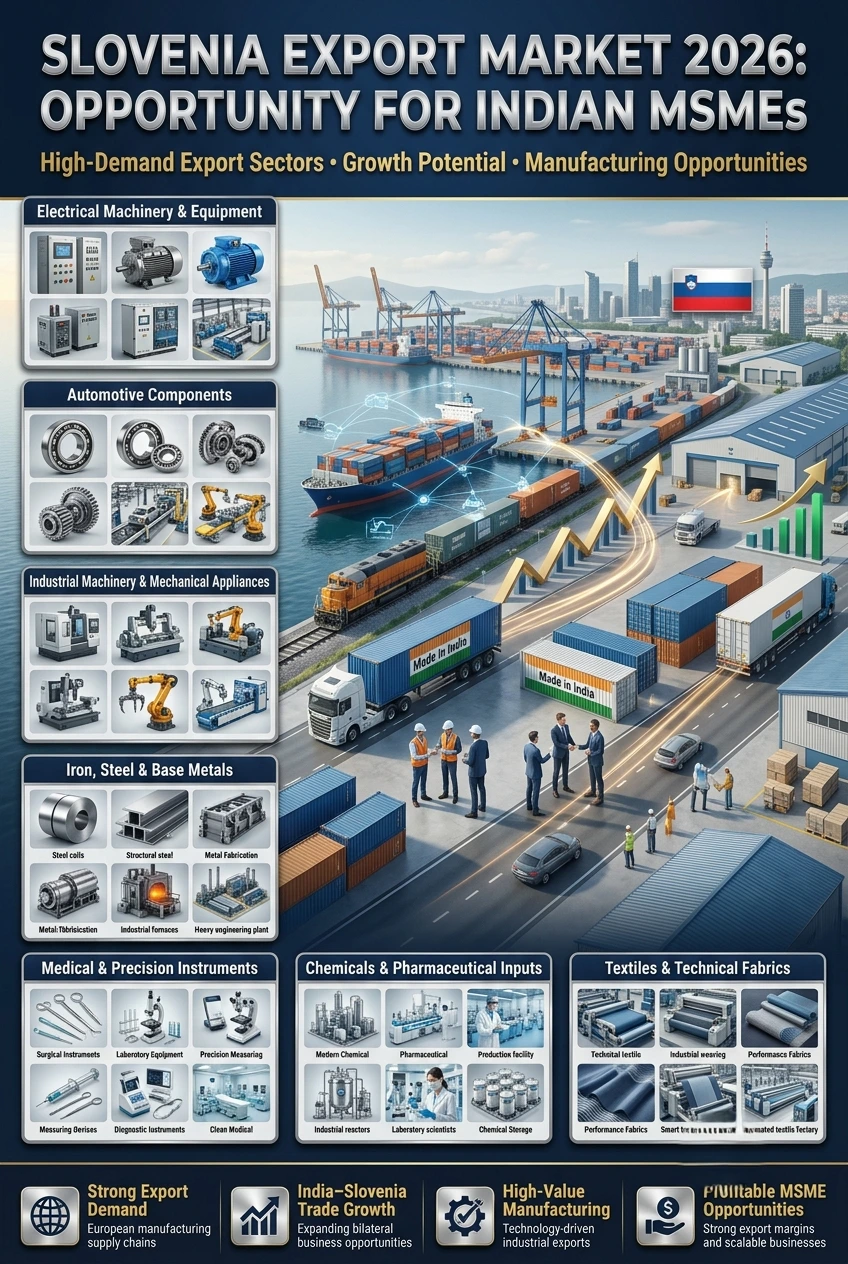
Slovenia has an industrial economy, good connections with the rest of Europe and an upper middle class EU economy that puts pressure on its import needs. The areas that have the best match between the import demand and manufacturing capabilities of Indians are as follows.
1. Electrical Machinery and Equipment
The manufacturing industry in Slovenia relies on advanced electrical systems. Motor units, switchgear assemblies, power distribution equipment, motors, transformers, and electric automation components are among the constant and expanding import line items.
Indian manufacturers in this area have an inherent competitive edge – having the capability to produce the goods, understanding international standards and being competitive in terms of price, with existing suppliers to the German or Italian supply chain.(Slovenia Export Market)
Slovenian buyers will require control panels, industrial motors, switchgear, transformers, power cable, drives and automation devices that conform to EU electrical safety standards (IEC/EN series).
View Full Project Details: Electrical, Electronic Industries and Power Projects
The preparations required by Indian exporters: CE marking according to the Low Voltage Directive (LVD) and the Electromagnetic Compatibility (EMC) Directive and ISO 9001 quality certification.
Business models: direct OEM supply, partner with Slovenian electrical distributors, set up European technical sales office.
2. Automotive Components
The sector is one of the highest opportunity sectors for Indian exporters. Slovenia’s automotive supply industry directly serves major OEMs from Germany, Austria, and Italy, including Volkswagen, BMW, Daimler, Stellantis, and Fiat.
Indian Tier-2 and Tier-3 automotive component manufacturers that make precision machined parts, castings, forgings, rubber components, electrical assemblies and plastic injection moulded parts can go for the Slovenian buyers who provide these OEM platforms. The cost-quality equation Indian manufacturers provide is a real competitive edge.
Slovenian buyers require: Precision castings and forgings, Machined metal parts, Rubber and plastic parts, Wiring harnesses, Electronic sub-assemblies, to IATF 16949 quality standards.
The challenges Indian exporters will face: IATF 16949 certification, PPAP documentation, dimensional and material certifications, and co-development with Slovenian engineering teams.(Slovenia Export Market)
Business Models: Long-term Tier-2 Supply Contracts, sample development programmes, exploratory JV arrangements with Slovenian component manufacturers.
3. Industrial Machinery and Mechanical Appliances
Slovenian industry is operated by process equipment imported from all continents, and more and more from Asia. Slovenian manufacturers of food processing, chemicals, plastics and general engineering are consistent importers of boilers, industrial pumps, compressors, heat exchangers, reactors, centrifuges and general engineering assemblies.
The process equipment manufacturing industry in India is based in Gujarat, Maharashtra and Tamil Nadu and manufactures a wide range of equipment’s used in the manufacturing of capital goods, at internationally competitive prices. Expectations of industrial buyers in Slovenia include quality documentation, test certificates and third-party inspection.
Slovenian buyers: Pumps, Compressors, Boilers, Heat Exchangers, Pressure Vessels, Industrial Filtration Equipment Compliance to PED (Pressure Equipment Directive) and CE.
What Indian exporters need to do: Obtain CE marking in compliance with the relevant EU Machinery Directives, material test certificates, and have the capability to commission in India or arrange for European service providers.
4. Iron, Steel, and Base Metals
The Indian steel industry already has a good footing in Slovenia. Indian competitiveness in hot-rolled coils, structural sections, plates and fabricated steel products have contributed to the 16-fold growth in bilateral trade. Slovenian manufacturers — in construction, automotive, and general engineering — are active buyers.
This is a known market with existing buyer relationships and logistics routes for Indian MSMEs in the steel fabrication industry, with the efficient Port of Koper entry point. The opportunity is to strengthen these relationships, diversify the export portfolio with value added products and to leverage the steel products into the neighbouring EU markets via Slovenia.(Slovenia Export Market)
Slovenian buyers want: Hot-rolled steel coils, structural sections, precision steel tubes, stainless steel products and fabricated metal parts.
What Indian exporters need to do: Mill test certificates, EN/ISO material standards compliance, competitive pricing of CIF to Port of Koper.
Read the Complete Book Here: Steel and Iron Handbook
5. Medical and Precision Instruments
The healthcare industry is growing in the Republic of Slovenia. The government is spending more on healthcare, hospitals are on the purchasing list, and the nation is buying a lot of medical devices, diagnostic equipment, surgical instruments and lab equipment.
Medical device manufacturers in India that have invested in EU MDR (Medical Device Regulation) compliance are well positioned to capture this market segment. In non-critical device categories pricing can be significantly better than European domestic suppliers.(Slovenia Export Market)
Slovenian buyers require surgical instruments, diagnostic devices, hospital furniture, laboratory instruments and rehabilitation devices that comply with EU MDR.
What Indian exporters need to make ready: EU MDR conformity evaluation, CE marking for relevant device classes, and ISO 13485-certified quality management systems.
6. Chemicals and Pharmaceutical Inputs
The pharmaceutical and specialty chemicals sector in Slovenia is well-developed. This is because companies such as Krka, one of Europe’s important generic pharmaceutical producers, headquartered in Novo Mesto, Slovenia, generate consistent demand for API (Active Pharmaceutical Ingredients), specialty chemicals, chemical intermediates and industrial chemical inputs as B2B products.
Indian pharmaceutical and chemical manufacturing industry is known all over the world for its quality and cost effectiveness. Direct B2B offtake opportunitie0s are available with the Slovenian pharmaceutical and chemical companies with Indian API manufacturers and specialty chemical producers.(Slovenia Export Market)
Slovenian buyers require: Active Pharmaceutical Ingredients (APIs), chemical intermediates, specialty chemicals, and industrial process chemicals with EU REACH and GMP approval.
Items that Indian exporters will have to be ready: EU GMP for pharma exporters, REACH compliance documents, DMF (Drug Master File) submission (if applicable).
7. Textiles and Technical Fabrics
Slovenia imports textiles and technical fabrics for both consumer and industrial end-use. Indian textile manufacturers, including producers of technical textiles, industrial fabrics, yarns, and finished clothing, enjoy natural cost and scale advantages that Slovenian buyers actively seek.
The fact that Slovenia serves as a logistics hub also means that Slovenian distributors import textiles and ultimately deliver them to retail and industrial customers across other EU destinations. A Slovenian importer relationship can support several Central European markets.(Slovenia Export Market)
Slovenian buyers are looking for: Technical textiles, yarns, knitted and woven fabrics, industrial fabrics, finished garments in compliance with EU REACH textile standards and OEKO-TEX certification requirements.
Related Article: Technical Textile Manufacturing: The Export Opportunity Indian MSMEs Are Still Missing
Business Models and Opportunities for Indian MSMEs
These sectors are indicative of business opportunities for Indian MSMEs/Entrepreneurs. The following are models, that is direct actionable ones:
- Export Manufacturing Units: Set up separate production lines for European Specification – build from the ground up to meet EU standards and specification. There is less rework in post-production and faster speed of buyer acceptance.
- OEM Component Supply: Become an OEM component supplier for Slovenian manufacturers assembling for the European OEMs. This model provides high volume, repeat orders with definitive quality requirements.
- Contract Manufacturing: Provide private label/ contract manufacturing to European brands who are looking for cost competitive and quality compliant manufacturing in India. An efficient entry point is Slovenia’s integration in European brand supply chains. Slovenia’s integration in European brand supply chains is an efficient entry point.
- Industrial Trading and Distribution: Source Indian engineering products of various categories and establish an export trading unit to tie up with industrial distributors/wholesalers of Slovenia.
- Engineering Services Export is offering CAD designing, product engineering, reverse engineering and technical documentation services to the manufacturers in Slovenia with the requirement of cost-effective technical support service.
- Medical Device Export: Engage Slovenian hospital procurement and medical distribution system with EU MDR compliant medical devices and diagnostic devices.
- Value-Added Steel and Metal Products: Go beyond trading commodity steel to precision fabricated products, custom sections and premium margin specialty alloys in the Slovenian industrial market.
Government Schemes That Support Indian Exporters Targeting Slovenia
The policy landscape in India is positively geared toward the manufacturing sector with export focus. There are several government schemes which directly lower costs and risks for the companies entering Slovenian market.
The Ministry of MSME provides credit support, technology upgradation assistance under CLCSS and market development assistance for export oriented small businesses.
The Directorate General of Foreign Trade (DGFT) under the Ministry of Commerce and Industry implements the following schemes which lower the cost burden on engineering exporters: RoDTEP (Remission of Duties and Taxes on Export Products), advance authorisation and the EPCG scheme.
Startups under Startup India are recognized and given income tax benefits under the fast-track procedure & are connected with the export network for technology-led engineering and manufacturing startups.
Make in India offers a blueprint for export growth through manufacturing and statespecific support to the companies for creating manufacturing capacity in the EU standards.
Invest India helps companies set up their business, provide a single window regulatory support, and connect investors for manufacturing businesses with export orientation.
The SIDBI (Small Industries Development Bank of India) offers working capital loans and Credit Guarantee to MSMEs interested in export opportunities. Trade finance support and international market access programmes by NSIC are directly relevant to access to European markets.
Key Slovenian Government & Trade Resources for Indian Exporters
The table below summarizes the most relevant official resources that the Indian exporters should bookmark before approaching the Slovenian market. The links are all from official and authoritative sources.
| Resource / Authority | Official URL |
| SPIRIT Slovenia – Trade & Investment Agency | www.sloveniabusiness.eu |
| Slovenian Government – Investment Promotion | gov.si/en/topics/investment-promotion |
| Statistical Office of Slovenia – Trade Data | stat.si – Exports & Imports of Goods |
| Port of Koper – Luka Koper (Official Port) | www.luka-kp.si/en |
| Slovenian Exporter Database (via SPIRIT) | www.sloexport.si |
| Indian Govt – DGFT (Export Policy) | www.dgft.gov.in |
| Indian Govt – Ministry of MSME | www.msme.gov.in |
First steps for all Indian exporters: visit www.sloveniabusiness.eu and send your business enquiry to SPIRIT Slovenia. The agency will search its database for the relevant Slovenian buyers or distributors according to the profile of your product and sector — free of charge.
How Indian Companies Can Prepare for the Slovenian Market
Step 1: Research Using Official Slovenian Trade Data
Before approaching any buyer, check with the Statistical Office of the Republic of Slovenia to confirm whether Slovenia actually imports the particular category of goods you are interested in. Analyze volumes, growth and competition from countries of origin by filter by HS code. This data-driven approach avoids duplication of effort in entering the market.
Step 2: Register with SPIRIT Slovenia
Provide SPIRIT Slovenia Business Development Agency with your company profile, product list and certifications. SPIRIT offers free B2B matching and market intelligence and introduces buyers from Slovenia. This is the one tool which makes market entry the most cost-effective for Indian companies supplying industrial goods.
Step 3: Knowledge of EU Compliance Requirements
European buyers aren’t ready to live without regulatory compliance. Machinery, electrical equipment and medical devices must be CE marked. The basic ISO standard for quality management is ISO 9001. Automotive exporters must have IATF 16949. The medical device exporters require ISO 13485 and EU MDR conformity. Relying on these certifications from the beginning opens up all 27 EU member states at once.
Step 4: Optimise Logistics Through Port of Koper
The Port of Koper on the Adriatic coast is the primary entry point for Asian cargo into Slovenia and Central Europe. Transit times from major Indian ports — JNPT, Mundra, Hazira — to Koper are typically 18 to 25 days. Koper is served by CMA CGM, Hapag-Lloyd, MSC, and other major container lines. Contact Luka Koper directly through their official portal to identify approved freight forwarders and customs agents for the India–Koper lane.
Step 5: Leverage Indian Government Export Schemes
Use DGFT’s RoDTEP scheme to offset duty costs on exported products. Apply for EPCG (Export Promotion Capital Goods) licences to import machinery for EU-standard production lines at zero duty. Apply to MSME Ministry schemes for market development assistance that partially reimburses international trade fair participation and export promotion costs.
Planning Your Slovenia Export Business: The Role of Feasibility Intelligence
Why a Feasibility Report Matters Before Market Entry
Identifying a target market is the first step. The more critical step is understanding whether your specific product, at your cost structure, with your current certifications, can compete in that market at a price that generates sustainable margins.
Niir Project Consultancy Services (NPCS) helps entrepreneurs, manufacturers, and exporters answer exactly these questions. For companies considering entry into the Slovenian or broader European market, NPCS provides structured feasibility intelligence:
- Detailed Project Reports (DPRs) covering plant setup, machinery requirements, raw material sourcing, production costs, and financial projections for export-oriented manufacturing units
- Techno-Economic Feasibility Reports that assess product-market fit, competitive positioning, and investment viability for specific export business ideas
- Market Research identifying demand volumes, buyer profiles, price benchmarks, and competitive landscape in target export markets
- Project Identification services recommending the specific sectors and product categories with the strongest export potential for a given entrepreneur’s background and investment capacity
- Manufacturing Consultancy covering plant layout, process design, quality systems development, and EU compliance preparation
- Export-Oriented Business Planning aligned with government incentive schemes, certification timelines, and realistic market entry timelines
For an entrepreneur evaluating whether to invest in, say, an automotive component manufacturing unit targeting European OEM supply chains, an NPCS feasibility report provides the financial modelling, market sizing, raw material analysis, and regulatory roadmap needed to make an informed decision before committing capital.
Sector Intelligence Table: India–Slovenia Export Opportunity Overview
| Sector | High-Demand Products | Business Model | Indian Advantage | Key Opportunity |
| Electrical Machinery & Equipment | Control panels, motors, transformers, switchgear | OEM supply, direct export | Cost-competitive precision manufacturing | Slovenia’s industrial modernisation drives consistent import demand |
| Automotive Components | Castings, precision parts, assemblies, forgings | Tier-2 / Tier-3 supply, contract mfg | IATF 16949-certified suppliers, competitive pricing | Slovenia feeds German, Italian, Austrian OEM supply chains |
| Industrial Machinery | Pumps, compressors, boilers, reactors | Direct export, distributor tie-up | Established process equipment sector | Growing capex spend across Slovenian industry |
| Iron, Steel & Base Metals | Hot-rolled coils, structural sections, fabricated products | B2B industrial trading, direct supply | Scale, pricing, and product range | India already 2nd largest non-EU supplier to Slovenia |
| Medical & Precision Instruments | Surgical instruments, diagnostic tools, optical devices | Niche export, OEM component supply | Growing EU-compliant medical device capacity | Premium EU pricing with expanding healthcare spend |
| Chemicals & Pharmaceuticals | Specialty chemicals, API, industrial inputs | B2B supply, contract manufacturing | World-class generic pharma infrastructure | Home of Krka – major EU pharma buyer of Indian APIs |
| Textiles & Technical Fabrics | Technical textiles, yarns, industrial fabrics | Direct export, EU distributor supply | Scale, design capability, competitive cost | Slovenia re-exports to wider EU markets |
Frequently Asked Questions
Q1: Why should Indian exporters prioritise Slovenia over larger European markets?
Germany and France are highly competitive, well-supplied markets dominated by established European and Asian suppliers. Slovenia, by contrast, is a growing industrial economy with active import demand where Indian suppliers are already gaining ground. It also offers the same EU regulatory framework — meaning compliance work done for Slovenia applies across the entire European single market. SPIRIT Slovenia also provides free B2B matching support that is not available in most other EU markets.
Q2: How does an Indian exporter connect with Slovenian buyers officially?
The most direct route is through SPIRIT Slovenia Business Development Agency at www.sloveniabusiness.eu. Submit your company profile and product categories and SPIRIT will identify suitable Slovenian buyers, distributors, or industrial partners from its database — at no cost. The Slovenian Exporter Database at sloexport.si is also searchable for potential Slovenian business partners.
Q3: How does the India–EU FTA affect the Slovenia export opportunity?
Currently, Indian engineering goods entering the EU face tariffs ranging from 3% to 10% depending on the product category. When India and the EU conclude the Free Trade Agreement, they are expected to reduce many of these tariffs significantly or eliminate them altogether. Indian manufacturers who establish relationships with Slovenian buyers and secure EU compliance certifications before the FTA takes effect can scale rapidly when tariff conditions improve.
Q4: What certifications do Indian companies need to export to Slovenia?
You will need CE marking to ship electrical devices, machinery, or medical equipment. The basic standard is ISO 9001 quality management, although automotive exports will require IATF 16949. Medical equipment exports demand ISO 13485 plus compliance with EU MDR; and chemicals will need the correct documentation to meet REACH. Spending money on this initial process immediately opens up all 27 member countries of the European Union.
Q5: What logistics route should Indian exporters use for Slovenia?
The primary suggested solution is to ship goods to the Port of Koper on the Adriatic Coast. The Port is operated by Luka Koper d.d. The port handled 1.27 million TEUs in 2025, up 12% year-on-year, and connects efficiently to Ljubljana and broader Central European distribution networks by road and rail. Transit times from major Indian ports — JNPT, Mundra, Hazira — to Koper are typically 18 to 25 days.
Q6: Where can I verify Slovenia’s trade import data before committing to the market?
The Statistical Office of the Republic of Slovenia provides official, current import and export data by product category. This is the authoritative source for verifying that your specific HS code product category is actively imported and growing. The data is publicly available in English.
Q7: What support does the Slovenian government offer to foreign suppliers?
The Slovenian Government’s investment promotion framework provides information on investment incentives, sector priorities, and manufacturing support programmes. To enable direct linking of suppliers and buyers SPIRIT Slovenia is the executive body that provides professional support to foreign companies in doing business with Slovenia and support them in establishing contacts, organising trade fairs or seeking partners, free of charge.
Q8: Is Slovenia just an entry point, or a significant market in its own right?
Both. Slovenia’s demand for industrial imports makes it a substantial market on its own – most especially in electrical equipment, automobile components, steel, and industrial equipment. It is also a proven gateway into Austrian, Italian, Hungarian, and Croatian markets through established Slovenian distribution channels. Indian exporters often find that a Slovenian buyer relationship evolves into a regional Central European distribution arrangement over time.
Conclusion: The Window Is Open — But Not Indefinitely
Slovenia represents a specific and measurable export opportunity for Indian manufacturers. The trade growth data is real and officially verified by the Statistical Office of Slovenia. The import demand is structural. The logistics route through Port of Koper is established and growing. The regulatory environment, governed by EU commercial law, is stable and predictable. And India’s competitive position — as the second-largest non-European supplier to Slovenia — is already proven.
What makes this moment particularly significant is the convergence of several factors: the ongoing India–EU FTA negotiations that will reshape tariff economics; Slovenia’s active industrial modernisation programme supported by the Ministry of Economy, Tourism and Sport; the growing recognition among Slovenian buyers that Indian suppliers offer quality levels that compete with European alternatives at meaningfully lower price points; and the availability of SPIRIT Slovenia’s free B2B matching service that removes the biggest barrier to first buyer contact.(Slovenia Export Market)
For Indian MSMEs entering the European market, Slovenia offers one of the EU’s lowest barriers to entry. Many businesses hesitate due to perceived complexity, but Slovenia provides a stable, well-regulated, and EU-compliant market for Indian companies. Suppliers are already known and respected. A government agency also helps foreign suppliers find Slovenian buyers.
The window is open. The question for Indian exporters is how quickly they intend to step through it.


