
Matcha Business Opportunity
A Tea Estate Just Changed India’s Green Tea Game
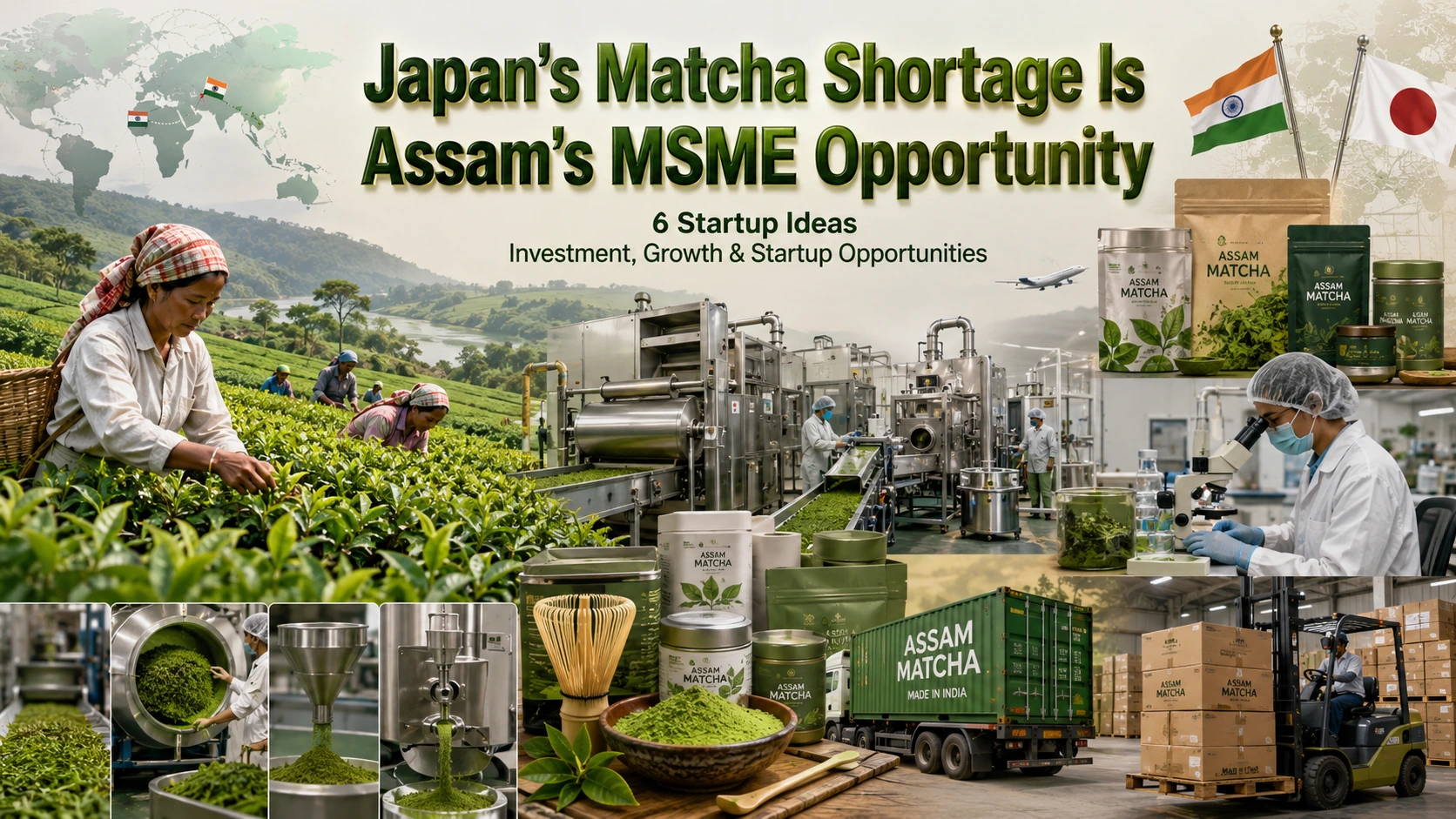
Until now, matcha – the bright green, stone-ground tea powder that has been virtually a Japanese, Chinese and Vietnamese specialty – has never been produced on a commercial scale in India until this week, when Chota Tingrai Tea Estate in Tinsukia district in Assam became the first to do so in the country, reports the Economic Times. The first lot was sold at the Guwahati Tea Auction Centre at a premium price, indicating good demand for the tea.
This is no experiment on a small scale. In fact, The estate took a decade to develop the concept of bringing a fully automated Japanese-type processing line in place, and that process involved close cooperation with Japanese equipment manufacturers and agronomists, reports Economic Times. Such a capital payout in the oldest tea-producing area in India is a clear market message.
Why is it important for entrepreneurs and MSMEs? Moreover, with the world’s demand for matcha increasing exponentially and global tencha production lagging far behind market demand, India has now proven that it can produce authentic, export-quality matcha. In consultancy language, any gap in a tight global supply chain is a business opportunity waiting for a suitable founder to take it.
Get Detailed Insights from This Book: The Complete Book on Cultivation and Manufacture of Tea
What Recent Economic Times Reporting Means
The Economic Times manufacturing desk report indicates that the launch was met with enthusiasm by Assam Chief Minister Himanta Biswa Sarma who said in a public speech that it was a historic step for Assam’s tea legacy and a diversification plan to boost the ‘Brand Assam Tea’ positioning in the international market.
The message for the founders is simple: it’s market validation, not speculation. Furthermore, a recognised tea estate has already taken the technology risk and demonstrated the workability of a domestic supply chain. Therefore, The opportunity that remains is downstream, with the processing by-products, retail packaging, café-ready distribution, quality certifications and export logistics, all of which will be much more suited to a small enterprise than to the establishment of a tea garden.(Matcha Business Opportunity) The Economic Times consistently tags India’s food-processing industry and MSMEs as import-substitution winners, and the matcha story is a typical example. Domestic manufacturers now produce this premium import, and entrepreneurs who provide ancillary services early earn the highest margins.
Why This Industry Is Growing
Different research firms estimate the global matcha market at about $4 billion to $5 billion, and all estimates point in the same direction. Most forecasts expect the market to grow to $7 billion to $9 billion by the early 2030s, with a compound annual growth rate of 7% to 11%. Furthermore, Asia-Pacific is the biggest current consumer region. Moreover, market research firms identify India, along with China, as one of the fastest-growing individual country markets for matcha consumption.
Three forces are coming together. Firstly, The first is the rise of café culture, and the matcha latte is now more of a trendy way of life for urbanites than a health-giving drink. Second, Japan has a limited supply of tencha (raw matcha leaf) due to land and labour constraints, thus causing a structural shortage, which buyers are continually attempting to remedy through diversification of their suppliers. Third, the know-how for growing shade tea is already available in India as is the auction system and export licensing system and that was what the matcha supply chain has lacked until now.(Matcha Business Opportunity)
Get Detailed Project Report (DPR): Assam Business Opportunities Guide
Government Policies & Incentives Founders Should Know
India already has a policy framework that encourages this kind of value-added agri-manufacturing. Founders can leverage existing support channels to begin building around the matcha opportunity, rather than starting from a vacuum.
On MSME Ministry portal, the coverage details of collateral-free credit guarantees and subsidised technology upgrade and priority sector lending, when undergoing MSME registration under Udyam, are available.
New business can also get registered under Startup India for tax benefits, self-certification compliance, quicker patents processing etc., which is helpful for all those developing a proprietary blending, packaging or extraction process.(Matcha Business Opportunity)
Those intending to import processing machines or export finished matcha products must research the current norms for licensing in foreign trade under the Directorate General of Foreign Trade, the laws governing India’s import-export code (IEC) and import-export compliance of the product.
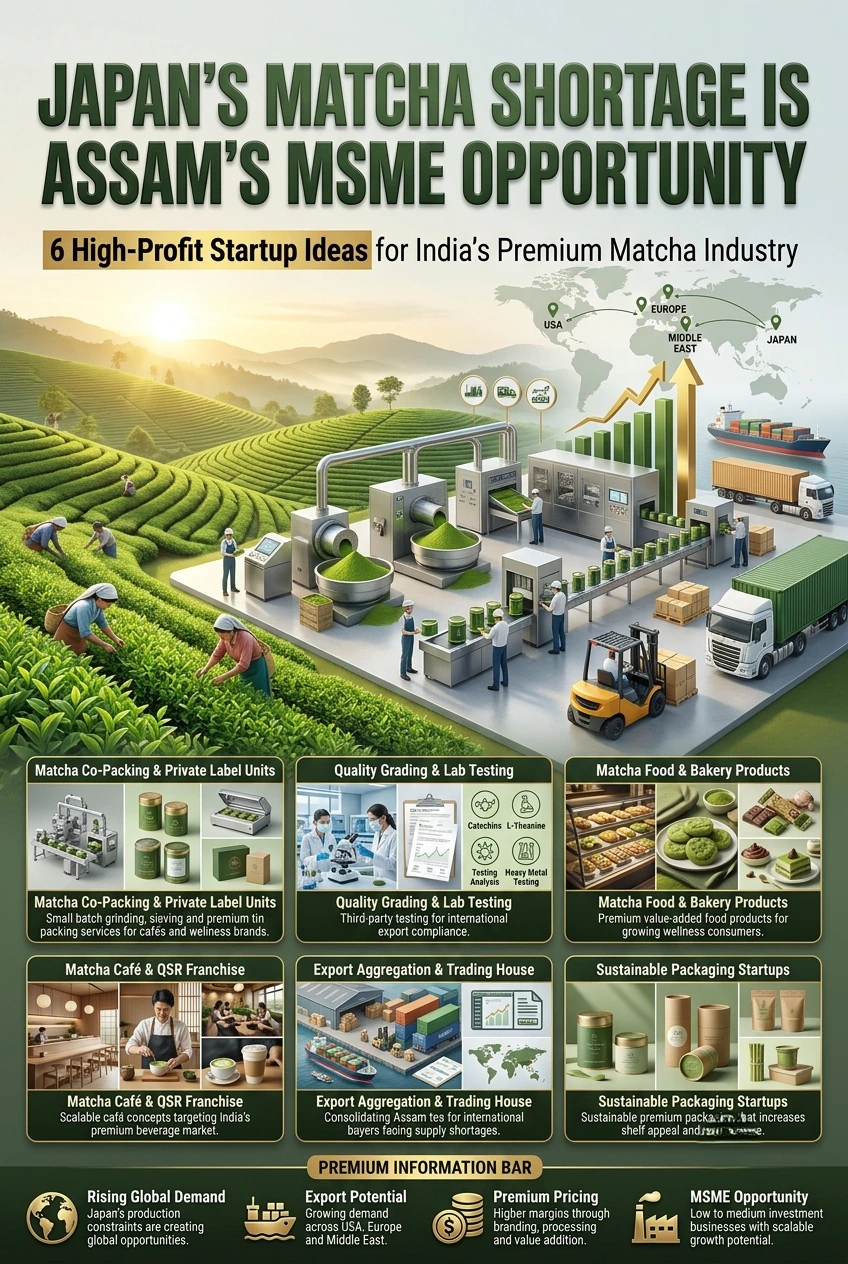
6 Business Ideas for Startups
- Matcha co-packing and private label units: small batch grinding, sieving and tin packing services for cafés and D2C wellness brands who don’t want to invest in building their own facility.
- Quality-grading and lab-testing labs: independent testing of catechins, L-theanine and heavy metals, as the export buyers in the US, EU and Middle East require a third party’s certification.
- Matcha food and bakery products: matcha cookies, energy bars, ice cream and confectionery targeted at the same premium-snacking population that is consuming flavoured green tea.
- Café and QSR matcha bar franchises: a ‘lean’ format for a bar, similar to how filter-coffee and bubble-tea chains expanded into tier-1 and tier-2 cities in India.
- Export aggregation and trading houses: consolidating small tea-garden produce into exportable lots for foreign buyers who are dependent on Japan and who are short of supply.
- Sustainable packaging start-ups: The biodegradable tins and pouches designed for a premium and wellness positioned product that packaging becomes a strong attribute to the shelf price.
Import–Export Opportunity Analysis
India currently imports most of its matcha from Japan and China, and businesses re-brand much of it before selling it in the domestic market. Therefore, A proven Indian origin supply chain puts that right, allowing local brands to benefit from the sale of their authentic and freshness benefits, and reducing logistics time from weeks to days.
In the export market, the Indian tea exporters have always been guided by the industry bodies tracking agri-exports, such as Agricultural and Processed Food Products Export Development Authority (APEDA), with data on market access, buyer-seller interactions and support for quality certification for the MSMEs that are interested in matcha.(Matcha Business Opportunity)
Exporters should be alert to rules in place in their destination markets: Pesticide residue and heavy metal restrictions exist in the US and EU on powdered teas, and complying with those regulations early is more cost-effective than complying with them at a later stage.
Related Article: Which Manufacturing Sector is Best for Startups in Assam?
Indian MSME Success Stories
India’s tea and agri-MSME landscape already have proof points worth studying. For example, Small Darjeeling and Nilgiri packers-built export brands purely on origin storytelling and boutique packaging, without owning a single tea garden. Similarly, Assam’s own orthodox tea revival over the past decade, supported by state incentives, shows how producers can reposition a traditional commodity as a premium product once processing and branding catch up with global tastes. Moreover, Chota Tigray’s matcha launch itself is the newest such case — a decade of quiet capability-building converted into a first-mover market position almost overnight.
About NPCS — Niir Project Consultancy Services
For founders who want a bankable, investor-ready blueprint before committing capital, Niir Project Consultancy Services (NPCS) stands among India’s established industrial and project consultancy firms and provides detailed project reports, feasibility studies, and technology sourcing guidance across food-processing and agri-based manufacturing sectors. Moreover, the news above highlights that a matcha co-packing, testing, or export-aggregation venture offers exactly the kind of niche opportunity that benefits from a structured feasibility study before entrepreneurs purchase the first machine.(Matcha Business Opportunity)
Discover business ideas that actually make money
Data Snapshot: Matcha Market at A Glance
| Metric | 2025/2026 Value | Forecast |
| Global matcha market size | ~$4–5 billion (2025-26) | $7–9 billion by 2032-33 |
| Typical CAGR forecast | 7% – 11% | Through early 2030s |
| India matcha tea market | ~$42 million (2024) | ~$96 million by 2033 |
| Leading production region | Asia-Pacific (>55% share) | Continued dominance |
| India’s first commercial producer | Chota Tingrai Tea Estate, Assam | Launched July 2026 |
FAQ Section for Founders
Q1. Do I need to own a tea garden to enter the matcha business?
No. Most of the opportunities described above — co-packing, testing labs, food products, café formats and export trading — sit downstream of tea cultivation and entrepreneurs can start them with a processing, testing or branding setup instead.
Q2. Is matcha production limited to Assam?
Assam is currently the first state to commercialise it, but other shade-grown tea regions in India could follow once the processing technology and know-how spread, especially with government MSME technology-upgrade support.
Q3. What licenses are essential to start a matcha-related food business?
Businesses must procure an FSSAI food license for food-grade products along with Udyam MSME registration. Those seeking to export products must also obtain an Import Export Code issued by DGFT.
Q4. How much capital is typically needed for a small co-packing or testing unit?
This varies widely by scale and equipment quality; a structured feasibility study, such as those prepared by industrial consultancies like NPCS, is the recommended first step before finalising a budget.
Q5. Is the export market realistic for a small Indian matcha brand?
Yes, particularly because global matcha supply is currently tight. Meeting international pesticide-residue and quality standards early gives small exporters a genuine opening in the US, EU and Middle East markets.
Q6. Why does the timing matter right now?
Because Chota Tingrai is currently the only commercial-scale Indian producer, the ancillary ecosystem — packaging, testing, retail, export aggregation — is still wide open. That window narrows as more players enter.
Conclusion: Why Founders Should Act Early
Economic Times’ reporting on Assam’s matcha breakthrough is more than a feel-good regional story — it is a live signal that India’s tea industry is diversifying into a high-value, supply-constrained global category at exactly the moment international buyers are looking for alternatives to Japan. The founders who move first into processing, certification, packaging and export aggregation will be building alongside genuine market validation rather than guessing at demand.
As Economic Times’ coverage of India’s manufacturing and MSME landscape has repeatedly shown, the biggest advantage in these emerging niches goes to entrepreneurs who act within the first 12–18 months of a category opening up — before competition compresses the margins that early movers currently enjoy.