
Capsicum Oleoresin Manufacturing Plant
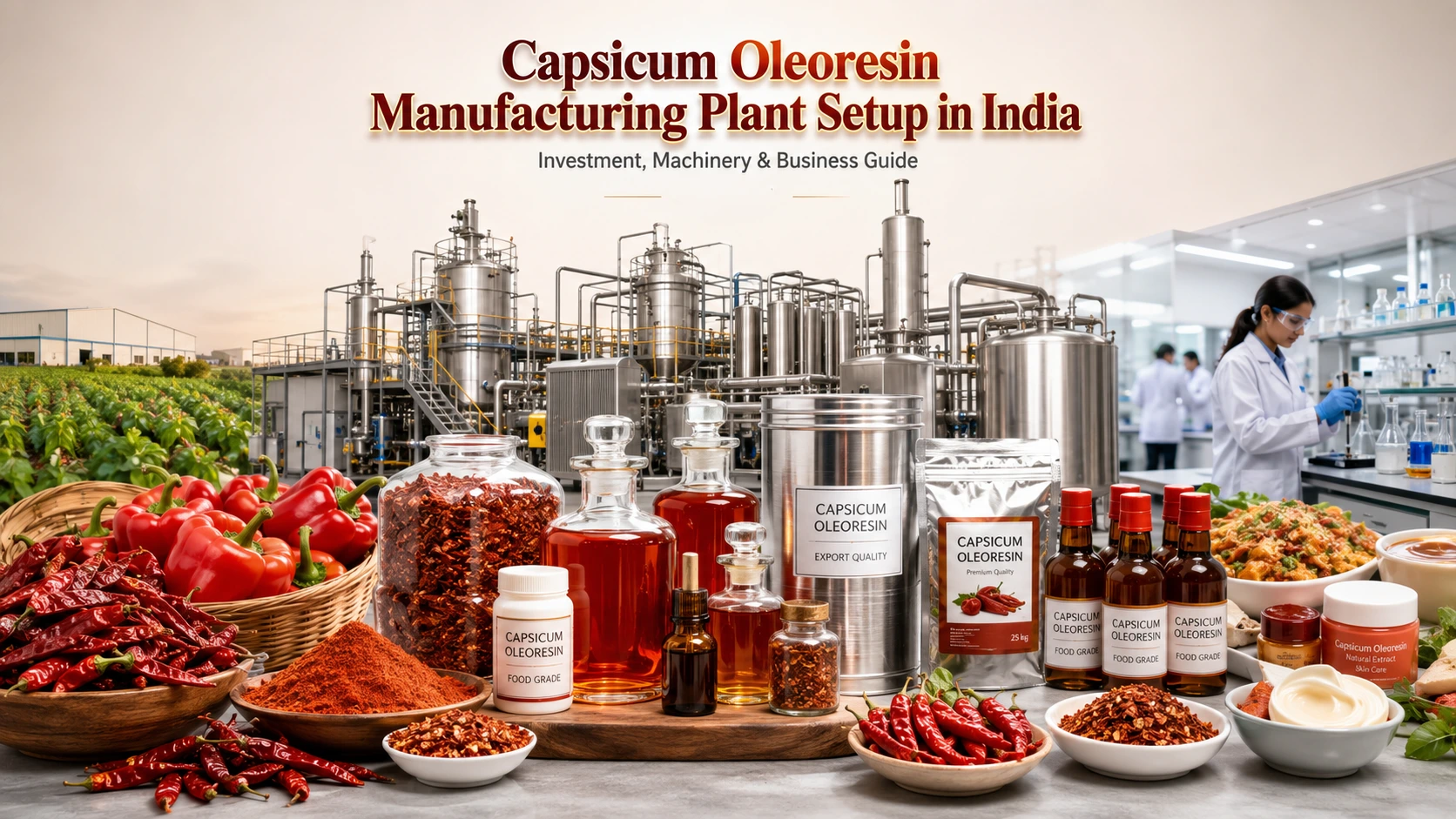
There are a number of business ideas in India’s agro-processing industry that are very actionable including a capsicum oleoresin extraction plant. India is the largest producer and exporter of chillies, creating a significant raw material cost advantage for the domestic chilly producers. The oleoresin extracted from capsicum, which is a concentrated liquid extract with high content of capsaicin, capsorubin, and capsanthin, is in very high demand from food processors, pharmaceutical firms and personal care brands around the world.
Understanding the Product and Its Applications
Capsicum oleoresin: It is the concentration of the active and other desirable constituents extracted from chilli fruits by solvents. The principal two constituent are capsaicinoids (capsaicin and dihydrocapsaicin) producing heat and carotenoid pigments (capsanthin and capsorubin) responsible for the red colour. Both these functional groups are in service to different end-markets at the same time. For the heat and colour, capsicum oleoresin is used in food processors to make sauces, marinate food, processed meats and seasoning blends. Pharmaceutical companies, meanwhile, have been using capsaicin found in the capicum oleoresin, in topical pain relief formulations.
The Spices Board of India reported capsicum and chilli oleoresins as one of the major exports of spice extracts in India. The domestic market is also important with the rapid advancement of the packaged food industry and customers’ preference for standardized packaged food with standardized ingredients rather than food made of whole chillies which vary in size and colour from one to another.
Get Detailed Project Report (DPR): Complete Oleoresin of Spices Manufacturing Guide
Government Support and Policy Framework
The Ministry of MSME provides subsidy on capsicum oleoresin manufacturing units under PMEGP up to 35% in rural areas. NABARD’s Food Processing Fund is also available to entrepreneurs for priority credit facility at a concessional interest rate. The Spices Board of India offers technical support, quality certification assistance and export facilitation. In the Make in India initiative, spice value added processing has been identified as a priority industry with the simplified regulatory clearance.
Machinery and Equipment Requirements
Core Extraction Equipment
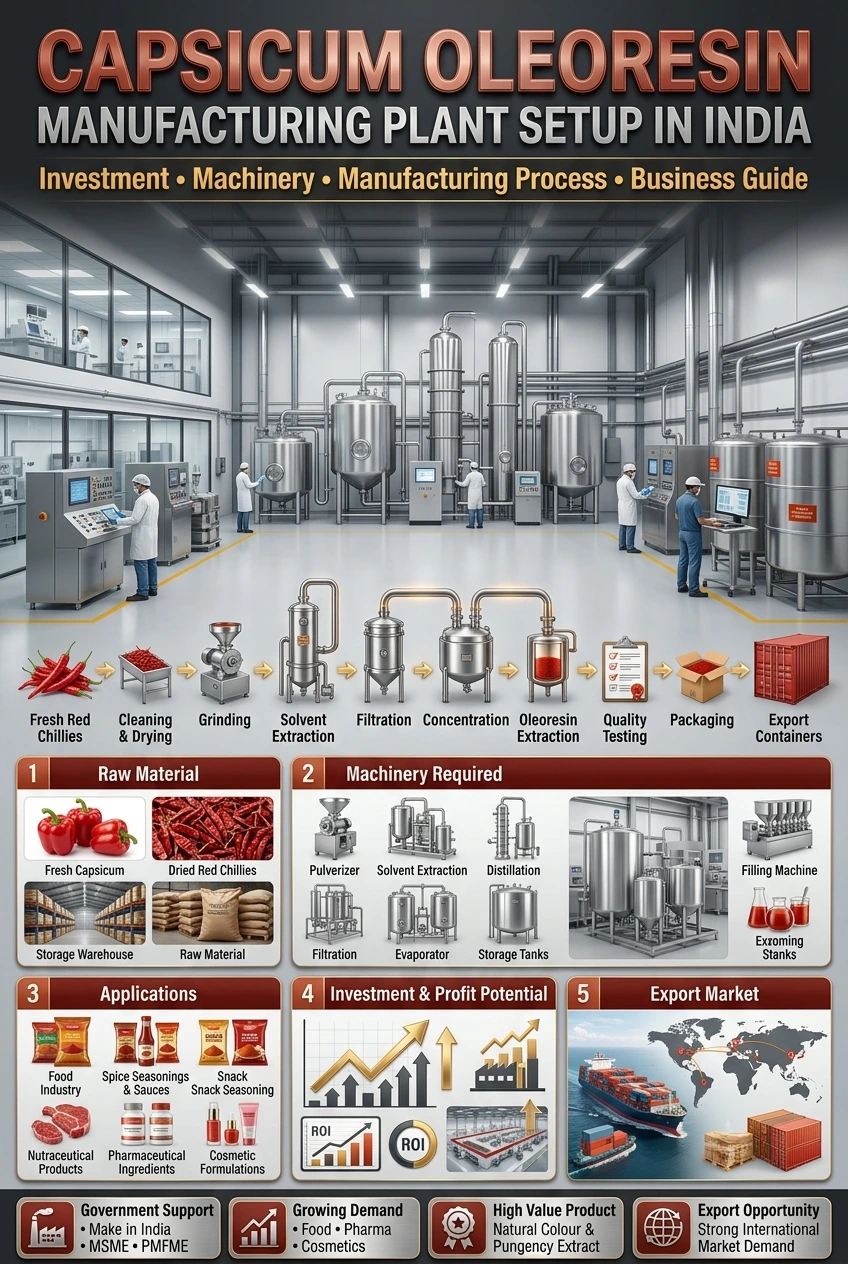
Capsicum oleoresin plant’s core is the solvent extraction system. It includes pre-treatment area (chilli cleaning, drying and milling), extraction area (usually stainless-steel jacketed tanks with a solvent circulation system), solvent recovery area (distillation area), and polishing or filtering area (for final product clarity). The total cost of the machinery for a medium scale unit which has an annual capacity of 25,000 to 40,000 litres is in the range of ₹2.5 – 4 crores depending on the level of automation and the material of construction. CO₂ supercritical extractors cost more than other methods, but they eliminate concerns about solvent residue and manufacturers use them for premium food and pharmaceutical-grade products.(Capsicum Oleoresin Manufacturing Plant)
Get Detailed Insights from This Book: Handbook on Spices
Supporting Infrastructure and Utilities
A capsicum oleoresin plant needs considerable utility infrastructure in addition to the basic extraction machinery. This encompasses a thermic fluid/boiler system for maintaining extraction temperatures, chiller system for condenser cooling, solvent storage and recovery tanks for explosion proof safety and laboratory systems for quality testing (HPLC for capsaicin quantification, spectrophotometer for colour measurement), and ETP (Effluent Treatment Plant) for process wastewater management. Due to the flammable nature of hexane solvent, industries must install safety systems such as ATEX-compliant electrical fittings, fire suppression systems, and solvent vapour detection systems.
Raw Material Analysis and Sourcing Strategy
Manufacturers use dried chilli or capsicum of various varieties as the main raw material, namely Byadagi (for colour), Teja (for heat), and Guntur Sannam (as a balanced capsicum variety). The combined area of Andhra Pradesh, Telangana and Karnataka contributes more than 70% of the country’s chilli production. Procurement contracts or farmer partnership with aggregators at farmer level near the major chilli markets in Guntur, Khammam and Byadagi helps to bring down the raw material cost and continuity of supply. In a medium scale unit, 200-400 MT of dried chilli is consumed every year.
Cost Estimation and Financial Overview
The capital investment comprises land and civil construction (₹1.2–1.8 crore), plant and machines (₹2.5–4 crore), and working capital (₹1–1.5 crore) for the initial month of production. The overall cost of the project is in the range of ₹5 to ₹8 crore. Considering the current market prices and industry average capacity utilisation, such a unit can recover its capital costs within a range of 35-42%. Export incentives are also provided by APEDA which further increase the realization of export-oriented units.
Build a profitable business with the right idea
Export Opportunity
Capsicum oleoresin export markets are fairly organized and are worldwide. The USA, European Union, Japan, South Korea and Australia are regular importers. The data from IBEF shows that natural food colour and flavour ingredients are in the list of fastest-growing export categories in India. The most critical issues in securing good export prices in EU markets are getting a EU residue compliance certificate and maintaining stable ASTA colours.
MSME Success Stories
Synthite Industrial Chemicals — Kerala
Becomes the standard reference for manufacturing capsicum oleoresin in India. The Thomas family from Kerala established and developed Synthite, driven by their vision of providing products of consistent quality and building strong linkages with chilli farmers. They had leading extraction and lab facilities to secure long-term supply agreements with big food companies all over the world. Synthite’s story for new business owners is a testament to the fact that spending upfront on systems and customer relations will pay off over time.
AVT Natural Products — Kerala and Andhra Pradesh
AVT Natural Products operates capsicum and paprika oleoresin extraction plants in Kerala and Andhra Pradesh as part of the AVT McCormick Ingredients group. Their strategic location helps improve supply chain efficiency. Companies place the extraction units close to raw material sources in Andhra Pradesh and marketing operations in Kerala. This geographical advantage reduces raw material procurement costs for volume-oriented manufacturers.
Related Article: How to Start an Oleoresin Extraction Plant in India: Investment & ROI Guide
About NPCS
At Niir Project Consultancy Services (NPCS), we offer expert services for creating market survey and detailed techno-economic feasibility reports (DPRs). Our reports are comprehensive and include detailed manufacturing processes, market research and demand analysis, process flow diagrams, product mix and capacity planning, machinery and raw material details, project financials with break-even analysis and profitability analysis.
Capsicum Oleoresin Plant: Equipment and Cost Summary
| Component | Specification | Estimated Cost |
| Chilli Pre-processing (Cleaning, Drying, Milling) | Continuous belt system, 500 kg/hr | ₹35–60 Lakh |
| Solvent Extraction System | SS extraction vessels, 2,000–5,000 L capacity | ₹80 Lakh–₹1.5 Crore |
| Solvent Distillation & Recovery | Vacuum distillation column | ₹60–90 Lakh |
| Boiler / Thermic Fluid Heater | 2–4 TPH capacity | ₹25–45 Lakh |
| Chiller and Condenser System | 60–100 TR capacity | ₹20–40 Lakh |
| Laboratory Equipment | HPLC, Spectrophotometer, GC | ₹30–60 Lakh |
| ETP and Safety Systems | Explosion-proof, fire suppression | ₹25–50 Lakh |
| Civil Construction & Land (3–5 acres) | Industrial zone, state-specific | ₹1.2–1.8 Crore |
| Working Capital (1 month) | Raw material + utilities | ₹1–1.5 Crore |
Conclusion
Setting up a capsicum oleoresin extraction plant in India offers a well-proven manufacturing opportunity that provides a clear path to earning profits. The raw material advantage, well-established export avenues, and government support provide a conducive environment for new players in India. This business requires a careful plant layout, a strict quality system, and a focused market development strategy to achieve success.(Capsicum Oleoresin Manufacturing Plant)
Frequently Asked Questions
Q: What solvent is commonly used in capsicum oleoresin extraction?
Commercial manufacturers typically prefer hexane for capsicum oleoresin extraction because hexane shows high selectivity for capsaicinoids and carotenoids. Manufacturers can easily recover these compounds through distillation. Food-grade ethyl alcohol extracts alcohol-soluble compounds, while supercritical CO₂ helps produce high-value residual-free products.
Q: What are the key quality parameters for capsicum oleoresin?
Some critical quality parameters include total capsaicinoid content (%), ASTA colour value, essential oil content (%), residual solvent levels (ppm), moisture, and visual appearance. For export buyers, the sales contract specifies the minimum acceptable range for capsaicinoids and colour value.
Q: What safety precautions are required for a capsicum oleoresin plant?
Due to use of inflammable solvents, the plant should consist of: ATEX approved electrical equipment, solvent vapor detection instruments, firefighting system and intrinsic safe equipment with excellent ventilation system. The plant management should perform and conduct regular safety drills for all personnel. State Pollution Control Board permit should also obtain.
Q: How long does it take to break even in this business?
A Medium Scale Capsicum Oleoresin Plant (well managed plant) usually offers breaks-even in about 2.5-3.5 years. Export oriented plants offer breakeven in around 1.5 to 2.5 years because their realisation in overseas markets is generally very good over and above in domestic markets.
Q: What is the shelf life of capsicum oleoresin?
Capsicum Oleoresin will have a shelf life of 18-24 months when packaged correctly in air tight containers at cool, light and temperature-controlled locations. Manufacturers can increase the product’s shelf life by flushing packages with Nitrogen to prevent the carotenoid pigments from oxidizing.