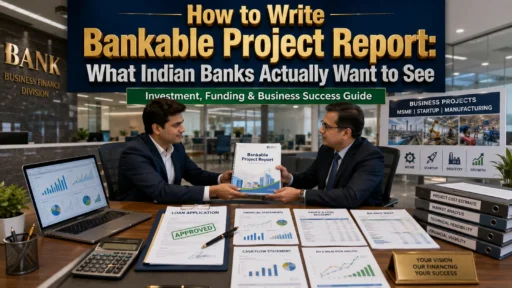
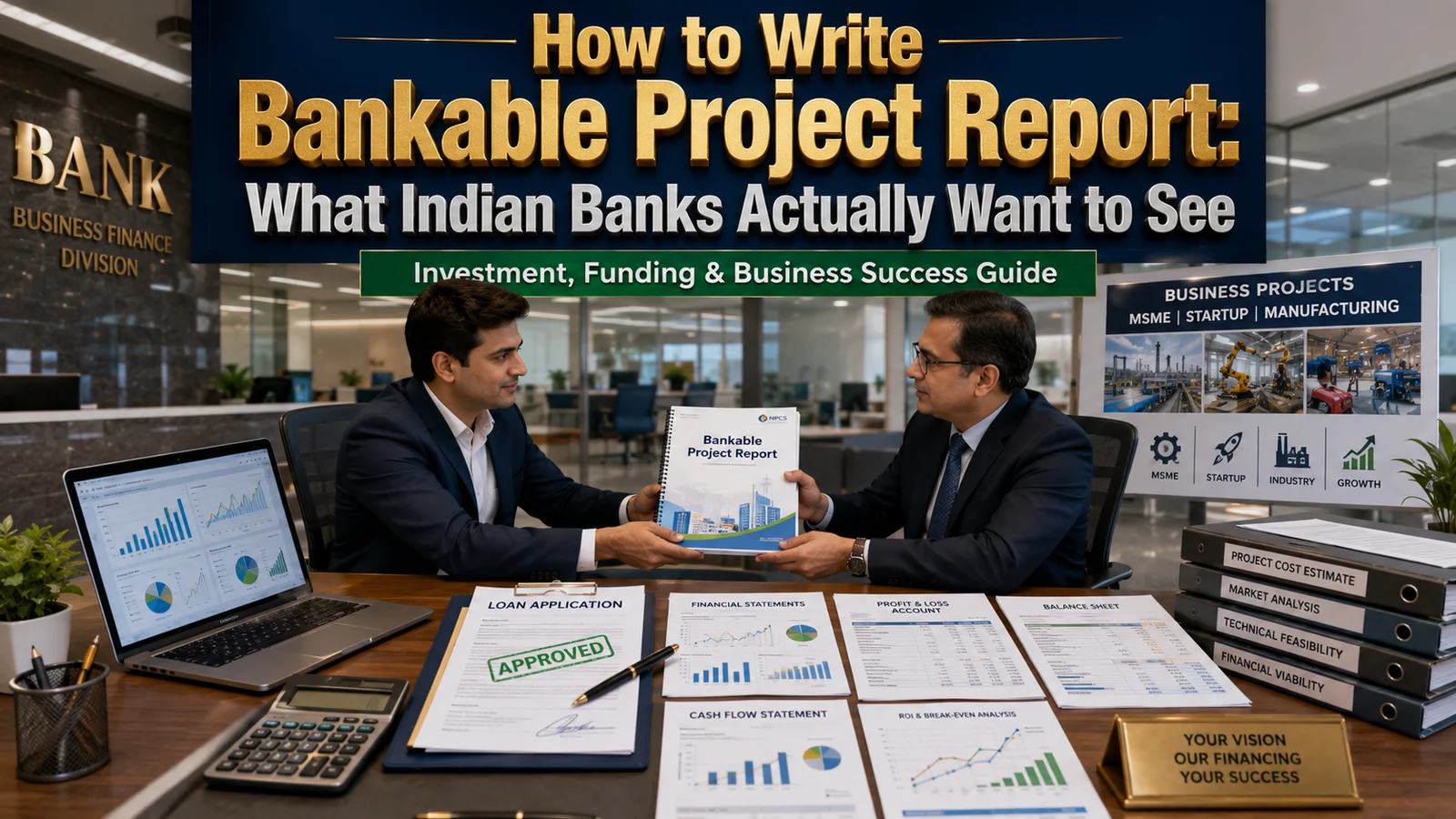

Every year thousands of viable ideas fail to come to fruition because of the inadequacy of the Detailed Project Report (DPR) that accompanies them. Banks don’t reject loan applications because they dislike business owners. They reject applications when the information provided fails to answer the questions credit officers need to assess. Government data available on the KVIC PMEGP e-Portal shows that authorities approve only about 12 per cent of applications and reject nearly 88 per cent, with documentation issues causing most rejections rather than the business itself. This guide will tell you exactly what a bankable project report should include, what numbers banks will look for, and the pitfalls that will make a project that gets you funding go under.
A DPR, also known as a project report for bank loan or business plan based on a scheme, is your business’ comprehensive case file. It needs to persuade a credit officer, who has not met and has never heard your own fervent optimism, that the project is technically viable, the market is legitimate, and that the numbers work out to be able to afford the loan without any problems.
Why the DPR Matters More Than the Business Idea
Banks are fiduciaries. They provide loans to their depositors and legally, as per prudential norms laid by the Reserve Bank of India, are obliged to check the creditworthiness of their borrowers before they lend money. When your credit officer is looking at your file, he’s not looking at whether your idea is cool; he’s looking to see if the numbers in front of him are cool. It’s for this reason that a well-prepared DPR can be the lender’s credit history substitute in some instances. By presenting a detailed document that answers the market, the technical questions and the repayment questions, the credit committee of the bank has exactly what it is looking for to approve the project.
The documentation deficit in India is really substantial. Many DPRs submitted for MSME loan are template-based and do not include details of the local market, as it applies to the individual applicant’s business. Once the credit officer recognizes an applicant’s application as a generic submission after reading a handful of these reports, they are very likely to question the business’s creditworthiness.(Bankable Project Report for Bank Loan)
Read the Complete Book Here: Select & Start Your Own Industry
The Standard Format Every Indian Bank Recognises
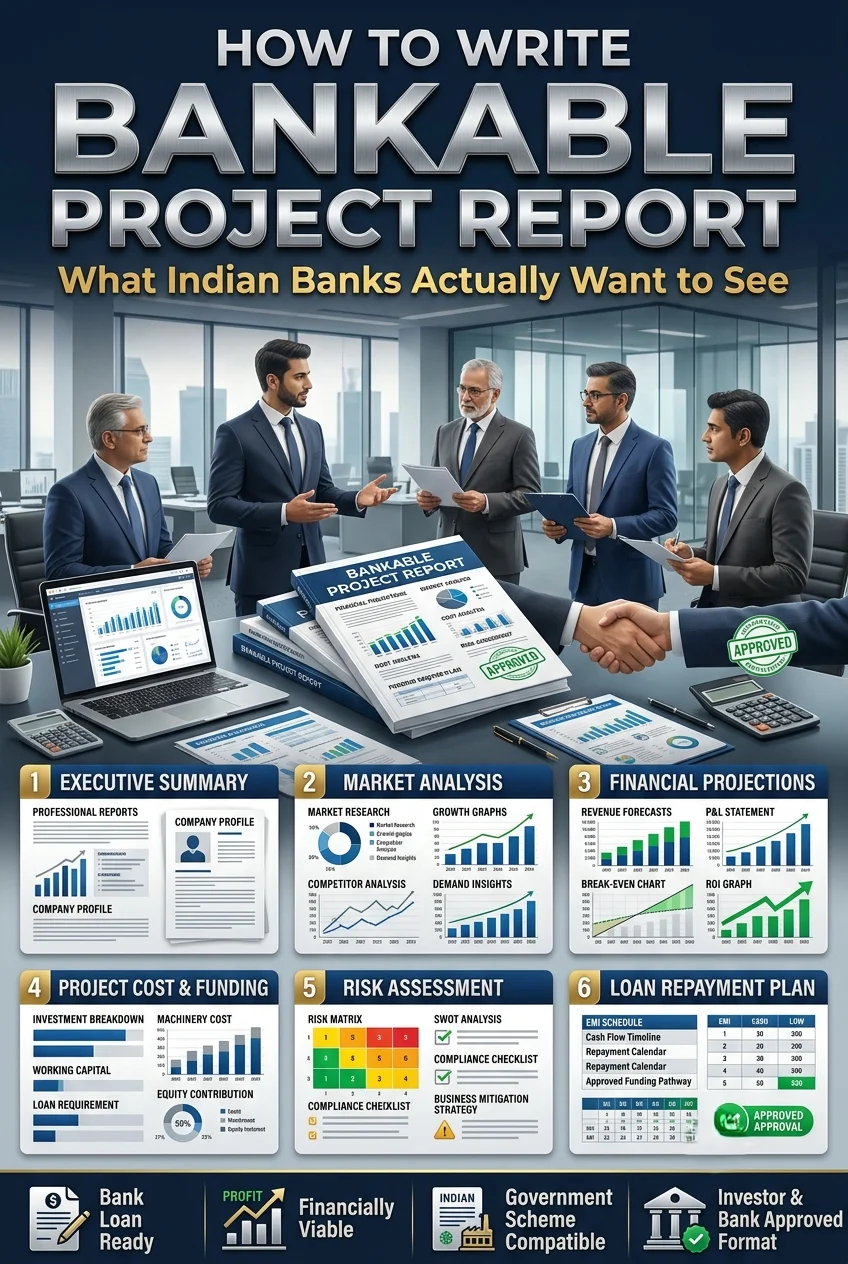
The Indian banks, SIDBI and government agencies employ general similar formats based on the IBA (Indian Banks’ Association) Credit Monitoring Arrangement structure. It is accepted by SBI, PNB, Bank of Baroda, Canara Bank, Union Bank and all the nationalised and major private banks as well as District Industries Centres for granting applications under PMEGP. A DPR in this format usually comprises eight sections, which are: an executive summary, promoter background, technical feasibility, market analysis, project cost and means of finance, financial projections, key financial ratios and supporting annexures (quotations and licences).
The executive summary (of 4-6 pages) is the first thing a credit officer reads and must contain the promoter’s qualifications, the product, overall project cost, sources of financing, internal rate of return and payback period in a way that can be digested in one sitting. This section will go wrong and set a poor tone for the rest of the report, even if the detailed sections later in the report are good.
The Numbers Banks Actually Check
In addition to the narrative portions, each credit officer has a set of financial ratios that they run against the report and if the financial ratios fail, the business case is questioned or rejected, irrespective of how well it is written. The Debt Service Coverage Ratio (DSCR), which refers to how well anticipated profits can keep up with loan payments, should be at or in excess of about 1.25, and more comfortable at 1.5 for most lenders. The promoter contribution, as defined as the contribution made by the promoter/promoter group for the project, apart from the loan amount, is usually in the range of 25 – 33 percent for regular MSME term loans depending on the scheme, whereas it can be much less for the schemes with subsidy and guarantee.(Bankable Project Report for Bank Loan)
A breakeven point of less than 60 per cent indicates good business performance because the business does not have to operate close to peak capacity to remain a going concern. By the very first year of use, one of the most frequent and preventable technical mistakes is to assume that capacity will be at 80-100% capacity on a yearly basis. Experienced credit officers feel that the utilisation does not start at zero but at 40 to 60 percent in the first year and builds up over the years, and that a report telling them that the business was at full capacity from the outset is either a sign of inexperience or bluster about the real situation.
Get Detailed Project Report (DPR): Read the Complete Book Here
The Mistakes That Quietly Kill Applications
There is a formal rejection letter with some rejections. Many more occur out of sight and without notice: an application waits in the status of “query” for a long time without being acted upon, it is quietly deprioritised, or it is returned for revision a thousand times, and the entrepreneur gives up. A detailed assessment of typical DPR pitfalls in Indian MSME lending reveals that inconsistency is the most harmful and avoidable error. This issue occurs when the figures in the top half of the DPR (project report narrative) do not match the figures in the bottom half (the CMA data attached to the DPR). The banks will check both documents when appraising, so any discrepancies will raise doubts with them as to the accuracy of the entire submission.(Bankable Project Report for Bank Loan)
Secondly, asking for a 100 per cent bank loan with no real promoter contribution usually indicates high risk, and banks frequently reject such proposals even when the business is of high quality. A third issue is incomplete submission—missing machinery quotations, an absent lease deed, no MSME registration, or registration under a different entity. As a result, the bank returns the application without processing it instead of officially rejecting it. This delays the process for weeks before the entrepreneur even knows what is missing. Fourth, and perhaps most overlooked, is the lack of sensitivity or risk analysis—the report doesn’t consider how changes in raw material prices, lower-than-projected demand, or delays in starting production could affect repayment ability.
Scheme-Specific Requirements Worth Knowing
While the core DPR structure remains constant, specific government schemes layer additional requirements on top of it. A PMEGP report must explicitly demonstrate that the project is genuinely new rather than an expansion, that the promoter has not previously benefited from PMEGP or a comparable subsidy, and that the project cost falls within the scheme’s ceiling of ₹50 lakh for manufacturing and ₹20 lakh for services. The financial section must clearly show how subsidy, promoter margin, and bank loan components balance against total project cost, since any imbalance here is an immediate red flag for the appraising officer.(Bankable Project Report for Bank Loan)
A CGTMSE-backed application must demonstrate MSME classification under the MSMED Act and clearly justify why the lender should extend the loan without collateral. It should prove that the project’s cash flow and viability, rather than pledged assets, can give the lender confidence. A NABARD-refinanced agricultural or rural project must follow NABARD’s bankable model format, covering unit economics, cost per unit, and input-output ratios specific to that activity, since NABARD refinances the lending bank and therefore has its own appraisal criteria layered on top of the bank’s own.
Turn your budget into a successful business plan
How Long a Proper DPR Actually Takes
Timelines vary considerably by project scale and scheme. A professionally prepared report for a small-scale unit with project cost under ₹2 crore typically takes 10 to 20 working days from initial data collection to final delivery, while medium and large projects can take 35 to 60 days given the additional technical and financial complexity involved. For PMEGP or KVIC-linked loans, the promoter can sometimes complete scheme-specific formats within 7 to 10 days by providing complete data upfront. Entrepreneurs consistently underestimate how much this timeline compresses when they organise their documentation, machinery quotations, land or lease papers, and financial history before report preparation begins. In contrast, the timeline stretches when they provide this information piecemeal.(Bankable Project Report for Bank Loan)
How NPCS Can Help You Access and Use Bankable Project Reports and DPR Preparation
Knowing that a government scheme exists is very different from being able to use it. Most schemes, whether SISFS, CGTMSE, PLI or a state fund, ask for a detailed project report or a techno-economic feasibility study before they release money. This is where Niir Project Consultancy Services (NPCS) becomes useful for entrepreneurs who are strong on their business idea but less familiar with the paperwork that banks, incubators and nodal ministries expect.
NPCS is an established industrial and business consultancy that prepares Market Survey cum Detailed Techno-Economic Feasibility Reports for entrepreneurs setting up new businesses across manufacturing, food processing, chemicals, engineering and emerging sectors. Such a report typically covers the manufacturing process, market and demand analysis, machinery and raw-material planning, project cost, and complete financial projections. This is close to exactly what a bank loan officer, a CGTMSE-linked lender, or a PLI nodal ministry asks to see before approving funding.(Bankable Project Report for Bank Loan)
Beyond the project report, NPCS offers pre-feasibility studies, project identification support, and general technical and commercial guidance for setting up a new industrial unit. For an entrepreneur trying to combine multiple schemes, for instance a Udyam-registered MSME loan alongside a state subsidy, having one clear, bankable document makes every subsequent application faster. You can explore their reports and services at niir.org.
Related Article: DPR for Bank Loan: Format, Example & Step-by-Step Guide for MSME Loan Approval
DPR Financial Benchmarks Banks Expect
| Metric | Typical Bank Expectation | Why It Matters |
| DSCR | 1.25 to 1.5 or higher | Confirms profit can cover loan repayment |
| Promoter Contribution | 25–33% (standard); lower under MUDRA/PMEGP | Shows genuine stake and reduces lender risk |
| Year 1 Capacity Utilisation | 40–60% | Reflects a realistic production ramp-up |
| Break-even Point | Below ~60% capacity | Signals viability without maximum output |
| Report Length (loans up to ₹25L) | 15–25 pages | Sufficient depth without unnecessary bulk |
| Report Length (₹1 crore+) | 40–80 pages with annexures | Matches complexity of larger project finance |
Frequently Asked Questions (FAQ)
Is a DPR mandatory for every business loan?
Not for the smallest loans. MUDRA Shishu loans up to ₹50,000 typically accept a simple business plan. Above roughly ₹10 lakh, and for any manufacturing unit or scheme-linked financing such as PMEGP or CGTMSE, a formal DPR is effectively mandatory.
Can I prepare my own DPR without hiring a consultant?
Technically yes for smaller loans, but a self-prepared report rarely survives appraisal for loans above ₹10 lakh, since banks look for specific financial modelling, regulatory mapping, and sector-specific market data that usually requires professional expertise to assemble correctly.
What is the single biggest reason DPRs get rejected?
Inconsistency between the project report and the CMA data submitted alongside it is one of the most common and damaging issues, since it signals careless preparation even when the underlying business may be sound.
How much should I budget to get a professional DPR prepared?
Costs vary by complexity, but standard professional preparation for an MSME term loan commonly ranges from a few thousand rupees for template-based tools to a higher fee for a fully customised report from a specialist consultancy, depending on project size and sector.
Do I need a different DPR for each government scheme?
The core business plan generally stays the same, but you need to adapt the sections: PMEGP requires proof of first-generation entrepreneurship and a specific subsidy calculation, CGTMSE requires an MSME classification and justification for collateral-free funding, and NABARD-refinanced projects require a bankable model format specific to the activity.
What single change most improves approval chances?
Replacing generic, templated market analysis with local, specific demand data, and ensuring first-year capacity utilisation assumptions are realistic rather than optimistic, together address the two most common reasons credit committees lose confidence in a report.