Introduction: Agri Startup Ideas India
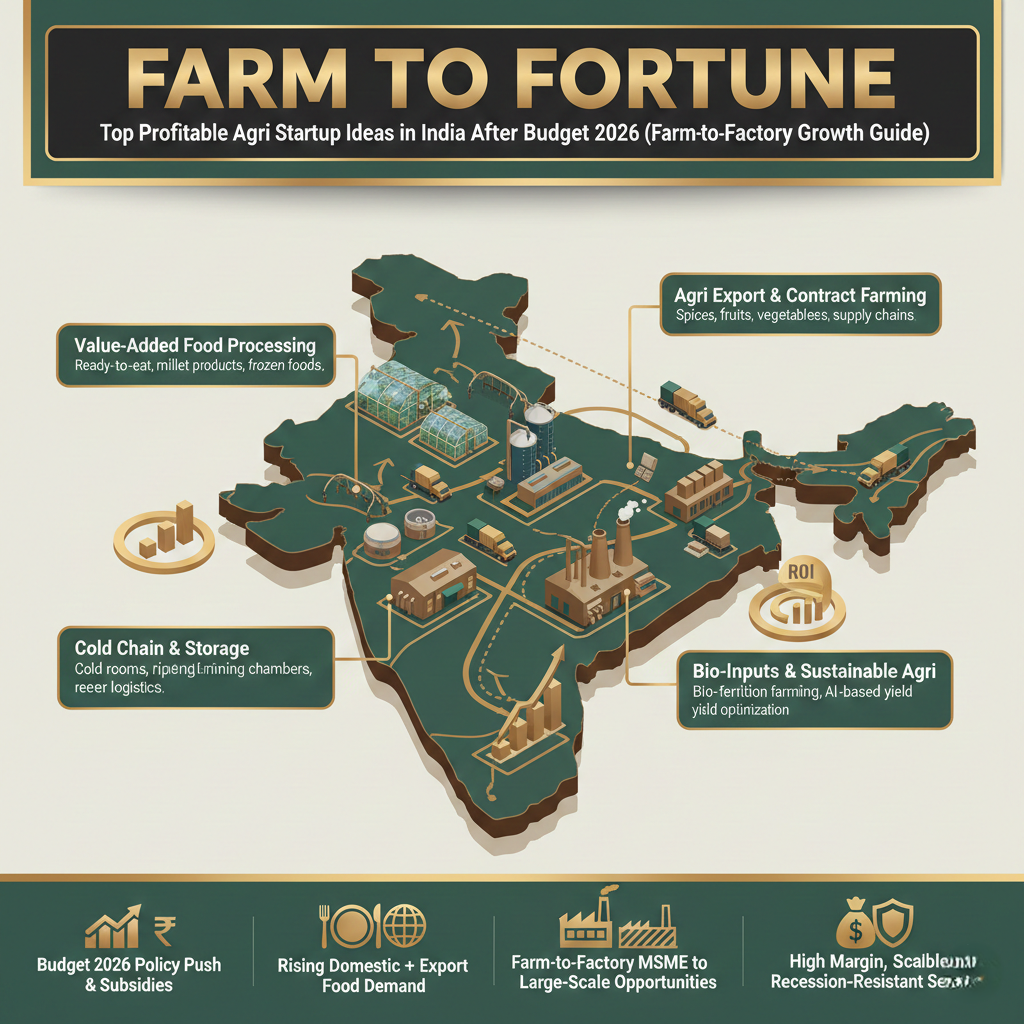
India’s Union Budget 2026-27 has heralded a strong transformation in the agricultural ecosystem. For decades the agriculture practice was about yield, acreage, and government procurement. Today, the policy focus is to move from raw production to value creation, processing and market-driven entrepreneurship. This change has paved a new way for agri startups, MSMEs & first generation entrepreneurs.
The “Farm to Factory” approach has evolved beyond its initial marketing function to become the fundamental principle driving agricultural development in India. Through better logistics, artificial intelligence and technology-enabled platforms, and by keeping agriculture focused on manufacturing, exports and technology integration, the government is pressing agriculture towards manufacturing, exports and technology integration.
For startups willing to innovate beyond the farm gate, this transition is a rare chance to create scalable, resilient businesses in sectors that were previously viewed as low margin or that could only be built with subsidies.
Read More: Modern Technology of Agro Processing & Agricultural Waste Products
Why Farm to Factory Agriculture is a Game Changer
The Budget 2026 is not a set of scattered schemes, it is an overall structural redesign designed to make the whole agri value chain more robust. The agricultural sector now shows a definite transition toward industrial agriculture through investments made in fisheries, horticulture, high-value crops and agri-tech platforms.(Agri Startup Ideas India)
Processing and manufacturing provide agri businesses with stability. The market establishes seasonal price variations for raw commodities while processed goods maintain their price stability through branding and contractual agreements and export market requirements. Entrepreneurs who go even one or two steps beyond primary production realize much higher value.
Major benefits of the farm-to-factory model are as follows:
- Maintain profit margins – processed products
- Better export opportunities
- Reduced dependence on fluctuating farm gate prices
- Scalable manufacturing-based revenue models.
- Data- and AI-based Predictability using Technology
1. Fisheries Processing: High Potential Export Manufacturing
The fisheries sector is the perfect example of the changing agri strategy of India. Rather than just concentrating on harvest volumes, policies have come to include support for integrated value chains such as processing, cold storage, packaging and export logistics.
Startup opportunities exist in fields such as frozen seafood, ready-to-cook product, value added fillets and institutional supply chains. Export incentives and better access to markets make fisheries processing a good manufacturing opportunity.
Successful entrepreneurs in this space are focussed on:
- End-to-end quality control
- Strong cold-chain infrastructure
- Adherence to global food safety standards
- Diverse product lines in order to control the volatility of raw materials
Processing turns fisheries into a trading business to an all-out manufacturing business with regular demand from all over the world.
Read More: Handbook on Fruits, Vegetables & Food Processing with Canning & Preservation (3rd Edition)
2. Cashew and Cocoa Processing: Consumption into Industry
Growing Indian consumption of cashew and cocoa has led to a huge demand-supply gap between the domestic market and local processing capacity. Policy support is encouraging startups to set up processing units at clusters of cultivation centers, cutting logistics costs as well as working capital efficiency.
High value opportunities include:
- Flavoured cashew products (roasted)
- Cocoa powder and chocolate ingredients
- Nuts snacks, premium packaged products
- Industrial chocolate and covered production
Profitability is improved if entrepreneurs maximise the utilisation of by-products, such as cashew shells or cocoa husks. Rather than starting consumer brands straightaway, many successful MSMEs start their business as reliable processors supplying established exporters and manufacturers.
3. Coconut Based Manufacturing: The Multi-Product Benefit
Coconut processing is one of the most versatile agri manufacturing opportunities. A single raw material can generate multiple revenue streams such as virgin coconut oil, coconut milk, desiccated coconut, fiber products, activated carbon and wellness products.
The multi-product model enables startups to manage risk. Primary products help to cover fixed operational costs whereas secondary products create extra profit margins.
Growing global demand for plant-based food, organic wellness products and sustainable materials further supports the export potential of coconut-based manufacturing. Entrepreneurs who create flexible processing plants create a huge competitive advantage.
4. Horticulture Processing: From Expendable Crops to Profitable Products
Horticulture has been one of the promising but risky sectors of Indian agriculture since time because of perishability and price volatility. Policy measures that support high-density cultivation and orchard rejuvenation are aimed at improving continuity of supply – an important factor for processing industries.
Popular opportunities in horticulture manufacturing include:
- Fruit pulps and concentrates – This will contain the following ingredients.
- Natural Healthy Snacks for Kids: – Dehydrated fruits and vegetables
- Frozen IQF (Individually Quick Frozen) products
- Nutraceutical and functional food ingredients
Startups that achieve success begin their operations by securing contracts and developing crop schedules before they commit to purchasing major equipment. It allows for the alignment of plant capacity and the availability of crops during the seasons, and prevents underutilisation and financial stress.
Read More: Manufacture of Food & Beverages with Project Profiles (3rd Edn.)
5. Agri-Tech and AI Integration: Intelligent Factories in Agriculture
One of the most ahead-of-the-game is the integration of digital agri platforms and agricultural systems that are smartified. These technologies are not confined to the adaptive use of apps to farmers – they are changing procurement, processing and supply chain operations.
Some of the key opportunities for agri-tech startups include:
- Yield forecasting tools for processors
- AI based quality grading systems
- Supply chain planning and inventory optimisation
- Data-driven procurement platforms
The most powerful agri-tech companies are the ones that build their software into manufacturing and sourcing processes and are thus invisible infrastructure that enables operational efficiency.
Export Opportunities: Dual Market Advantage
Many of the processed agri products are naturally export-oriented, such as seafood, coconut products, cocoa products and dehydrated horticulture products. Improved logistics and trade facilitation measures boost India’s competitiveness in world markets.(Agri Startup Ideas India)
For export-focused startups, early investment should be made in:
- International certifications
- Standardised product formats
- Quality assurance systems
- Compliance-driven manufacturing processes
Balancing domestic contracts with export sales brings financial stability and long-term growth potential.
Read More: Startup Opportunities in Processing Fruits, Pulses, Spices, and Dairy
Risks and Strategic Factors for Agri Startups
While there are some significant opportunities, entrepreneurs must be aware of the operational challenges of agri manufacturing.
Common risks include:
- Inconsistency in the supply of raw materials
- High initial capital expenditure
- Complexity of the process and compliance requirements
- Seasonal variations in demand
The organization employs multiple sourcing strategies together with adaptable processing systems and comprehensive feasibility assessments and data-driven operational development to achieve its operational objectives.
Read More: How India’s New Budget Is Creating a Billion-Dollar Container Manufacturing Opportunity for MSMEs
Final Thoughts: Agriculture as an Industrial Opportunity
The Agri sector of India is rapidly evolving into an industrial system which supports export activities. The policy framework combined with increasing international interest in sustainable products and processed food has made agricultural manufacturing a primary sector for startup development.(Agri Startup Ideas India)
Entrepreneurs who build businesses for supply chain efficiency by integrating technological processing systems will develop scalable enterprises that extend beyond typical agricultural boundaries. The future of Indian agriculture is not only the production of crops but the manufacture of high-value products for the benefit of the domestic as well as the international market.
FAQs: Agri Startups After Budget 2026
- Which Agri sector provides fastest start up growth?
Fisheries processing and manufacturing based on coconuts often stabilise rapidly because of diversification of demand and opportunities for exports.
- First-generation entrepreneurs: Can they make it in agri manufacturing?
Yes, but only on the condition that projects are appropriately sized, supported by feasibility studies and based on robust sourcing networks.
- Do Agri startups need to think export right from day one?
Not necessarily. Many businesses start with their own domestic contracts and later go on to export when quality systems are in place.
- What is the greatest hidden threat in Agri startups?
Raw material inconsistency is one of the biggest challenges. Long-term sourcing agreements and flexible product lines are ways to manage this risk.
- Is Agri-tech a viable model on its own as a startup?
Yes, but the most successful models are integrated closely with either manufacturing, procurement or financing operations.