Introduction: Toy Manufacturing Business in India
The toy manufacturing sector in India is undergoing a major change due to increased local demand, governmental initiatives and the increased preference towards locally manufactured products. The Indian toy market has been relying on imports, particularly the Chinese ones, largely over decades. Nevertheless, the shift in policies, rise in consumer awareness and the impetus of the Make in India have presented vast opportunities to local manufacturers.
Today, India does not only boast of one of the highest numbers of child population in the world but also it has a fast-growing middle class which is ready to pay more on safe, educative and environmentally friendly toys. Although this is demanded, local production continues to satisfy only a small fraction of the market demand. This is a big business opportunity to new entrepreneurs.
Toy manufacture business in India can be very lucrative when it is strategically planned, correctly invested, equipped, compliant with and understanding of the market.
Get Detailed Insights from This Book: Comprehensive Toy Manufacturing Handbook
Growing Toy Market in India
Indian toy industry is presently estimated to be worth more than 15,000 crore and is expanding steadily at an average of 13-15 percent per year. Among the major trends in this industry is the growing need of educational, STEM-based, and environmentally-friendly toys.(Toy Manufacturing Business in India)
Contemporary parents are more aware of the quality of products, level of safety, and the educational purpose of toys. This change is slowly taking the place of low-quality imports with more-designed national products.
Nevertheless, India continues to import a high proportion of its toys and this indicates a gap in supply and demand. Such a gap is a great chance to allow local manufacturers to enter the market and create scalable units of production.
Government Support and MSME Toy Cluster Scheme
The Government of India has launched a number of programs to help in domestic toy production as part of the larger, Make in India initiative. The MSME Toy Cluster Scheme is one of these.
The scheme is based on establishing special toy production zones where small and medium enterprises will be able to work with a common infrastructure and lowered costs.
Key benefits include:
- Financial support of general infrastructural facilities like testing laboratories and design centers.
- subsidies in MSME schemes such as PMEGP.
- CGTMSE collateral-free loans.
- PLI schemes Incentives under Production Linked Incentive (PLI) schemes.
- Restrict on importation of low quality toys to encourage local production.
Such efforts make entry barriers very low and enhance profitability to new entrepreneurs.
Get Detailed Project Report (DPR): How to Start Kids Electronic Toys Factory
Types of Toy Manufacturing Businesses
Toy production is a variety of business, and entrepreneurs can select the category, depending on the investment funds and their skills.(Toy Manufacturing Business in India)
1. Plastic Toy Manufacturing
It is the most widespread category and encompasses the toy vehicles, building blocks, and action figures. It involves more investment in such machinery as injection molding machines, but provides mass production and steady demand.
2. Wooden Toy Manufacturing
The popularity of the wooden toys is increasing because of the increased demand of environmentally friendly and sustainable products. They are usually handcrafted and can be exported successfully in terms of their export potential, particularly in Europe.
3. Soft Toy Manufacturing
Soft toys are rather simpler to produce and less expensive to invest. This is a labour-intensive segment that is appropriate to small-scale entrepreneurs.
The categories are advantageous in each case, and the preference is based on the budget, target market, and long-term business objectives.
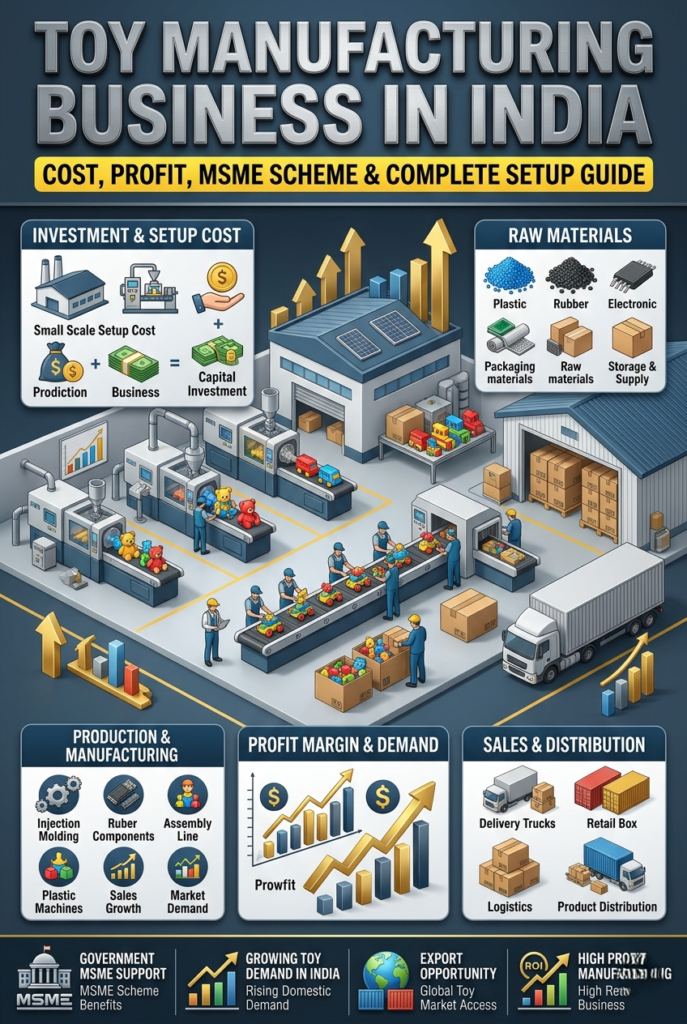
Setup Process for Toy Manufacturing Business
Establishing a toy production facility involves organised planning and legal and technical considerations.
Step 1: Business Registration
The entrepreneurs are required to undergo Udyam Registration, GST registration and factory licensing. The government requires registration for people who want to obtain their benefits and financial support.
Step 2: Location Selection
Industrial areas and MSME clusters receive special advantages because they have access to high-quality infrastructure and affordable prices and skilled workers.
Step 3: Machinery Installation
The machinery needed will be dependent on the kind of toys being manufactured. In the case of plastic toys, injection molding machines are necessary but wooden toys need cutting, shaping and finishing.
Basic requirements include:
- Industrial space of 2,000–3,500 sq. ft.
- Production machinery
- Painting and finishing set-up.
- Packaging unit
- Storage system of raw materials.
Step 4: BIS Certification
BIS requires toys in India to be certified. The system protects products through its safety measures while ensuring compliance with national standards.
Step 5: Staffing and Production
The process begins when organizations establish their machinery and obtain their necessary approvals to start hiring semi-skilled and skilled workers and commence production.(Toy Manufacturing Business in India)
Turn your budget into a successful business plan
Investment and Profitability
The toy manufacturing industry requires significant investment yet allows for extensive business expansion. The investment depends on the level of operations.
- Small-scale unit: ₹40 lakh to ₹50 lakh
- Medium-scale unit: Up to ₹1.5 crore
Financial overview:
- Monthly revenue: ₹18 lakh to ₹30 lakh
- Net profit margin: 16% to 22%
- Gross margin: 28% to 35%
- Payback period: 3-5 years.
When production becomes constant and channels of distribution are already in place, then the business is very profitable and is highly growth oriented.
Why Toy Manufacturing Is a Strong Business Opportunity
Toy production is a stable business since demand is constant. People need toys throughout the year, unlike seasonal businesses, which means they generate constant sales.
Key advantages include:
- Increasing demand of educational toys.
- Good domestic consumer base.
- Exports in the world markets.
- Policy incentives and government assistance.
- Move towards environmentally friendly and healthy products.
These are some of the reasons why the production of toys is one of the best MSME opportunities in India today.
Related Article: Start an Electronic Toy Business in India with ₹15–25 Lakh
Role of NPCS in Toy Manufacturing Setup
To start a manufacturing business, technical planning and organizing finances are necessary. Failure of many new entrepreneurships is due to lack of proper project report or feasibility study.
NIIR Project Consultancy Services (NPCS) is of major importance in addressing this issue. NPCS is among the largest Indian industrial consultancy organizations that have decades of experience in creating detailed projects reports and business feasibility studies.
NPCS provides services such as:
- Bank loan Detailed Project Reports (DPR)
- Market research and feasibility research.
- Machinery selection guidance
- Plant layout and production planning.
- Budgeting and estimation of costs.
- Technical consultancy on MSME projects.
These reports are popular among banks, financial institutions and government agencies and as such, it is now easier that entrepreneurs raise funds and commence operations without any hitches.
They can be found at niir.org.
Conclusion
The toy manufacturing industry in India is on a crossroad. Having high government support, the domestic demand is on the increase and the limit to imports is on the increase, it is the sector opening great opportunities to new entrepreneurs.
The first movers are able to take advantage of reduced competition, government policies, and increasing consumer demand. Toy production could be a very lucrative and expansive venture in the MSMEs of India with proper planning, investment and execution.
FAQs
1. What is the minimum investment?
Minimal toy manufacturing business needs about ₹40 lakh to 50 lakh.
2. Is there a profitability in toy manufacturing?
Yes, the profit margins are usually between 16-22 percent based on operations.
3. What are the licenses that are needed?
GST, Udyam Registration, Factory License, Pollution Clearance, and BIS certification are needed.
4. Is BIS certification compulsory?
Yes, it is obligatory to guarantee product safety and compliance in India.
5. Can small entrepreneurs venture into this business?
No, particularly in soft toy and wooden toy segments, which need a lesser investment.