Introduction: Smart Polymer Manufacturing Business in India.
A novel type of materials is gradually changing the world industries-smart polymers. These are not just any plastics. They are smart materials that are capable of responding to external stimuli of heat, light, pH, pressure, or electricity.
Think of a protective layer which heals itself upon being scratched, or a capsule which expels a drug when it gets to a tumour, or a fabric which becomes harder or softer when struck. These are practical uses that are already in the advanced industries.
India is just emerging in this segment. Indian industries mostly use smart polymer materials, which are imported in countries such as Germany, Japan, and United States. In the meantime, the domestic demand is increasing at an alarming rate due to pharmaceuticals, EV production, electronics, and infrastructure.
This unmet demand and supply has resulted in a ₹1,800 crore MSME opportunity in the Indian specialty chemicals market.
Why Smart Polymers Are Becoming a High-Growth Industry
The smart polymer market is already estimated to be USD 5.8 billion in the world and is projected to increase at an annual rate of above 11 percent CAGR in the next years. The growth in demand is even more rapid in India because of the growth in industries.
The demand drivers are:
- Fast increase in drug exporting that demands advanced drug delivery systems.
- Growth in production of electric vehicles and batteries.
- Under government projects, smart infrastructure development.
- Increasing trend in the use of high-performance materials in electronics and packaging.
In comparison with conventional plastics, smart polymers fall under the specialty chemicals category whereby value addition is much greater and competition in India is still low.
Get Detailed Insights from This Book: The Complete Technology Book on Polymers with Processing & Applications
The Market Gap: Why MSMEs Have a Big Opportunity
India has a good foundation in commodity plastics such as polyethylene and polypropylene. But smart polymers are an entirely different type of engineered materials.
The most important distinction is value:
- Commodity plastics: ₹80 – ₹200 per kg
- Smart polymers: ₹4,000 – ₹22,000 per kg
Home production is very low in spite of high demand. Only a few organized manufacturers work within this area, and the majority of industries continue to be highly dependent on imports.
Pharmaceutical clusters in Hyderabad, chemical in Gujarat and EV manufacturing centres in Pune and Chennai are major user industries. This gives a good chance to MSMEs to be early entrants.
Investment Required to Start a Smart Polymer Unit
There is no need to have very large infrastructure to start a smart polymer manufacturing business, however, it needs very precise equipment and controlled production systems.
Investment Overview:
- Small-scale unit: ₹80 lakh – ₹1.2 crore
- Mid-scale unit: ₹2.5 crore – ₹3.5 crore
The common unit is to produce 500-800 kg monthly, though a mid-scale unit may up to 3,000-5,000 kg monthly based on product line and degree of automation.
Major cost components include:
- Polymerization equipment and reactor.
- Laboratory testing instruments
- Raw materials and chemicals.
- Civil infrastructure and utilities.
- Working capital and compliance costs.
Machinery Required for Production
An intelligent polymer plant will need special chemical processing equipment. The following are some of the important machineries:
- Jacketed stainless steel or glass lined reactors.
- pH and temperature control systems.
- FTIR spectrometer – Spectrophotometer to study the molecules.
- DSC (Differentiating Scanning Calorimeter)
- Rheometer of viscosity and flow behaviour.
- Freeze or spray dryer systems.
These tools guarantee quality assurance and uniformity of products which are crucial in this sector.
Get Detailed Project Report (DPR): Super Absorbent Polymer business opportunity
Manufacturing Process Overview
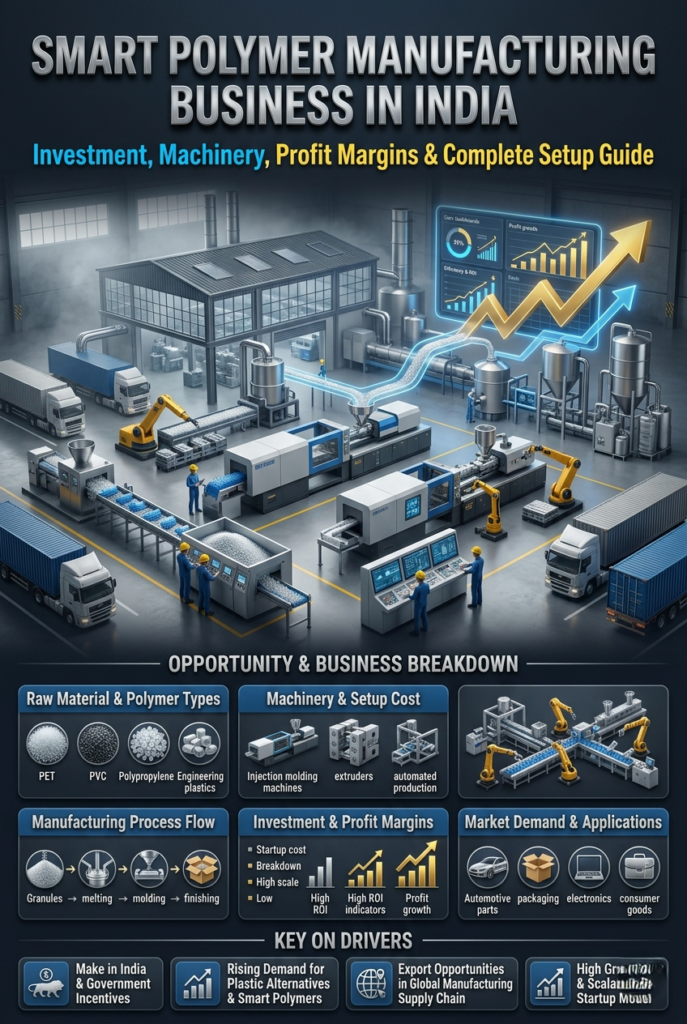
Smart polymers are produced in a controlled chemical reaction. The monomers are initially chosen depending on the required properties. In reactors, these are then polymerized under controlled conditions of temperature and pressure.
To make the polymer behave in a particular manner, like changing with a pH or temperature change, cross-linking agents are incorporated to provide the polymer with a smart response. Once polymerized, purification, drying, and quality testing of the material are done and then it is packaged.
Any minor change in temperature or chemical composition can alter the final properties and this is why the control of precision is highly required.
Profitability and Financial Potential
High-margin specialty chemical Smart polymer manufacturing is viewed as a high-margin business.
Financial Highlights:
- Gross margin: 38% – 48%
- Net profit margin: 18% – 28%
- Monthly revenue (mid-scale): ₹28 lakh – ₹65 lakh
A mid-scale unit is capable of producing a good cash flow at full capacity because the value of the product in kilos is high. Pharmaceutical grade polymers are usually the most profitable.
The payback period will mainly depend on the rate of acquiring customers and the efficiency of the production process, and will lie within 2.5 to 4.5 years.
Government Schemes Supporting This Industry
Under the various schemes, the Indian government is actively promoting specialty chemical manufacturing.
Key support programs include:
- PMEGP Scheme -25-35% capital subsidy on micro units.
- MUDRA Loan Scheme – 10 crore funding without collateral.
- CGTMSE Scheme -85% credit guarantee.
- PLI Scheme (Specialty Chemicals) 5%-10% incentive on incremental sales.
- Gujarat, Tamil Nadu and Telangana state subsidies.
These schemes have a highly positive effect of lowering entry barriers of MSME entrepreneurs.
Find high-return business ideas based on your budget & ROI
Regulatory Approvals Required
A number of approvals are needed before production can begin:
- GST Registration
- Udyam MSME Registration
- The Factories Act has the Factory License.
- Pollution Control Board Consent (CFE & CFO)
- BIS certification (in case of providing government projects)
- Pharmaceutical grade polymers CDSCO approval.
Depending on the state policies, approval timelines are normally between 3 to 6 months.
Role of NPCS in Smart Polymer Project Setup
It is a technical industry and one needs to be well planned and do a feasibility analysis before entering such an industry as smart polymers. It is here that NPCS (NIIR Project Consultancy Services) comes in.
NPCS offers a full-scale end-to-end support of MSME entrepreneurs, which consists of:
- Project Reports (DPRs).
- Plant design and choice of machinery.
- Cost estimation and financial modelling.
- Guidance on sourcing of raw material.
- Market entry and feasibility studies.
NPCS has a history of more than 40 years of consulting services in chemical and manufacturing projects which makes it one of the most reliable companies in India. They assist in minimizing risk in a project and make decisions prior to investment.
Further details can be found at niir.org and entrepreneurindia.co.
Related Article: Most Profitable Polymer Manufacturing Business Ideas in India – (High Demand MSME Projects)
Conclusion: A High-Value MSME Opportunity in India
One of the most promising advanced manufacturing opportunities in India presently is Smart polymers. This sector is a great opportunity to MSME investors due to the combination of increasing demand, a lack of domestic production, substantial margins, and the support provided by the government.(Smart Polymer Manufacturing Business in India)
Nonetheless, this is not a manufacturing company in general. It needs technical knowledge, proper planning, and good customer alignment prior to installation.
Early entrants with the appropriate strategy have the potential to create highly lucrative businesses in a field that is underdeveloped in India. Due to increasing demand of intelligent materials in the world, India can shift its status to being an importer to a producer.
FAQs
How much is needed in terms of investment?
A mini-sized smart polymer will cost between ₹80 lakh and 1.2 crore based on capacity and equipment.
Will this business be profitable?
Yes; the net profit margins lie within the range of 18-28, which is a high-value specialty chemical business.
Which industries use smart polymers?
Pharmaceuticals, EV production, electronics, infrastructure and packaging.
Is any technical knowledge required to begin?
Yes, it is advisable that you have some knowledge in chemical or polymer science or you will need to employ skilled professionals.
What is NPCS?
NPCS (NIIR Project Consultancy Services) offers DPRs, feasibility reports and full guidance on the set up of MSME projects.