Why Processed Food Business Ideas Are Rewriting the Entrepreneurship Story in India
The food processing industry in India is one of the most interesting areas for startup entrepreneurs and first-generation entrepreneurs to establish sustainable and scalable ventures. These food business ideas today are as diverse as pickles and spice mixes or as complex as plant-based protein foods and functional nutrition products; every type offers real business potential for the savvy investor. The agricultural surplus in the country, coupled with the rapid urbanisation of the culture and the increasing consumption of packaged and branded food, presents an enviable demand situation for few industries.
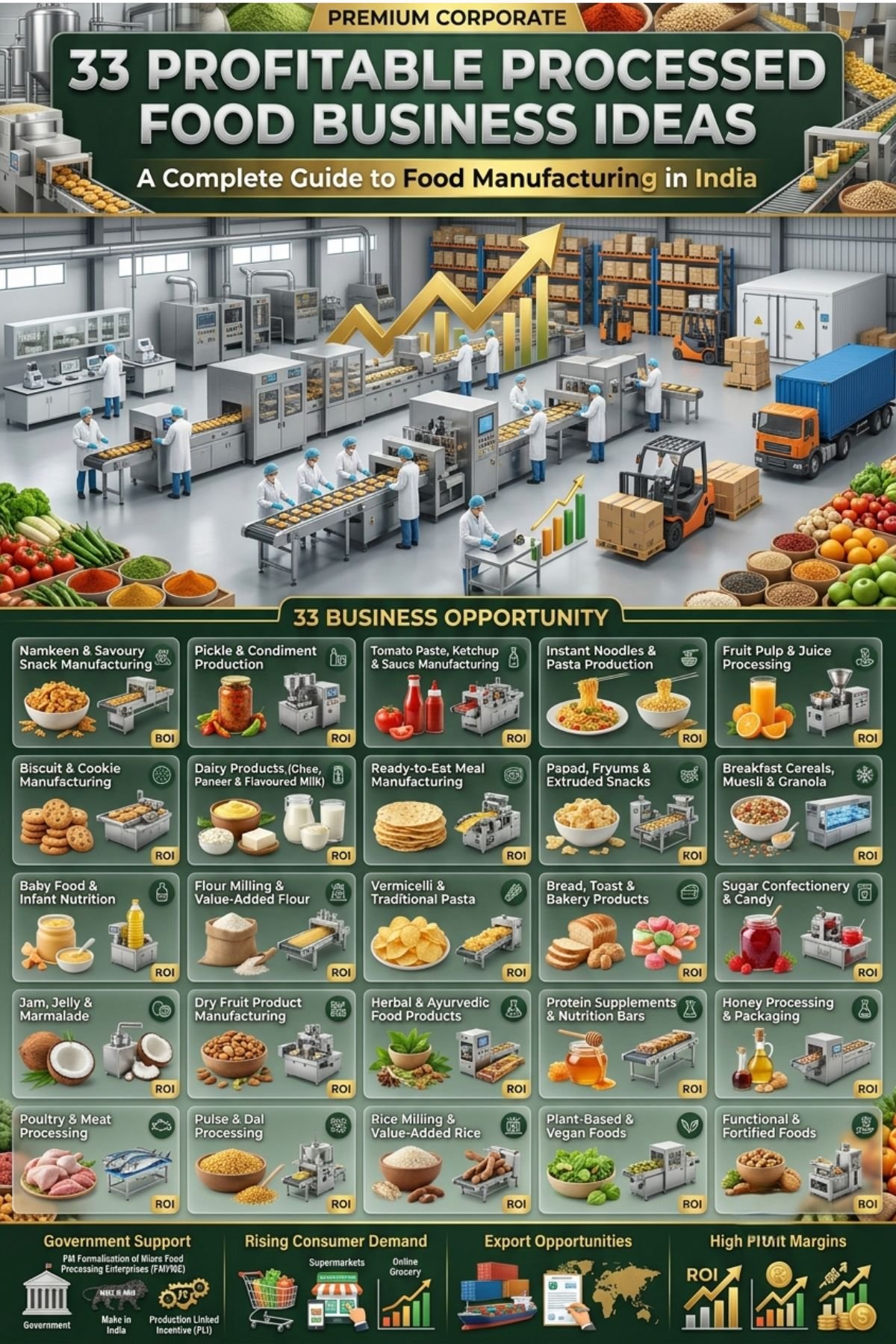
The Ministry of Food Processing Industries (MoFPI) classifies India as one of the top 5 countries in the world of food processing. However, its potential is largely untapped within value added processing, the branded product categories and export-oriented manufacturing. Now is an especially fitting time for those business owners who can take a breath and make thoughtful decisions, fundamental planning, and disciplined execution. This article runs through 33 specific processed food business concepts, the rationale behind the markets, investment ranges and the policy questions that lie ahead for new players in the market.
Why the Processed Food Sector Rewards Smart Entrepreneurs
Processed food manufacturing is being pushed by three factors of growth. For one thing, India has become a nation with more than half of its population residing in cities; convenience is no longer a luxury, it is a necessity. Households who work, nuclear families and a large market of students and young professionals are constantly demanding packaged ready-made, ready-to-eat food products. It’s a high frequency and relatively inelastic demand and thus will not dissipate when the economy takes a mild hit.
Secondly, the modern retail and digital commerce have truly brought retail to the masses. Ten years ago, a small food business in Tier-2 city had to establish an expensive physical distribution system to penetrate into the city consumers. In the current times, the same manufacturer is able to target consumers in various cities from day one of launch using quick-commerce platforms, e-grocery channels, and D2C websites. This is a huge reduction in time and investment to establish a sustainable revenue stream.
Third, India’s raw material advantage is second to none in the world. The country has an enormous range of agricultural commodities, such as spices, fruits, vegetables, cereals, pulses, dairy, poultry and seafood, which are produced at internationally competitive prices. This will provide a structural advantage to Indian food manufacturers over their foreign counterparts, especially if they are targeting export markets. India’s processed food exports are consistently recognised as being competitive by the Agricultural and Processed Food Products Export Development Authority (APEDA) and this view is corroborated by the trade data in various categories.
Government Policies and Incentives That Support Food Manufacturing Startups
The policy context for food processing business is now better than ever. The government provides Production Linked Incentive (PLI) Scheme for Processing of Food (PLI) which provides incentives based on incremental production including Ready to Eat foods, processed fruits and vegetables, marine products, mozzarella cheese, etc. For entrepreneurs that are entitled to PLI benefits, they can greatly enhance their project economics, most significantly during their initial years of operations.
The PMFME (PM Formalisation of Micro Food Processing Enterprises) Scheme offers credit linked capital subsidy up to 35% of the eligible project cost to micro food processing enterprises. It is useful for entrepreneurs who are entering into the manufacturing of products such as bakery items, papad, pickles, and mixing spices which can be manufactured in micro-scale and can generate commercial value. Moreover, the MSME-registered food business can avail central funds of CGTMSE (Credit Guarantee Fund Trust for Micro and Small Enterprises), which significantly enhances the availability of credit facilities for the food business owners who have less asset collateral.
The programme Startup India is a scheme launched by DPIIT to support startups in the food processing industry, by providing them with input tax credit exemption for 3 years, expedited patent processing and access to the Fund of Funds for Startups. In addition to monetary benefits, FSSAI (Food Safety and Standards Authority of India) has systematically made the licensing and registration procedure easier and less cumbersome over the years, so that new food enterprises can make their approval process easier. These schemes together provide a truly positive environment for the successful enterprise builder who will take time to familiarise herself with and make use of the support mechanisms at her disposal.
33 Profitable Processed Food Business Ideas for Startups
1. Namkeen and Savoury Snack Manufacturing
Snack culture is rooted in India and its behavior is prevalent in all income groups and across all geographies. Namkeen (sev, bhujia, mixture, chivda), in every region, has a steady year-round demand with small seasonality. A small-scale unit can be set up on a modest capital investment and the product can be stored for a long period of time, making distribution logistics simple even for the first-time exporters. The premium snack category is the fastest growing, as urban consumers are interested in high quality, clean label snack options. Investors in differentiated recipes (grain mixes, cold-pressed oils, baked recipes, or regional authenticity) typically make higher margins than commodity producers. In this aspect, the two most important success factors are brand positioning and packaging quality.
2. Pickle and Condiment Production
Pickle production is one of the most convenient avenues into the food processing industry in terms of being scalable and easily managed. The availability of raw material is good in all Agricultural belts of India and production process involves relatively simple equipment at the micro and small scale. The real opportunity today is clean label positioning, where pickles are being produced without artificial preservatives, with traceable and transparent sourcing of ingredients and premium packaging and are selling at two or three times the price of commodity pickles in organised retail or D2C channels. Another high-margin export opportunity is the UK, US, Canadian diaspora, and the Gulf – founders should keep developing this channel step by step from the very start of the business.
3. Tomato Paste, Ketchup, and Sauce Manufacturing
A unique category of foods that is structurally appealing to food manufacturers is tomato products given the size of the tomato crop in India and the wide range of price fluctuations around harvests. Smart processors purchase raw material when it is in surplus, when farm gate price is the lowest, and make the raw material into shelf stable paste and ketchup which last for 12 to 24 months. This arbitrage technique plays out the volatility of commodity prices as a competitive advantage. The food service sector (hotels, restaurants, quick-service restaurants and institutional catering) constitutes a predictable, large B2B customer base for ketchup and paste, which complements the retail sales and ensures revenue cycles are stable. International cuisines (sriracha, chilli garlic, schezwan) are a growing niche in this sector with sauce production.(Processed Food Business Ideas)
Get Detailed Project Report (DPR): Tomato Processing and Value-Added Products
4. Instant Noodles and Pasta Production
The instant noodles market in India has grown tremendously in the last decade, owing to the convenience aspect of the product even among students and working professionals, as well as lower to higher income groups. Right now, however, it’s a market that’s dominated by a few big national brands, which is oddly enough huge white space for regional and health-positioned brands. Entrepreneurs who seek to serve niche markets such as instant millets, oats pasta, high protein pasta or regionally flavoured products can establish sustainable market footholds without going head-to-head against the mass market. Near-term revenue stability is achieved through regional distribution partnerships and institutional supply contracts, and brand equity is created over time. In particular, the health-noodles segment is demonstrating excellent growth as consumers become more aware of the nutritional value of the product.
5. Fruit Pulp and Juice Processing
India’s tropical fruit wealth, like mangoes, guavas, papayas, litchis, bananas, and others is a tremendous raw material base for fruit pulp and beverage manufacturers. Processed fruit pulp is used as a vital intermediate product by juice brands, ice cream makers, bakery companies, and confectionery makers, ensuring a steady B2B sales cycle and providing ample product volume. Premium shelf positioning of value-added products like NFC (not-from-concentrate) juices, cold-pressed drinks, and blended functional beverages are being gained in modern retail. The National Horticulture Board actively promotes horticulture-based processing by implementing a subsidy programme, which makes this particular area a very attractive business for a founder, who lives close to the fruit growing areas.
6. Spice Grinding and Blending
Firstly, India’s spices are known all over the world for their quality, diversity and flavor. However, Although large companies dominate international bulk exports, there are also great commercial possibilities in the branded spice blends segment which serve as premium retail products in the domestic market and ethnic food products in international markets. The initial capital needed for a spice grinding and blending unit is relatively low, and the margin enjoyed on proprietary blends is significantly higher than the margins obtained on commodity whole spices. The most defensible business models in this category are around proprietary masala formulations such as region-specific curry bases, restaurant-style spice packs, BBQ rubs and fusion seasoning packs that establish genuine product differentiation and consumer loyalty over time.(Processed Food Business Ideas)
Explore This Book: Handbook on Spices, Seasonings and Condiments Processing, Extraction with Kitchen Spices Manufacturing
7. Biscuit and Cookie Manufacturing
Biscuits continue to be one of the most popular types of packaged food consumed by all income groups and all age groups in India. The existing national biscuit brands have significant distribution strength and dominate the mass-market, however, the premium, artisanal and health-biscuits segment has potential opportunities for new brands. The willingness to pay a premium is relatively strong in the following categories: multigrain biscuits, nut-enhanced cookies, sugar-free cookies, keto-friendly cookies, and bakery snacks based in regional tastes. A small to medium size automated biscuit line can be cost competitive and be very flexible in producing limited runs on multiple SKUs that provide an agility advantage for smaller manufacturing facilities over larger standardised manufacturing operations.
8. Dairy-Based Products: Ghee, Paneer, and Flavoured Milk
Moreover, The dairy processing segment is one of the most stable business segments in Indian food industry and is supported by a strong and consistent domestic demand. In recent times, there has been a significant premium revival in ghee. It is due to the consumer demand for A2 milk ghee, grass-fed ghee and traditional bilona preparation technique which fetches three to five times the price of commodity ghee. Additionally, These are also excellent sources of diversification for the portfolio, within the same processing plant, since the products are flavoured milk, paneer, dahi, shrikhand, and dairy desserts. Finally, Quality and traceability of the supply chain are critical considerations for founders looking to venture into this category, as they directly impact product quality uniformity and consumer confidence in premium dairy products.
9. Ready-to-Eat and Heat-and-Serve Meal Kits
The ready-to-eat segment has come a long way from being a niche convenience product to a mainstream food consumption pattern, especially in urban India. A high frequency consumer base such as busy professionals, nuclear families, students and single households are active consumers looking for quality RTE options for daily meals. Retort packaging technology allows manufacturers to introduce shelf-stable RTE meals with a 12-month shelf life, without relying on a cold chain, thereby making pan-India distribution logistics much easier.
Food developers have already proven base sauces for dal makhani, rajma, biryani, chole, and sambar, along with region-specific curry preparations, as a reliable product development blueprint for new entrants who value authentic curry recipes and clean-label ingredient transparency.(Processed Food Business Ideas)
10. Papad, Fryums, and Extruded Snacks
While Papad making has been a rich tradition in India, it has changed drastically from the traditional lentil papad to a host of varieties. Snacks such as extruded puffed rice, corn puffs, ring snacks, and pellet-based snacks create new and exciting product development opportunities that align well with modern snacking lifestyles. Moreover, For quality of the margin profile, the level of availability of the extrusion machinery at MSME level is increasing, while the level of availability of commercial papad is much inferior when produced by margarines. Additionally, The level of availability of the extrusion machinery at MSME level is increasing while the level of availability of the commercial papad is much lower when produced by margarines.
Brands that establish local brands that are based on a true recipe, short ingredient lists, and appealing packaging always excel over the generic brands. Indian-origin snacks exported to the outside world, especially to the North American and Middle Eastern markets for the snacks made by individual Indian nationals, is on the rise.
11. Breakfast Cereals, Muesli, and Granola Manufacturing
Firstly, The Indian breakfast cereals market is undergoing a structural change as consumers are shifting from heavy breakfast meals to lighter ones with nutritional health consciousness. Moreover, The fastest-growing sub-categories are muesli, granola, oats-based cereals and multi-grain flakes, and the quality difference between the products available and consumer expectations is still high enough to allow for several new brands to enter the market. Additionally, It is possible for entrepreneurs to realize a substantial price premium for ingredients such as whole grain oats, natural dried fruits, natural sweeteners, and premium nuts, and still provide a greater value. As a result, Being present on the health and wellness retail channel, from pharmacy chains to modern trade, offers an existing distribution platform to start from and adds focus without the need to go mass market first.(Processed Food Business Ideas)
12. Frozen Foods Manufacturing
Overall, The India Frozen food market is expected to witness significant growth owing to the growth of modern retail cold chains and rising consumer awareness of frozen convenience foods. Moreover, The fastest volume growth comes from frozen parathas, frozen snacks (samosas, spring rolls, cutlets) and frozen vegetables and ready meals. However, The capital cost of frozen food production is moderately higher than the ambient product categories, mainly because of the blast freezer and cold storage needs, but the margin profile for the branded frozen products can easily cover the extra capital cost. Furthermore, Food service and institutional supply (airlines, hotel chains, QSRs) is a high-volume B2B channel which complements retail sales and makes efficient use of production capacity.
13. Baby Food and Infant Nutrition Products
Firstly, A unique commercial niche in the Indian food processing industry exists for the baby food sector as it is a relatively low volume/high trust/high margin food segment where quality and regulatory compliance are a must. Moreover, As parents get more educated about nutrition and they are willing to spend on quality infant foods, there is an increasing trend of parents using cereal-based infant foods, puree pouches, stage-wise nutrition products and toddler snack foods. Furthermore, Comprehensive Food Safety Standards (FSS) regulatory framework for infant nutrition, complying to FSS is a must. But a successful entrepreneur who manages this complication is able to get access to the consumer part of the population with high brand loyalty and not so high price sensitivity.
14. Edible Oils and Specialty Oil Processing
Edible oils are one of the leading markets in India, and premiumisation is a significant trend in the market. The cold pressed oils (groundnut, coconut, sesame, mustard and flaxseed) are seeing tremendous uptake in urban areas, where there is a growing health consciousness, and these oils command considerably higher prices than commodity oils. A cold-press oil unit has fairly simple machinery, and the oil production process results in the retention of natural nutrients, flavors and aromas that would be lost in refined oils. This natural quality advantage becomes a direct brand storytelling and consumer willingness to pay a premium. For new cold-pressed oil brands, the best places to launch the product are likely to be D2C channels and modern health retail.(Processed Food Business Ideas)
15. Flour Milling and Value-Added Flour Products
However, The business is flour milling, but the value-added flour products are quite out of the ordinary. The consumer preference is moving towards alternatives to refined wheat flour, and all of these are expanding categories. Furthermore, All these are growing categories and the preference is moving away from refined wheat flour. Therefore, Flour entrepreneurs who can place themselves in the health and nutrition category, who use clean-label messaging, traceable sourcing and whole grain visible indicator can sell for three to five times the cost of commodity atta. In addition, Another important B2B revenue stream is the institutional supply to bakeries, restaurants and food manufacturers, which allows for a more stable production planning.
16. Vermicelli and Traditional Pasta Production
Vermicelli is an integral part of the Indian cuisine, from the north to South, both in savory and sweet dishes. The size of the category is large, consistent and has strong household consumption patterns with high predictability of revenue. Rice vermicelli, millet vermicelli, multigrain vermicelli and protein fortified vermicelli are emerging as significant competitors as health-conscious alternatives to the traditional wheat-based vermicelli. The commercial niche of entrepreneurs who can combine traditional tastes with modern nutritional properties is especially valuable. The institutional supply channel (catering companies, hospitals, schools, mid-day meal programmes) offers a steady stream of orders that small manufacturers can plan for.(Processed Food Business Ideas)
17. Potato Chips and Wafers Manufacturing
18. Bread, Toast, Rusk, and Bakery Products
The bakery products are one of the food categories with a steady demand of the people in the house, irrespective of the season and the economic cycle. Rusk is one of the high-margin bakery products with a good shelf life and strong demand across all age groups. Tea stalls, small restaurants, and canteens consume it heavily due to its popularity and convenience. As consumers upgrade their daily bread choices, premium bread is quickly gaining popularity in urban markets such as multigrain, sourdough, whole wheat and enriched breads. A bakery manufacturing company can sell through a variety of outlets at the same time enabling the business owner to diversify without significant extra investment after setting up the bakery line, thus providing multiple lines of income.
19. Sugar Confectionery and Candy Manufacturing
The confectionery market in India is large and price segmented with impulse purchases across all segments all the time. The market gives equal importance to the traditional Indian sweets and confections like toffees, boiled sweets, chikkis, sugar candy and the novelty candies along with the western style gummy candies which has a similar degree of product innovation. The entry cost is relatively low at the micro and small scale for sugar confectionery production, and its long shelf life makes logistics easier in the distribution process. The small manufacturers can also achieve a premium price for their confectionery exports to Gulf countries as well as to Indian diasporas with a new international revenue stream.(Processed Food Business Ideas)
20. Jams, Jellies, and Marmalades
Consumers are driving a significant premiumisation trend in the jams and preserves segment, as they prefer products made from real fruit, with lower sugar levels, and without artificial preservatives or colours. This evolution has given rise to tangible white space for new brands to be able to position themselves authentically on fruit quality and clean-label claims. The versatility of the product (retail, breakfast service in hotels, bakery, QSRs) gives a small jam and jelly manufacturing unit several sales channels, with relatively low capital investments. Product development offers strong opportunities for differentiated new entrants, as fruit-based flavours remain underrepresented in the organised retail market, especially those such as amla, jamun, starfruit, and kokum.
21. Coconut Products Manufacturing
The Indian coconut production is vast and limited to the coastal areas and the states of Kerala, Karnataka, Tamilnadu, Andhra Pradesh, having a good raw material base for manufacturing coconut derived products. All the products related to the coconut (such as desiccated coconut, coconut oil, coconut milk, coconut flour, coconut sugar, and coconut cream) have seen an increase in demand for both domestic and export markets. As consumers around the world look for plant-based, dairy-free alternatives, the market for natural coconut products has grown dramatically. There is immense proximity advantage for entrepreneurs in the coconut producing zones in terms of procurement cost of raw materials and APEDA’s export facilitation programmes make a special effort in providing facilitation support for coconut product manufacturers catering to international markets.
Discover business ideas that actually make money
22. Dry Fruits Processing and Premium Packaging
23. Herbal and Ayurvedic Food Products
Notably, Food meets traditional Ayurvedic Wellness is one of the fastest growing segments in the packaged food industry in India. Moreover, Consumers interested in functional nutrition backed by strong traditional knowledge systems actively support herbal-based health drinks and products such as chyawanprash, ashwagandha-enriched foods, triphala-based foods, moringa supplements, tulsi tea, and other immunity-boosting products. Furthermore, AYUSH Ministry’s regulatory pathway offers a framework for approvals of herbal food products while entrepreneurs who invest in developing superior formulation as well as clinical support can develop highly differentiated products with exceptional consumer loyalty. Consequently, A global expansion opportunity emerges when businesses add exports to the USA, UK, and Australia—markets where Ayurveda-focused wellness products are becoming mainstream—to their domestic operations.
24. Protein Supplements and Nutrition Bars
Notably, The fitness and health supplement industry in India has grown exponentially, with office people, homemakers and senior citizens actively looking for protein supplements and for easy and ready-to-go nutrition. Moreover, High-growth sectors include whey protein, plant-based protein mixes, nutrition bars, meal replacement products and sports nutrition snacks. Additionally, The branded nutrition product margin profile is significantly higher than for commodity foods and the D2C digital channel is especially good for targeting the health-conscious segment. As a result, Businesses in this space become more resilient when entrepreneurs invest time in quality ingredients, conduct third-party testing for label accuracy, and build strong communities through consistent, meaningful work.(Processed Food Business Ideas)
25. Honey Processing and Packaging
26. Vinegar and Fermented Food Products
Moreover, The science of gut health, diversity of the microbiome of the gut and the connection of fermented foods to overall wellness is driving a global renaissance of fermented foods. In addition, India has a strong tradition of fermented foods. These include kanji, idli and dosa batter, jalebi batter, and various pickled vegetables. Therefore, Food entrepreneurs will find several product development opportunities in the fermented foods industry. Specifically, These include apple cider vinegar, kefir, kimchi, miso-inspired foods, and functional probiotic drinks. However, The high end of this market pays for those who combine genuine fermentation methods with modern marketing. They translate health benefits into something mainstream consumers can understand and experience.(Processed Food Business Ideas)
27. Poultry and Meat Processing
Notably, India’s meat processing industry is hardly developed when compared to the size of the country’s non-vegetarian population. Therefore, The structural need presents a significant opportunity for entrepreneurs willing to invest in the appropriate cold-chain infrastructure, FSSAI meat processing licence, and quality control systems. Meanwhile, Urban households, quick-service restaurants, and hotel kitchens are driving strong growth in processed chicken products. In particular, These include nuggets, sausages, cold cuts, and marinated cuts, which are seeing healthy demand. However, For an industry where trust is the most valuable asset, entrepreneurs must overcome consumers’ mistrust of hygiene products. They can do this by clearly communicating their practices, avoiding preservatives and artificial flavours entirely, and maintaining a proper cold chain. This approach helps build strong brand equity.
28. Seafood and Fish Processing
India has an area of 7500 km long coastline and huge inland fisheries that offer an exceptional raw material base for seafood processing. Among the frozen seafood, dried fish, fish meal, ready-to-cook marinated seafood and value-added products such as prawn, the products have good export demand especially in South and Southeast Asian countries, Japan, Europe and United States. Marine Products Export Development Authority (MPEDA) actively supports the seafood processors by facilitating export, infrastructure support, and subsidy. There are significant procurement opportunities for entrepreneurs in the coastal areas, and the export margins for seafood products certified and traced are among the highest in all food processing areas.
29. Pulse and Dal Processing
Firstly, Pulses are eaten across all parts of India in every household, regardless of income group. They are consumed daily in most homes. However, fragmentation and inefficiency in the farm-gate-to-consumer value chain create opportunities for entrepreneurs. Therefore, They can deliver a consistent, high-quality, and modern product in a market still dominated by commodities. Additionally, Pulse brands with geographical origin (Masoor from Malda, Tur from Vidarbha, Moong from Rajasthan), clean processing (stone-free, dust-free, sortex-cleaned), and convenient packaging (portion packs, resealable pouches) can command a premium price. As a result, They also build strong consumer loyalty through repeat purchases, which is the core value of FMCG businesses.(Processed Food Business Ideas)
30. Rice Milling and Value-Added Rice Products
Firstly, Rice is one of the largest producers and exporters in India and there are various opportunities for rice entrepreneurs with different levels of investment. Moreover, Apart from normal rice, specialty rice products add real value. In addition, These include aged basmati, parboiled rice, quick-cooking rice, organic rice, and traditional heritage varieties such as black rice, red rice, and Kerala Mappillai Samba, etc. These are rice flakes, rice flour, poha, and muri (puffed rice). Additionally, They add value to the rice processing value chain and also increase product lines from raw rice as the input material. Importing high-quality basmati and specialty rice to the Middle East, Europe, and North America is a well-established trade route. It is commercially viable.
Related Article: Rice Husk Ash (RHA) Se Silica Manufacturing Business in Andhra Pradesh – 2026 Guide
31. Tamarind Products and Derived Ingredients
Firstly, Tamarind is an agricultural product used in a wide range of applications, including food, beverages, confectionery, and industrial uses. Moreover, A single well-equipped processing unit can produce a range of commercial products. These include tamarind paste, tamarind concentrate, tamarind candy, tamarind powder, and tamarind-based cooking pastes. Furthermore, India is one of the biggest producers of tamarind and the raw material is available in the region consistently and competitively. Additionally, Tamarind products such as processed paste and concentrate are seeing growing demand in Southeast Asian, African, and Western markets. As a result, People in these regions are recognizing tamarind as a new food source. Therefore, Diversification into the tamarind product line offers good income stability over market cycles.
32. Plant-Based and Vegan Food Products
One of the most structural trends in the global food market is to eat plant-based foods.
In fact, This is intriguing in India. Moreover, A large number of people want meat-like protein. However, many are unwilling to eat real meat. This creates strong potential for plant-based protein alternatives. Furthermore, Soy-based meat alternatives, pea protein products, jackfruit-based options, and plant-based milk (oat, almond, coconut) are all growing quickly. Additionally, Tofu is also seeing rising demand. Moreover, Plant-based food producers entering this market can benefit from India’s strong supply of legumes and grains. Therefore, This enables globally competitive products for health-focused domestic consumers and cost-competitive exports.
33. Functional and Fortified Foods
Firstly, Functional foods – those foods which provide a specific health benefit in addition to their nutritive value – are the cutting edge, and one of the most exciting long-term processed food business opportunities. Moreover, Vitamin-enriched flour, iron-enriched rice, probiotic-enhanced foods, omega 3 enriched foods, immunity enhancing, and adaptogen infused food products are all categories that have high demand and growing demand. Furthermore, The Food Safety and Standards Authority of India (FSSAI) has set out a regulatory regime to permit the use of claims on fortified foods, both for health claims and nutrient content claims, which offer a clear pathway for products to be developed in compliance with these new regulations. Therefore, Formulation Scientists and Entrepreneurs can invest in formulation science and clinical evidence generation to develop defensible, high-margin product portfolios in this emerging and high-potential category.
Import-Export Opportunity Analysis for Food Processing Startups
MSMEs are continuously underutilising India’s potential in the processed food export market. Domestic manufacturers have structural cost advantages over developed markets competitors because of the country’s natural advantages in the production of spices, fruits, seafood, cereals and dairy products. Market development assistance, subsidised participation in trade fairs, and exposure to institutional buyers are some of the supports available to APEDA-registered exporters. These supports are especially important for first-time entrepreneurs.
The immediate export market for processed food producers in India is still the GCC countries. The GCC is an obvious initial export market for pickles, ready meals, spices, rice and dairy products due to an established Indian population, its proximity and powerful organised retail sector. Indian exporters are also tapping markets outside the GCC, as Southeast Asian countries like Malaysia, Singapore, and Vietnam are showing increased interest in Indian processed foods such as ethnic snacks, condiments, and spice blends. The India Brand Equity Foundation (IBEF) offers comprehensive market intelligence and entry frameworks which food entrepreneurs with export intentions can use when selecting and planning for markets.(Processed Food Business Ideas)
Inbound: Imported specialty products, especially high-value food ingredients (e.g. High-value food additives, processing enzymes, specialty flavours) and sophisticated food packaging often are sourced globally. Best manufacturers use imports and, where possible, domestic sourcing. This helps reduce currency fluctuations and supply chain risks through dual sourcing strategies. The gradual in-sourcing of formulation capability further reduces reliance on import ingredients and progressively enhances margin trends.
Indian MSME Success Stories in Processed Food Manufacturing
Prataap Snacks: From Regional Roots to National Scale
Firstly, Amarjit Singh Bhatia is a co-founder of Prataap Snacks, a company with the Yellow Diamond brand which was born from a small manufacturing unit in Gujarat. Moreover, The company’s early plan to target low-priced extruded snacks in Tier-2 and Tier-3 markets afforded it distribution access that the bigger guys overlooked. However, the subsequent growth of Prataap clearly illustrates a key principle. Therefore, MSME food manufacturers can achieve real scale across the country if they persist in deepening distribution channels and delivering the product at the right quality. In fact, This is more effective than spending heavily to market the product as a national brand. Ultimately, The company eventually went public, and the commercial sustainability of its business model was proven.
Catch Foods: Redefining Spice Brand Equity
Catch Foods, a DS Group brand, is redefining Indian consumers’ perception of how spices are packaged and handled.
Haldiram’s: Scaling Cultural Heritage to Global Commercial Success
The story of Haldiram’s shows how a small sweet shop in Bikaner grew into one of the world’s most famous snack and processed food companies. It is one of the best examples of successful growth in India’s food processing history.
Their strong focus on product authenticity, quality control, and disciplined expansion helped build the brand. Today, it holds a premium position in both domestic and international markets.
The Haldiram story sends an important message to MSMEs. If they maintain manufacturing discipline and consistent quality, they can succeed. Regional recipes and food culture can become a strong and lasting competitive advantage in global markets.(Processed Food Business Ideas)
How NPCS Helps Food Entrepreneurs Make Confident Investment Decisions
Our firm Niir Project Consultancy Services (NPCS) offers professional Consulting services for preparing Market Survey cum Detailed Techno Economic Feasibility Reports (DPRs) for establishing new industry or business. Our reports feature manufacturing processes, market research, market demand, process flow diagrams, product mix/capacity planning, machinery details, raw-material details and complete project financials along with profitability analysis. We want to aid entrepreneurs in determining if and how profitable their processed food business idea will be and if it has the potential for longevity before they invest investment capital.
When considering a spice blending unit, a fruit processing plant, a frozen food plant or a functional food brand, NPCS provides analytical rigor and market intelligence necessary for well-informed and confident decisioning. Founders can also refer to the industry data and policy updates published by the Confederation of Indian Industry (CII) Food Processing Division and the Federation of Indian Chambers of Commerce and Industry (FICCI) on regular basis which are relevant to the food processing entreprneurs.
Processed Food Business Ideas: Investment and Revenue Snapshot
| Business Idea | Approx. Investment (Rs.) | Est. Revenue/Year (Rs.) | Key Market Segment |
| Namkeen & Savoury Snacks | 5-15 Lakh | 30-80 Lakh | Retail, Horeca, Export |
| Pickle & Condiments | 3-8 Lakh | 20-50 Lakh | Retail, D2C, Export |
| Tomato Paste & Ketchup | 10-25 Lakh | 50 Lakh-1.5 Crore | Food Service, Retail |
| Instant Noodles & Pasta | 20-50 Lakh | 1-3 Crore | Retail, Canteens |
| Fruit Pulp & Juice | 15-40 Lakh | 60 Lakh-2 Crore | Retail, HORECA, Export |
| Spice Grinding & Blending | 5-12 Lakh | 25-70 Lakh | Retail, Institutional |
| Biscuit & Cookie Mfg | 10-30 Lakh | 50 Lakh-2 Crore | Retail, Bakeries |
| Dairy Products (Ghee, Paneer) | 8-20 Lakh | 40 Lakh-1.5 Crore | Retail, D2C, Export |
| Ready-to-Eat Meals | 25-60 Lakh | 1-4 Crore | Retail, Food Service |
| Papad & Extruded Snacks | 5-18 Lakh | 25-75 Lakh | Retail, Export |
| Breakfast Cereals & Muesli | 15-35 Lakh | 50 Lakh-2 Crore | Retail, Health Stores |
| Frozen Foods | 30-80 Lakh | 1.5-5 Crore | Retail, HORECA |
| Baby Food & Nutrition | 20-50 Lakh | 1-3 Crore | Retail, Medical Stores |
| Edible Oils & Vanaspati | 25-70 Lakh | 1-4 Crore | Retail, Food Service |
| Flour Milling & Value-Added Flour | 10-30 Lakh | 50 Lakh-2 Crore | Retail, Bakeries |
| Vermicelli & Pasta | 8-20 Lakh | 30-90 Lakh | Retail, Food Service |
| Potato Chips & Wafers | 10-30 Lakh | 40 Lakh-1.5 Crore | Retail, Vending |
| Bread, Toast & Rusk | 15-40 Lakh | 60 Lakh-2.5 Crore | Retail, Institutions |
| Sugar Confectionery & Candies | 8-25 Lakh | 35 Lakh-1.5 Crore | Retail, Export |
| Jams, Jellies & Marmalades | 5-15 Lakh | 20-60 Lakh | Retail, HORECA, Export |
| Coconut Products | 10-30 Lakh | 40 Lakh-1.5 Crore | Retail, Export |
| Dry Fruits Processing & Packaging | 8-25 Lakh | 40 Lakh-2 Crore | Retail, Export, D2C |
| Herbal & Ayurvedic Food Products | 10-30 Lakh | 40 Lakh-1.5 Crore | Health Retail, Export |
| Protein Supplements & Nutrition Bars | 20-50 Lakh | 1-4 Crore | Retail, Gyms, D2C |
| Honey Processing & Packaging | 5-15 Lakh | 25-80 Lakh | Retail, Export |
| Vinegar & Fermented Products | 5-12 Lakh | 20-60 Lakh | Retail, Food Industry |
| Poultry & Meat Processing | 30-100 Lakh | 2-8 Crore | Retail, HORECA, Export |
| Seafood & Fish Processing | 25-80 Lakh | 1.5-6 Crore | Export, Retail, HORECA |
| Pulse & Dal Processing | 10-25 Lakh | 40 Lakh-1.5 Crore | Retail, Institutions |
| Rice Milling & Parboiling | 15-50 Lakh | 60 Lakh-3 Crore | Retail, Export |
| Tamarind Products | 5-15 Lakh | 20-60 Lakh | Retail, Food Industry, Export |
| Plant-Based & Vegan Foods | 20-60 Lakh | 1-4 Crore | Retail, D2C, Export |
| Functional & Fortified Foods | 25-60 Lakh | 1-4 Crore | Health Retail, Export |
Note: All investment and revenue estimates are indicative figures based on small-to-medium scale operations. Actual figures will vary based on location, production scale, technology selection, product mix, and market positioning strategy.
Frequently Asked Questions (FAQs)
Q1. What is the minimum investment to start a processed food business in India?
The level of investment differs from one category to another. For micro-scale operations for pickles, spices, namkeen and papad, Rs. 3-10 lakh can be considered as starting capital. Semi-automated plants have an estimated cost of Rs.10-40 lakh for biscuit, ketchup and fruit pulp production. Expensive industries such as a frozen food industry, meat processing or seafood processing can cost Rs.30-100 lakh or more. NPCS feasibility reports deliver investment details by category in a breakdown and realistic profitability projections, to help founders right size their capital investment before they approach lenders/investors.
Q2. What are the more relevant government schemes for a new food processing start-up?
For existing food manufacturers, the three actionable schemes are PM FME, PLI Scheme for Food Processing and MSME credit support through CGT
MSE. For any entrepreneur who is aiming for export markets, it is important to obtain APEDA registration. The benefits of this recognition by DPIIT under Startup India are extra such as tax exemption and regulatory facilitation. Founders need to check both MoFPI and the nearest MSME Development Institute to comprehend the applicable schemes based on the product category and investment size.
Q3. Does every food business have to be registered by FSSAI?
Yes. There is no exception to the requirement of FSSAI registration or food license for all food businesses in India. This will depend on the size and scale of the business, the turnover and the extent to which the business extends beyond state boundaries (whether basic, state or central registration licence). In addition to the mandatory compliance requirement, FSSAI is a quality indicator for institutional buyers, organised retail chains and export customers. Founders should not treat FSSAI compliance as a burden. Instead, they should see it as an important step in building trust in their brand. Founders should interpret FSSAI compliance as an investment in their brand’s credibility, not as a bureaucratic requirement.
Q4. Among food processing categories, which ones are the most suitable for export for small manufacturers?
Spices and spice blends, pickles and condiments, processed fruit pulp, seafood, rice and ready to eat ethnic foods are regular performers for the small Indian manufacturers regarding their export performance. Most categories are targeted at GCC countries, UK, Canada and the US. First-time exporters can use APEDA’s facilitation services to meet international compliance and logistics requirements. These services include market development assistance, trade fair subsidies, and buyer-seller meet facilitation.
Q5. How important is product packaging for a processed food business?
Packaging is one of the most underinvested areas in the MSME food business. It directly influences consumer purchase decisions, shelf-life protection, and acceptance by retail buyers. Packaging quality is a basic requirement for product quality. Consumers form their first impression of a product based on its packaging. Consumers are more likely to buy and remember products when brands use professional, food-grade, and category-appropriate packaging. They are also more willing to pay a premium for such products. This is especially true compared to competitors that cut corners on packaging quality.
Q6. How does NPCS support food processing entrepreneurs specifically?
Conclusion: Build Your Processed Food Business with Preparation and Conviction
At such a strategic inflexion point India’s processed food manufacturing business offers incredible scope for growth. Consumption is increasing both vertically and horizontally. New categories are emerging, and new income segments are joining the market. Retail channels are maturing further. They are expanding into Tier-2 and Tier-3 towns. Policy is also evolving. It now supports the establishment of new food manufacturing enterprises. The article outlines 33 business ideas for entering processed food manufacturing. These ideas represent a curated mix across this promising sector. However, success depends less on the specific idea a founder chooses. It depends more on the preparation done before making the investment decision. Founders who rely on solid market research, defensible models, and practical validation build stronger companies.
They tend to create businesses that are more durable, profitable, and scalable than those driven only by enthusiasm and flair. Consequently, spend time and build a structured understanding of your chosen category. India’s food processing sector presents a major structural opportunity. Entrepreneurs who approach it with preparation and confidence can capture a large share of the value it creates..