
Changing landscape of regulation in South Asia. The need to introduce plastic waste management Extended Producer Responsibility (EPR) systems is growing. The impact on Indian manufacturing is already being felt. New, compliant manufacturing, waste processing, and materials are emerging as governments throughout the region are formally requiring producers, importers, and brand owners to assume responsibility for the plastic waste their products produce. The message for entrepreneurs, MSMEs and startup founders in India is clear: “The time to take a look at this opportunity is now, before the market gets overrun.
The EPR rules for India are already in place as Plastic Waste Management (Amendment) Rules, 2022, which require producers and brand owners to collect and recycle plastic packaging. The framework is growing deeper, the targets are higher and enforcement is getting stricter. South Asian neighbours are implementing parallel systems, at a fast pace. One new rule after another, such as setting collection quotas, recycling rates and reporting requirements, are establishing new needs for just those things Indian manufacturers are more likely to provide: equipment, materials, services, and systems. This is not something that’s happening further out on the horizon. It’s making a structural change to real demand – at this very moment.
What This Development Means for Indian Businesses
Plastic waste obligations imposed by governments through EPR regulations come with a compliance burden. The other side is the business opportunity it affords those who provide the solutions. The new regulatory framework is systematically increasing demand in 4 clearly defined business segments: Collection and processing of plastic waste, recycling machinery and technologies, alternative packaging material that meets the new regulations, and sustainable solutions. These include Producer Responsibility Organisation (PRO) management services.
The plastic packaging industry in India is huge in size. The country generates millions of tonnes of plastic waste each year, although considerable informal recycling activity exists, the formal recycling industry, particularly for plastics, remains poorly developed in terms of technology and formal processes. Increased EPR goals drives the need for a verified recyclate from brand owners to fulfill their responsibility. This demand is directly fed to recycling plant operators, machinery manufacturers and collection logistics providers. This opportunity is not limited to plastic recycling, but can be considered for value added downstream uses: recycled polymer pellets, refuse derived fuel, construction aggregates and compounded materials.
This is a space that entrepreneurs are entering today which has been designed to have a compliance-driven curve that can never start to slow down. The targets are only increasing over time. The longer India goes without developing recycling and compliant packaging infrastructures, the more the gap will grow, and the bigger the premiums will be for those that get ahead of the curve.
Why This Industry Could See Stronger Growth
The structural drivers for plastic waste management and alternative packaging manufacturing in India are the growth drivers. There are multiple converging forces at play at the same time.
Regulatory escalation: India’s EPR targets under the Plastic Waste Management Rules increase year on year. Producers who fail to meet targets must purchase EPR certificates from registered recyclers or face penalties. This creates a guaranteed market for verified recycled plastic—and for the machinery and systems that produce it.
Pressure on brand owners to be plastic neutral/neutral on plastic reduction: large FMCG companies, food manufacturers and beverage producers now face public and investor pressure to demonstrate plastic neutrality/plastic reduction commitments. Numerous have made voluntary commitments to include a certain percentage of recycled material by a certain time. These commitments are becoming actual procurement of recycled polymer from certified Indian recyclers.
Single-use plastics ban: The ban on identified single use plastics now has forced brand owners and packaging companies to look for alternatives which comply with the rule. This is driving demand for the bagasse and its derivatives, e.g. bagasse moulded fibre, compostable films, kraft paper packaging and coated paper solutions; all of which are unique manufacturing opportunities.
Export market demand: Several South Asian, Middle Eastern and African markets are introducing EPR-type regulations. The domestic manufacturers, who develop their capacity for recycling and sustainable packaging production that meets standards can meet the needs of the domestic market by exporting.
Investment in EPR systems for vehicles, sorting lines, washing systems, pelletising facilities, and testing laboratories is also growing. The expansion of the recycling plant network will allow equipment suppliers and integrators to develop significant companies that cater to the ever-expanding market.
Government Policies and Incentives
Indian entrepreneurs entering plastic waste management and sustainable packaging manufacturing have access to a meaningful range of government support mechanisms.
The Ministry of Environment, Forest and Climate Change (MoEFCC) administers India’s Plastic Waste Management Rules and the EPR framework. Registered recyclers who accept EPR certificates generate verified recyclate and earn income from both the recycling process and the certificate market. Understanding this framework is the first step for any entrepreneur in this space.
The Ministry of MSME operates the PMEGP (Prime Minister’s Employment Generation Programme), which provides margin money subsidies of up to 35% for new manufacturing units in rural and semi-urban areas. Plastic recycling units, packaging manufacturers, and waste processing plants are eligible under the scheme.
Entrepreneurs can access collateral-free credit through the Credit Guarantee Fund Trust for Micro and Small Enterprises (CGTMSE), which covers loans up to ₹5 crore for MSMEs. This is particularly relevant for recycling plant setups and small-scale packaging manufacturing.
The Ministry of Food Processing Industries (MoFPI) supports the food-grade packaging manufacturing segment through its PLI (Production Linked Incentive) scheme for food processing, which includes packaging materials used in food applications—relevant for entrepreneurs developing compostable or paper-based food-grade packaging.
Plastic Waste Recycling Plant
State-level industrial development authorities such as the Maharashtra Industrial Development Corporation (MIDC) offer plug-and-play infrastructure, subsidised land, and common effluent treatment facilities for MSMEs setting up manufacturing operations—making them ideal for recycling and packaging units.
The Startup India initiative by DPIIT offers recognition, tax exemptions for three years, and access to a government fund-of-funds for eligible startups. Technology-enabled plastic waste management and sustainable packaging startups can apply for DPIIT recognition to access these benefits.
For export-oriented businesses, the Plastics Export Promotion Council (PLEXCONCIL) provides market intelligence, buyer-seller meetings, and export promotion support. Recycled plastic pellets, compostable packaging, and specialty packaging films all have documented export demand from European and North American markets.
The Bureau of Indian Standards (BIS) sets the quality and testing standards for plastic products, recycled polymers, and compostable materials. Certification to IS standards—and IS 17088 for compostable plastics in particular—is increasingly a market requirement.
Finally, the Central Pollution Control Board (CPCB) is the primary regulator for EPR registration and certificate issuance under India’s plastic waste framework. Any recycler or processor seeking to generate EPR certificates—and earn income from the EPR certificate market—must obtain CPCB registration.
Manufacturing Business Opportunities Emerging from This Development
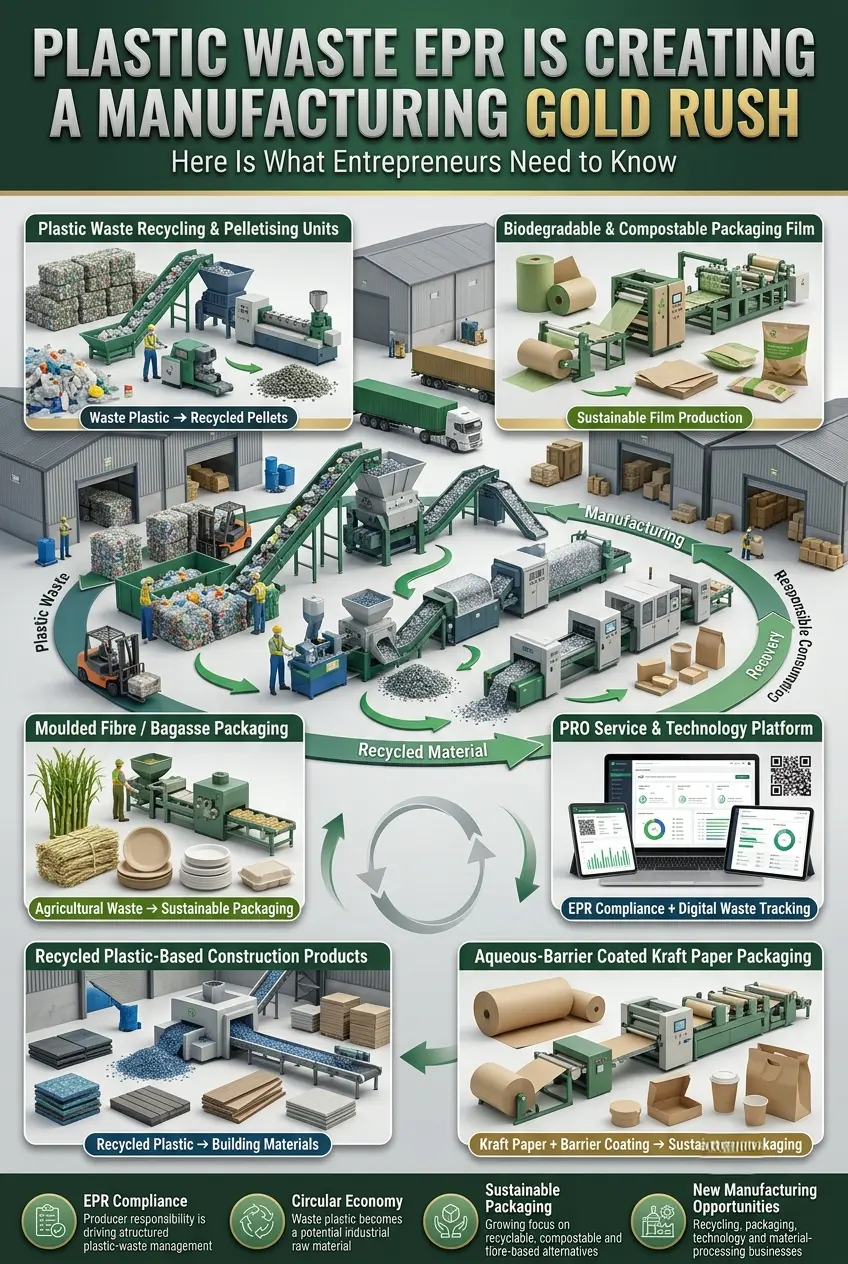
1. Plastic Waste Recycling and Pelletising Units
The most direct manufacturing opportunity created by EPR mandates is the plastic recycler. Recycled polymer pellets, a raw material that is required by brand owners in order to comply with their EPR requirements, are generated by recycling plants which collect, sort, wash, shred and pelletise post-consumer plastic waste. The demand for verified recyclate is growing with the growing EPR targets. A well-designed rigid plastic (PET, HDPE, PP) recycling unit can go for both the EPR certificate market and direct supply of recycled pellets to the compounder or product manufacturer.
The business is suitable for small scale and medium scale entrepreneurs, has a high growth potential and has better economics when input materials collection systems develop. The facility can be configured with a range of capacities, and could be expanded in the future. Better material supply is achieved if the geographic location is close to FMCG manufacturing clusters or close to retail waste aggregation points.
Explore the Plastic Waste Recycling Plant Project Report
2. Biodegradable and Compostable Packaging Film Manufacturing
Single use plastic is under pressure from the regulators and a structural deficit in the market for alternatives is being created. Replacement films for thin plastic film application which use thin film of bio-polymer (compostable film) such as PLA (polylactic acid), PBAT (polybutylene adipate terephthalate) and blended bio-polymers are beginning to become more popular in the fields of food service, grocery stores and e-commerce marketplaces. The film extrusion equipment for compostable film should be modified to process bio-polymer resins, certified to IS 17088 or equivalent international standards, and act in partnership with the film brand owners and/or packaging film converters. The raw material (bio-polymer resins) is available from domestic and international suppliers. This is an emerging segment which has high price tags, offers export opportunities to European markets where compostable packaging is mandatory, and provides excellent MSME entry conditions at low production levels.
Handbook on Biodegradable Plastics (Eco Friendly Plastics)
3. Moulded Fibre / Bagasse-Based Packaging Manufacturing
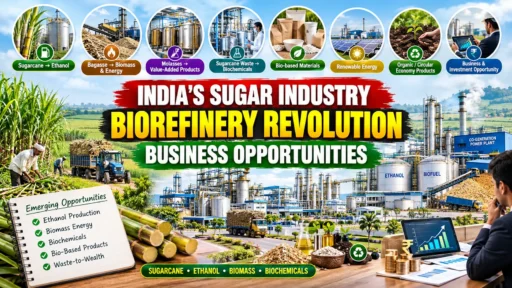
Sugar cane bagasse, the fibrous by-product of sugar production, is now one of the most commercially viable raw materials for plastics replacement in the food packaging industry, replacing plastic trays, food packaging, plates, cups, and clamshell boxes. The sugar industry generates a huge amount of bagasse every year in India.
The bagasse pulp moulding machine is required for a moulded fibre manufacturing unit using bagasse pulp. To complete the overall system, a drying system and a finishing/trimming line are also required. The final products are suitable for quick service restaurant (QSR) chains, airline catering, institutional food service, modern retail applications and are FSSAI compliant for food contact applications. They are also compostable. The investment required for a small/medium sized unit is comparatively easy to access. There are also domestic equipment suppliers who offer turnkey solutions. Moulded fibre packaging is in demand in export markets, including the Gulf, Southeast Asia and Europe.
4. PRO (Producer Responsibility Organisation) Service and Technology Platform
In India, the EPR concept involves two methods. A brand can either establish its own collection and recycling system, or designate a PRO to handle the collection and recycling of its products. A PRO collates the plastic waste liabilities of a number of brand client companies. It coordinates collection, recycling, documentation, and offers certified EPR fulfilment. service-plus-manufacturing business model. It requires the PRO to run or contractually manage plastic collection, sorting, and recycling centers. Tracking technology, GPS fleet management for waste pickup, and digital dashboards for EPR reporting to clients are built-in requirements for technology platforms. This is a good place to start for new companies. These companies can be technology-focused and operate at the bottom end of the collection process. This is a high value business in the medium-term due to sticky client relationships and recurring revenue.
5. Recycled Plastic-Based Construction Products Manufacturing
Mixes of plastic waste not suitable for pelletising as a clean recyclate can be processed to make plastic lumber, roof tiles, wall panels, interlocking paving bricks and insulation boards for use in construction. Manufacturers are making plastic lumber from mixed HDPE/PP waste and marketing it for furniture, fencing, decking and outdoor infrastructure. Researchers have proved the mixed plastic construction bricks as a new building material. They could use them as cheap building material. These products provide recyclers opportunities for value recovery from lower grade plastic streams. Otherwise, these streams would be sent to landfill or combusted. Technology is proven, and capital requirement is moderate. The market is growing in parallel with an expansion of housing construction in India. Recycled plastic products are starting to be called for in municipal and government procurement.
6. Aqueous-Barrier Coated Kraft Paper Packaging
Single use plastic packaging applications have commonly been made from polyethylene coated kraft paper (also known as paperboard). Historically, these applications relied on kraft paper being coated with polyethylene. This coating prevents recycling and composting.
The technology used for aqueous barrier coating incorporates a water-based functional barrier layer. It is moisture-, grease-, and oxygen-resistant, while maintaining the paper substrate as recyclable and compostable.
To make an aqueous-coated kraft paper or paperboard, a paper coating line is necessary. Formulation development for the barrier coating is also required. This is available in the market from specialty chemical suppliers. Food-contact compliance testing is also necessary. For QSR, food processors and E-commerce food brands, this product is in active demand due to its compliance and functionality. Supports are provided for the plant setup by the domestic machinery suppliers and international licensing technology suppliers of coating technology.
Import-Export and International Market Opportunity
Export Opportunity
Education is one of the important domains where India can have a huge export market. European buyers are now looking for certified sustainable packaging options from Asia. Packaging regulations, such as the Packaging and Packaging Waste Regulation (PPWR) and restrictions on per- and polyfluoroalkyl substances (PFAS) in food-contact materials, drive demand for sustainable alternatives. Indian manufacturers of compostable films, moulded fibre packaging and aqueous-coated kraft paper have an edge. They benefit from raw material availability (sugarcane bagasse, natural fibres) and lower manufacturing expenses. Indian recycled-content demand for exports is active for recycled plastic pellets, especially PET and HDPE.
Gulf Cooperation Council (GCC) countries are also implementing plastic reduction policies, creating demand for alternative packaging materials which are safe for food use from the region. Geographically, Indian manufacturers are very well placed and have trade linkages in this region. PLEXCONCIL actively helps plastic & packaging exporters find their international buyers.
Import Substitution
India is already importing significant quantities of advanced recycling machines, sorting machines and specialty bio-polymer resins. At present, manufacturers produce limited mid-range plastic recycling plant equipment, sorting conveyors, near-infrared (NIR) sorting systems, and pelletising lines, while the technology is still developing. The segment is an import-substitution opportunity for entrepreneurs having background in machinery manufacturing. In the same way, the bio-polymer raw material supply chain series—PLA, PBAT—is largely import oriented. The potential of domestic bio-polymer production (even on a small scale) based on the availability of agro-based feedstock (corn, Cassava) is huge in the long term and has attracted the interest of the ministries of chemicals and petrochemicals.
Indian MSMEs and Startups in Related Industries
Nepra Resource Management (Ahmedabad): Nepra has developed one of the most well-documented plastic waste collection and recycling programmes in India, collaborating with brand owners and municipalities for the aggregation and processing of post-consumer plastic. The company has shown how well it is possible to organise waste collection. It involves waste pickers and infrastructure for sorting. This can serve as the foundation for a business that can generate a profit from plastic recycling. Entrepreneurs developing PRO service models or recycling units can learn how Nepra has integrated collection logistics, material processing, and compliance documentation of EPR.
ECOWARE (Delhi): Ecoware is one of the known Indian companies which manufacture bagasse based moulded fibre packaging.
Its product portfolio is composed of food service containers, plates, bowls and agricultural packaging for QSR chains, airlines and food manufacturers. The experience of Ecoware shows that bagasse based moulded fibre production is feasible in India. It can go into the institutional B2B market and establish repeat order relationships with big brand customers.
Moulded fibre entrepreneurs looking to benchmark their go to market strategy and product development can refer to the go to market plan of Ecoware. They can also refer to its product development strategy.
BioGreen (Hyderabad): BioGreen is a domestic manufacturer of compostable and biodegradable packaging films and bags for retail, agriculture and food packaging industry. The company proves that it is possible to manufacture compostable film in India commercially and that the domestic market for certified compostable packaging, which was seen at first as a premium market, is gaining momentum due to regulatory pressure. Entrepreneurs thinking about making compostable film extrusion, can refer to BioGreen’s domestic and export market development experience.
What Entrepreneurs Should Evaluate Before Investing
For any entrepreneur considering entering the plastic waste management, recycling or sustainable packaging manufacturing business, a proper pre-investment feasibility study is recommended.
Market Demand: Decide on a product stream (PET bottles, HDPE containers, mixed plastic, food-contact compostable film, moulded fibre packaging), and trace the demand for these products from the actual buyers (EPR certificate purchasers, compounders who buy recycled pellets, brand owners who buy alternative packaging). Demand cannot be assumed; it must be validated using direct market conversations.
Recycling Unit Critical Constraints: Reliable and consistent plastic waste feedstock is the constraint for recycling units. Determine aggregation routes – with organised retail, waste picker cooperatives, industrial waste generators and municipal collection contracts. Map the bio-polymer/pulp from bagasse supply chain and set prices for alternative packaging.
Technology and Machinery: Determine the level of technology required for the planned scale (entry level vs. high throughput). The washing line capacity and the specification of the pelletiser are important considerations for recycling plants. The know-how for extruding the composition and formulation is important in the case of compostable film. Both domestic and imported machines need to be considered in terms of cost, after sales support and capability match.
Turn your budget into a successful business plan
Regulatory Requirements: Recyclers who produce EPR certificate need to be registered with CPCB. The alternative packaging manufacturers need to adhere to the FSSAI guidelines for food contact, BIS guidelines for compostable packaging and pollution control authorisations as applicable. Include regulatory compliance timelines in project plan.
Investment Consideration: Recycling units can be installed in a range of sizes from dry process shredder-pelletiser systems to complete wet wash-pelletise lines. The alternative packaging plants (moulded fibre, compostable film) involve moderate capital investment in machinery. Feedstock inventory, utility and labour are all considered working capital requirement.
Competition & Pricing: Recycling market is growing and more formal. New players should stand out on the access to feedstock, consistency of output and CPCB registration. Premium pricing for certified compostable & food-safe products is still the case in the alternative packaging market. The current market prices of the target product should be used to validate entry pricing and margin assumptions.
Feedstock supply disruption, polymer commodity price fluctuations, and their impact on the prices of recycled pellets are key risks. Regulatory changes that impact the value of EPR certificates and the difficulty of assuring output quality are also key risks. For entrepreneurs, there is a need to plan for some scale-up time. They should also make sure that working capital buffers are maintained.
How NPCS Can Help Entrepreneurs Evaluate the Opportunity
For more than 30 years, NPCS – Niir Project Consultancy Services has been helping entrepreneurs, investors, and industrial groups. It helps them assess manufacturing potential in various segments of the chemical, polymer, packaging and environmental management industry.
NPCS offers comprehensive project reports for entrepreneurs who are thinking of entering the plastic recycling and sustainable packaging manufacturing or other EPR-compliant service businesses. These include market demand, technology selection, plant and machinery specifications, raw material requirements, capital cost estimation, revenue and profitability projections, and break-even analysis. Before setting up a plant, feasibility study carried out by NPCS guides the entrepreneurs/investors in making a judicious decision to allocate the capital.
NPCS also supports technology evaluation and identification of domestic and international machinery suppliers for specific production requirements. It also supports consultancy services at the business planning and DPR (Detailed Project Report) preparation phase. If an entrepreneur is looking to secure bank or DFI lending or private investor financing, a professional DPR prepared by NPCS will enhance the investment case.
Business Opportunity Snapshot
A quick reference guide to the EPR-driven plastic waste management and sustainable packaging opportunity:
| Parameter | Details |
| Industry | Plastic Waste Management, Recycling, Sustainable Packaging Manufacturing |
| Market Driver | EPR mandates under Plastic Waste Management Rules; rising recycled content targets; single-use plastic bans across South Asia |
| Key Development | Expanding EPR regulatory frameworks in India and across South Asia mandating collection, recycling, and producer accountability for plastic waste |
| MSME Opportunity | Plastic recycling units, compostable film manufacturers, moulded fibre packaging plants, PRO service providers, plastic lumber and construction products |
| Manufacturing Potential | Recycled polymer pellets, biodegradable packaging films, bagasse moulded fibre containers, aqueous-coated kraft paper, recycled-plastic construction materials |
| Export Potential | Compostable packaging to EU / GCC / Southeast Asia; recycled PET/HDPE pellets to EU markets; moulded fibre packaging to Middle East and Southeast Asia</td></td> |
| Import Substitution | Plastic recycling machinery, near-infrared sorting equipment, bio-polymer resins (PLA, PBAT), specialist barrier coating chemicals |
| Government Support | PMEGP margin money subsidy, CGTMSE collateral-free credit, PLI for food packaging, CPCB EPR certificate market, PLEXCONCIL export support |
| Investment Consideration | Ranges from small-scale recycling/pelletising to medium-scale alternative packaging plants; working capital for feedstock and utility requirements |
| Risk Level | Moderate — subject to feedstock availability, EPR certificate price fluctuations, and regulatory enforcement consistency |
| Growth Outlook | Strong — structurally driven by rising EPR targets, brand-owner sustainability commitments, and regulatory enforcement momentum |
Conclusion
One of the most commercially impactful regulatory changes in the manufacturing sector in the past decade in South Asia has been the movement towards formalizing producer responsibility for plastic waste.
Enforcement of collection mandates, recycling needs and EPR mandates are transforming an informal waste management system. It is becoming a formalised, entrepreneurial and economically rewarding value chain across India and the region.
Indian entrepreneurs and MSMEs have a real opportunity and has layered opportunity. There are several commercially realistic entry points. These vary in investment profile, market demand, and risk characteristics, such as plastic recycling and pelletising, compostable packaging, biodegradable packaging, bagasse based moulded fibre packaging, PRO service platforms, recycled-plastic construction products, and aqueous-barrier coated paper. Early movers benefit from support from the Government in various modes, such as PMEGP, CGTMSE, CPCB registration, and PLEXCONCIL export channels.
The right approach is: Market Research → Feasibility Study → DPR Preparation → Investment Planning. NPCS – Niir Project Consultancy Services is always ready to assist entrepreneurs throughout this journey.