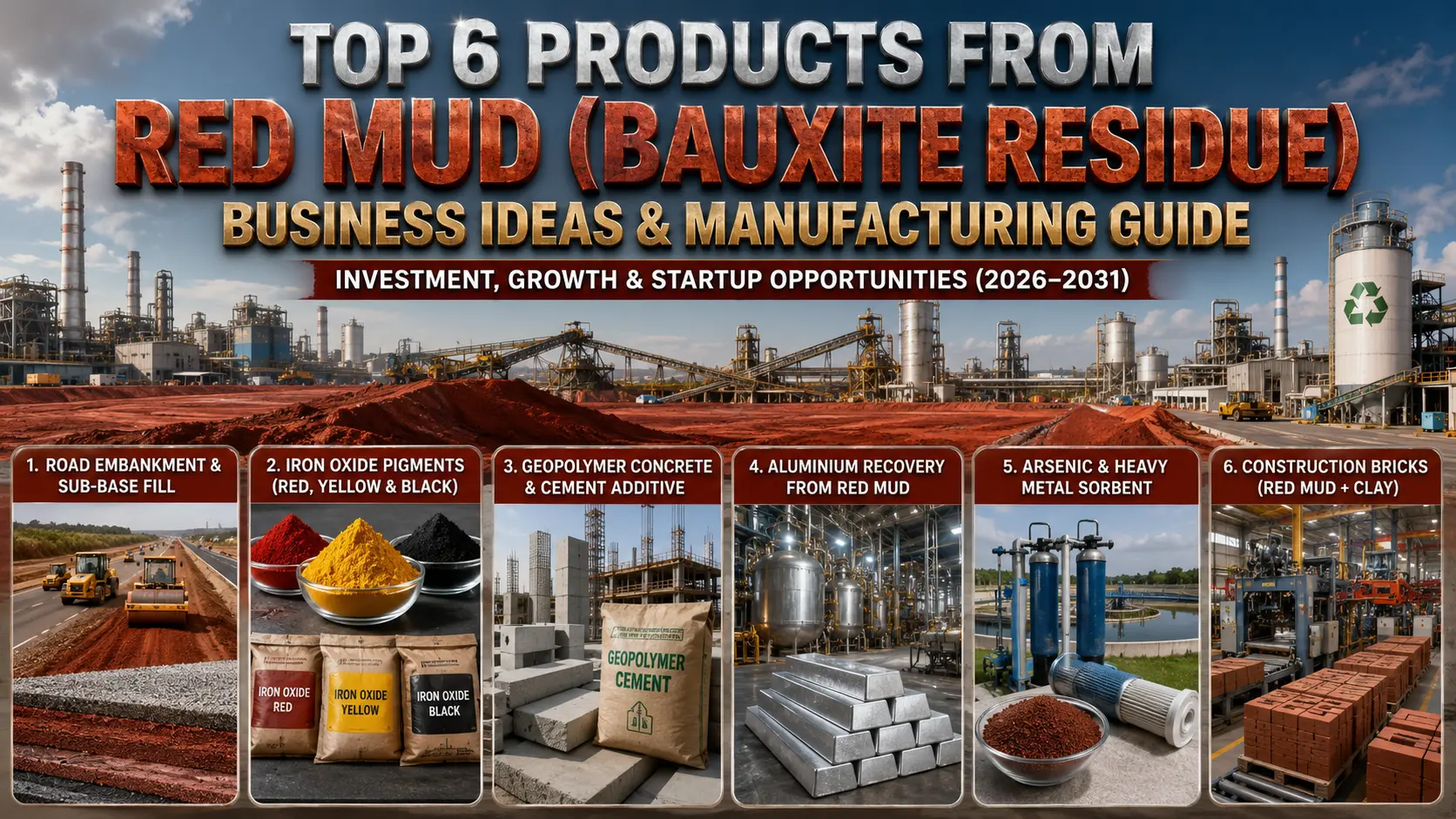

Red Mud Products Business
Red mud is the highly alkaline, iron-rich by-product of the production of alumina from bauxite by the Bayer process. The production of aluminium causes one to two and a half tonnes of red mud as one of the largest volume industrial by-products in the world. The Indian aluminium industry with its backbone companies like NALCO (Odisha), Vedanta BALCO (Korba) and Hindustan Aluminium Corporation, produces about 15 – 20 million tonnes of red mud every year. Industries store this waste in large slurry ponds that occupy thousands of hectares of land, increase the risk of dam failure, and degrade groundwater quality because of their high caustic soda content (pH 10–13).
The chemical composition of red mud, consisting of 30-45% iron oxide (Fe₂O₃), 10-20% alumina (Al₂O₃), 10-15% silica (SiO₂), 5-10% titanium dioxide (TiO₂), 5-10% calcium oxide (CaO), and 5-10% sodium oxide (Na₂O), suggests multiple potential applications, such as the production of iron pigment, road construction, geopolymer concrete, and environmental cleanup. The main challenges include high alkalinity, which requires neutralisation; high moisture content, which requires drying; and variations in composition depending on the bauxite source. Global researchers and commercial developers have made considerable progress in utilizing red mud, while pilot-scale projects have commercially demonstrated its use in road construction and geopolymer applications.
Explore proven business ideas with high success potential
Top 6 Products from Red Mud
1. Road Embankment and Sub-Base Fill
The neutralised and dried red mud (mixed with lime or CO₂ carbonation to lower the pH of the material, below 9) is a suitable road fill material for sub base construction and low traffic embankments. Embankments of red mud have been used in several state highway departments in Odisha and Chhattisgarh with good outcomes. Road projects can absorb large volumes of red mud, with a single project using hundreds of thousands of tonnes of the material.
2. Iron Oxide Pigments (Red, Yellow, Black)
They are made up of between 30-45% oxide of iron, predominantly the red ore haematite (FeO2) and goethite, the yellow ore (FeOH). Manufacturers selectively dissolve the non-iron constituents in red mud and then calcine the material at different temperatures to produce iron oxide pigments. These pigments are used in construction coatings, ceramics, plastics, and concrete colouring. Investment: Rs. A red mud iron pigment plant was set up at a cost of 2 to 5 crore.(Red Mud Products Business)
3. Geopolymer Concrete and Cement Additive
Geopolymer binders are made with red mud and fly ash and a sodium hydroxide activator which eliminates the need for Portland cement. Laboratory trials are conducted to prove the viability of red mud geopolymer concrete at the lab scale (20-40MPa), which could be utilized in non-structural and moderate structural applications. A Geopolymer precast concrete unit with Red Mud: 1–3 crore.
Get Detailed Project Report (DPR): Concrete, Cement and Cement based Products and Projects
4. Aluminium Recovery from Red Mud
The alumina content of red mud is between 10–20% un-recovered alumina from the primary Bayer process extraction. Enhanced digestion or hydrometallurgical leaching can recover the remaining aluminium content from red mud, achieving a recovery rate of 30–50%. It is a capital-intensive process (Rs.) It decreases the amount of raw material needed for primary alumina production and the amount of waste produced, but also costs 10-30 crore.
5. Arsenic and Heavy Metal Sorbent
These properties of having high surface area of iron oxide and alumina make the dried red mud suitable for binding arsenic, phosphate and heavy metals (such as lead and cadmium) present in aqueous solution. Studies show that red mud effectively treats arsenic-contaminated groundwater and removes phosphates from agricultural runoff. Granulated red mud sorbent for water treatment: The production and testing of 50–150 lakh units
6. Construction Bricks (Red Mud + Clay)
Mixed with clay and fired at 900-1050 °C, red mud (30-50%) makes building bricks with compressive strength of 50-150 kg/cm2, which is sufficient for houses. Iron oxide in red mud is used as a natural flux which lowers the firing temperature and gives the red coloration. A red mud clay brick unit in the vicinity of aluminium plant: 40–100 lakh.(Red Mud Products Business)
Explore This Book: The Complete Technology Book on Bricks, Cement and Asbestos
Investment and Market Summary
| Product | Investment (Rs.) | Value Add | Key Consideration |
| Road Fill / Sub-Base | Rs. 20–50 lakh (prep) | Rs. 200–600/MT | Neutralisation Required |
| Iron Oxide Pigment | Rs. 2–5 crore | Rs. 20,000–60,000/MT | High Processing Cost |
| Geopolymer Concrete | Rs. 1–3 crore | Rs. 3,000–8,000/m³ | Alkali Activation Needed |
| Brick Manufacturing | Rs. 40–100 lakh | Rs. 4–8/brick | Firing Energy |
| Water Treatment Sorbent | Rs. 50–150 lakh | Rs. 5,000–15,000/MT | Regulatory Approval |
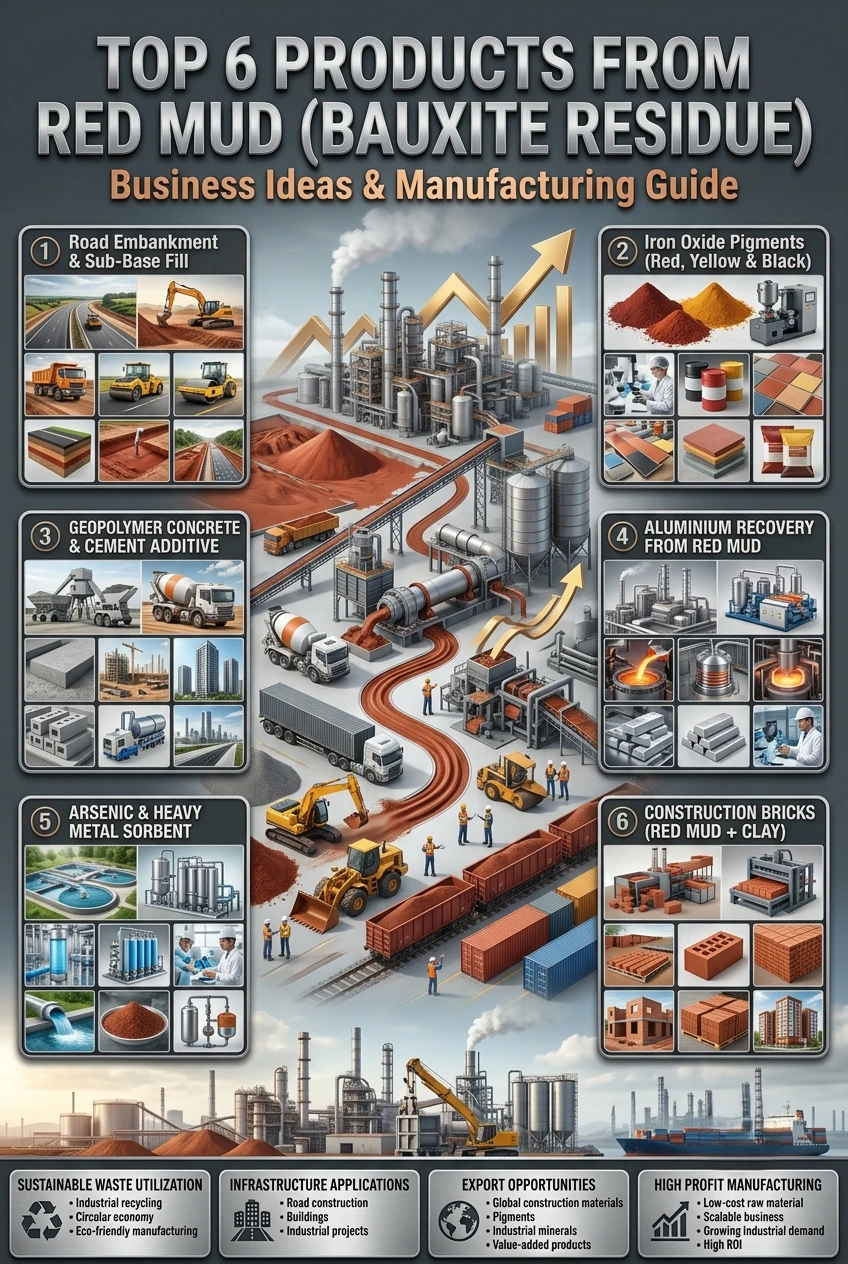
The Challenge of Red Mud Scale and Alkalinity
The main problems in the commercial use of red mud are its high alkali content (pH 10 – 13) and high sodium content (5 – 10 % Na₂O). Most applications will require that the seawater is treated for neutralisation (with seawater, CO₂ carbonation, or acid treatment). The project economics should account for the energy and chemical costs associated with neutralisation. Road construction applications in coastal countries can be closest to the coast, the most economical method being seawater neutralisation (techno-acceptable in Jamaica and Australia). CO₂ carbonation of flue gas from captive power plants is an attractive neutralisation pathway which is environmentally and economically attractive for inland plants (such as BALCO in Korba). This is the most viable commercial collaboration with the aluminium producer in the installation of on-site neutralisation infrastructure.
Global Aluminium Industry Red Mud Burden and Indian Context
The global aluminium industry generates about 180 million tonnes of red mud each year. India is expanding its aluminium production capacity to reach 10 million tonnes annually by 2030. As production grows, the country will generate larger volumes of red mud. The Aluminium Association of India estimates that more than 200 million tonnes of red mud are stored across thousands of hectares near NALCO facilities in Odisha, Vedanta BALCO’s operations in Korba, and Hindalco facilities in Jharkhand and Uttar Pradesh.
The 2010 failure of a red mud pond dam in Hungary released 1 million m³ of toxic red mud and prompted regulators worldwide to strengthen red mud utilisation programmes. MoEF & CC has been discussing with aluminium companies regarding compulsory red mud utilisation targets as prescribed for the power plant industries for fly ash utilisation.
Such a directive would generate a lot of demand pull from the red mud processing entrepreneurs and have supply agreements with aluminium companies that require proof of utilization as per regulations. Commercial-scale ventures that begin utilising red mud before the formal mandate takes effect can gain a first-mover advantage in securing raw materials and developing product markets.
Pilot Scale Testing: The Critical First Step for Red Mud Products
Before any commercial-scale investment in red mud products, pilot-scale testing at 1–5 tonne/day is essential — both for product quality validation and for buyer qualification. Red mud’s variable composition (depending on bauxite source and Bayer process conditions) means laboratory results do not always translate directly to consistent commercial product quality. Pilot testing should demonstrate: consistent pH post-neutralisation batch-to-batch, uniform particle size distribution after drying and classification, leachate quality meeting specified limits (TCLP testing on pilot-produced aggregate or brick), and structural performance (compressive strength for bricks, CBR value for road fill) meeting stated specifications. Pilot test results, documented by NABL-accredited testing laboratories and submitted to prospective buyers (road departments, brick manufacturers, cement companies), convert the commercial conversation from theoretical possibility to documented fact.
NALCO and Vedanta BALCO’s R&D departments have conducted extensive pilot testing on red mud products — engaging with their CSR and sustainability departments for pilot collaboration access is the most cost-efficient route to initial technical validation before independent pilot investment.(Red Mud Products Business
How NPCS Helps Entrepreneurs Enter This Sector
Niir Project Consultancy Services (NPCS) offer professional consultancy for Preparing Market Survey cum Detailed Techno-Economic Feasibility Reports (DPRs) on the Setting up of red mud bauxite residue and aluminium industry waste processing manufacturing business. Our reports will cover entire detail of manufacturing process, demand survey, process flow diagram, plant layout, machinery and raw materials sources with full detailed financial projection with profitability.
For entrepreneurs looking to enter waste-based manufacturing, NPCS project reports give you the technical and financial foundation to approach banks, investors, and government agencies with confidence. Visit www.niir.org to explore our full library of waste-based project reports.
Related Article: How to Manufacture Fly Ash Bricks in India: A Complete Guide for Industrial Entrepreneurs
Conclusion: The Business Case for Red Mud Manufacturing
Red mud’s combination of enormous generation volume and complete absence of organised utilisation makes it both India’s most acute industrial waste management challenge and one of its largest unexploited mineral processing opportunities. Iron oxide pigments, road construction fill, and geopolymer concrete represent proven pathways from laboratory to commercial scale. Entrepreneurs who partner with aluminium producers to develop on-site neutralisation and downstream processing infrastructure are addressing one of India’s most significant environmental liabilities while building businesses on a raw material that costs nothing and is available in near-unlimited quantities.(Red Mud Products Business)
Entrepreneurs who enter waste-based manufacturing early can build strong raw material relationships and buyer networks. They can also secure regulatory approvals before competition increases. Latecomers may find these advantages difficult to replicate.
The best time to explore these business ideas is before the sector becomes crowded. For most waste streams covered here, the opportunity window is still open.
Frequently Asked Questions (FAQ)
Q1. What is the pH of fresh red mud and how is it neutralised?
Fresh red mud slurry has pH 10–13 from residual caustic soda (NaOH) from the Bayer process. Neutralisation methods: seawater neutralisation (pH reduces to 8–9 through calcium and magnesium hydroxide precipitation); CO₂ carbonation (forming sodium carbonate and reducing pH to 8–9); and gypsum neutralisation (adding calcium sulphate that reacts with sodium hydroxide). Time and cost of neutralisation is a key project variable.(Red Mud Products Business)
Q2. What is the iron oxide content of Indian red mud and is it suitable for pigment?
Indian red mud from bauxite processed at NALCO (Koraput bauxite) contains 35–45% Fe₂O₃. After sodium removal and calcination, iron oxide concentration increases to 55–70% — approaching commercial iron oxide pigment purity requirements. Additional purification by magnetic separation or leaching improves iron oxide concentration. International pigment standard ISO 12647 specifies purity and colour requirements.
Q3. Are there commercial red mud utilisation examples globally?
Jamaica uses red mud in road construction (neutralised with seawater). Russia and China use red mud in cement and brick manufacturing. Australia and Europe have pilot geopolymer concrete projects. India has NALCO-funded research on red mud construction material applications. Commercial scale is still emerging globally — India has an opportunity to lead in aluminium-proximate construction markets.
Q4. What are the environmental regulations for red mud storage and disposal?
MoEF&CC classifies red mud as ‘hazardous waste’ in some states due to alkalinity and trace metal leaching. Red mud pond construction requires environmental impact assessment, hydrological barrier design, and leachate collection. Utilisation routes that reduce red mud pond volume are strongly encouraged by regulatory authorities.
Q5. Can red mud be used in cement kiln raw meal?
Yes, as a partial substitute for iron ore in cement kiln raw meal (providing Fe₂O₃ and Al₂O₃). However, high sodium content can trigger alkali-aggregate reactions in concrete, so manufacturers should limit red mud substitution to less than 5% of the raw meal by weight. Several cement plants in Odisha near NALCO have tested limited red mud raw meal substitution.
Q6. What research institutions support red mud utilisation in India?
Several institutions conduct active research on red mud utilisation. These include NML Jamshedpur, CSIR-IMT Bhubaneswar, IIT Kharagpur, and NALCO’s R&D division. Collaboration with these institutions provides both technical guidance and regulatory recognition for new utilisation approaches.
Key References and Useful Links
- Ministry of MSME — Government of India
- Make in India — Official Portal
- DPIIT — Dept. for Promotion of Industry
- APEDA — Agricultural and Processed Food
- NPCS — Waste-Based Project Reports
- Ministry of Environment, Forest & Climate