Introduction: Why Bio-Based Chemicals Are the Business Idea of the Decade
Today, go into any top-quality grocery store and look at the back of a hand wash or shampoo. These will be displayed as ‘plant-derived’, ‘sulfate-free’, or ‘biodegradable. These are no marketing terms, but chemical specifications. Behind each of those, there’s a manufacturer that’s transitioned from petroleum chemistry to bio-based surface chemistry. This change is now opening some of the most interesting business ideas within the Indian specialty chemicals domain. Biosurfactant market is witnessing a growth rate of 4.45% annually in India and the bio-polymer market is even growing at a higher pace as the plastic ban regulations are being implemented, export buyer demand is growing for sustainable products, and consumer preferences are shifting towards sustainable products. Odisha, with the feedstock infrastructure available at Paradip Petrochemical Complex and its agricultural backdrops becoming biomass is most conducive to the growth of this manufacturing category in Eastern India.
Get Detailed Insights from This Book: The Complete Book on Biomass Based Products (Biochemicals, Biofuels, Activated Carbon)
Why This Sector Is Growing So Fast
Three forces are driving demand for specialty chemicals that are derived from living materials. First, EU Green Deal sets a target of 50%+ bio-content for 65% of household products by 2030. If any Indian manufacturer is supplying personal care or cleaning products to the European brands, then they need to switch to bio-based surfactants or else they will lose the contract. Secondly, the Indian government’s own EPR (Extended Producer Responsibility) regulations and plastic bags are driving immediate demand for alternatives in the country which are compostable and biodegradable. Thirdly, there is a change in consumer preferences in the Indian urban market. The beauty and personal care industry is becoming more premium and that translates to more sustainable ingredients in the products.
In addition, FMCG companies such as Unilever and P&G have made public statements to use bio-based surfactants in their formulations. Unilever has reported a 25x sales premium for bio-based-formulated products. Each of their pledges generates a supply shortfall — and a sales opportunity for Indian manufacturers to pony up certified bio-based specialty chemicals at scale.
Source: Invest India – Chemicals & Petrochemicals
Government Policies and Incentives Supporting This Sector
The Government of India has put a high emphasis on bio-based chemical manufacturing. The National Bioeconomy Strategy and BIRAC (Biotechnology Industry Research Assistance Council) offer funding and equity assistance for bio-refinery and bio-based chemical test beds. Specialty chemicals are covered by the PLI scheme for the manufacturers that qualify. Further, Odisha’s industrial policy offers capital investment subsidy of 15–25%, 5-year stamp duty exemption for new manufacturing units and electricity duty exemption.
Capital barrier of new entrants in bio-based chemical manufacturing is significantly lowered by the shared infrastructure offered by the PCPIR (Paradip Chemical Process Industries Region) that includes common effluent treatment, power, and logistics. The timelines for project approvals are very fast with single window clearance through State Level Single Window Clearance Authority (SLSWCA).
Source: Odisha Industrial Policy – Invest Odisha
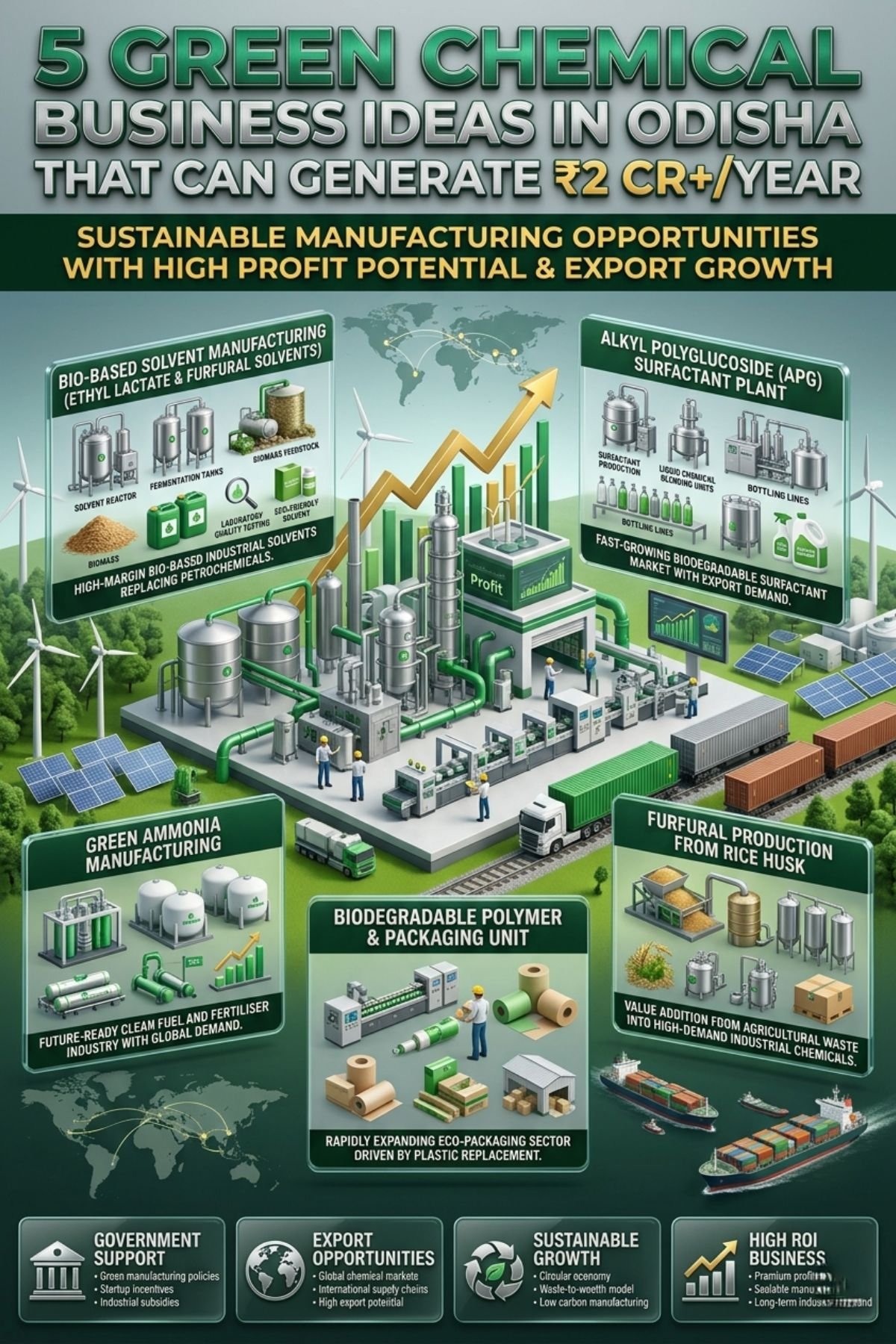
Related Article: 5 Green Chemical Business Ideas in Odisha That Can Generate ₹2 Cr+/Year
Business Ideas: Specific Products to Manufacture
Business Idea 1: Alkyl Polyglucoside (APG) Surfactant Manufacturing
APG surfactants are made from renewable and sustainable raw materials, such as glucose and fatty alcohols. They are completely biodegradable, non-toxic and qualify EU Ecolabel. Worldwide premium cosmetic companies are willing to pay 40-80% higher prices for APG formulated products than with traditional anionic surfactants. There is no large APG manufacturing plant in the eastern corridor in India. An entrepreneur setting up the APG unit at or near the Paradip PCPIR will have direct access to import of fatty alcohol from the port and export of glucose from the domestic units producing starch. This is a first-mover manufacturing opportunity with good margins and a strong defensible position in the personal care supply chain with steadily growing personal care market and accelerating export demand from European formulators. Funds required: ₹30–100 crore (depending on scale).
Business Idea 2: Methyl Ester Sulfonates (MES) — Sustainable Detergent Base
Firstly, MES is a bio-based anionic surfactant derived from palm oil methyl esters (palm oil vegetable oil). Moreover, It is the most similar bio-based alternative to LAS (linear alkylbenzene sulfonate), the main surfactant used in detergent powders. Consumers are trying to reformulate consumer brands, as they are more interested in making claims to environmental sustainability and complying with export regulations, which is driving MES demand to increase by 8-10% a year. The material is currently completely imported from the western coast in the eastern part of India. The planned MES sulfonation plant near Paradip, with feedstock delivered by sea from the southern palm producing areas, would be the first plant dedicated to the production of MES in the whole eastern corridor. Investment range: ₹40–120 crore.
Business Idea 3: Polylactic Acid (PLA) Compounding and Bioplastic Products
Firstly, PLA is the world’s most commercialized bioplastics based on lactic acid which is produced by lactic acid fermentation of starch. Moreover, It is applied to packaging, 3D printing filaments, medical sutures and agricultural mulch films. Furthermore, The introduction of plastic packaging rules and EPR in India is generating a pressing need for compostable alternatives of PLA which most domestic brands cannot procure from the local market. Consequently, The compounding facility, which can operate in the vicinity of 500 km of its customers in FMCG, pharmaceutical and institutional packaging, needs ₹15–40 crore in investment and is based in Odisha. In comparison, The product sells in the market for ₹150-300 per kg, as compared to conventional HDPE or PP product which fetches ₹80-120 per kg.
Business Idea 4: Sophorolipid and Rhamnolipid Biosurfactant Fermentation
Firstly, Microbially produced biosurfactants are fermented sugars by selected bacterial and yeast strains, such as sophorolipids and rhamnolipids. Furthermore, They are applied in high quality cosmetics, enhanced oil recovery, agricultural bioformulations and pharmaceutical cleaning. Additionally, The prices of these biosurfactants range from ₹300 to ₹2,500 per kilogram depending on the grade, which are some of the most valuable specialty chemical products that a fermenter can manufacture per kg. Moreover, The fermentation technology is known and the key investment is in the fermentation and purification of the downstream vessels. Finally, The cost of a 500-2000 TPA unit is ₹20-60 crore and the projected commercial price is of the order of ₹15-50 crore per year.
Business Idea 5: Starch-Based Biodegradable Packaging Compounds
India’s mass market compostable packaging material is most cost-effective starch-based biplastic compounds, which are composites of thermoplastic starch and PLA or PBAT (polybutylene adipate terephthalate). Furthermore, They have the ability to be formed into carry bags, food service ware, agricultural mulch films and loose fill packaging. The raw material used (cassava or corn starch) is locally sourced. Moreover, The production technology can be compared easily with the conventional polymer compounding technology, so it is easy to learn. As a result, The lowest capital entry point for producing biodegradable polymer products is a starch-blend compounding unit of ₹10-25 crore, and domestic demand is growing by 20-25% a year, so units can be recouped in 4-6 years.
Get Detailed Project Report (DPR): Sustainable Biodegradable Materials
Import–Export Opportunity Analysis
Competitive manufacturing of these products is possible with the Indian feedstocks but the country is importing huge quantities of APG surfactants, MES and PLA resin now. From an export point of view, the most important export market is the European one. EU requirements explicitly call for bio-based content in cleaning and personal care products, giving a regulatory push to the Indian bio-based surfactant exporters where a conventional surfactant manufacturer can’t be found.
Southeast Asian markets, especially Indonesia, Vietnam and the Philippines, are seeing increasing demand for high quality personal care products. Odisha based exporters of biosurfactants will have the freight competitive advantage over any port in the west of India, due to the geographical advantage of related western shipping corridor to ASEAN from Paradip. Furthermore, there is a trend of increasing use of bio-based personal care ingredients in Middle Eastern and African markets, which are becoming a significant channel for consumer goods multinationals to expand.
Source: IBEF – Indian Chemicals Industry
Indian MSME Success Stories in Bio-Based Specialty Chemicals
Galaxy Surfactants — Proving Specialty Surfactants Can Scale
The specialty surfactant export firm of Galaxy Surfactants, promoted by U. Shekhar and co-founders, is India’s most trusted and exemplary firm. Its concept of deep product knowledge, consistent quality and premium customer targeting transformed the small chemical company into a business with a turnover of more than ₹3,000 crore, exporting to 80+ countries. What it means to a biosurfactant entrepreneur: concentrate on one group of products, establish quality quality track record, and sell directly to multinational FMCG customers, not through trading intermediaries.
Rossari Biotech — Fermentation-Based Specialty Chemistry
Notably, Sunil Chari, Edward Menezes’s co-founder at Rossari Biotech, has demonstrated that specialty chemicals, derived from fermentation processes, can be a high growth, investor-backed business in India. Furthermore, Rossari was founded in 1999 to produce textile chemicals, and has since grown into home and personal care chemicals and animal health chemicals, all with enzyme and bio-based formulation chemistry. As a result, Its successful IPO and ongoing revenue growth prove that the manufacturing of the product using bio-organic materials can be very attractive to institutional investors in India and yield excellent returns on investment. Therefore, Rossari is the most relevant role model for a biosurfactant start-up both for the business model and growth path.
Fineotex Chemical — From MSME to Listed Specialty Chemical Company
Firstly, Surendra Tibrewala, Chairman of Fineotex Chemical, took the company, a specialty surfactant manufacturer from Mumbai, from its humble beginning to become a BSE-listed company with global presence in textile, construction and personal care chemicals. Moreover, Listings, international expansion and premium positioning in the market is possible not just for big MSMEs but even for mid-size MSMEs such as Fineotex; all that matters in the eyes of the industry is the quality of product and the relationship with customers, not the price.
Discover business ideas that actually make money
How NPCS Can Support Your Bio-Based Chemical Project
Niir Project Consultancy Services (NPCS) prepares a detailed Market Survey cum Detailed Techno-Economic Feasibility Report for the entrepreneurs who are entering into Biobased and Bio-degradable Chemical industries. The project reports include detailed manufacturing processes, raw material and feedstock analysis, process flow diagrams, specification of machinery, detailed costing, detailed profitability analysis and payback period projections. You can use our feasibility analysis to help you understand the complete investment situation before investing in either an APG surfactant plant, a biosurfactant fermentation unit or a PLA compounding facility. We take on projects from ₹5 crore to ₹500 crore, with the same dedication.
Source: NPCS – Feasibility Reports
Market Overview: Bio-Based Specialty Chemicals in India
| Product Category | India Market Status | Price Premium Over Conv. | Est. Capital (₹ Cr) |
| APG Surfactants | No eastern India producer | 40–80% | 30–100 |
| MES (Bio Detergent Base) | Largely imported | 20–35% | 40–120 |
| PLA Bioplastic Compounds | Mostly imported resin | 80–150% | 15–40 |
| Rhamnolipid Biosurfactants | Nascent domestic supply | 300–800% | 20–60 |
| Starch-Blend Biopolymers | Small domestic producers | 25–40% | 10–25 |
Frequently Asked Questions (FAQ)
1. What is the difference between a biosurfactant and a biodegradable surfactant?
Microorganisms can be used to produce a biosurfactant by fermentation, rhamnolipids or sophorolipids for example. Biodegradable surfactant: Any surfactant that breaks down naturally (includes microbially produced and plant-based surfactants such as APG). They’re both good, but for different market segments and price points.
2. Does there is any domestic demand for bio-surfactants in India or it is only export play?
Both domestic and export demand are strong. Within the country, premium personal care brands and FMCG companies that are working to create products with sustainability claims are actively looking for alternatives to the surfactants they are using. On the export side, the EU and UK regulations generate regulatory pull demand which cannot be captured by conventional surfactants.
3. What are the raw materials required for the production of APG surfactant and are available in Odisha?
APG cannot use glucose (from starch) and fatty alcohols (from palm or coconut oil). Glucose is available from domestic starch processors. The coastal strength of Odisha is a direct advantage as fatty alcohols can be imported through Paradip Port from palm processing units in Indonesia or Malaysia.
4. What is the time taken for obtaining environmental clearance of bio-surfactant plant in Odisha?
Bio-based chemical plants that make chemical products using natural raw materials and that are biodegradable are often eligible for B2 environmental clearance, a lighter touch regulatory approach. The Odisha SWCS has been giving approvals in much lesser time compared to the national average.
5. Is there government subsidy for biosurfactant or bioplastic production?
Yes. Capital investment subsidies of 15-25% are available with the MSME and large industry policies in Odisha. Department of Biotechnology’s BIRAC scheme caters to the bioproduct ventures based on fermentation technology. Depending on product category and size, PLI scheme for specialty chemicals may also be applicable.
What is the smallest size scale that could be considered commercially viable for an APG plant?
APG can start to be commercially viable at 2,000-5,000 TPA of product. Below this level, fixed cost recovery is going to be challenging. Once you have a volume of 5,000–20,000 TPA, economies of scale come into play and export grade quality management systems become cost effective. The best scale for a first-generation entrepreneur to consider for a commercial entry is 3,000–5,000 TPA.
Conclusion: Eastern India’s Bio-Based Chemical Market Is Uncontested — For Now
There are no big Indian biodegradable surfactants or bio-based polymers manufacturer today operating in eastern India. This is not a problem. This is an opportunity of astronomical size. The regulatory pressure from Europe, consumer trend from Indian urban market and FMCG reformulation drive are all converging in one direction. That is bio-based specialty chemicals. India’s infrastructure, feedstock availability and port proximity is an obvious foundation for the earliest entrepreneur to build upon. Time is ripe for entry. First mover advantage in chemical manufacture vanishes when the first plant is commissioned. So, the right time to conduct feasibility study, acquire land and start project development is not next year.