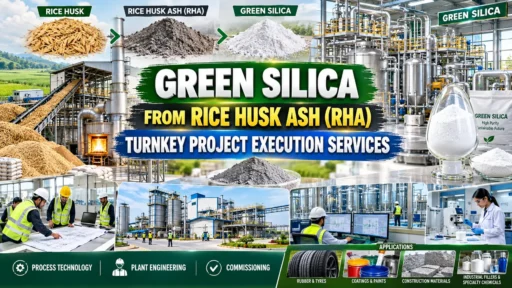
Conversion of Agriculture Waste to Industrial Gold
Hello, aspirational entrepreneur!
Every year, India generates millions of tonnes of “waste” from agriculture. But within this waste material, there exists one of the most valuable resources available to industry—that is, high-purity silicon. Rice husk ash contains 85 to 95% pure amorphous silicon. It’s as if gold is available in garbage.
All that is needed is some clever tech to innovatively produce high-margin products out of this material in the rubber, construction, chemical, cosmeceutical, pharmaceutical industries, to name a few.
There’s more here than meets the eye when it comes to recycling—it’s actually a very real and relevant business idea connected with India’s green drive and the demand for it in the global arena.
Let’s delve into how you can make this work.
Why Silica from Rice Husk Ash is a Business Proposition
India produces rice in excess of 130 million tonnes every year; this translates to 23 million tonnes of rice husk every year. Whether it is burnt as fuel or dumped elsewhere, it ultimately contributes to 4-5 million tonnes of ash production each year. Instead of filling landfills with this product, it can be used as something far better.
Key Advantages
- Abundant and low-cost raw material: Easy access to a large supply of raw material since it is near rice mills and biomass production sites, free or low cost, and always available. No need for searching for raw supplies
- Higher content of silicon: Of much finer quality than many sands, making it easier to process
- Industrial demand: Used in tires, cement, rubber, paints, detergents, cosmetics, toothpaste, drugs, and water treatment, silica has a broad application base.
- Sustainability and policy support: Aligns with “India’s circular economy philosophy” and support in states such as Tamil Nadu, with pilot projects and subsidies, helps adoption.
- Export and import substitution potential: Currently, we import quality silica from China and Europe, but export potential exists for supplies for Asia and the US.
- Market outlook: It is the right time. The global rice husk silica market is currently over USD 3.4 billion and is set to grow to around USD 5 billion by the end of 2033 with a CAGR of 5% +. The factors include the growth of infrastructure and cement, tires and rubber industries, eco-friendly fillers, uses of silica-based beauty and health products, and government restrictions on mining. As a leading producer ofrice, India has tremendous potential to dominate bio-silica.
Read More: Top 4 Manufacturing Opportunities in Drinking Water, Bamboo Charcoal, Aluminium Recycling & Rice Husk Biomass Pellets
High-Value Products from Rice Husk Ash to Silica
The good thing is that with one material, you have various options. You can switch depending on the market.
1).Precipitated Silica (Amorphous Silica Powder):
Main product: Highly prized and in great demand.
Applications: Tires and rubber, paints, adhesives, toothpaste, cosmetics, and even for foods and drugs.
Why it’s great: Very profitable, in big demand at home and abroad, possibly better than sand-cement versions.
2).Silica Gel & Desiccants: A slight process modification results in the production of silica gel.
Applications: Protects products from moisture in the following: drugs, electronics, general articles; laboratory applications; catalysts support.
Business:
The main advantage: Year-round customers and green branding
3).Micro Silica (Silica Fume) for Cement & Concrete: Silica fume helps in increasing the strength and water repellency properties of concrete.
Because India is undergoing a building boom, this is a high-volume winner.
Sodium Silicate (Liquid Glass): Gateway product with stable demand.
Applications: Detergents, paper, water treatment, Lower start-up costs, with possibilities of scaling to pure silica later.
4).Refractory, Ceramic & Insulating Materials: Suitable for bricks, furnaces, insulation, and ceramics.
“If you’re targeting the steel or glass industry, this is a natural fit.”
Environmental & Agricultural Applications:
Absorbents in oil spills, water filters, and soil conditioners. These are niche markets, but they add to the product and the green halo.
Read Our Book: Click Here

Export-Import Insights & Geographical Positioning
“We’re investing millions of dollars in bringing in specialized silica and gels from China and Europe. Why don’t we develop this expertise ourselves?”
Export orders to Vietnam, Bangladesh Sri Lanka,, and the US are on the upswing. It is a good sign that the international community is interested in our work.
Smart Moves for Your Startup
- Begin with local purchasers for rubber, cement, and chemicals.
- Undercut imports with competitive pricing.
- Expansion worldwide only happens after acquiring the necessary certifications.
- Partner with a rice mill or with a biomass player for ease of access to the material.
Drawing Lessons from Indian Entrepreneurs
Think Dhirubhai Ambani, who built an entire business empire from scratch, Azim Premji, who managed to revamp his entire business, or N.R. Narayana Murty, who earned the trust and respect of the entire global community.
One can think of many more, including the likes of Kiran Mazumdar-Shaw, who was able to achieve so much in the field of science, and already successful Tanmay Pandya at Brisil Technologies, who is already supplying RHA silica to several brands.
Read Business Plans / Project Profiles : Click Here
How NPCS Helps You Build This Business Right
At Niir Project Consultancy Services (NPCS), we help convert dreams into doable strategies. Our reports contemplate:
- Procedures and instructions to remove and process Silica
- Market dynamics, pricing, and competition – Diagrams, Layouts, and Layout Planning
- Product ideas and scaling
- Requirements for equipment, power, and materials
- Profitability, ROI, and Break-Even Analysis We want you to invest with insight, not guesswork.
Final Thoughts: Waste Today, Wealth Tomorrow
Rice husk ash is now more than just an agricultural by-product—it is a resource of great importance to the industry. This venture, combining technology, market knowledge and a good execution plan, can give both environmental impact and good financial returns.
In India’s future green manufacturing, with the perfect set of tools, meticulous planning, and support, turning rice husk ash into high-purity silica can be a win-win situation.