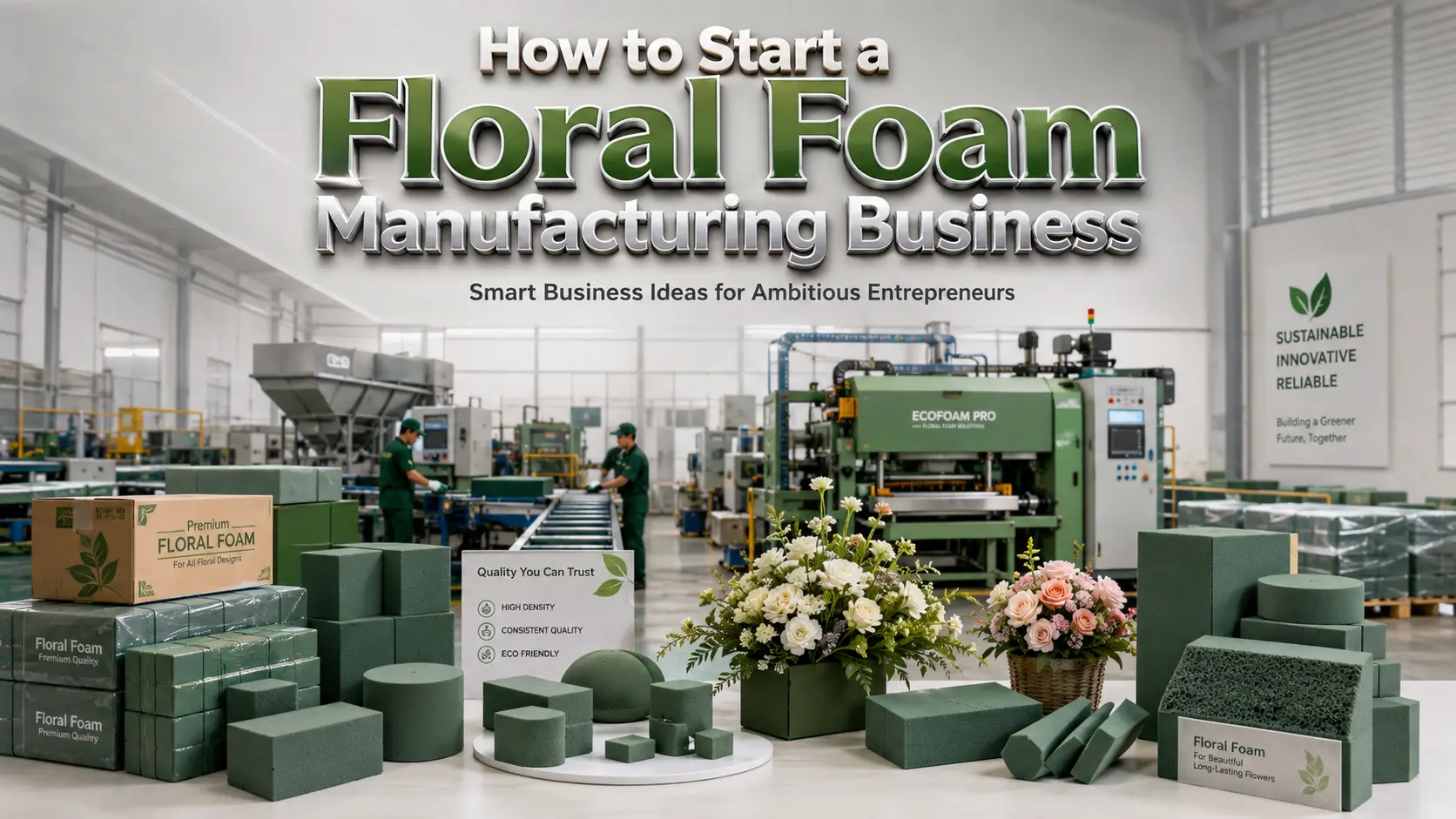

Florists, event decorators and wedding planners do not usually consider the industrial science of their dense green brick when picking it up to hold flowers. However, the flourishing manufacturing industry in India has an idea of business that is arguably one of the most lucrative and undervalued – floral foam. A phenolic resin-based foam that is lightweight, water absorbent and easy to cut, this material plays a key role in holding an entire chain together through floriculture, hospitality, retail gifting and export industries for events. Floral foam is definitely worth considering if you are an entrepreneur looking for a niche manufacturing business with solid demand fundamentals, low domestic competition and reasonable start-up economics.
Indian floriculture industry has been growing steadily. The country is also among the world’s largest producers of flowers and the downstream market for floral accessories, such as holding foam, is growing with it. The market remains poorly organised, and imports are still covering much of the demand, which clearly shows a gap that well-prepared MSMEs can capture.
Why the Floral Foam Sector Deserves Your Attention
Floral foam is not a product of commerce. It is a technical specialty product and that is important to entrepreneurs when considering the barriers to entry and margins. Process the product in a controlled manner, ensure a consistent cell structure, and achieve highly accurate water absorption behaviour. But with the right guidance, you can replicate it at small- to mid-scale units with good margins once you achieve consistent product quality.
As per the data released by National Horticulture Board (NHB), the market for floriculture in India is worth more than ₹13,000 crore. Much of this expenditure goes towards post-harvest and arrangement accessories such as floral foam. Organised domestic production is scarce, with most institutional buyers such as the wedding planners, hotel chains and export bouquet companies relying on imported bouquets that come at a higher price. An in-house manufacturer with a comparable quality level and competitive pricing is ready to market.
In addition, there is a great potential for exports. Countries in the Middle East, Southeast Asia, and Africa import floral accessories such as foam blocks in bulk quantities. MSME-certified Indian exporters offering competitive pricing can access these markets through established trade channels. So, if you are starting a business now, you’re not only aiming at an internal market, you are creating an export-ready tool.
Get Detailed Project Report (DPR): Floral Foam Manufacturing Plant Report
Government Policies and Incentives Supporting New Manufacturers
The policy climate for small manufacturers is, at best, very conducive in India. The Ministry of MSME has several schemes that are targeted at new units of floral foam. The Credit Guarantee Fund Trust for Micro and Small Enterprises (CGTMSE) offer collateral-free loans of up to ₹2 crore, helping startups obtain capital without the risk of collateral. A very important enabler for first generation entrepreneurs who don’t have legacy collateral.
Under the Prime Minister’s Employment Generation Programme (PMEGP) through KVIC (Khadi and Village Industries Commission) subsidies are provided of up to 35% of the project cost to manufacturing units set up in rural areas or semi-urban areas. This amounts to a subsidy of ₹10–17 lakh per floral foam plant, which is significant and lessens the burden on the promoter.
Further, the government through Make in India (DPIIT) encourages local Specialty and Chemical materials production. The Udyam portal will allow entrepreneurs to register, avail technology support from CSIR labs and take advantage of incentives from the state government for land, power tariff, and stamp duty waivers. A few state governments such as Maharashtra, Gujarat, and Tamil Nadu offer incentives to specialty chemical and polymer manufacturing units.
Business Ideas for Aspiring Floral Foam Entrepreneurs
1. Standard Floral Foam Block Manufacturing Unit
Firstly, The simplest option is to set up a unit that manufactures standard rectangular foam pieces, which florists across India and the world most commonly use. Additionally, Production of a thermoset foam with a consistent, fine cell structure, by mixing phenol, formaldehyde and a surfactant, at controlled temperature. Entrepreneurs can set up a small batch unit capable of producing 500–1,000 kg/day with an investment of ₹25–35 lakhs in plant and machinery.
The most widespread market is of standard foam blocks, and it is a market for retail flower shops, kirana level florists as well as institutional buyers. The gross margins usually range between 28–40%, depending on how we source raw materials and package the product.
New entrants to manufacturing can use this approach to build production capability, gain quality credibility, and expand their customer base before moving into specialised product lines.
Related Article: Top 3 High-Growth Industrial Ideas for Entrepreneurs
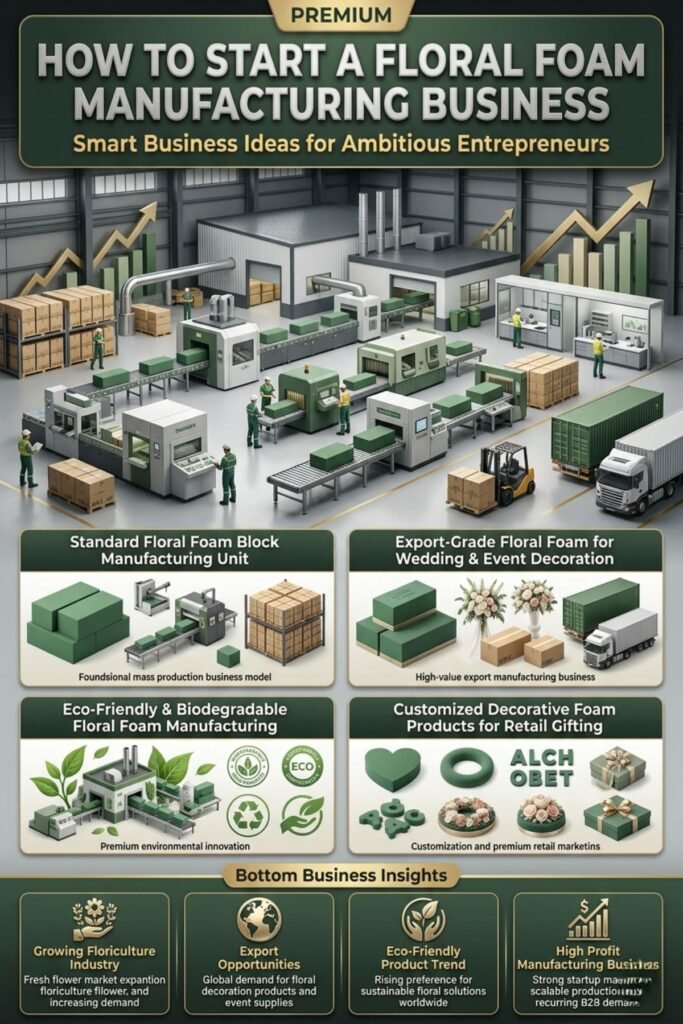
2. Export-Grade Floral Foam for Wedding and Event Decoration Exporters
We designed this model as an upgrade to the standard version specifically for export markets and premium domestic buyers. Export-grade floral foam should maintain a consistent density (usually 0.018–0.023 g/cm³), optimize water uptake to absorb up to 60 times its own weight in water within 60 seconds, and meet international phytosanitary standards through appropriate packaging.
The business concept is to construct a production facility that is ISO 9001 certified, interact with the export councils like Agricultural and Processed Food Products Export Development Authority (APEDA) and market the product to the UAE, Saudi Arabia, Singapore and East Africa. Export grade products are 20-30% higher in price than the foams sold on domestic market. Furthermore, the cycle of the export channels is more stable, and sales volume determines the repeat order. This area is much more insurmountable to competition for entrepreneurs that invest in lab testing infrastructure and international quality certification.
3. Eco-Friendly or Biodegradable Floral Foam Manufacturing
Traditional phenolic foam is non-biodegradable and increasingly in focus in Europe and North America, where standards for the floral industry regarding sustainability are becoming stricter. This is an interesting opportunity for Indian manufacturers to get into the emerging segment of biodegradable floral foam, which are natural fibre composites or plant-based polymers or modified cellulose substrates.
A couple of global brands are already creating eco options, but at high prices that give a chance to domestic manufacturers to compete. It is a business opportunity that needs to invest in R&D, which can be done in association with a CSIR or IIT attached lab. Once a viable formulation is reached, however, the market differentiation and value of the intellectual property is significant. For partnership opportunities, please check CSIR Technology Transfer and Licensing. Those who move in first will be ahead of the regulatory and consumer demand curve, which is likely to continue to grow.
4. Customised Shapes and Decorative Foam Products for Retail Gifting
In addition to the traditional format of brick, there is an expanding retail market for gifting in some custom format, such as floral foam hearts, flowers-stars, alphabets, frames, geometric shapes, etc. They are sold in gifting stores, online and to event companies. This is a very high-margin segment where the value-added moves from the supply of bulk materials to the presentation of the products, which are designed.
It is possible to have a manufacturing unit that creates standard foam blocks and then operate a secondary cutting and shaping line with CNC foam cutting machines. The cost of the shaping line is low – usually it’s as low as ₹3–6 lakh for a basic CNC foam cutter. But the additional revenue per unit of foam sold is much greater. This model combines manufacturing and product design, making it well-suited for creative entrepreneurs or those with strong retail channel connections.(Floral Foam Manufacturing Business)
Discover business ideas that actually make money
Import–Export Opportunity Analysis
The Indian floral foam trade clearly exhibits asymmetry, as imports dominate the market while exports remain underdeveloped. The import of floral foam and other specialty foams is consistent in volumes and mainly from China, Netherlands and South Korea, according to data from the Directorate General of Foreign Trade (DGFT). This import dependency is a direct opportunity for domestic manufacturers not only to meet import demand but to also gain export competitiveness, based on the increased floriculture production in India.
The Middle East is the nearest short-term export market. The UAE, Qatar, and Saudi Arabia import large quantities of event decoration materials, and Indian suppliers have already established a strong track record in related categories. The next level of growth is Southeast Asia, especially Malaysia, Indonesia, and Vietnam, where the wedding and hospitality sectors are increasing in popularity, leading to a rise in demand for floral accessories. Once a competitive price, consistent quality and reliable logistics are in place, an MSME exporter can start building a meaningful export book in 18-24 months from the commencement of Production.
The FIEO (Federation of Indian Export Organisations) offers a suite of export facilitation services that are especially helpful for new exporters dealing with the various aspects of export compliance abroad: buyer-seller meets, access to various trade fairs, documentation assistance etc.
Indian MSME Success Stories in Specialty Foam and Floriculture Accessories
Rubco Rubbers Ltd, Kerala
Although Rubco Rubbers Ltd is more famous for its rubber products, it has proven that a Kerala-based MSME can successfully create export markets for specialty material products through quality manufacturing and active trade participation. Their approach of investing in certifications, developing connections with export councils and ensuring quality of product is directly transferrable to manufacturers of floral foam. Entrepreneurs who come to this space should keep an eye on how Rubco is using the Make in India platforms and MSME portal listing to get the inquiries from international distributors.(Floral Foam Manufacturing Business)
Get Detailed Insights from This Book: The Complete Book on Rubber Processing and Compounding Technology (4th Revised Edition)
Florex Industries (Pune-based Florist Supply MSME)
Florex Industries is a medium-sized company producing and distributing floral accessories such as imported and locally-made foam products. The promoter, a person who has been in the wholesale flower trading business, understood the need to foster a single supply chain and local entrepreneurship in the accessory value chain. The company invested in a small production house and formed wholesalers’ network in Maharashtra and Gujarat; this resulted in a regular income flow and flourishing of repeat business. The big takeaway from Florex is the importance of distribution network investment – in the case of floral foam, reliable relationships with bulk buyers in wedding-rich markets (Pune, Surat, Ahmedabad) is a sustainable competitive moat.
Greenleaf Floriculture Exports, Bangalore
Greenleaf Floriculture Exports is a MSME unit which provides fresh flowers to export markets in Europe and the Middle East. As the promoter geared up for increased export business, he recognized considerable cost and quality variations in the purchase of floral foam and other holding supplies. The company then adopted a strategy of backward integration — obtaining and finally assessing the local foam supply. The experience suggests that one thing is consistent: institutional buyers in the floriculture export chain actively prefer to buy domestically from foam suppliers that can provide consistent supply, timely replenishment and competitive cost over importing alternatives that are subject to lead time volatility.
How NPCS Can Help You Set Up a Floral Foam Manufacturing Business
If you’re interested in manufacturing a specific floral product, such as floral foam, enthusiasm alone isn’t enough. You need a clear project blueprint that outlines the production process, machinery requirements, raw material selection, working capital needs, and realistic financial projections.This is where expert feasibility advice is crucial.(Floral Foam Manufacturing Business)
Niir Project Consultancy Services (NPCS) prepares Market Survey cum Detailed Techno-Economic Feasibility Reports (DPRs) for the entrepreneurs in establishing new manufacturing enterprises. In case of a flower foam project, we provide the entire manufacturing process, polymerisation parameters, raw material specifications for phenol and formaldehyde, selection of machine and identification of the machine vendors, plant layout planning, plant product quality testing and procedure, market demand analysis, complete financial model and profitability projections. We want to help you decide if this project is viable, profitable and how to make it work for a long time before you invest the money.
Floral Foam Manufacturing: Key Business Metrics at a Glance
| Parameter | Small Unit | Mid-Scale Unit |
| Project Investment (Plant & Machinery) | ₹20–30 Lakh | ₹50–80 Lakh |
| Land & Infrastructure | ₹5–10 Lakh (leased) | ₹15–25 Lakh |
| Working Capital Required | ₹8–12 Lakh | ₹20–35 Lakh |
| Production Capacity (per day) | 400–600 kg | 1,000–2,000 kg |
| Estimated Annual Revenue | ₹60–90 Lakh | ₹1.5–2.5 Crore |
| Gross Margin Range | 28–35% | 32–42% |
| Payback Period | 2.5–3.5 Years | 2–3 Years |
| Key Raw Materials | Phenol, Formaldehyde, Surfactant | Same + specialty additives |
| Key Markets | Local florists, event companies | Exporters, hotel chains, retail gifting |
Frequently Asked Questions (FAQ)
Q1. What are the raw materials required for floral foam production?
The basic raw materials are phenol, formaldehyde, a blowing agent (usually pentane or similar compound), and a non-ionic surfactant which controls cell size. Certain colorants are also used by some manufacturers to obtain the signature green colour. These chemicals are available from industrial chemical suppliers in India with valid licenses. However, due to the hazardous nature of the chemicals, a strict adherence to handling and storage as per the Hazardous Chemicals Rules is mandatory in any manufacturing unit.
Q2. What licenses and registrations are required for a floral foam unit?
A floral foam manufacturing unit must obtain Udyam registration (MSME), GST registration, factory license (Factories Act), and clearances from state pollution control board for handling of hazardous chemicals. Also, depending on the state, Entrepreneurs need to obtain consent to establish and operate from environment and pollution board. Usually, the timeframe for these licenses is 60-90 days for a new unit, and professional project consultants may significantly speed up the process.
Q3. Is there export demand for Indian manufactured floral foam?
Yes. Export opportunity exists and is not fully catered for by the Indian manufacturers. The largest markets include the Middle East, Southeast Asia, parts of Africa where buyers source similar products from China and Europe. India can effectively penetrate these markets if manufacturers can ensure quality standards at competitive prices, by directly contacting buyers and utilizing FIEO for trade fairs, B2B export platforms. APEDA can provide market access assistance as well to exporters in agri-allied sector.
Q4. How much time it would take for setup of a small-scale floral foam unit?
The entire setup of a basic small scale floral foam unit (right from project sanction till production start) takes around 4-6 months. This includes civil works and plant establishment (2-3 months), machinery acquisition and installation (1-2 months), trial production and quality checks (4-6 weeks), initial marketing push (ongoing) in which case a thorough DPR would save a lot of time from having errors on specifications from beginning which require expensive changes mid-project.
Q5. What is the minimum investment required for a floral foam business?
A small scale functional floral foam unit would cost a total of around 30-45 lakh which includes the plant and machinery, working capital and preliminary marketing expenses. However, eligible promoters under PMEGP can receive government subsidies of ₹10–16 lakh, which can cover a significant portion of the initial cost. The entrepreneur must prepare a thorough DPR for claiming these subsidies, and can also use the CGTMSE for obtaining term loans from the bank.
Q6. Can a first-generation entrepreneur with no chemical background succeed in this business?
Yes, given that they get the correct support. Chemical process involved in making floral foam is teachable and most operators involved are in trading or commerce. The entrepreneur should ideally invest in a feasibility study before investing funds. Hire an experienced Production Supervisor for first 12-18 months and focus on maintaining stringent quality controls along with customer relationship building. An accurate techno-economic feasibility report with consultancy support would significantly cut down the learning curve for first-generation entrepreneurs.
Conclusion
While the manufacturing of floral foam is hardly an attractive headline choice it possesses all characteristics for a sensible and sustainable investment by an MSME: actual demand; scarce domestic competition; good margins; the potential for exports and a definite support channel in terms of government policies. For a budding entrepreneur who is willing to invest in the right plan in the form of a proper detailed project report; with suitable machinery selection and a methodical entry plan the venture can be profitable within a relatively short period.(Floral Foam Manufacturing Business)
The Indian floriculture industry has started to blossom, and the rising trend in categories such as functions, weddings, hotel decor and gifting will eventually generate demand for floral foam. India still relies on imports despite having the capability to produce high-quality floral foam domestically at an optimal cost, making this an attractive import-substitution opportunity. The window of opportunity has not closed for any aspiring manufacturer who acts as a first mover.
The first steps for a genuine aspirant interested in the floral foam manufacturing industry will include a thorough techno-economic viability study, for which technical support will be readily available at NPCS. Any assistance regarding government schemes will require a thorough understanding of the available MSME Schemes Portal for new manufacturing units and the various available government schemes. The infrastructure is present, and the market is there, the only requirement is the right entrepreneur.


What difference between floral foam polyurethane origin and phenolic risen origin . Which is better and more common in the market.
Iam interesting in this field and looking to make a business in this field