Jewelry Business Ideas in India
No other industry in India has such a perfect mix of culture and trade as a jewellery store does. Jewelry presents a fascinating mix of artisan craftsmanship, rising consumer demand, and high export opportunities for any entrepreneurs looking for a business idea in a manufacturing, retail, or exportable product. India is one of the largest markets for jewellery, both as a consumer and as a producer, and the dynamics at the grassroots are even better today than they have been at least the past decade. The jewelry industry offers clear and quantifiable returns in various verticals, whether you are a first-generation founder with lakhs to invest or an MSME investor looking for scalable exports.
It’s not only about sentiment or tradition; it’s about the math. The gross margins are generally higher than 40% in imitation and artisan jewellery; there is structurally recurring demand in domestic wedding season and the Government of India has launched multiple support systems in skill development, facilitation for exports and support for manufacturing. In this article, I highlight 12 specific, actionable business ideas for jewellery, explore the jewellery trade opportunity landscape, discuss how government policies support jewellery entrepreneurs and share lessons learnt from entrepreneurs who have succeeded in building businesses that have changed the category trajectory from small beginnings.
Why the Jewelry Sector Warrants Serious Entrepreneurial Attention
India’s jewelry market is demand-led in nature both at the domestic and export side, with the former being driven by the wedding, festivals and gift culture and the latter by the Indian craftsmanship’s global reputation. The gems and jewellery industry is one of the key foreign exchange earners industries in India and it has always been a significant contributor to the overall merchandise exports. Surat, Mumbai, Jaipur and Chennai are internationally known production centers and each has its own specialization; diamonds, gold, gemstones and silver, respectively, which provides a definite entry point for new entrepreneurs depending on the availability of capital or geographic location.(Jewelry Business Ideas in India)
The transformation towards the lab-made diamonds has created an entirely new value chain in India. Today, an increasing number of Indian manufacturers produce large quantities of lab-grown diamonds for the export market, and the government has taken note of this as well with dedicated incentives. On the other hand, tier-2 or tier-3 cities have seen a consumption explosion in both fashion jewelry and fake jewelry markets due to aspirational shopping and the democratization of style through social commerce. The traditional barriers to market access have been broken by ecommerce and direct-to-consumer business models, helping even small-batch artisan producers to connect with customers across the world. In the wider consumer manufacturing sector, the risk-reward profile of jewellery businesses is one of the best for the consultants assessing the possibility of a business. Especially for the investments between ₹5 lakh and ₹50 lakh.
Government Policies & Incentives: A Supportive Regulatory Architecture
The Government of India has recognized gems and jewelleries as one of the priority sectors of export and the policy emphasis is also indicating the same. One of the most accessible funding options for artisan-based jewelry startups is the Pradhan Mantri MUDRA Yojana (PMMY), which offers loans up to ₹10 lakh without the need for collateral. The Credit Guarantee Fund Trust for Micro and Small Enterprises (CGTMSE) allow the entrepreneurs to avail working capital without putting in much collateral, especially in the gold and silver jewellery manufacturing segment where cost of raw materials is high.(Jewelry Business Ideas in India)
The Cluster Development Programme (CDP) of the Ministry of MSME has established dedicated jewelry clusters, particularly in Rajkot, Jaipur, and Thrissur, which offer infrastructure facilities, common facility centres, and collective marketing to lower down the per-unit cost for the new entrants significantly. The MSME Ministry has been implementing a scheme called the ‘Scheme of Fund for Regeneration of Traditional Industries’ (SFURTI) for the benefit of the artisans and clusters of artisans in the jewelry and handloom industries, who have been granted capital support, marketing linkages, etc.
The Gems & Jewellery Export Promotion Council (GJEPC) is the nodal agency for facilitating the export and it provides participation assistance in trade fairs, organizes buyer-seller meets and provides export certification assistance. The government’s SEZ policy has facilitated the establishment of SEZs for manufacturing of gems and jewellery, especially the Mumbai’s SEEPZ SEZ, where the manufacturers are allowed duty-free import of raw materials and machines. The Merchandise Exports from India Scheme (MEIS) successor mechanisms are still operative under the Foreign Trade Policy, offering incentives based on the FOB export value, encouraging manufacturers to establish an export pipeline from the beginning.(Jewelry Business Ideas in India)
More importantly, the government’s decision to consider lab grown diamonds as a separate category of manufacture, and the exemption of custom duty on lab grown diamond seeds, has boosted investments in this area. Entering the lab grown diamond market today, startups have an edge over others, considering that India is fast emerging as a global hub for lab-grown diamond production.
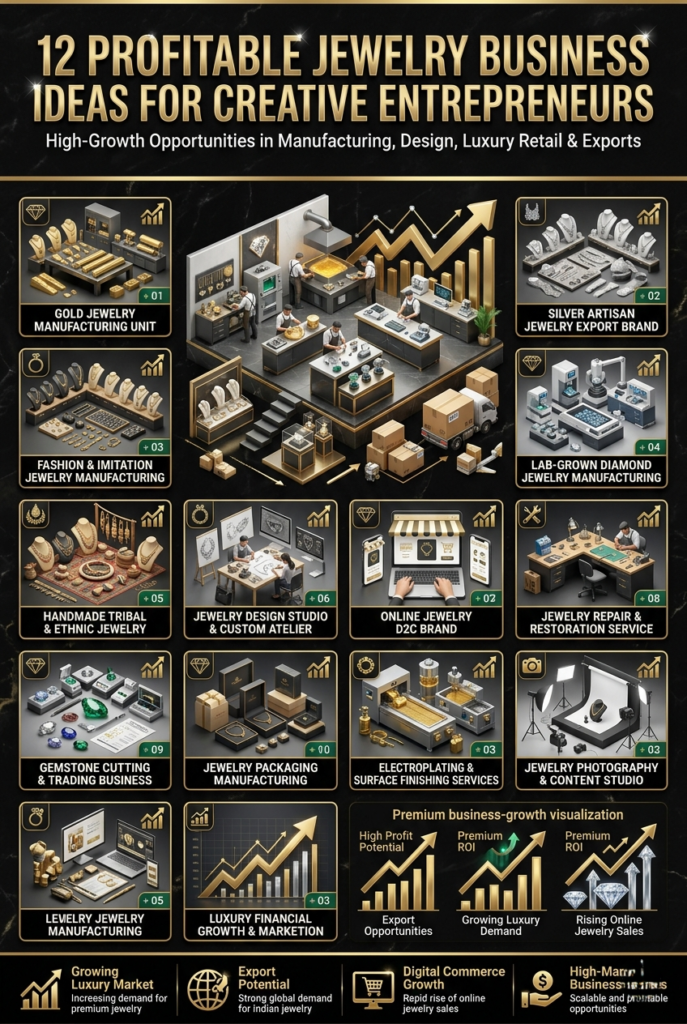
12 Specific Jewelry Business Ideas for Startup Entrepreneurs
1. Gold Jewelry Manufacturing Unit (Hallmarking-Ready)
The small-scale manufacturing of gold jewellery either with 3 to 5 skilled karigars (craftsmen) or less is among the most structurally sound businesses in this sector. The most prominent difference now is that of BIS hallmarking compliance, which is now compulsory for gold jewellery in India that exceeds a certain value.
Hallmarking certification is a better choice for entrepreneurs who establish their production system with hallmarking certification from the beginning. Entrepreneurs who establish their production system from the beginning with hallmarking certification have fewer regulatory friction points and command a price premium in the wholesale market.
A basic workshop-level unit includes basic machines, initial raw material stocks (usually leased) and hallmarking registration costs ranging from ₹15 lakh to ₹50 lakh, depending on the scale of investment. While wholesale to retail prices usually range from 18-28%, the direct retail or custom order models may see margins up to 35%.(Jewelry Business Ideas in India)
Access Complete Business Plan: Gold and Silver Jewellery
2. Silver Artisan Jewelry Export Brand
Filigree jewellery from Odisha, Bidriware from Karnataka, and Thewa jewellery from Rajasthan are types of silver jewellery. They fetch a regular premium in the markets of Europe and America. Creating a curated export brand around a regional craft is a strong opportunity. Raw materials are relatively inexpensive compared to gold. The government supports artisans through SFURTI and craft development programmes. Demand from Western markets is also increasing as people show more interest in handmade and heritage crafts.
A newcomer to this area needs to focus on design documentation and quality standardization. They should also build direct connections with boutique retailers and e-commerce sites in target markets. The investment needed to launch a silver artisan export operation is low, around ₹5 lakh to ₹20 lakh. The margin is also better when selling directly to foreign buyers or B2B marketplaces than in the domestic wholesale market.
3. Fashion / Imitation Jewelry Manufacturing for Modern Retail
Fashion Jewelry, which is crafted from zinc alloy, brass, copper, acrylic and resin, is one of the most growing segments in the Indian consumer market. With the rise of social media, influencer culture, and the trend of “occasion jewelry,” the imitation jewelry market has surged. It has seen significant growth in both metro and tier 2 cities. Manufacturing operations in this segment can be pursued with ease, with investments ranging from ₹2 lakh to ₹10 lakh.
The business model also works well for e-commerce, where high-volume transactions are driven by a low average ticket size of ₹200 to ₹2,000 per piece. Short production cycles, low reliance on raw materials imports and rapid adaptation to trend cycles are advantages that entrepreneurs in this vertical can avail. This is where Jaipur and Saharanpur are becoming low-cost manufacturing hubs and tie-ups with these clusters can further bring down the capital requirement.(Jewelry Business Ideas in India)
4. Lab-Grown Diamond Processing and Jewelry Manufacturing
India has become a strong player in the lab-grown diamond market. It is one of the most scalable business ideas for people who want to invest capital. These diamonds are optically and physically identical to mined diamonds. They are made in labs using two methods: Chemical Vapor Deposition (CVD) and High-Pressure High Temperature (HPHT).
Indian production of lab-grown diamond seeds has become competitive globally because the government reduced customs duty on them. An entrepreneur entering this segment may act as a CVD diamond processor or a lab-grown diamond jewelry manufacturer. They may purchase polished lab-grown diamonds and use them in gold or platinum jewelry. They can target fast-growing markets in the USA and Europe, where lab-grown diamond jewelry is already mainstream.
The cost of setting up a jewelry manufacturing unit with lab grown diamonds is generally ranging from ₹30 lakh up to ₹2 crore. This cost depends on whether the entrepreneur is polishing the stones themselves or buying ready-made stones.
5. Handmade Tribal and Ethnic Jewelry (Export & Domestic)
India’s jewellery heritage includes Dokra from West Bengal and Jharkhand, Lac jewellery from Rajasthan, and Bamboo jewellery from Northeast India. These are valuable but underused commercial assets. The market for these goods is strong in domestic premium markets and in international markets. Buyers are motivated by authenticity, sustainable production, and cultural storytelling.
Entrepreneurs in this space act as brand curators. They source products from artisan clusters. They also add some standardization to ensure quality. package the cultural story in a clear way. Finally, they distribute products through premium retail stores, craft fairs, and export channels.
The government’s One District One Product (ODOP) initiative is in full swing. GI-tagged jewellery items now have higher premium value. The investment required is relatively low. An entrepreneur needs Rs. 1 lakh to Rs. 10 lakh to enter the market. Profit margins can be high with proper brand positioning. (Jewelry Business Ideas in India)
6. Jewelry Design Studio and Custom-Order Atelier
Custom jewelry is a relationship-based, high-margin business with strong repeat potential. Customers order custom rings for weddings, anniversaries, and other major life milestones. It takes CAD (Computer-Aided Design), a reliable manufacturing partner or a fancy in-house casting facility and a robust client relationship management to establish a jewelry design studio. The focus of the investment is on design technology, the skills of designers, and the positioning of the brand, not on the industrial infrastructure. This is something that many entrepreneurs with an architectural or fine arts background transition into. They usually have a revenue range of ₹25,000 to lakhs per order, and with a small team of 2-4 individuals, a well-positioned studio in a metropolitan area can become profitable within the first ye
Get Detailed Insights from This Book: Our Books
7. Online Jewelry Aggregator and D2C E-commerce Brand
You can start a direct-to-consumer jewellery business with just ₹3–5 lakh. It is a capital-efficient model for India’s e-commerce platforms and can also be run through an independent website. The entrepreneur is responsible for the brand-building process. They either produce their own product or procure it from established artisans and clusters. They then develop a unique brand identity based on design language, sustainability, or culture. Flipkart, Amazon, and Meesho have built extensive distribution networks. This helps them scale their efforts effectively. Instagram and Pinterest are still strong discovery apps for jewelry brands. Content quality, photography, and the ability to tell a brand story are critical success factors in this model. These elements help build loyalty and encourage repeat purchases. Branding and customer retention is important and gives a better return on investment than a price comparison business.
8. Jewelry Repair, Restoration, and Customization Service
A jewelry repair/customization shop is a capital-light business that has repeat, loyal customers. This is an unmet market in Tier 2 and Tier 3 cities with skilled antique and heritage jewellery restoration in particular. The business has several revenue streams including basic repair, resizing, replating, stone replacement and restoration of heirloom pieces for high prices. The investment required is not high; the tools and equipment needed are between ₹1.5 lakh and ₹5 lakh, and the business is likely to start showing profit after the first month. Customization service (where the customer orders a metal or stone that is to be redesigned) adds to average transaction value and establishes an up-market positioning. This is also one of the few jewelry business models that is actually enhanced by older and more traditional neighborhoods and high traffic market locations, instead of premium malls.(Jewelry Business Ideas in India)
9. Gemstone Cutting, Polishing, and Trading
Jaipur is one of the few global centres where cutting and polishing of coloured gemstones is done on a large scale. Entrepreneurs who enter the gemstone processing business procure rough stones from India and other countries. They process these stones in the well-established Jaipur cluster. Then they sell them to jewellery manufacturers and exporters. This business benefits from information asymmetry.
A key competitive advantage is knowledge of gemstone quality grading. Another is understanding origin certification. Awareness of international buyer preferences is also important.
The investment required for a gemstone trading business ranges from ₹10 lakh to ₹1 crore. This depends on the quality and geographic source of the stones being traded.
Demand for rubies, sapphires, and emeralds is steady in the UAE, Hong Kong, and the US. These markets are important for India’s coloured gemstone exports.
10. Jewelry Packaging and Accessory Manufacturing
The ancillary, packaging around the jewelry — boxes, stands, velvet pouches, tissue wrap, branded carry bags, etc. — is a real business opportunity that is not often realized. With the increasing number of jewellery brands, particularly D2C brands, the demand for high-end packaging that creates a better ‘unboxing experience’ and that helps reveal the quality of the brand, is also surging. The establishment of a small jewelry packaging line equipped with screen printing, UV coating, embossing is suitable for hundreds of jewelry brands with B2B business. The investment amount varies between ₹5 lakh to ₹25 lakh, based on the type of machinery selected, and the clients range from jewelry brands, watchmakers, luxury accessory brands, to corporate gifting companies. However, those who have already experience in printing/packaging may have an advantage as an entrepreneur.
11. Jewelry Electroplating and Surface Finishing Services
Another major operation in fashion jewellery manufacturing is the electroplating of a thin layer of gold, silver, rhodium, or platinum onto the base metal substrate; this is usually a service that is performed by smaller fashion jewellery manufacturers. Establishing a jewelry cluster electroplating services unit for the local jewelry cluster, which demands are predictable and continuous, is a B2B business. Generally, the investments in electroplating equipment, chemical processing tanks, and effluent treatment plant are around ₹8 lakh to ₹30 lakh. Environmental compliance is not a matter of negotiation and an entrepreneur who invests in this upfront does not face any regulatory risk down the road. Margins are secure, clients are regional and loyal, and the enterprise naturally expands as the jewelry market expands.
Build a profitable business with the right idea
12. Jewelry Photography, Styling, and Content Studio
The world of jewelry can be incredibly competitive for digital visibility, especially as hundreds of jewelry brands vie for attention, making professional jewelry photography and content creation a high demand, niche B2B service. A jewelry content studio can work 20-40 brand clients per month on a retainer or per-shoot basis, with the proper equipment, lighting control setups, digital retouch, and a good model or styling partner. Investment required is ₹3 lakh to ₹8 lakh for the professional equipment and studio setup. The revenue from a brand client can range from ₹8,000 to ₹50,000 based on the output and the jewelry segment clients are willing to pay a premium for capturing the quality, finish and the stone design detail. It is one of the most scalable services in the jewelry industry that doesn’t rely on raw materials.(Jewelry Business Ideas in India)
Import–Export Opportunity Analysis
The Gems & Jewellery Export Promotion Council (GJEPC) is the backbone of jewelry export in India and has helped its members trade in 50+ countries. The top 5 countries to which India exports most jewellery are consistently the U.S., UAE, Hong Kong, Singapore and the UK, and they account for the bulk of India’s export of gems and jewellery. In the eyes of a startup entrepreneur, the biggest entry point to export is not the large gold or diamond segment, which requires huge investment; but it is the artisan jewelry segment, the silver jewelry segment, the fashion jewelry segment and the lab grown diamond jewelry segment where it is possible to make the difference at relatively small investments.
As for import, lab-grown diamond and gem entrepreneurs are at an advantage as India has a liberal import policy on rough and seed material. GJEPC has separate facilities and services for export documentation, quality certification and buyer matching, thus lowering the cost of transacting the establishment of export relations. The biennial and organized by GJEPC India International Jewellery Show (IIJS) is the most significant trade exhibit for fresh exporters to expand their international buyer base.
It is important to note that American consumers have long shown a strong, increasing preference for ethically sourced and sustainably-produced jewelry, so Indian handmade, tribal and lab-grown diamond producers are faring better than others in the field. Education of traceability of supply chains is also gaining force in the EU, which means that Indian producers have an advantage in presenting their production practices.(Jewelry Business Ideas in India)
Indian MSME Success Stories: Learning from Proven Models
Kalyan Jewellers — T.S. Kalyanaraman’s Trust-First Strategy
T.S. Kalyanaraman, Founder of Kalyan Jewellers, started his journey with a single store in Thrissur, Kerala to establish one of the biggest chains of Jewellery stores in India. What set Kalyan apart was its strategic decision to build the trust infrastructure, investing in clear pricing, hallmarking certification and customer education before these were becoming commonplace among most competitors. In jewelry, the Kalyan model is an important takeaway for new entrepreneurs that perceived trust can be a more significant competitive edge than product differentiation itself. Kalyanaraman grew in a disciplined and well-researched manner, vetting each new geography based on its purchasing power and competitive intensity. As a new company looking to enter the jewelry retail or manufacturing market, it’s important to make certain investments rather than optional ones such as certification, transparency, and systematic communication with customers.
PC Jeweller — Balram Garg’s Export-First Manufacturing Logic
PC Jeweller, promoted by Balram Garg, started as a small production unit in Delhi. It later grew into a brand recognized across India. This was achieved by integrating a strong export manufacturing capability to a domestic retail business. Export-quality manufacturing was emphasized from the very beginning. This required stricter consistency standards. As a result, manufacturing discipline improved and became a key competitive advantage in retail. Being export-ready along with retail operations, while also developing domestic retail in parallel, helps Indian jewelry manufacturers diversify their revenue. Any entrepreneur entering the manufacturing segment should focus on export readiness from day one. This includes quality documentation, buyer relationship management, and production flexibility as a parallel strategic priority.
Titan Tanishq — Xerxes Desai’s Category Transformation
Tanishq, launched under Xerxes Desai from the house of Titan, has truly defined the organised branded jewelry retail category in India when only family jewelers constituted the industry. It’s near shutdown in the beginning and eventual recovery is a textbook on brand endurance and customer education. Tanishq spent on consumer education regarding hallmarking, standardization, and assurance for a customer who had never even thought about these. For present-day entrepreneur, the big learning is that in fragmented, trust- deficit markets, the entity that spends on consumer education and infrastructure on quality before concentrating on transaction volume builds the lasting brand equity. Tanishq’s story also proves that premium brand positioning in jewellery is possible even in price-sensitive segments, as long as the brand delivers on its promises.(Jewelry Business Ideas in India
Related Article: Industrial Uses of Silver in 2026: Demand Growth & Profitable Business Opportunities
How NPCS Supports Jewelry Entrepreneurs
At Niir Project Consultancy Services (NPCS), we work with entrepreneurs at a critical stage: from idea to investment. At this stage, proper feasibility analysis separates smart investment from costly failure.
Our consulting work for jewelry projects includes Market Survey cum Detailed Techno-Economic Feasibility Reports (DPRs). These reports provide detailed process descriptions of manufacturing. They also include competitive market analysis.
We cover raw material sourcing and machinery sourcing. We also provide detailed financial projections. These include capital costs, working capital requirements, projected profitability, and break-even calculations.
Whether the investment project is that of setting up a silver art work export unit, an in house manufacturing facility for lab grown diamonds or a fashion jewelry d2c brand, a professionally documented DPR will allow for bank funding as well as support for discussions with the investor, for internal go/no-go decision. We aim to facilitate entrepreneur to assess feasibility, viability and sustainability prior to investing money and not after. The costs for a dependable feasibility study are only a fraction of the cost of an ill-advised investment.
Jewelry Segment: Investment & Margin Overview
| Jewelry Segment | Approx. Investment Range | Gross Margin (%) | Export Potential |
| Gold & Diamond Jewellery | ₹25L – ₹2 Cr | 18–30% | High (UAE, USA, UK) |
| Silver Artisan Jewellery | ₹5L – ₹50L | 25–40% | High (Europe, USA) |
| Fashion / Imitation Jewellery | ₹2L – ₹20L | 35–55% | Moderate (SEA, GCC) |
| Handmade Tribal / Ethnic | ₹1L – ₹10L | 40–60% | Moderate–High (EU, USA) |
| Lab-Grown Diamond Jewellery | ₹30L – ₹3 Cr | 20–35% | Very High (USA, EU) |
| Gemstone Studded Exports | ₹15L – ₹1 Cr | 22–38% | High (UAE, Hong Kong) |
Note: Figures represent indicative ranges based on industry consultancy data and MSME sector intelligence. Actual results vary based on location, scale, operational efficiency, and market conditions.
Reference Resources for Jewelry Entrepreneurs
1. Ministry of MSME – Government of India — MUDRA loans, CGTMSE, cluster development, SFURTI scheme details.
2. Gems & Jewellery Export Promotion Council (GJEPC) — Export data, trade fair calendar, buyer-seller facilitation.
3. DPIIT – Department for Promotion of Industry and Internal Trade — FDI policy, SEZ framework, investment promotion.
4. Make in India – Official Portal — Sector-wise investment guides and policy overviews.
5. Bureau of Indian Standards (BIS) – Hallmarking — Mandatory hallmarking regulations, certification process.
6. India Brand Equity Foundation (IBEF) – Gems & Jewellery Sector Report — Market size data, export statistics, growth drivers.
Frequently Asked Questions (FAQs)
1. What is the most profitable jewelry business in India?
Fashion jewelry, bespoke jewelry, and lab grown diamond jewelry provide high profit margins presently.
2. What is the minimum investment for a jewelry business in India?
Minimum investment for jewelry business varies from Rs. 1 Lakh for small & artisanal business and over Rs. 2 Crore for advanced manufacturing businesses.
3. Is it possible to start a jewelry business from home?
Yes. You can start an online jewelry store, a handmade jewelry brand, and a custom jewelry company from your home.
4. Is BIS hallmarking necessary in India?
Yes, every jewelry in India is supposed to beBIS hallmarked except the old ones and some special cases.
5. How do I export jewelry from India?
An IEC and export registration would be needed along with ways to connect with international buyers, through the B2B portals and trade shows.
6. What is the profitability of the imitation jewelry business in India?
The profit margins of an imitation jewelry business range from 35%-55% and it can be started with relatively small investment.
7. Which online platform is the best to sell jewelry on?
A few starting platforms to begin with are: Amazon, Flipkart, Meesho, Instagram shop, Facebook marketplace and shopify stores.
8. What is the best jewelry business for a fresher?
Fashion jewelry, handmade jewelry, repairing services and online jewelry stores are advised for freshers as they do not require a very large investment.