Who Prepares a Detailed Project Report
One document is quietly making or breaking a business idea before order is placed on one machine or a loan application is submitted, and that document is the Detailed Project Report (DPR). Each year, there are thousands of dreams of new MSME entrepreneurs who invest their meager savings in new businesses without a proper DPR. Many fall because their business ideas were sound, but they had not done sound financial projections, not conducted a sound market analysis, and not done a sound capacity planning. The DPR is a remedy to all of the above.
One question that founders find themselves tripping up at the starting line, however, is who is really responsible for creating this document? This is not an easy question to answer. The quality of your DPR directly affects the ability of banks to consider your loan request, government agencies to consider your subsidy applications, and investors to consider your business viability. The wrong preparer is a very expensive error. This article explores the question, who prepares a Detailed Project Report, who they are and what they offer, and how smart founders should make their decision.
What Is a Detailed Project Report — And Why Banks Demand It
Detailed Project Report is a document of feasibility and business planning of any proposed project that includes all the important aspects of the project. It is not a business plan as in a casual way. It is a data-driven and structured document containing information on market demand, manufacturing process, raw materials needs, machinery specifications, land and building cost, project finances, working capital estimate and profitability estimate.
Moreover, Lenders such as SIDBI, Nationalized Banks and NBFC institutions demand a well prepared DPR for term loans beyond a certain amount. For disbursement of the MSME funds, the Ministry of MSME and credit schemes such as CGTMSE, PMEGP require the submission of a DPR. Thus, the DPR is not a subsidiary bureaucracy. It’s the financial and operational roadmap that you can defend on every penny that you are about to invest.
Related Article: How to Start a Project Report Consultancy in India: A Low-Investment, High-Profit Business
Who Prepares a Detailed Project Report? The Five Key Experts
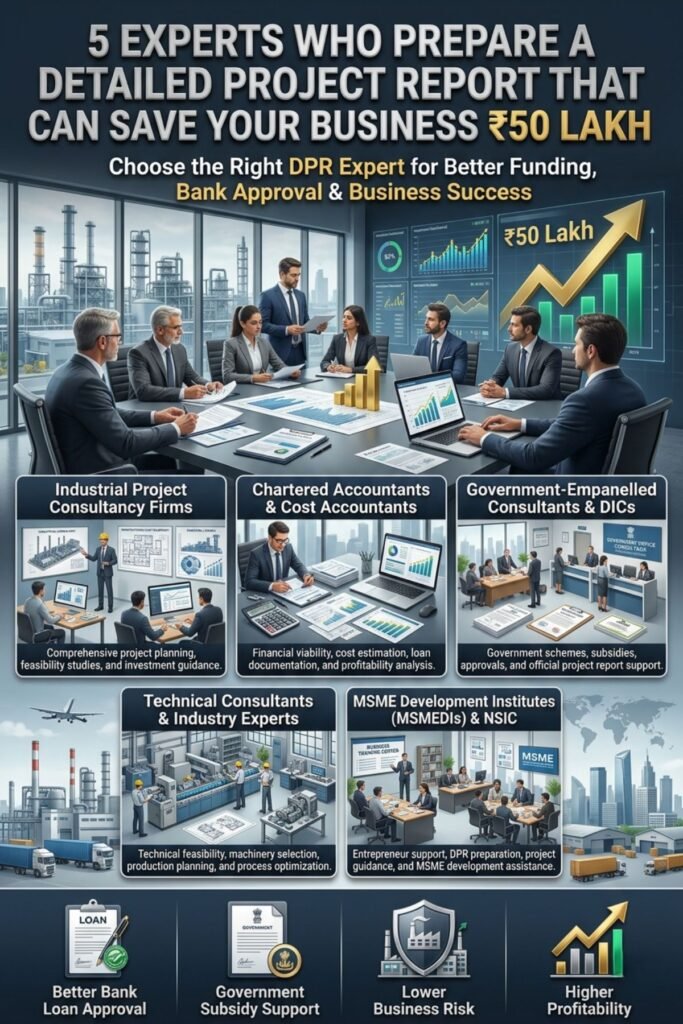
1. Industrial Project Consultancy Firms
The best and most trusted is a specialised industrial consultancy company. Such firms possess a mix of market research skills, engineering expertise and financial modelling expertise. They have prepared DPRs for various industries such as food processing, chemicals, textiles, plastics, agro-processing etc. Also, they usually meet the documentation standards for institutional lenders and government subsidy portals. A good consultancy firm doesn’t just simply plug in a template, it does primary and secondary market research, validates demand data and creates realistic financial models based on actual industry benchmarks.(Who Prepares a Detailed Project Report
This type of company includes Niir Project Consultancy Services (NPCS). They have organized DPRs for hundreds of industries, and have current databases for machinery costs, raw material costs, and regulations. If you are a first-time entrepreneur with a great sense of business, but not much knowledge of financial modelling or techno-economic analysis, it is almost always better to invest in a specialised consultancy firm.
2. Chartered Accountants and Cost Accountants
For smaller MSME projects, a CA or CMA is often sought out to prepare a DPR. They have robust financial modelling and accounting compliance skills. Further, banks and NBFCs trust the documents certified/prepared by Practising CAs with high level of confidence. But the drawback here is space. A CA-prepared DPR is typically cost-focused and may not be as detailed in certain aspects like process engineering, machinery specifications, and industry-specific knowledge. Therefore, this method is best suited to a person with existing technical expertise in the industry and who requires a financial feasibility document, rather than a marketing plan.(Who Prepares a Detailed Project Report)
3. Government-Empanelled Consultants and DICs
District Industries Centres (DICs), functioning under the control of State government, usually have a panel of project consultants. These consultants are responsible for drafting simplified DPRs (Document of Proposal) for small businesses that are seeking approval under schemes such as Prime Minister’s Employment Generation Programme (PMEGP) or MUDRA. In a similar fashion, the KVIC (Khadi and Village Industries Commission) and the nodal offices at the state level also appoint consultants to draw up subsidised or low cost DPRs for micro enterprises. There is a shallower analysis, which is often sized to the needs of the scheme, but at a lower price. For projects with small budgets (under ₹25 lakh) this is a sensible choice.
Discover business ideas that actually make money
4. Technical Consultants and Industry Experts
In certain manufacturing segments – chemicals, pharmaceuticals, food processing and engineering – domain technical experts often prepare Domain Process Releases (DPRs) that are very strong on process design, plant layout, plant equipment specification, and production capacity planning. They may not, however, be equally adept at market analysis, or financial modelling. For this reason, many founders opt for a combination strategy, i.e. engage a technical specialist to handle process side inputs and a CA or consultancy firm to create the financial model. Such expertise is recognised by DPIIT (Department for Promotion of Industry and Internal Trade) in its Startup recognition framework.
5. MSME Development Institutes (MSMEDIs) and NSIC
Central government is also providing support in preparing DPR through MSME Development Institutes (MSMEDIs) which are available if the founders can’t afford to hire trained project consultants. Likewise, the National Small Industries Corporation (NSIC) offers advisory and consulting services to new MSME projects. Many of these institutions are of great benefit to entrepreneurs in Tier-2 and Tier-3 cities where access to private consultancy firms is not a given. Their help is more general, however, and can be supplemented by the founder conducting independent market research.
Government Policies That Make the DPR Even More Critical
There are several flagship government schemes in which quality of DPR is directly associated with the approval of funding. Credit is available for MSMEs under the Credit Guarantee Fund Trust for Micro and Small Enterprises (CGTMSE), but lenders will only provide it if the MSME has a credible DPR. Likewise, DPIIT will require techno-commercial proposals before it sanctions incentives under the Production Linked Incentive (PLI) Scheme for new manufacturing investments.(Who Prepares a Detailed Project Report)
While the Pradhan Mantri MUDRA Yojana (PMMY) has already provided lakhs of crores in financial assistance to micro businesses, many applicants still fail to secure loan approval and disbursement because they do not submit sufficient project documentation. A good DPR addresses these “friction points” before they even begin. In addition to this, the PMEGP government scheme for providing non-repayable funding for new manufacturing and service businesses explicitly requires a DPR. Thus, the DPR is NOT just a document for any entrepreneur who intends to seek institutional loan or government assistance. It’s a money passport.
Import–Export Opportunity Analysis: DPRs for Trade-Oriented Projects
The DPR becomes even more strategic for the founders who have their manufacturing units oriented towards exports. For making available the lines of credit or long term loans under the Export financial assistance schemes of export promotion bodies like EXIM Bank, India, proper documentation of projects is essential for the exporters engaged in manufacturing activities. Further, the various EPCs such as Textiles, Engineering, Chemicals and Pharmaceuticals often help members find the international demand information that can boost DPR market analysis sections.
A DPR prepared by a reputed industrial consultancy firm has a lot of credibility for the foreign partners and domestic lenders, when the founders are aiming at Agriculture Export Policy or the Agriculture Export related Joint Ventures. Further, the import substitution thesis—the production of high-value goods currently being imported—offers an attractive investment opportunity. A well-researched DPR can effectively assess and quantify its potential. This has good potential in specialty chemicals, industrial machinery components and medical devices.
Indian MSME Success Stories: How Smart Founders Used DPRs as Launch Pads
Prataap Snacks — From a Small Plant to a Listed Company
Yellow Diamond is a small snack unit started by Arvind Mehta, the founder of Prataap snacks in Indore. The business concept was not unique as it is a highly competitive business of namkeen and snack foods. But Mehta’s discipline at detailing the project documentation in each growth stage, enabled him to raise institutional funding at all stages. The lesson for new founders: A well-prepared feasibility report is not just for the first project. It is the one tool that enables finance to be made affordable.(Who Prepares a Detailed Project Report?)
Parag Milk Foods — Building Credibility Through Documentation
Devendra Shah of Parag Milk Foods created one of the biggest integrated dairy units in Maharashtra. Each new plant, be it a cheese processing unit or a whey protein plant was supported by detailed techno-economic feasibility analysis from the outset. This discipline helped lenders and investors to believe the promoter’s capacity to carry out big capital projects. This is a very useful model for MSMEs in Agri-processing.
Get Detailed Insights from This Book: Market Research Report on Milk Processing & Dairy Products in India
Kiri Industries — Specialty Chemicals and Export Discipline
From humble origins in the chemicals belt, P. Kiri established Kiri Industries as one of the biggest exporters of dye intermediates from India. All the product line extensions have been followed by careful market and cost feasibility studies. The rigour of a DPR – to ensure that market demand is met before investment in new capacity – is directly linked to the company’s consistent export performance. This is a model that can be replicated for entrepreneurs in specialty manufacturing.
Get Detailed Project Report (DPR): Chemicals (Organic, Inorganic, Industrial) Projects
How NPCS Helps Entrepreneurs Prepare Investment-Grade DPRs
Entrepreneurs looking to start a new industry or expand an existing business can obtain a Market Survey cum Detailed Techno-Economic Feasibility Report from Niir Project Consultancy Services (NPCS). Our DPRs encompass every aspect of analysis ranging from detailed documentation of manufacturing process, market Research and demand analysis, process flow diagrams, product mix and capacity planning, machinery and raw material sourcing details and complete project financials including profitability analysis, Cash Flow projections, Break Even analysis etc.
We want to give our entrepreneurs a clear idea of feasibility, profitability, and scalability before investing capital. Our reports have helped in loan sanctions, application to the government scheme, investor presentations and expansion decisions over the years, across the manufacturing sectors. NPCS offers an end-to-end solution with proven experience in the real world, designed to create a DPR that will pass muster with banks, governmental bodies, and strategic partners for founders who wish to create an investment-grade document.
Comparison Table: DPR Preparers — Who Should You Choose?
| Type of Preparer | Technical Depth | Financial Modelling | Bank Acceptance | Cost Range |
| Industrial Consultancy Firm | High | High | Very High | ₹25K–₹2L+ |
| Chartered Accountant (CA) | Low–Medium | High | High | ₹15K–₹80K |
| Govt. Empanelled Consultant | Medium | Medium | High (for schemes) | ₹5K–₹25K |
| Technical Domain Expert | Very High | Low–Medium | Medium | ₹30K–₹1.5L |
| MSMEDIS / NSIC | Medium | Medium | Medium–High | Low / Free |
Source: NPCS internal benchmarking; MSME Ministry guidelines
FAQs
Q1. Is it compulsory to get DPR for all MSME loans?
No, it is not compulsory for micro loans less than 10 Lakh (MUDRA Shishu category where simple application form suffices) in all cases, however term loan of more than 10 Lakh and all Govt. Subsidized scheme applications (PMEGP, CGTMSE, state capital subsidy) requires a DPR, either compulsory or enhances loan approval prospects, as banks evaluate promoter’s preparedness and viability of the project based on it.
Q2. How much time does it takes to get the DPR prepared?
It typically takes 2-4 weeks to prepare a quality DPR for medium sized MSME project; however, this period may vary depending on the sector complexity and the amount of market research needed. The smaller projects in known and researched sectors can be completed earlier. Don’t fall for services promising a comprehensive DPR in 48-72 hours, they often resort to using pre-filled template documents.
Q3. What is the average cost of DPR preparation?
Costs of DPR preparation varies significantly between preparer and project complexity, ranging from 5,000-15,000 for government assisted consultants at DICs and 25,000 to 2 Lakh or more for private consultancy firms with comprehensive market research and financial modeling, depending on size of the project and sector complexity. This must be seen in proportion to total project cost; for a 1 crore project, a good DPR costing 50,000 is worth spending on as a risk mitigation.
Q4. Can I get it prepared myself?
Technically Yes; there is no law that prohibits preparing it oneself. However, banks and other lending institutions have higher scrutiny levels of self-prepared DPRs, particularly on financials. For smaller projects, applicants with a strong industry background, access to reliable data sources, and CA-certified financial statements can prepare their own DPR. For larger projects, however, a professionally prepared document significantly strengthens the proposal.
Q5. Which are the required sections for a DPR acceptable to the bank?
A typical bank ready DPR includes: executive summary, promoter background, product and market analysis, manufacturing process, plant and machinery, raw materials, land and infrastructure, cost of the project, sources of finance, financial projections (P&L, cash flows, balance sheet), break-even analysis, and implementation plan; failure in any of these aspects may lead to asking for additional information or even rejection.
Q6. Are DPRs useful only for new businesses?
Not really, DPRs are equally useful for expanding the business. An existing MSME considering adding a new product line, expanding existing capacity, exploring new markets or setting up a Greenfield facility in a new geography can use the same decision support provided by a DPR. Banks often prefer DPRs for expansion loan proposals as it would clarify commercial viability and feasibility of the expansion, especially in conjunction with the company’s existing liability profile.
Conclusion: Choose Your DPR Preparer as Carefully as Your Business Partner
A Detailed Project Report is as good as the expertise behind it. It is a strategic decision, then, who prepares your DPR. Industrial consultancy firms have the widest range of technical and financial expertise. Financial rigor is the strength of Chartered Accountants. Consultants are appointed by the government for particular needs of the schemes. Technical experts plug in sector specific gaps. Both have their place and the decision depends on project size, complexity, and funding sources.
Furthermore, founders who invest in a well-designed DPR early in the process save significant time and money by avoiding mistakes, preventing loan rejections, and designing projects more effectively. Driven by initiatives like Make in India and Atmanirbhar Bharat, the Indian MSME sector is expanding rapidly, and high-quality project documentation will increasingly distinguish projects that secure funding from those that do not. The DPR is the first serious piece of investment towards the success of your business and the expert who prepares it is the one.
References & Useful Links
1. Ministry of MSME, Government of India
2. DPIIT – Department for Promotion of Industry and Internal Trade
3. CGTMSE – Credit Guarantee Fund Trust for MSEs
4. NSIC – National Small Industries Corporation
5. KVIC – Khadi and Village Industries Commission
6. EXIM Bank of India – Project Finance