
The data has been taken from: Annual Report 2025-26 of Ministry of Chemicals and Fertilizers, Government of India | Published on: mocf.gov.in
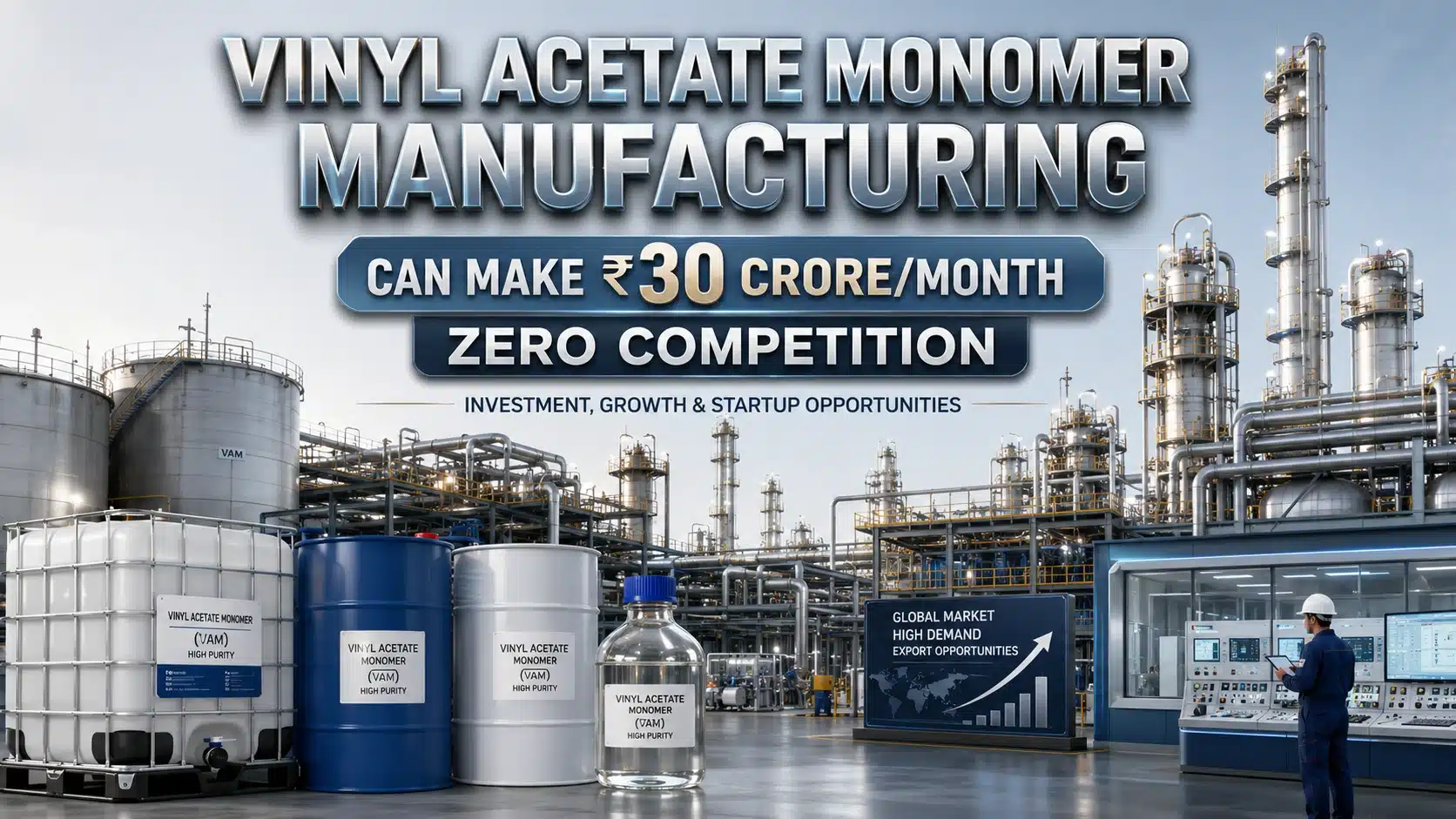
India is an almost 100% importer of Vinyl Acetate Monomer. The country has installed capacity of 30,000 MT per annum with zero MTs produced in the country from this installed capacity. No output. No utilization. A space that foreign suppliers have been filling (and profiting from) for years. The petrochemicals data in the Annual Report 2025–26 of the Ministry of Chemicals and Fertilizers, Government of India shows an anomaly: it reports an installed capacity of 30,000 MT for Vinyl Acetate Monomer, while showing no production across the last five reporting periods.
That is not a typo. It’s a policy-level entry point which sharp entrepreneurs have yet to take over. The government has announced an extension of the VAM Quality Control Order until March 2026, showing that it is preparing to enforce domestic standards once production capacity becomes available. Such is the first window available in the Indian chemical policy to a first-generation manufacturer to build capacity now.
The Demand Gap That Makes VAM a Compelling Industrial Bet
The making of vinyl acetate monomer is not a niche-play product. VAM serves as a feedstock for producing polyvinyl acetate (PVAc), polyvinyl alcohol (PVOH), and ethylene-vinyl acetate (EVA) copolymers. These materials find daily use in paints, adhesives, paper coatings, construction chemicals, textiles, solar encapsulants, and food packaging. The construction industry alone in India is a multi-lakh crore market which consumes a large quantity of adhesives and surface coatings derived from VAM. EVA granules are used to make footwear and solar panels, both growing by double digits.
However, India’s contribution to total FDI equity inflows since 2000 is just 3.0% as per the Ministry of Chemicals and Fertilizers, Govt. of India (Annual Report 2025-26). The sector received Rs. 8,942 crores in FY 2024-25, a 28% increase over the preceding year. However, there has been no commissioned plant yet for VAM. The domestic demand is estimated to be between 250,000 and 300,000 MT annually, with the bulk of this demand being met by imports from China, the USA and Southeast Asia producers.
If you plot the current level of import dependency with the downstream demand pattern, the math to import substitution practically writes itself. VAM demand increases in a similar proportion as construction and packaging activities both are growing at 7-10% per year in India. The revenues generated by such a 50,000 MT VAM unit running at 80% capacity would be in the Rs. At the current import parity pricing level, 350-450 crores.
Read the Complete Book Here: Handbook On Chemical Industries (Alcohol Based)
Why the QCO Extension Changes the Strategic Calculus
The QCO for Vinyl Acetate Monomer has been amended four times. The most recent amendment extended the enforcement date to 31 March 2026. QCOs are a common policy tool used by the government to protect future domestic manufacturers from low-cost imports once local production begins. The extension is significant because it signals the government’s intent. Rather than cancelling the QCO, the government appears to be waiting for at least one domestic producer to become commercially viable. Once that happens, import quality restrictions could be enforced, which would likely increase the landed cost of imported VAM.
To a trader or investor this QCO history is not just an accumulation of bureaucracy. It is a demand signal for the fish. If the QCO is implemented, BIS-licensed domestic VAM will enjoy a competitive edge over volumes from imports without a QCO. The downstream purchasers in adhesives, textile finishing and paper coatings will have huge compliance driving forces to change their sourcing from foreign manufacturers. This is what pricing power is. That’s called margin protection.(Vinyl Acetate Monomer Manufacturing)
Project Opportunities in VAM Manufacturing
Opportunity 1: Greenfield VAM Plant via Acetyl enation Route
Ethylene, acetic acid, and oxygen react in a fixed-bed catalytic reactor to produce vinyl acetate on a commercial scale. A 30 – 50 thousand MT/year plant needs investment of Rs. In the range of 200 to 350 crore as per the source of acetic acid (external or co-production). Adhesive manufacturers, paint manufacturers, and EVA manufacturers are the main buyers. With the current VAM import parity price of around Rs. Even at 60-65% capacity utilization in the first year, the operating cash flow can cover the term debt. Gross margin is generally 22-28% before overheads based on the variable cost of production, for a well located, feedstock secure unit.
Target site: Gujarat’s PCPIR at Dahej, and the availability of a 40 MLD CETP facility, port access and linkages with the ethylene feedstock infrastructure at PCPIR. Based on the Annual Report 2025-26 of Ministry of Chemicals and Fertilizers, Government of India, it comes to us as no surprise that more than Rs. There are 2,079 chemical units already operating at the Dahej cluster with 1.28 lakh crore in investments. There are VAM off-take buyers in the same geography with 2,079 chemical units already operating with 1.28 lakh crore in investments.Vinyl Acetate Monomer Manufacturing)
Opportunity 2: Polyvinyl Acetate (PVAc) Emulsion Manufacturing
An MSME investor with Rs. A downstream PVAc emulsion plant for white glue, wood adhesive and textile binder grade products requires 15-25 crore of capex. These are sold at Rs. Likely in the range of 60-120kg as per the specification; gross margin is in the range of 30-38%. The unit economics are valid on as low capacity as 3000-5000MT/year. Furniture manufacturers in Morbi and Rajkot, paper mills in Vapi and textile processing houses in Surat and Tirupur are the major buyers. Clean Energy Technology is the MSME point of entry into the VAM value chain – low capital, quick payback and local demand absorption.
Get Detailed Project Report (DPR): Guide to Plastics, Polymers and Resins
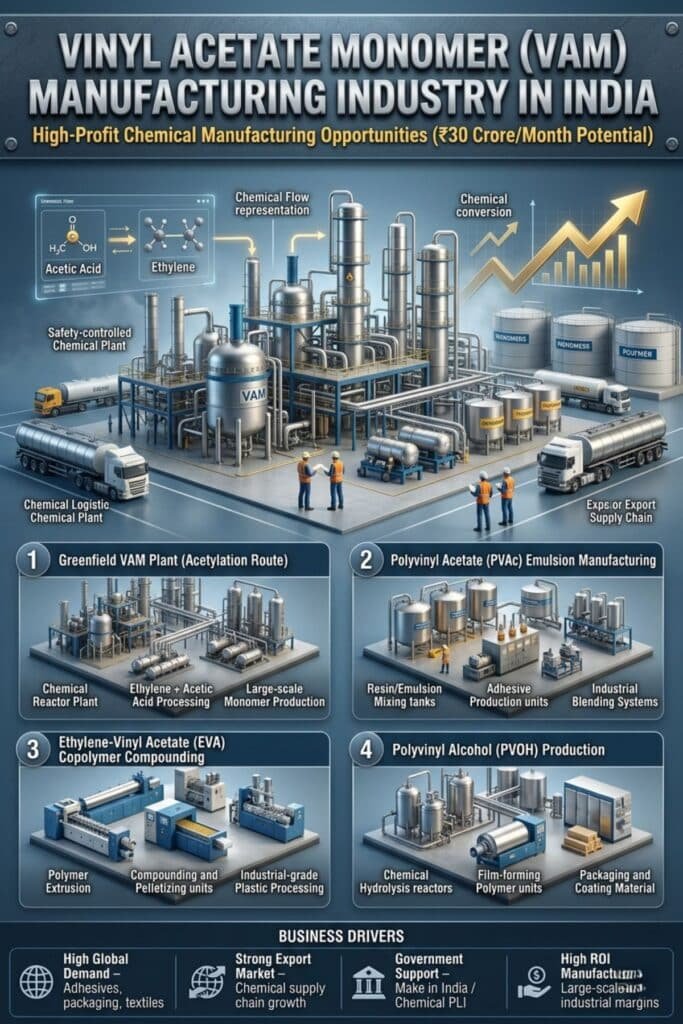
Opportunity 3: Ethylene-Vinyl Acetate (EVA) Copolymer Compounding
Firstly, EVA compounding is for sole manufacturers of footwear and solar module encapsulant manufacturers. Moreover, The Production Linked Incentive scheme for solar modules provides Indian EVA encapsulant film manufacturers with a captive off-take stream, as the solar installation pipeline is gaining momentum in the country. Additionally, Capes costs are Rs. for a compounding of 5,000-8,000 MT/year. Extruder Based systems ranging from 8-18 crore. The price of blended EVA compounds is Rs. 150-250/kg based on the VA content and application grade. The formulated product margins are between 18-25%.(Vinyl Acetate Monomer Manufacturing)
Opportunity 4: Polyvinyl Alcohol (PVOH) Production
Firstly, Manufacturers produce PVOH by saponifying polyvinyl acetate, and industries use it in textiles for warp sizing, in paper for barrier coatings, and in pharmaceuticals for making capsules. Moreover, Indian PVOH market is 100% dependent on imports from China and Japan. A 2,000-4,000 MT PVOH plant costs Rs. The estimated cost of setup for the plant is 30–50 crore, if imported or domestic PVAc is sourced. However, The selling price is from Rs. The margin ranges from 180–350/kg depending on the hydrolysis grade. Therefore, Well-positioned Indian producers can achieve a 30–40% margin over the landed price of Chinese PVOH, as shipping timelines and quality issues continue to impact Chinese supply.
Related Article: Furfuryl Alcohol Plant in India: Complete Guide, Investment & Process
Indian Entrepreneurs Who Understood Feedstock Gaps Early
The playbook of cracking an import dependent chemical segment is not abstract; indeed, several Indian promoters have done so effectively, in many cases in more capital-intensive environments.
Initially, When India did not have an indigenous supplier of aliphatic amines, Yogesh Kothari, promoter of Alkyl Amines Chemicals Ltd (Pune) spotted the need to replace importation and decided to find a domestic supplier for the product. He incrementally built capacity, had a downstream customer in place prior to plant commissioning, and dealt with the challenge of ammonia/ethanol chemistry feedstocks. Today’s Alkyl Amines is a Rs. 2,000+ crore revenue business. The take home: Chemical segments are import dependent and early movers in these segments may have very little local competition for 5-8 years after commissioning, which is more than enough time to build scale and backward integration.(Vinyl Acetate Monomer Manufacturing)
Ashok Boob, chairman of Vinati Organics Ltd, made isobutyl benzene and ATBS world-class Indian products. He first created domestic demand and later entered export markets after achieving the required quality and production scale. He focused on sectors with only two or three global suppliers. VAM manufacturing in India follows a similar distribution model, where most suppliers are foreign companies.
Moreover, Deepak Mehta is the founder of Deepak Nitrite, which he transformed into a Rs. company. Furthermore, 8,000 crore enterprise did so by dealing with phenol and acetone as a single entity and not two separate plays. Additionally, His advice to the VAM investors: Integration along the lines of producing PVAc emulsion or compounding of VAMs along with or immediately after VAMs; this safeguards investors from commodity price cycles and gives a huge boost to the blended margins.
Find high-return business ideas based on your budget & ROI
Import Substitution Arithmetic and Export Potential
Firstly, India imports about Rs.on VAM. 2.5 lakh to 3 lakh crore every year at current landed costs. Furthermore, The domestic 50,000 MT plant requires about Rs. Of that import, 400-500 crores of it is being imported every year. Moreover, Once two or three plants of similar scale are in operation, the prize for import substitution will approach Rs. Therefore, The strategic investors and financial backers are attracted by the headline figure, 3,000 crores.(Vinyl Acetate Monomer Manufacturing)
However, It’s not a play – export potential is a medium-term story. More than 40% of the world’s VAM production capacity is in China, and Chinese VAM prices have been fluctuant as a result of the volatility of energy prices and environmental shutdowns from time to time. While downstream Indian producers can compete effectively with buyers in Southeast Asian countries such as Bangladesh, Vietnam, and Thailand, energy costs at production sites and PCPIRs in Southeast Asia are generally higher because the region has less reliable supplies of acetic acid and ethylene. Indian VAM plant can achieve regional export revenues of 15-20% to total production by the time it is 3 years old.
Government Policy Support: What the Framework Offers VAM Investors
The Department of Chemicals and Petrochemicals (DCPC), available at the Ministry of Chemicals and Fertilizers (https://mocf.gov.in/), has established a policy framework that directly Favors new VAM players. Standalone plant developers can’t duplicate the land, utilities, shared ETP and feedstock location of the Petroleum Chemical and Petrochemical Investment Regions at Dahej in Gujarat, Vishakhapatnam-Kakinada in Andhra Pradesh and Paradeep in Odisha. The total investment in these three PCPIRs is more than Rs. The supply chain ecosystem is real with over 3.71 lakh persons being employed, 3.40 lakh crore.(Vinyl Acetate Monomer Manufacturing)
In addition to PCPIRs, VAM investors can avail term loans with CGTMSE up to Rs. Including 10 crore without any collateral for MSME scale downstream units. Higher scale of greenfield VAM plant is eligible for state level investment subsidies like Gujarat has 5-7% interest subsidy on term loans for chemical manufacturing units with investment of more than Rs. 50 crores. In reality, PLI scheme support for the downstream EVA solar encapsulant producers is a pull-through demand incentive for Indian VAM supply and is not structured as such today.
Feasibility Planning Before You Commit Capital
Firstly, Whether it’s a 3,000 MT PVAc emulsion VAM project or a 30,000 MT greenfield VAM synthesis project, investors must conduct a thorough pre-investment analysis before committing capital and putting the project on the ground. Moreover, The project team must conduct process technology selection (acetylation vs. ethylene-based approach), structure raw material supply contracts, map off-take buyers, and develop full project financials in a disciplined manner comparable to a consultant-grade DPR rather than relying on a spreadsheet estimate.(Vinyl Acetate Monomer Manufacturing)
Niir Project Consultancy Services (NPCS) has extensive expertise in the petrochemicals, polymers, and specialty chemicals sectors. The company has prepared detailed techno-economic feasibility reports for entrepreneurs planning to establish new industrial units in these industries.
Firstly, NPCS reports cover manufacturing process selection, process flow diagrams, market demand analysis, and demand-supply gap assessment. Moreover, They also include plant capacity planning, product mix planning, machinery specifications, raw material specifications, and comprehensive financial projections. Furthermore, These projections include break-even analysis, Internal Rate of Return (IRR), and payback period calculations.
For first-time borrowers, a well-prepared Detailed Project Report (DPR) from a reputable consultancy can significantly improve the chances of securing term loan approval from lenders.
Conclusion: The Window Is Open — But Not Indefinitely
Notably, India has a 30,000 MT installed VAM capacity block that has not produced any output so far. Moreover, The country’s demand stands at 250,000–300,000 MT per year, and India imports the entire requirement. Furthermore, The QCO framework, extended until March 2026, will eventually benefit active producers in India by providing them import protection. In addition, The PCPIR is economically feasible at 30,000-50,000 MT greenfield unit due to its infrastructure of feedstock access and shared utilities at Dahej, Visakhapatnam.((Vinyl Acetate Monomer Manufacturing)
The range of the capex is Rs. 200-350 crore for full VAM synthesis plant and entry points of MSME at Rs. PVAc and EVA compounding: 8-25 crore. Furthermore, The margins vary from 22 to 40% along the value chain depending on the level of the product and its integration. This is the first-mover window for Indian entrepreneurs who have the know-how of chemical manufacturing, access to PCPIR in Gujarat or Andhra Pradesh and the discipline to build a BIS-compliant and export-friendly business.
The import bill is real. The downstream demand is real. Moreover, The government declares its policy intent. However, The first Indian manufacturer needs to set up and commission a Vinyl Acetate Monomer plant and capture a market that foreign suppliers have dominated for the past two decades. As a result, This manufacturer will not be the only one but it will be the one who is making the biggest profit.
VAM Value Chain: Project Opportunity Snapshot
| Product / Project | Scale (MT/yr) | Capex Range | Gross Margin | Target Buyer |
| Greenfield VAM Plant (Ethylene Route) | 30,000–50,000 | Rs. 200–350 Cr | 22–28% | Adhesive / Paint / EVA mfrs |
| PVAc Emulsion Unit | 3,000–5,000 | Rs. 15–25 Cr | 30–38% | Furniture, Paper, Textile |
| EVA Copolymer Compounding | 5,000–8,000 | Rs. 8–18 Cr | 18–25% | Footwear, Solar Module |
| Polyvinyl Alcohol (PVOH) | 2,000–4,000 | Rs. 30–50 Cr | 30–40% | Textile, Pharma, Paper |
| VAM Derivatives (Mixed) | 1,000–3,000 | Rs. 5–12 Cr | 28–35% | Construction Chemicals |
Frequently Asked Questions
Q1. What is the minimum viable capital to get involved in the VAM downstream value chain?
An MSME investor can set up a PVAc emulsion unit with an investment of Rs 15–25 crore or establish an EVA compounding unit with Rs 8–18 crore. Unlike an upstream greenfield VAM synthesis unit (Rs 200-350 crore) where it costs quite a bit, the downstream segments offer the scope to tap in with significant less capital and still achieve gross margins of 30-40%. Because of loan guarantees covering up to Rs 10 crore without collateral under CGTMSE, the equity contribution for small-scale downstream units would be as low as Rs 5-8 crore.
Q2. How much time will it take for a VAM manufacturing plant to reach break-even?
A VAM synthesis unit of 30,000-50,000 MT capacity, running at 75-80% by year 2, can typically reach cash break-even in 36-48 months. For MSME downstream units – PVAc emulsion and EVA compounds – this time frame is much shorter at 24-36 months because of lower overheads and fasterramp-up. Feedstock costs (ethylene and acetic acid) and capacity utilization in the ramp-up are critical factors determining break-even time.
Q3. What licenses and permits do I need for a VAM plant?
To establish a VAM synthesis plant, you require a Consent to Establish from the State Pollution Control Board (since it’s a red category chemical plant), factory license under the Factories Act, no objection certificate from the local fire safety authority, and, depending on plant capacity, Environment Clearances from the MoEFCC. The QCO would also require a BIS certification (under IS 12345:1988) once it’s enforced. Units located within PCPIRs have access to single window clearance which typically brings down time of approvals by 30-40%.
Q4. Can Indian VAM manufacturers compete with Chinese manufacturers on price?
Yes, in terms of location efficiency and feedstock efficiency. Chinese manufacturers typically integrate upstream into ethylene, but when exporting to India, their freight and insurance costs (around Rs 12–18/kg) make their CIF landed prices higher. In contrast, Indian manufacturers that source ethylene domestically (for example, OPaL at Dahej) and procure acetic acid locally can operate at a cost advantage of about Rs 5–10/kg compared to Chinese landed CIF prices. Energy efficiency and catalyst life are the only two factors which will influence the manufacturing cost over a long run.
Q5. Is this segment covered under the PLI scheme and what government financial support is available?
VAM synthesis is not a PLI-covered product per se. However, the PLI scheme for the solar component manufacturing segment includes EVA solar encapsulant film—a downstream product—which ensures offtake from Indian VAM manufacturers. The state governments offer significant benefits. Gujarat’s Capital Subsidy Scheme offers an upfront grant on capital expenditure up to 20% of total investment with a max of Rs 30 crore for chemical manufacturing investments above Rs 50 crore, for investments in specified chemical clusters/regions. For small MSME downstream chemical processing investments, state governments have incentives for cluster development.