On July 1, 2026, Economic Times manufacturing desk reported that Tata Steel is aiming to reduce its dependence on the ferro alloys business and raise the value-added segment from about 20 per cent to 70-80 per cent as the company sets up a robust domestic speciality steel input base. It was revealed by Sushanta Kumar Mishra, Executive In-charge, Ferro Alloys & Minerals Division, Tata Steel, while addressing the 15th India Minerals and Metals Forum.
This isn’t a typical corporate announcement. It is an indication of a change in the pattern of manufacturing steel in India where the major steel producers are now looking to get the chrome, nickel and other alloying materials, which are currently mainly imported, on a different footing. That change provides fresh opportunities for MSMEs and startups in the specialty steel alloy processing, testing and scrap beneficiation and ancillary manufacturing areas which are critical for the defence, aerospace and auto industries.
See the original coverage here:
Full report: Tata Steel aims to raise value-added Ferro Alloys share to 70-80% — Economic Times Manufacturing
What Recent Economic Times Reporting Means
The Economic Times report says that Tata Steel imports most of the value added inputs for the production of speciality steel including some ferrochrome derivatives. The company’s goal is to gradually move the business from the current fifth of value-added product (VAP) sales to the 70-80 per cent VAP segment in the next couple of years to replace imports, Mishra told the publication.
The same report added that Tata Steel has a bigger objective to increase its steel production to approximately 40 million tonnes per annum from its current level of around 24 million tonnes per annum, keeping up with the Indian Government’s goal of 500 million tonnes of steel production by 2047. There is also a policy vacuum that Mishra pointed out Economic Times readers should be aware of: Better allocation of critical mineral mining leases, and different treatment for critical minerals’ royalties versus conventional ores.
The message for the founders is clear: when a company of this size makes a strong bet towards import substitution at this rate, it usually brings a vendor and ancillary ecosystem with it, and most first-generation entrepreneurs end up in that ecosystem.
Get Detailed Insights from This Book: Steel and Iron Handbook
Why This Industry Is Growing
The three forces are coming together in India’s speciality steel and ferro alloys space at this moment.
- National capacity targets: India’s target of building 500-million tonne steel by 2047 needs to be matched with the buildout of alloying inputs.
- Downstream demand: Defence, aerospace, automotive and energy manufacturing all use high chrome and low carbon speciality grades which are currently heavily reliant on imports.
- Rupee outflow on ferrochrome and critical minerals imports now means that for big steelmakers, forex is as much a policy priority as it is a cost consideration, when it comes to value addition in the country.
The change has been on the cards in several of the economic times manufacturing dispatches recently, and critical minerals and speciality alloys has always been amongst India’s fastest-growing industrial sub-sectors this year.
Government Policies & Incentives
Capitalists who start in this space don’t have to build by themselves. There are already several central schemes which have been put in place for the support of MSMEs in the following businesses:
- The Ministry of MSME portal provides registration and credit linked subsidy and priority sector benefits for small manufacturers.
- Through Startup India, tax incentives, compliance ease, recognition for new businesses in the materials processing sector can be availed.
- The Directorate General of Foreign Trade maintains the export licensing and the existing import-export policy framework with regard to ferro alloys and critical minerals.
They combine into the three windows of the business — registering, funding, and compliance with trade laws — which are the three most common practical challenges of new entrants in the alloys and speciality metals business.
Related Article: How to Start a Steel Fabrication Unit in India: Investment, Machinery & Export Potential
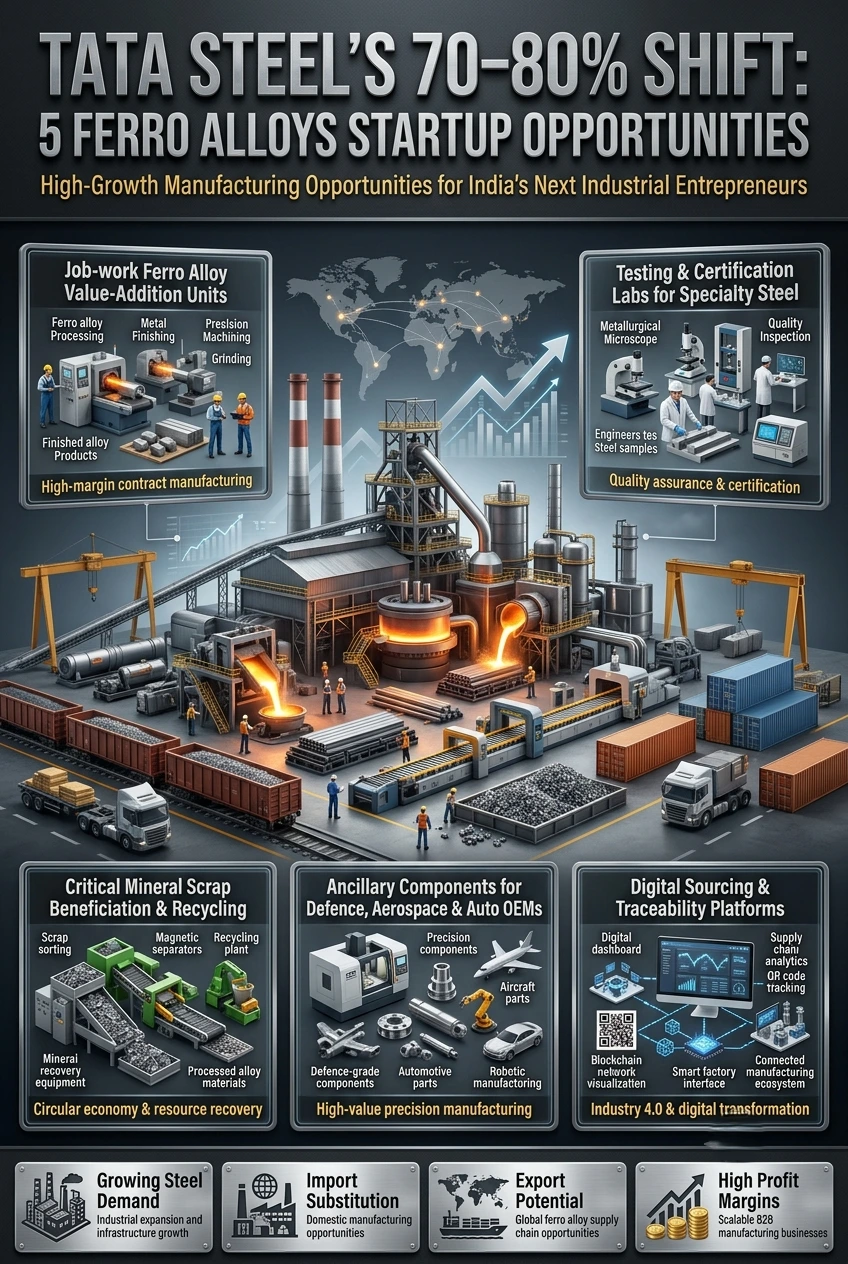
Multiple Business Ideas for Startups
1. Job-work ferro alloy value-addition units
Localising sourcing of ferrochrome or ferromanganese allows for the use of small processing units that produce higher value, low-carbon or ultra-low-silicon grades and deliver directly into the large steelmakers’ vendor chain.
2. Testing and certification labs for speciality steel
When the content of chromium, carbon and purity are becoming more stringent, specialized testing laboratories, which are accredited to test high chrome and nickel alloy, are crucial for large buyers to obtain these specialized services locally at a premium.
3. Critical mineral scrap beneficiation and recycling
Streamline the recovery of nickel, chromium, alloying elements from industrial waste and process them into the required feedstock for the furnaces, it becomes possible to reduce the dependence on raw importation and it is in line with the new public priority of the steelmakers.
Get Detailed Project Report (DPR): Steel Manufacturing Projects Guide
4. Ancillary components for defence, aerospace and auto OEMs
The steel industry is a downstream industry. Close to the front of the line of this growing value chain are precision component units of defence and aerospace primes needing certified high-chrome and low-carbon inputs.
5. Digital sourcing and traceability platforms
Large steel companies have already started digitizing scrap and alloy vendor onboarding. Producing a low-weight sourcing, quality-documentation or logistics-tracking system for smaller alloy manufacturers is a solution for a pressing need.
Import–Export Opportunity Analysis
This is exactly where Tata Steel’s target lies, as India continues to import most of the high value Ferro Alloy derivatives that are required in speciality steels. In the short run it is advantageous to import substitution manufacturing, if domestic units can produce products at a landed cost advantage relative to the import price.
As domestic capacity grows to the set target 70-80 per cent, the export potential follows too, especially for value added ferro alloys where the raw material base is good but processing capability is lagging. It is advisable for the entrepreneurs intending to venture into cross-border trade to keep a check on the licensing norms directly on the DGFT export-import policy portal prior to investment.
Indian MSME Success Stories
There are proof points for India’s ferro alloys and speciality steel ancillary base. Existing Indian manufacturers, like Sarda Energy & Minerals and Balasore Alloys, developed scaled ferrochrome enterprises based on export quality and regular supply to domestic steel factories.
On the other hand, in the smaller arena, vendors who connected to large steelmakers’ digital vendor networks, providing cleaned, homogenised ferrous and alloy scrap, but not raw material, have become regional aggregators in a few years by meeting the quality and compliance demands of large buyers.
Identify high-growth industries before others do
About NPCS – Niir Project Consultancy Services
Entrepreneurs evaluating a ferro alloys, speciality steel, or critical mineral processing venture typically need a bankable feasibility study before approaching lenders or partners. Therefore, Niir Project Consultancy Services (NPCS) prepares detailed project reports covering plant capacity, machinery, raw material sourcing, cost economics and regulatory compliance for metals and alloys manufacturing — the kind of documentation banks and investors expect before releasing funding for a new industrial unit.
Data Table: Key Numbers From The Ferro Alloys Shift
| Parameter | Current Level | Target |
| Value-added ferro alloys share | ~20% | 70-80% |
| Tata Steel own capacity | ~24 MTPA | ~40 MTPA |
| India national steel target (by 2047) | ~145 MTPA (approx. current) | 500 MTPA |
| High-chrome product chromium content | Standard grades | >65% chromium |
FAQ Section
Q1. What exactly did Tata Steel announce, and when?
On July 1, 2026, a Tata Steel executive told the Economic Times manufacturing desk about the company’s plans. The company aims to increase its value-added ferro alloys share from about 20% to 70–80%. This is part of a broader import-substitution and capacity-expansion strategy.
Q2. Which speciality steel segments offer the biggest startup opening?
Tata Steel has identified several key growth segments. These include low-carbon steel, high-chrome products with more than 65% chromium content, ultra-low-silicon grades, and nickel-based alloys. Each of these segments requires strong vendor support for processing, testing, and logistics.
Q3. What government support exists for a ferro alloys or speciality metals startup?
MSME registration and credit support are provided by the Ministry of MSME. Tax and compliance benefits are available through Startup India. DGFT provides export licensing guidance. Together, these cover the main regulatory and funding needs for a new entrant.
Q4. How can a small business enter this value chain without heavy upfront capital?
Q5. Is export potential real, or is this purely an import-substitution story for now?
In the near term it is primarily import substitution. Export potential will increase as domestic value-added capacity moves toward the 70–80% target. In addition, India’s cost competitiveness in processed alloys is expected to improve relative to imports.
Q6. Where can a founder get a bankable project report for this sector?
Specialised consultancies such as NPCS prepare detailed feasibility and project reports for ferro alloys and speciality steel ventures. These reports cover machinery, cost economics, and compliance requirements needed for bank financing.
Conclusion
Economic Times’ July 1 report on Tata Steel’s ferro alloys strategy is a live market signal, not background noise. A company produces roughly 24 million tonnes of steel annually and aims to reach 40 million tonnes. It has said publicly that it wants to quadruple the value-added share of its alloy inputs..(Tata Steel Ferro Alloys Startup)
For MSMEs and first-generation entrepreneurs, the best opportunity to enter this vendor ecosystem is in its early stages. This is before larger players consolidate the supply chain. Founders who act now in processing, testing, scrap recovery, or ancillary manufacturing can gain an early advantage as demand grows. Tata Steel has already confirmed that this demand is real and is already underway.