India Japan Green Ammonia Deal
Japanese Prime Minister Sanae Takaichi said this week that more than JPY 2 trillion in private-sector cooperation deals were reached between Japan and India, which he discussed during his visit to New Delhi for the India-Japan Joint Economic Forum. In addition to these agreements, she confirmed a joint project to produce green ammonia with an annual capacity of around 400,000 tonnes, describing it as a “symbol of a new chapter in bilateral energy security. This is no ordinary diplomatic photo call. It’s a move away from the paper memoranda and towards actual production capacity, and Tokyo explicitly noted that the collaboration is not just with the big conglomerates but also with startups and small businesses.
This kind of project doesn’t stay limited to two boardrooms very often. Developing and operating a 400,000-tonne green ammonia plant requires hundreds of ancillary suppliers, logistics partners, safety-testing labs and trained technicians. Indian entrepreneurs and MSMEs can do that right at the start of the supply chain before it gets full.
What Recent Economic Times Reporting Means
The Economic Times story on the Japan-India pacts also confirms that the Japan-India pacts are much more than an energy story. Cooperation, said PM Takaichi, is not limited to energy but is extended to a broad spectrum of parties such as startups and SMEs. The headline figure is not as important as that one line, which shows that Japanese firms are keen on partnering with Indian companies not just for billion-dollar joint ventures but also in the MSME segment.
Energy security co-operation is increasingly transforming into procurement contracts, ancillary manufacturing orders, and skilling programmes – that is the market change for the founders. The Economic Times coverage also mentions that India and Japan are aiming to draw about 10 trillion yen of Japanese investments in India over the next decade; this ammonia project is just the beginning of a longer investment journey.
Identify high-growth industries before others do
Why the Green Ammonia and Clean Energy Industry Is Growing
Green ammonia is in the crossfire of three global trends: carbon-free production of ammonia as fertilizer, the use of ammonia as a zero-carbon shipping fuel, and the provision of ammonia as a storable and mobile hydrogen carrier. India has plenty of renewable resources to produce ammonia cheaply and Japan is lacking in ammonia supply for co-firing their coal power plants and for reducing CO2 emissions. It is this complementary need that makes this deal a milestone and not just another MoU.
The Japanese investment comes on the back of domestic policy support and the momentum has already been created by the Indian government’s own National Green Hydrogen Mission. If a sector receives a guaranteed export order and government incentives simultaneously, then the additional business opportunities will start to grow rapidly.(India Japan Green Ammonia Deal)
Government Policies and Incentives Backing the Opportunity
Anyone who wants to get into the field as an entrepreneur doesn’t need to start from scratch. There are already a number of government platforms that support green energy manufacturing and exports, and MSME participation:
- Startups can benefit from recognition, tax relief and ease of compliance through Startup India for developing ancillary products for the green ammonia/hydrogen value chain.
- Miniature manufacturers providing components, valves, storage systems, etc. are provided credit guarantee schemes, subsidy, and small cluster development support by the Ministry of MSME.
- DPIIT monitors investment facilitation and industrial policy, such as the wider policy landscape that is attracting this Japanese investment into Indian manufacturing.
These schemes collectively reduce the threshold to become a vendor and not a mere watcher in this new supply chain for the MSMEs.
Get Detailed Insights from This Book: Fertilizers Manufacturing Handbook
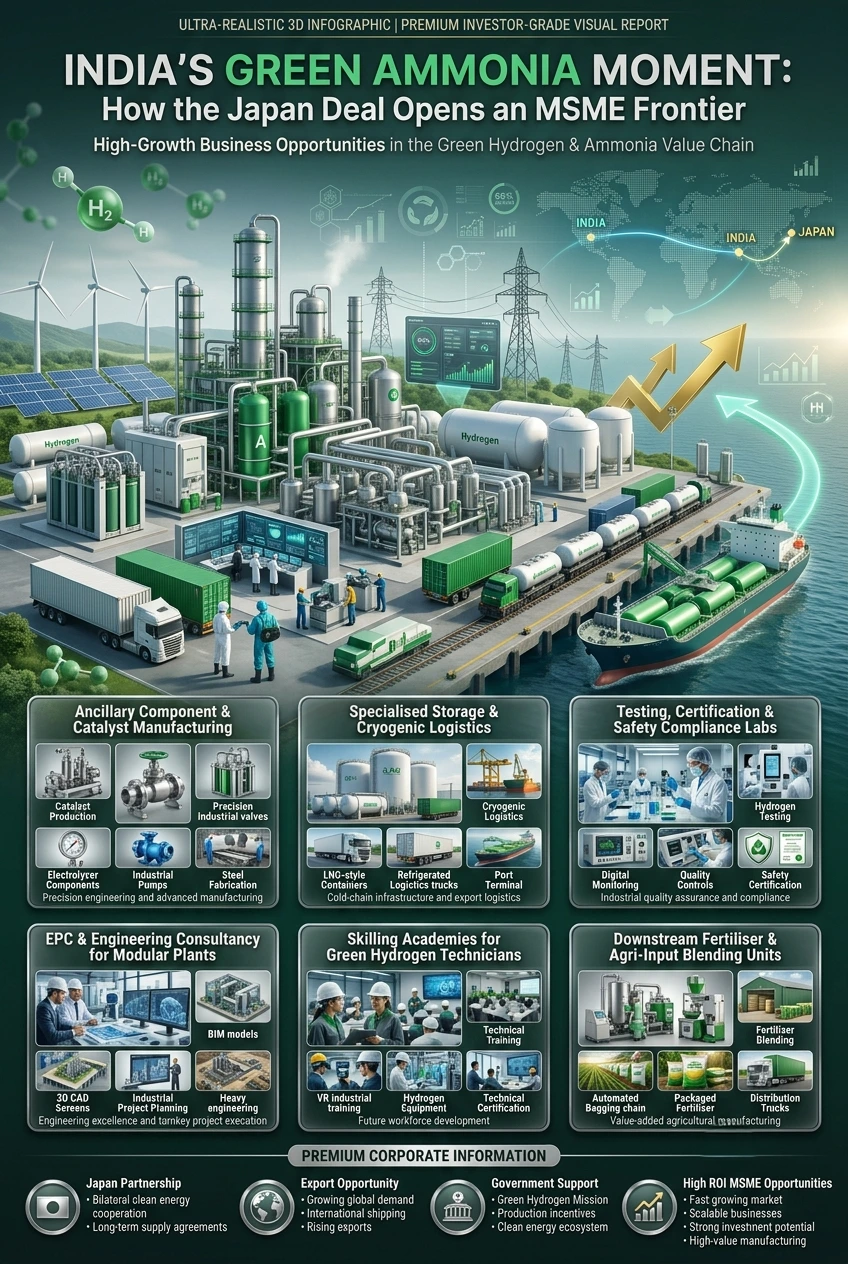
Multiple Business Ideas Emerging from This News
1. Ancillary Component and Catalyst Manufacturing
A series of reactors, catalysts, valves, and pressure-rated piping are required for ammonia synthesis units. Precision manufacturers can place themselves as suppliers to the new manufacturing facility and the project that it enables.
2. Specialised Storage and Cryogenic Logistics
Safe transportation of green ammonia involves pressurised tankers, cryogenic storage and port bunkering facilities. MSMEs in the logistics industry can carve a niche in this segment by obtaining the Safety Certification.
3. Testing, Certification, and Safety-Compliance Labs
All ammonia handling facilities should have leak detection, safety audits and compliance testing. These services can be provided at the several plants by independent testing laboratories.
4. EPC and Engineering Consultancy for Modular Plants
This flagship project is likely to be followed by smaller modular green ammonia and hydrogen units. The engineering consultancies who are capable of designing and implementing mid size plants can directly benefit from it.
5. Skilling Academies for Green Hydrogen Technicians
This requires training for its operators, safety officers, and maintenance technicians, with a capacity of 400,000 tonnes. Vocational institutes that develop a green-ammonia curriculum now will be prepared for the time of hiring.
6. Downstream Fertiliser and Agri-Input Blending Units
A key use of green ammonia is as a feedstock for fertiliser. MSMEs can adopt a strategy to support a cleaner and consistent local ammonia supply by blending and packaging agri-inputs to plan ahead in their operations.
Related Article: Green Hydrogen Production in India: The Next Trillion-Rupee Opportunity for Entrepreneurs
Import–Export Opportunity Analysis
Japan is a natural long-term buyer for the production of green ammonia in the Indian context, due to its demand for co-fired ammonia in coal plants and bunker cleaner marine fuel. Exporters must monitor compliance requirements from an early stage with the Directorate General of Foreign Trade (DGFT), which regulates export licensing, documentation and product-specific approvals for chemical and energy exports.
The other opportunity on import side is that Indian manufacturers might require to import specialised catalysts, sensors or plant machinery from Japan in the initial stages, which creates another opportunity for trading and customs-clearance MSMEs to handle cross-border logistics smoothly.(India Japan Green Ammonia Deal)
Indian MSME and Industry Success Stories
Early movers are already emerging with the green hydrogen and green ammonia initiative being India’s push. Over the last two years, several Indian energy companies have announced plans for the production of green hydrogen and ammonia in various states, including Gujarat, Odisha, and Andhra Pradesh, attracting global companies and export letters of intent. Unlike other projects, these projects always involve a large number of local component suppliers, civil contractors, and logistics vendors instead of relying on a single large entity to do everything in-house.
The pattern has been the same since every announcement of a major clean-energy project: in 2-3 years, dozens of smaller regional supplies are swallowed up in the project’s supply chain. As the niche vendor, a founder who are in position early are able to reap disproportionate value when the anchor project grows up.
About NPCS – Niir Project Consultancy Services
For entrepreneurs evaluating whether to enter the green ammonia, hydrogen, or fertiliser ancillary space, a structured feasibility study is the safest first step. NPCS, Niir Project Consultancy Services, prepares detailed project reports, market surveys, and techno-economic feasibility studies for entrepreneurs and MSMEs exploring emerging industrial sectors such as this one. A well-researched feasibility report helps founders validate demand, estimate investment needs, and approach lenders or government schemes with a credible business case before committing capital.
Get Detailed Project Report (DPR): Comprehensive Guide to Fertilizers and Fertilizer Projects
Data Snapshot
| Metric | Detail |
| Event | India-Japan Joint Economic Forum, New Delhi |
| Date | July 2, 2026 |
| Private-sector agreements | 129 pacts signed between Japanese and Indian companies |
| Investment value | More than JPY 2 trillion |
| Green ammonia project capacity | Approximately 400,000 tonnes per year |
| Stated 10-year investment target | Around 10 trillion yen mobilised into India |
| Sectors covered | Energy, manufacturing, AI, healthcare, startups and MSMEs |
FAQ Section
1. Is this green ammonia project open to MSME participation?
Yes. The Japanese Prime Minister specifically said the partnership now includes startups and small and medium enterprises, not only large corporations, which signals room for ancillary MSME vendors.
2. What kind of business can a small manufacturer start around this project?
Some of the entry points into the ammonia industry that dont involve making your own ammonia plant are component sourcing, storage tank manufacture, safety testing, delivery and driver training.
3. Does the government offer support for entering this sector?
Yes. Startup India, Ministry of MSME and DPIIT related programs provide certain registration benefits, credit facility and Industrial Facilitation suitable to the Value Chain.
4. Is there export potential for Indian-made green ammonia?
Given Japan’s carbonisation goals, it represents a potential long-term purchaser. Export sellers should therefore monitor DGFT instructions.
5. How risky is entering a sector this early?
Early entry carries execution risk. However, founders who commission a proper feasibility study can reduce that risk. Starting with a focused ancillary product also helps lower risk significantly.
6. Where can founders get a feasibility report for this sector?
Project consultancy firms such as NPCS prepare detailed feasibility reports and market studies. These reports are specifically designed for entrepreneurs entering emerging industrial sectors like green ammonia and hydrogen.
Conclusion
The Economic Times report on 129 Japan-India pacts and a 400,000-tonne green ammonia project is more than diplomatic news. This signals the emergence of a large, government-backed industrial supply chain, with explicit space for startups and MSMEs. Founders who move now—into component manufacturing, logistics, testing, or skilling—will position themselves well as this decade of 10-trillion-yen investment unfolds. As with any emerging industrial opportunity, timing and a solid feasibility study make the difference between chasing the news and actually building on it.