Urine Bag Manufacturing Business
In every hospital ward, including ICUs, urology departments, and home nursing care settings, healthcare professionals use Indian medical devices such as urine collection bags and urinary catheters for patients who require urinary catheterization during post-surgical recovery, mobility-restricted care, or chronic urological treatment. The urological consumables market, valued at Rs 500-700 crore, is picking up pace as India’s PMJAY hospital empanelment increases the number of beds at newly empanelled hospitals, while the home care nursing sector is expanding by leaps and bounds. The PIB: Ayushman Bharat PM-JAY Empanelment Data reveals that more than 28,000 hospitals have been empanelled under PM-JAY, contributing to an increased supply of institutional beds and urological consumables in India.
Market Opportunity: Why This Business Cannot Be Ignored
Although India has the processing capabilities of PVC and the production of silicone polymer, it imports a considerable number of urological consumables from multinational organizations, especially silicone Foley catheter and speciality urine drainage systems. Foley catheters are classified under Class C category of Medical Devices Rules 2017, while standard urine bags fall under Class B. This means that the regulatory pathway is a graduated one for the entrepreneurs, which will allow them to handle the less expensive devices (Class B, urine bags) and subsequently move to the class C (Foley catheters).
India’s home care nursing sector, which was a relatively new phenomenon, is also emerging as a new distribution channel for urological products as hospital stays have come down with the advent of PMJAY and most people with chronic urological conditions are aging and are now able to manage those conditions from home. The in-home healthcare schemes by NHM for newborn and elderly care are institutionalizing their training of home health aides and procurement of consumables from home-based manufacturers, providing a growing institutional buyer for certified domestic urological consumable manufacturers. WHO: Prevention of Healthcare-Associated Infections has recognized use of anti-reflux drainage in proper indwelling catheter management as a fundamental patient safety hospital practice worldwide.(Urine Bag Manufacturing Business)
Read the Complete Book Here: Handbook on Medical and Surgical Disposable Products
Industry Analysis: Growth Drivers and Demand Outlook
India’s urological consumable market (including urine bags and catheters) has an estimated size of Rs 500-700 crore and is growing at a CAGR of 12-15%. According to AIMED (Association of Indian Medical Device Industry) urological consumables are one of the priority import substitution segments where Indian manufacturers with CDSCO Class B and Class C certifications will be able to get access to government hospitals through GeM and Private hospitals with supply of competitive pricing of urological consumables products against the imported brands. The IBEF: India Healthcare Sector Growth foresees an increase of more than 30 percent in the number of hospital beds in India till 2025 which will directly drive the growth of the installed base of urological consumables in an institutional setting.
Established companies such as Romsons and SURU International already manufacture urine bags, and the market is large enough to accommodate new organized manufacturers. Make in India’s medical devices sector actively encourages and promotes manufacturing of urological devices in the country, with PLI incentives and regulatory support; as well as the rising home care market which was not available to manufacturers 10 years ago.
India Urological Consumable Market
| Parameter | Market Data | Notes |
| India Market Value (Urine Bags + Catheters) | Rs 500 – 700 crore per year | Industry estimates |
| Market Growth Rate | 12-15% CAGR | Hospital and home care expansion |
| Urine Bag (Class B) | Standard drainage bag with anti-reflux valve | Most common hospital product |
| Foley Catheter (Class C) | Two-way or three-way, PVC or silicone | CDSCO Class C, higher value |
| Leg Bag (Class B) | Portable urine bag for mobile patients | Growing home care market |
| Key Government Buyer | NHM hospitals, ESIC, defence medical | GeM procurement portal |
| Export Potential | Middle East, Africa, SAARC region | Competitive Indian pricing |
How to Start: Step-by-Step Guide for Entrepreneurs
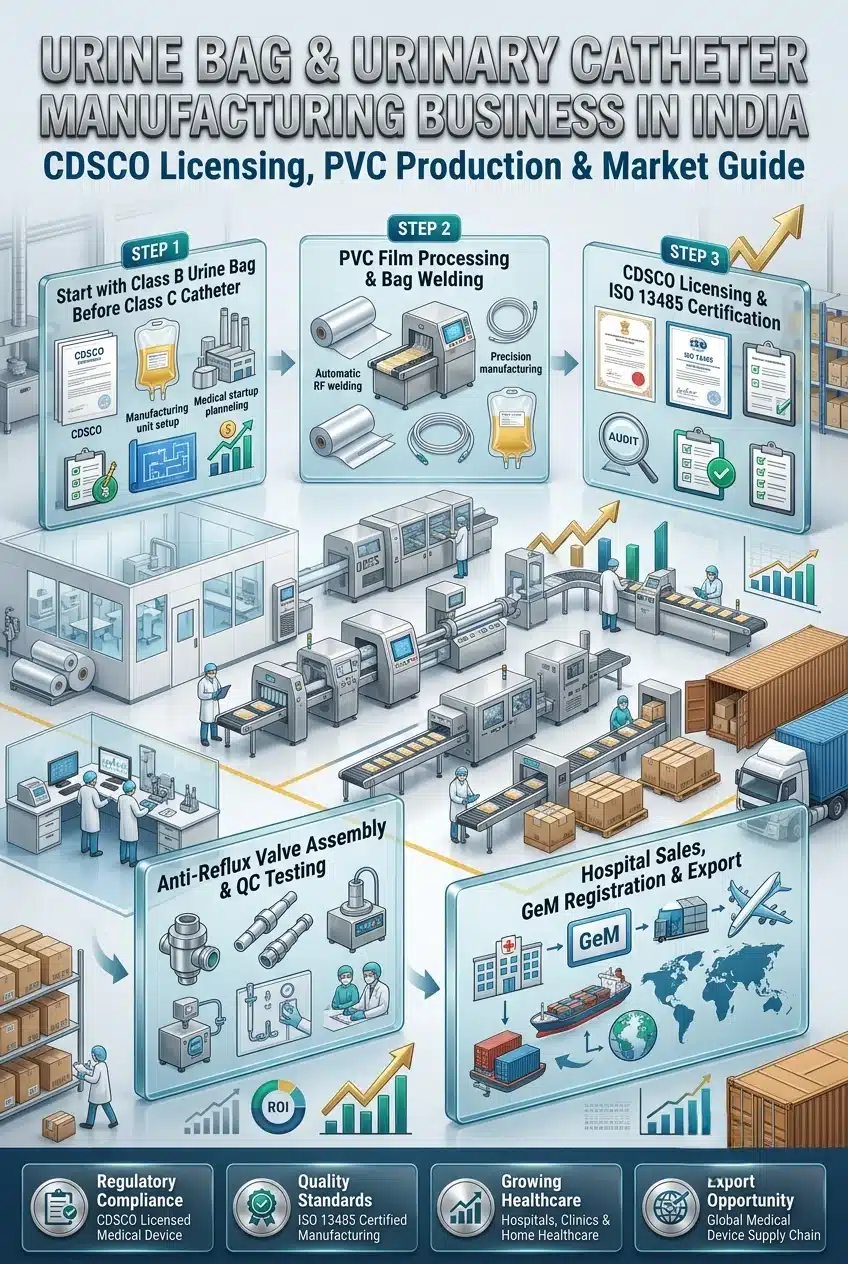
Step 1: Start with Class B Urine Bag Before Class C Catheter
Urine bags are Class B devices, have a more accessible regulatory pathway (State Licensing Authority licence) and simpler manufacturing technology of PVC bags. Rather than investing in the more complex Class C Foley catheter extrusion and balloon testing infrastructure, start with producing urine bags to earn some revenue and develop relationships with hospitals.(Urine Bag Manufacturing Business)
Step 2: PVC Film Processing and Bag Welding
Manufacturers produce urine bags by using HF (High Frequency) or RF (Radio Frequency) welding to join medical-grade PVC film (200–300 microns thick) into a bag body. The bag includes an inlet tube (catheter connector port), an outlet tube (with a sampling port and drain tap), and graduated volume markings, which manufacturers apply through screen printing or embossing on the bag surface. The anti-reflux valve (non-return valve assembly) prevents urine from flowing back to the patient.
Get Detailed Project Report (DPR): RIGID P.V.C. FILM Manufacturing Plant Project Report
Step 3: CDSCO Licensing and ISO 13485 Certification
Submit to the State Licensing Authority ISO 13485 QMS, PVC Urine Bags Bio-compatibility per ISO 10993, Product dimensional specification, and GMP facility compliance documentation for class B urine bags. Foley catheter type C (when established) use balloon inflation-deflation, lubrication testing (hydrophilic coating), and specifications for the geometry of the catheter tip in applications to get CDSCO approval centrally.
Step 4: Anti-Reflux Valve Assembly and QC Testing
The anti-reflux valve assembly is the most technically complex part of a urine drainage bag. It is required to be backflow proof at all drainage points and under pressure. Test individual lots for backflow prevention, valve closure integrity and drainage flow rate in a controlled assembly station. Print validated graduated volume markings on the face of the bag (100ml to 2000ml).
Step 5: Hospital Sales, GeM Registration, and Export
Establish institutional links with nurses and ward managers in the hospital urology department that identify daily urology consumable needs. Sign up on GeM for Government Hospital, Defence and ESIC Medical Services Bidding. Alternative channels are expanding for home nursing supply companies and patient equipment rental companies. Export medical devices to the Middle East and Africa via FIEO medical device export networks. The PHARMEXCIL: Medical Device and Catheter Export Statistics also helps the Indian urological device manufacturers to gain access in the export market and develop their products for the buyers in the hospital supply chain of the Gulf and African countries.(Urine Bag Manufacturing Business)
Build a profitable business with the right idea
Project Investment Breakdown
| Cost Item | Estimated Amount (INR) | Notes |
| HF or RF bag welding machine | Rs 15 – 28 lakhs | Core urine bag production equipment |
| PVC tubing extrusion machine | Rs 12 – 20 lakhs | Inlet and outlet tubing |
| Anti-reflux valve assembly station | Rs 5 – 10 lakhs | Valve components assembly |
| Volume marking screen printing machine | Rs 3 – 6 lakhs | Graduated scale printing |
| Individual packaging and box packing line | Rs 4 – 8 lakhs | Final packaging |
| CDSCO Class B licence and ISO 13485 | Rs 4 – 7 lakhs | Regulatory and QMS |
| Medical PVC film and tubing stock (1 month) | Rs 10 – 18 lakhs | Raw material |
| Working capital (3 months) | Rs 10 – 18 lakhs | Salaries and utilities |
| TOTAL PROJECT COST | Rs 63 – 115 lakhs | Add Rs 1-2Cr for Foley catheter line |
Financial Projections and Profitability
At blended hospital/home care price a urine bag manufacturing unit of 80,000 bags per month can earn Rs 3.5-5.5 crores per year. The urological consumables manufacturers who cater to both institutional hospital supply and the fast-expanding home nursing segment are doing better as compared to those who are catering for a single channel supply, as the home nursing segment in India is formalizing and growing at 25 percent CAGR, according to FICCI’s Healthcare Report.
The cost of Foley catheters is Rs 40-150 per unit (depending on the gauge of the catheter and silicone vs PVC) which is 5-10x that of the revenue of the standard urine bags per unit. The CGTMSE loan support option allows the capital required to increase Class B base to Class C class catheter extrusion to be provided through a collateral-free institutional loan.
Related Article: Top 3 Profitable Healthcare Manufacturing Ideas for Startups in India
Government Schemes and Incentives for Medical Manufacturers
| Government Scheme | Key Benefit for Manufacturer | Eligible Business Type |
| PMEGP (KVIC/MSME) | 25-35% capital subsidy, max Rs 25 lakh for manufacturing | New micro and small units |
| CGTMSE (SIDBI) | Collateral-free loans up to Rs 5 crore for MSMEs | All MSME manufacturers |
| PLI – Medical Devices | 4-6% production-linked incentive on incremental sales | Approved device manufacturers |
| Startup India (DPIIT) | 3-year income tax holiday, fast-track regulatory support | DPIIT-recognised startups |
| State MSME Capital Subsidy | 15-25% subsidy on plant and machinery (varies by state) | State-notified MSME units |
| SIDBI MSME Loans | Concessional term loans for equipment and capacity expansion | All small manufacturers |
Entrepreneur Spotlight
Prakash Rao | Chennai TN India
Prakash Rao, who holds a degree in biomedical engineering and previously worked in hospital equipment servicing in Chennai, started a urine bag manufacturing business in the Sriperumbudur industrial corridor with an investment of Rs 78 lakh. He obtained a Class B license from the CDSCO and secured ISO 13485 certification within 12 months.
Being based in Tamil Nadu, Prakash has 60,000 urine bags available for distribution in 24 hospital accounts in the state, Andhra Pradesh and Karnataka, with the average margin of 23 percent and the annual revenue of Rs 2.9 crore. He is channeling Rs 1.1 crore for his new product line—Foley catheter extrusion—to tap into the Class C market, which offers a larger margin, through the customer base of his existing hospital business.
How NPCS Supports Your Business Launch
In more than 45 years, Niir Project Consultancy Services (NPCS) has produced more than 8,000 Detailed Project Reports (DPRs) in various industrial areas, such as medical device manufacturing and hospital disposables. NPCS DPR includes Plant Layout, Machinery Specifications with supplier contacts, Raw material sourcing, CDSCO pathway for Plant License, Financial Projection, Bank Ready Investment Analysis for Urine Draining Bag and Urinary catheter manufacturing.
NPCS DPR guides entrepreneurs through government scheme applications, export registrations, and customized quality certification roadmaps based on their business scale and state. Check out sector project reports at niir.org and entrepreneurindia.co to read sector case studies and investment analysis in Entrepreneur India magazine.
Frequently Asked Questions
Q: Anti-reflux valve in a urine bag is what?
Anti-reflux valve is a non-return valve within the urine drainage bag inlet which prevents urine reflux from the bag to the patient’s bladder or catheter. Backflow may introduce bacteria from the bag, which may contain concentrated urine, to the patient’s urinary tract, which can result in a catheter-associated urinary tract infection (CAUTI). In the hospital grade urine bags, anti-reflux valves are required. According to the evidence gathered by NCBI: CAUTI Prevention Clinical Evidence, anti-reflux valve urine drainage systems are the most important clinical interventions aimed at the reduction of the incidence of CAUTIs in hospitalised patients.
Q: Urine bags are classified as surgical devices by the CDSCO.
Standard urine drainage bags (passive collection, non-invasive body fluid collection) are normally considered Class B medical devices under MDR 2017. The Foley catheters are of Class C category and have to be central CDSCO licensed. Specific products may be classified as regulated products and this should be confirmed with CDSCO at the time of application as clarifications are published periodically.
Q: PVC catheters and silicone Foley catheters are the same, except for the material.
PVC Foley catheters are cheaper and can be used for short term catheterisation (up to 7-14 days). The silicone Foley catheter has a low encrustation and infection rate and is biocompatible for long-term indwelling use (up to 3 months). The silicone catheter is priced at Rs 80-200 per unit as compared to PVC at Rs 20-60 with its focus on the intensive care, urology department and long-term care markets.
Q: Indian hospital urine bags come with standard volume markings.
Standard hospital urine bags have graduated volume markers on the face of the bag every 100mls, up to 2000mls or 2500mls to allow the nurse to keep track of urine output without emptying or changing the urine bag. The manufacturer shall ensure that screen-printed or embossed markings remain readable throughout the product’s entire service life, including when the product is full of urine.
.
Q: May I sell home nursing urine bags directly to home nursing customers?
Yes. Home nursing and home care is the new emerging segment of the urological consumables market in India. In-hospital patients with a urinary catheter need to continue using a urine bag at home. Institutional buyers in this expanding channel include medical equipment rental firms, home nursing companies, and home care services offered by pharmacies. Retail supply of pharmaceuticals with adequate labelling is also available.
Q: NPCS is able to assist in the planning of the business of urine bag manufacturing.
NPCS develops Detailed Project Reports for urological device manufacturers such as urine bag, urinary catheter etc. The DPR includes the details on PVC film welding machinery, anti-reflux valve assembly, CDSCO Class B & C licensing documents, hospital & home care sales strategy, and full financial projections. For details of project report visit niir.org.
Conclusion
The business of manufacturing urine bags is an easy-to-enter Class B medical device industry with a clearly defined CDSCO licensing process, with a rising channel of home care, and with significant institutional demand from hospitals. Adding the lower complexity Class B urine bag first builds revenue, compliance with the CDSCO and hospital buyer relationships before moving into the higher dollar Class C Foley catheter portfolio.
For urine bags and catheters, commission a Detailed Project Report (DPR) from NPCS. The report will help you plan your product roadmap and estimate capital requirements. It will also help define licensing timelines and develop an institutional sales strategy. Use CGTMSE’s collateral-free loan support to set up your first urine bag manufacturing unit. You can then expand into the Foley catheter business without using personal funds.