The surimi and value-added seafood products business is one of the most technologically advanced and lucrative sectors in India’s marine export market. Manufacturers process fish into surimi, a highly refined protein paste that they use to produce imitation crab, fish balls, fish sausages, and kamaboko products. Manufacturers mainly produce surimi in Japan, South Korea, and the United States using Alaska pollock and other white fish species. India has a good availability of low-value trash fishlike Lizardfish, Threadfin Bream etc. as an alternative raw material base for surimi production and MPEDA is actively encouraging surimi as a new category of high-value marine products export. Surimi and value-added seafood production is attractive to entrepreneurs who have technical processing capacity and invested in sophisticated seafood processing infrastructure, and provide premium pricing, institutional customer base and the long-term future demand from the food manufacturing industries in Asian and European countries.
Why Surimi and Value-Added Seafood Is a Premium Opportunity
The global surimi market meets the needs of the processed seafood industry, which has become increasingly popular on Japanese, Korean, and Southeast Asian food service menus and is steadily expanding across Europe. The processed seafood market includes products such as imitation crab legs, crab sticks, fish balls, and kamaboko. Technical barriers to the competition of well-equipped processors exist with the need for sophisticated production processes such as precise species selection, quick processing to avoid protein denaturation, addition of the cryoprotectant and block freezing to specification to obtain surimi.
Value added seafood products outside of surimi, such as ready-to-eat seafood snacks, marinated seafood, seafood ready meals, and specialty seafood ingredients are emerging markets, reflecting consumers’ increasing demand for convenient seafoods that offer longer shelf-life and consistent portion quality in food service and retail markets. These value-added product skills enable Indian processors to gain access to premium buyer relationships where quality aspects and product development skills are more important than raw price.
Get Detailed Insights from This Book: The Complete Technology Book on Meat, Poultry and Fish Processing
MPEDA and Government Support
The specific focus of MPEDA is surimi production as a value-added seafood export category, offering technical guidance on surimi production methodology, assistance in accessing Japanese and Korean technical expertise for plant set up and market development support to Indian surimi exporters who are looking to find buyers from the Japanese, South Korean and imitation seafood manufacturing industry in Southeast Asian countries. Sign up and get support via MPEDA portal.
The Department of Fisheries PMMSY scheme offers capital subsidy for the upgradation of the infrastructure of the fish processing plant, which is further made available to the new entrants, especially for the production of surimi. The use of PMMSY cold chain infrastructure support is significant for the processing plants of surimi which need the sophisticated freezing and cold storage infrastructure.
The Export Inspection Council (EIC) offers HACCP verification and EU Approved Establishment certification for surimi and value-added seafood processors providing access to the large processed seafood market of the European Union where surimi and fish-based food ingredients are popular ingredients for imitation seafood.
Sophisticated marine processing equipment like surumi lines, IQF tunnels, modified atmosphere packaging system and automatic fish processing system are covered under DGFT EPCG Scheme at zero import duty. The net investment required in surimi processing equipment from Japan and Korea under EPCG is much lower than the gross investment.
Business Ideas in Surimi and Value-Added Seafood
1. Surimi Block Production for Food Industry Export
Japanese, Korean, and Southeast Asian manufacturers of imitation seafood buy surimi blocks (usually 10 kg blocks of frozen fish paste) as a raw material to produce crab sticks, fish balls, and kamaboko. The coastal waters of Kerala, Karnataka, and Andhra Pradesh in India provide two fish species—Lizardfish (Saurida species) and Threadfin Bream—that are suitable for use as surimi raw materials. Setting up a surimi production line requires investment in fish heading and gutting equipment, mechanical deboning machines, washing and refining systems, mixing equipment (for adding cryoprotectants), and block-freezing equipment. The total investment typically ranges from ₹2 crore to ₹6 crore. Technical partnerships facilitated by MPEDA can offer the know-how needed for the production of surimi according to Japanese market standards. Indian surimi can be exported at the rate of $1.5-$3 per kg for quality surimi with specified gel strength and whiteness.
2. Fish Balls and Seafood Analogue Products
Fish balls, fish cakes, fish sausages and imitation crab sticks (made from surimi or simply from fish mince) are common street food and food service products in Southeast Asia, Japan and China. Establishment of fish ball and seafood analogue production facility enables Indian processors to shift from surimi block to consumer ready fish balls and seafood analogues with better margins. The investment needed for the combined surimi and analogue product line varies from ₹1.5 crore to ₹4 crore. Primary target buyers are food service buyers in Singapore, Malaysia, Thailand and UAE. Ensuring access to the Muslim market in the Gulf and Southeast Asian regions requires Halal certification.
Get Detailed Project Report (DPR): Meat, Chicken, Egg, Pork, Fish Processing, Marine Products, Seafood Processing Projects
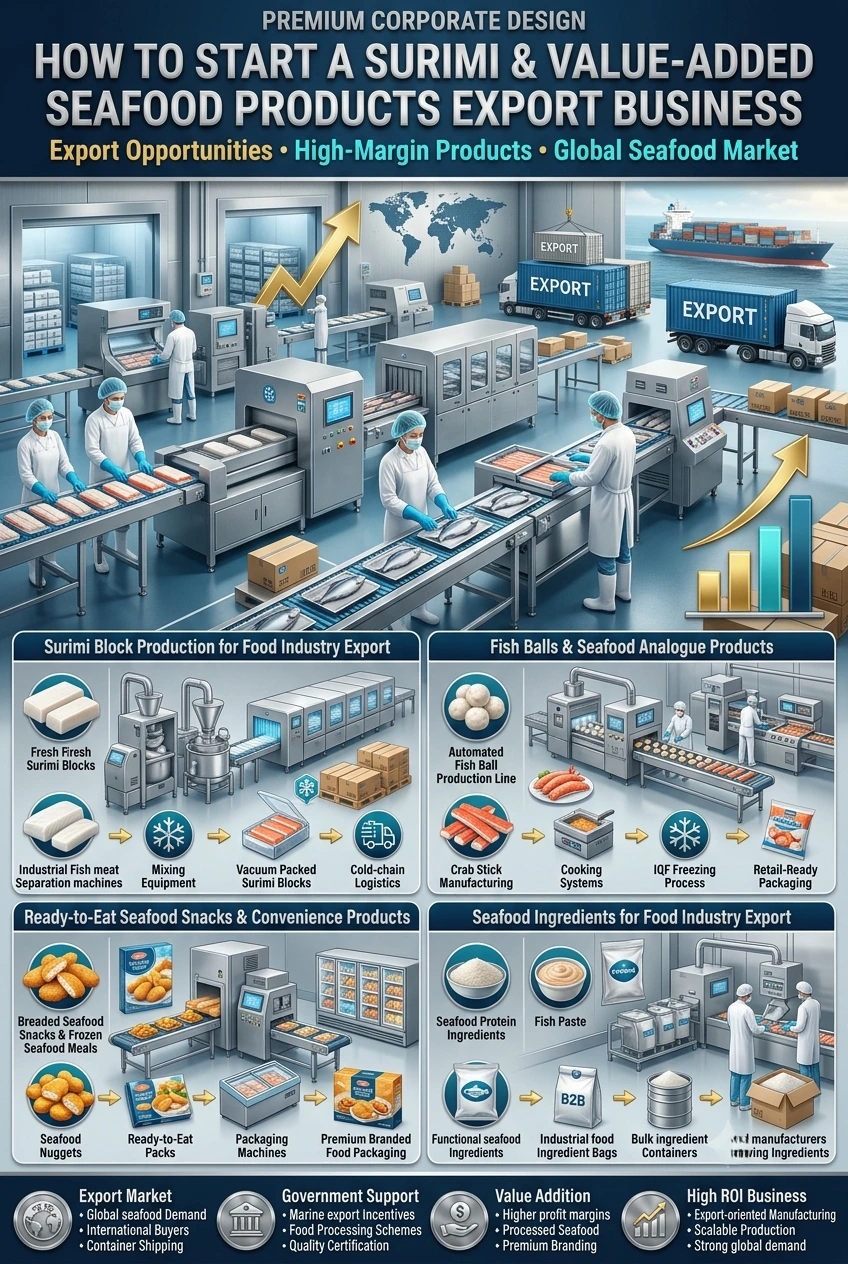
3. Ready-to-Eat Seafood Snacks and Convenience Products
Battered and breaded seafood snacks, seafood crackers, dried seafood snacks and seafood appetiser marinate are fast emerging export segments targeting retail consumer markets in the Gulf, UK and US. We create products by combining seafood raw materials, flavouring, processing, and packaging innovations to develop branded and private-label convenience products. The investment required for setting up a seafood snack manufacturing unit ranges from ₹60 lakh to ₹2 crore. Seafood Snacking is a high-volume opportunity for the Indian processors who comply to BRC Food Safety Standards for procurement by UK’s supermarket own brands. New demand for innovative seafood snack products in the Gulf as a result of the increasing snack culture.
4. Seafood Ingredients for Food Industry Export
Seafood food ingredients such as fish protein hydrolysates, fish collagen peptides, seafood flavour concentrates and tuna extract for bouillon and seasoning manufacturing are a high-value, B2B export segment with worldwide food ingredient manufacturers as their target. These products involve using seafood by-products that are either frames, heads, skin, or offal, but which would otherwise be waste, thus providing extra revenue from a material that processors already have. The investment cost of a seafood ingredient extraction unit is in between ₹80 lakh and ₹2.5 crore comprising the enzymatic hydrolysis reactors, spray drying and analytical testing. The main importers are Japanese, Korean and European food ingredient manufacturers.
Related Article: How to Start a Fish Farming Business in India
Import-Export Opportunity Analysis
Surimi and value-added seafood export from India is a growing but still underdeveloped category relative to India’s raw material advantage. The MPEDA export data shows value-added seafood products growing as a percentage of total seafood export value — a trend driven by MPEDA’s active promotion of value addition and the global seafood trade’s shift toward processed convenience products.
Japan’s surimi import market—the world’s largest—is actively seeking to diversify its supply sources. The country aims to reduce its traditional dependence on North Pacific pollock surimi from the US and Russia. Thanks to the unique protein properties of its tropical fish resources, surimi manufactured in India has a distinct functional profile. This profile may interest food formulators seeking greater versatility in their imitation seafood product lines. Surimi manufacturers in India supplying high-quality, reliable Japanese Tobisho (Special Grade) or Grade A surimi are targeting a high-value market. This market is willing to pay a premium for quality rather than prioritize price consistency.
Indian MSME Success Stories
To overcome some of the capacity challenges the Indian surimi sector faces, in September KIAL (Kerala Industrial and Technical Consultancy Organisation) and MPEDA joined together to set up surimi processing capacity in Kerala.
The KIAL project in Kerala shows that Indian institutions are already developing the surimi expertise and capacity needed to advance the industry. Several Kerala fish processors have established pilot surimi production units. These units were developed with Japanese technical assistance through MPEDA’s Indo-Japan fisheries cooperation programmes.
Sea Shells Food Products is a Tamil Nadu-based seafood company. It built a significant export business for fish balls and seafood analogues by investing in HACCP-certified production facilities. The company also developed recipe-specific product formulations for buyers in Malaysia and Singapore. This demonstrates that Indian value-added seafood manufacturers can access premium food service procurement opportunities in Southeast Asian markets.
Several Andhra Pradesh-based fish processing companies have built value-added seafood export businesses worth ₹10 crore to ₹30 crore. They supply breaded fish products and fish fingers to European retailers. They achieved EU Approved Establishment status and BRC food safety certification. This demonstrated that Indian processors can meet the highest international standards for convenience seafood products.
Build a profitable business with the right idea
How NPCS Supports Surimi and Value-Added Seafood Business Planning
We at Niir Project Consultancy Services (NPCS) provide professional consulting for the preparation of Market Survey cum Detailed Techno-Economic Feasibility Reports (DPRs) for setting up new marine products and seafood businesses. Our reports include detailed processing technology, market research and demand analysis, regulatory compliance roadmap, plant layout and equipment specifications, and complete project financials with profitability analysis. Our objective is to help entrepreneurs evaluate feasibility, profitability, and long-term scalability before investing.
Surimi and Value-Added Seafood: Key Data Overview
| Product Category | Investment Range | Key Certification | Target Markets | Typical Margin |
| Surimi Blocks (Food Grade) | ₹2 Cr – ₹6 Cr | HACCP + EIC + Japan Spec | Japan, Korea, SE Asia | 20–35% |
| Fish Balls and Analogues | ₹1.5 Cr – ₹4 Cr | HACCP + Halal + EIC | SE Asia, Gulf, EU | 28–45% |
| Seafood Snacks (Breaded/Battered) | ₹60L – ₹2 Cr | BRC + HACCP + EIC | UK, EU, Gulf | 35–55% |
| Seafood Ingredients | ₹80L – ₹2.5 Cr | HACCP + ISO 22000 | Japan, EU, US food industry | 40–65% |
| Seafood Ready Meals | ₹1 Cr – ₹3 Cr | BRC + HACCP | UK, EU, Gulf | 35–55% |
Frequently Asked Questions (FAQ)
1. What fish species are used for surimi production in India?
Main species processed in India for surimi: Lizardfish (Saurida species), Threadfin Bream (Nemipterus species), Big-eye Snapper, croakers. The characteristic feature of these species are high moisture content, white flesh and high level of gel-forming protein. The Indian domestic market classifies all of these as “low-value trash fish,” making them a cost-effective raw material source for the surimi industry.
2. What is gel strength in surimi and why is it important?
Gel Strength (Grams Force × Centimeters – gcm): Gel strength measures the ability of surimi protein to form an elastic gel when heated. High gel strength protein generally produces a higher quality imitation seafood. The Japanese buy suirimi and specify a certain gel strength on orders depending on the grade of fish – the value range of from 400 gcm to over 1000 gcm. On-board crews preserve fish quality by chilling the fish extremely rapidly, minimizing handling to prevent damage, and maintaining the correct processing temperatures.
3. What cryoprotectants are added to surimi?
Manufacturers add cryoprotectants—typically a combination of sucrose (4–8%), sorbitol (4–8%), and sodium tripolyphosphate (0.2–0.3%)—to surimi before block freezing to prevent protein denaturation during frozen storage. The cryoprotectant blend must meet buyer specifications — some Japanese buyers specify reduced sugar content for health-positioning. Food-grade cryoprotectants meeting CODEX standards are available from domestic chemical suppliers.
4. What is the minimum processing capacity for viable surimi production?
Usually, it takes between 5 and 10 tons of raw fish per day to make economically sound surimi (around 1-2 tons per day per processing line with 5-10% surimi in raw fish) . Smaller sizes will have a hard time making up for the depreciation of surimi processing and quality related equipment. The raw material supply seasonal aspects need also be accounted for.
5. How do I find Japanese buyers for Indian surimi?
MPEDA connects Indian surimi producers with Japanese buyers through its Japan Country Office. It also promotes Indian surimi by exhibiting at the Japan International Seafood Show in Tokyo. Japanese trading companies (sogo shosha) are the largest buyers of Indian surimi in the Japanese market. These companies play a major role in seafood procurement. Over the past few years, MPEDA’s Indo-Japan fisheries cooperation framework has helped introduce Indian processors to many Japanese buyers.
6. Can seafood snacks be exported through e-commerce channels?
Yes. Businesses can export packaged seafood snacks with a shelf life of 12–24 months to consumers in the US and UK through e-commerce channels such as Amazon Global Selling. Food businesses must complete FDA food facility registration for the US market and notify the relevant EU food business operator authority for European markets. Shelf-stable packaging (retort pouches, vacuum packs) and compliant nutritional labelling in destination language are the key e-commerce export requirements.
Conclusion
Surimi and value-added seafood products manufacturing is one of India’s most technically ambitious and commercially differentiated marine business opportunities. It moves beyond commodity raw material exports by producing proprietary processed products for global food manufacturers and food service industries. These products command premium prices and meet precise quality specifications.
MPEDA actively promotes surimi production and provides technical support through Japanese industry partnerships. The EPCG scheme reduces capital equipment costs by offering duty savings. In addition, India’s abundant supply of low-value fish provides a strong raw material base. Together, these factors create a favourable environment for entrepreneurs willing to invest in advanced processing capabilities.
Businesses established through this investment can produce surimi, fish balls, seafood snacks, and marine food ingredients. These products serve global food industries with high-quality, value-added offerings. India uniquely delivers quality, scale, and competitive pricing.