

Tripura rarely makes the first shortlist of a new manufacturer. However, founders usually start in Gujarat, Tamil Nadu or the NCR belt. Moreover, this habit is costly. At the same time, Tripura is India’s second-largest natural rubber producer, one of its richest bamboo states and home to a GI-tagged pineapple. Yet, most of this raw material exits the state unprocessed. Therefore, for entrepreneurs seeking practical business ideas that enjoy government support, the gap between resource and processing is where the money lies.
The state has two signals that improve the timing for private processors and suppliers. First, Tripura Small Industries Corporation Limited (TSICL) has now launched a dedicated project cell, TSIC DESK, and is empanelling agencies to prepare detailed project reports (DPRs) across 22 sectors. Second, Tripura Industrial Development Corporation (TIDC) already has developed industrial land, sheds and specialised parks for rubber, food, bamboo and export units. Therefore, When a state builds both a project pipeline and ready infrastructure, private processors and suppliers usually accompany.
In addition, this guide covers every one of those 22 sectors. Specifically, it reads Tripura the way a feasibility consultant would, considering raw material depth, market access, incentives and risk. Then, on a sector-by-sector basis, it lists projects that suit first-generation founders and MSME investors.
Why Tripura Deserves a Serious Look
A Resource Base That Still Leaves the State Raw
Rubber is the clearest example. Tripura has roughly 1.1 lakh hectares under rubber and produces about 1.1 lakh MT of natural rubber every year, according to Rubber Board officials. However, the same officials admit that less than 4% of this output is value-added within the state. About 96% of natural rubber exports as sheets or latex. Put simply, a grower sells sheet rubber to a factory in Kerala or Punjab, and hoses, soles and rubber bands later return to shops in Agartala. Every freight leg in that loop is a margin a local processor could keep.
Bamboo tells a similar story. Tripura hosts 21 of India’s bamboo species. According to Tripura’s bamboo sector profile and the work of the Tripura Bamboo Mission, the state meets about 60% of India’s requirement of bamboo sticks for agarbatti making. Even so, most bamboo still moves as round sticks, splits and handicrafts rather than engineered products.
Horticulture adds a third layer. Tripura grows pineapple on nearly 11,862 hectares with output close to 1.74 lakh MT. Its Queen variety is GI-tagged and has reached buyers in Dubai, Oman and Qatar. Meanwhile, agarwood, the tree that gave Agartala its name, is emerging as a high-value forest product under a regulated export regime.
Table 1: Tripura’s Core Resource Base at a Glance
| Resource | Key Data Point | Value-Added Direction |
| Natural rubber | About 1.1 lakh ha; about 1.1 lakh MT a year; under 4% processed locally | Moulded goods, hoses, soles, tread rubber, latex products |
| Bamboo | 21 species; about 60% of India’s agarbatti stick requirement | Machine-made sticks, engineered boards, charcoal, pellets |
| Pineapple | About 11,862 ha; about 1.74 lakh MT a year; Queen variety GI-tagged | Juice, pulp, canned slices, dehydrated snacks |
| Agarwood | Regional CITES quota of 1,51,080 kg chips and 7,050 kg oil | Agar oil distillation, graded chips |
| Location | Chattogram port about 80 km from Sabroom | Cold chain, warehousing, border-linked trade |
Ready Industrial Land Through TIDC
Land is where most North-East projects lose their first year. Therefore, TIDC reduces that risk. As TIDC’s industrial infrastructure page on Bodhjungnagar, R.K. Nagar and district estates explains, the Bodhjungnagar Industrial Complex in West Tripura has a total extent of about 535.73 acres and houses a Growth Centre, a Rubber Park, a Food Park and an Export Promotion Industrial Park. Similarly, next door, the R.K. Nagar Industrial Area has a total extent of about 226.16 acres and houses a Bamboo Park. Meanwhile, smaller integrated infrastructure development centres at places such as Tulakona, Santirbazar and Nagichhera extend the network into the districts.
The complex is about 12 km from Agartala. Furthermore, according to the state Industries Department, it has a natural gas supply network, power from a 132 kV substation and an iron-free water supply. Moreover, TIDC also plays a financing role, since state financial corporation provisions extend to it. In addition, an Asian Development Bank-supported programme is upgrading industrial estates across the state. As a result, for a founder, plug-and-play plots can cut months off the project schedule.
A State Building Its Own Project Pipeline
The TSIC DESK deserves attention from private investors, not just consultants. Under this model, a government department refers its project to TSICL and an empanelled agency prepares the DPR. Next, TSICL’s engineering division vets it against approved norms and the state’s Schedule of Rates, and a national institution may do a techno-economic review. In short, Tripura is professionalising how it plans public projects.
That matters because every approved project needs suppliers. Skill centres need equipment. Water projects need pipes. Hospitals, consumables. The sector list in the TSICL Expression of Interest, set out in its TECH-1 sector declaration, therefore works as a ready demand map. The sections below utilise that list to organise the business ideas.
Government Policies That Support Tripura Business Ideas
Tripura layers state incentives atop central schemes designed for the North-East. Used well, this stack reduces the capital burden sharply. Used carelessly, it becomes a paperwork trap. Here is how the main schemes fit together.
TIIPIS: The State’s Core Incentive Scheme
The Tripura Industrial Investment Promotion Incentive Scheme (TIIPIS) is the starting point. The state scheme details published by the Industries and Commerce Department set out the main benefits. These include a capital investment subsidy of about 30% of fixed capital for general units and about 40% for thrust-sector units, subject to ceilings. Units get an industrial promotion subsidy that reimburses the net GST actually paid, partial reimbursement for interest on term loans (4% for general and 5% for thrust units) and an export promotion subsidy of 10% on goods exported to Bangladesh through the state’s land customs stations.
The thrust tag is where the advantage lies. Thrust-sector units are those that use bamboo, rubber or agricultural and horticultural produce as their main raw material, and tea manufacturing is included. Consequently, a pineapple juice plant or rubber hose unit earns better treatment than a generic assembly business. Always confirm current rates and caps with the Directorate of Industries and Commerce before you freeze the project cost.
UNNATI: The Central Scheme for the North-East
At the national level, the Union Cabinet’s approval of the UNNATI scheme for the North-Eastern Region created a ten-year framework that DPIIT runs with the states. It offers a capital investment incentive, interest subvention on term loans and a manufacturing and services-linked incentive. Districts fall into Zone A (industrially advanced) and Zone B (industrially backward), and Zone B units get richer support. For micro industries, the construction of buildings can also count towards the capital investment incentive base.
One caution applies. UNNATI registration has run on fixed windows, and units must start production within set timelines. Therefore, check the current application status on the DPIIT portal before you build UNNATI benefits into a bank projection. A DPR that counts on an incentive the unit cannot register for will not survive appraisal.
PMFME for Micro Food Processors
The PM Formalisation of Micro Food Processing Enterprises (PMFME) scheme offers a 35% capital subsidy to eligible micro food units, credit-linked support for branding, common infrastructure and training. A Parliament reply on PMFME and ODOP implementation in the North-East notes that North-Eastern states share scheme costs with the Centre in a 90:10 ratio. It adds that One District One Product (ODOP) items get preference during implementation. As a result, a pineapple or spice unit in an ODOP district stands closer to the front of the queue.
Tripura Start-Up Policy for Innovation-Led Ventures
Founders with a genuinely new product or process can use the Tripura Start-Up Policy notified by the state’s Directorate of IT. Recognised start-ups can receive a Tri-Seed grant of ₹2 lakh, monthly operating cost reimbursement for up to a year, prototype assistance of up to ₹10 lakh, marketing support and patent filing reimbursement. The policy is sector-agnostic. A bamboo composite, agritech or healthtech venture can qualify, not just an IT firm.
Other Support Worth Stacking
Beyond these, PMEGP offers higher margin money subsidy rates in the North-East, and the state’s Swabalamban scheme supports self-employment ventures. CGTMSE backs collateral-free loans, the National Bamboo Mission funds bamboo processing, and the Rubber Board supports growers and processors. Stacking rules differ, so a unit usually cannot claim two capital subsidies on the same asset. Plan the combination early.
One practical view from the feasibility desk is to treat incentives as a cushion, not the business case. Most North-East incentives are reimbursed after production begins, and disbursals can lag. A unit that survives only on subsidy tends to struggle at the first delay. The best Tripura projects work on raw material cost and freight logic first. Subsidies then add a good return to an excellent one.
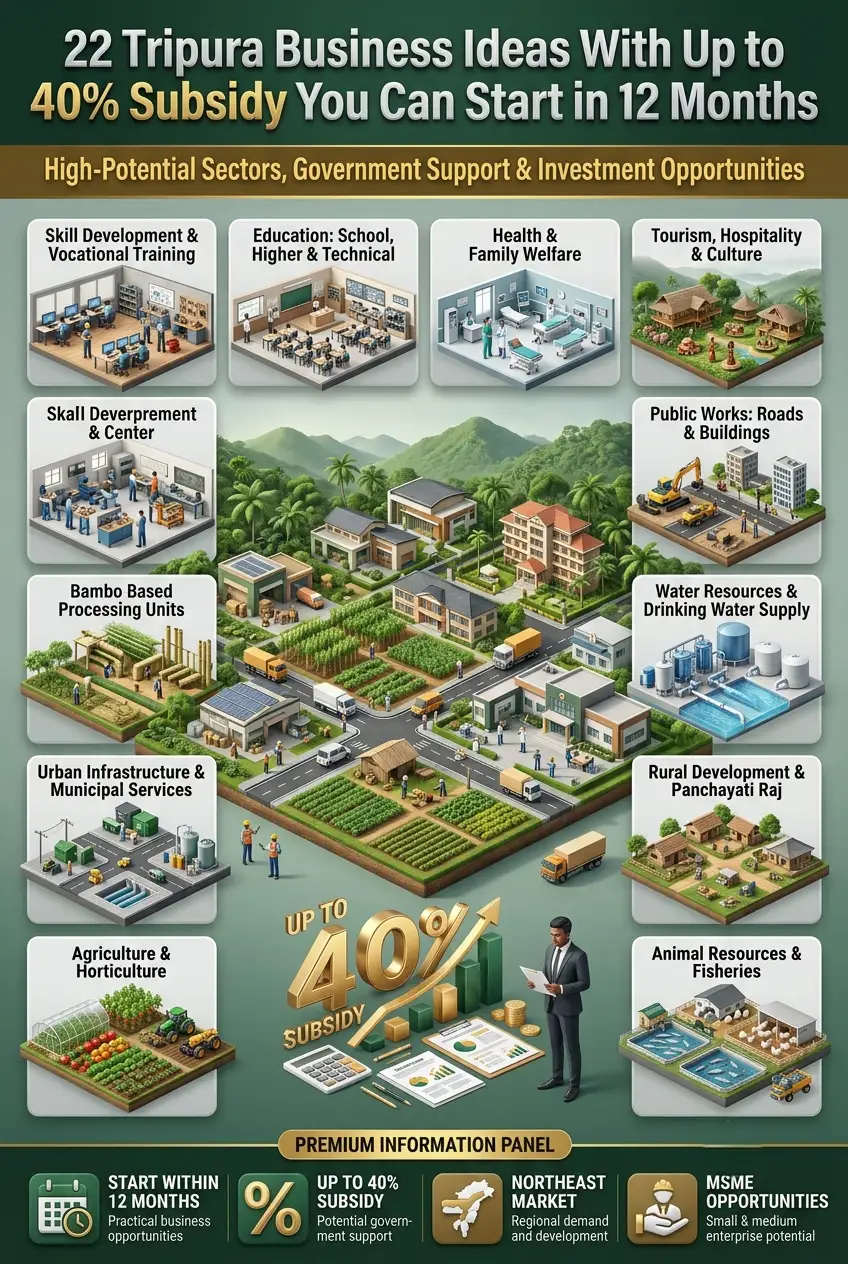
Business Ideas Across All 22 Sectors in Tripura
The 22 sectors below follow the order of TSICL’s sector declaration. For each one, the question is simple: what will the state and its people keep buying, and what can a Tripura-based unit supply better than an outside vendor? Some sectors lean towards manufacturing, others towards services. Together, they cover almost every realistic entry into the state’s economy.
1. Skill Development and Vocational Training
Skill gaps are Tripura’s constraint. Investors often say machines are easy to buy, but trained operators are hard to find. This creates room for private training-cum-production centres that train in rubber compounding, food safety, bamboo machine operation, electrical wiring or solar installation and then place trainees with local units. The state is also developing a Tool Room and Training Centre in the Bodhjungnagar area.
The best model links training with paid work. A centre that runs a small production line such as garment stitching or bamboo stick finishing earns revenue while trainees learn. Additionally, suppliers of training equipment, lab kits, safety gear and trainee uniforms find repeat demand every time a new skill project is sanctioned.
2. Education: School, Higher and Technical
Schools and colleges buy furniture, notebooks, uniforms, lab equipment in large, repeat volumes. A local unit making desks and benches from steel, engineered wood or treated bamboo can serve both government and private institutions across the state. Exercise book manufacturing, school bag stitching and uniform tailoring are similar repeat-demand businesses with modest technology needs.
On the digital side, the state has already boosted a local edtech start-up through its venture fund. Learning content in Kokborok and Bengali, test-preparation platforms and smart-classroom installation are underserved. For technical education, suppliers of workshop tools and training rigs can partner with ITIs and polytechnics.
3. Health and Family Welfare
Hospitals and health centres consume gloves, cotton, gauze, bandages, linen and disposables every day. Most of it comes from other states. Tripura’s rubber base makes latex examination gloves an obvious long-term project, although it requires strict quality systems and certification. Easier entry points include absorbent cotton and gauze, surgical dressings, hospital linen, disposable underpads and sanitary napkins.
Services offer another route. Diagnostic labs, medical equipment maintenance, biomedical waste handling and pharmacy distribution all expand as public health infrastructure grows. Herbal and Ayurvedic products from local medicinal plants add a manufacturing angle, provided founders meet AYUSH licensing norms.
4. Tourism, Hospitality and Culture
Tripura has a strong heritage base, from Ujjayanta Palace in Agartala and the lake palace of Neermahal to the rock carvings at Unakoti and the Tripura Sundari temple at Udaipur. However, quality stays, guided circuits and packaged experiences are limited. Eco-resorts and homestays built with treated bamboo, heritage tours and tribal cuisine restaurants all fit this.
Tourism also drives manufacturing. Souvenir crafts, cane and bamboo furniture for resorts, branded pineapple and tea gift packs, and textiles based on local motifs sell best where visitors gather. Build around a circuit rather than a single property, because tourists here usually plan multi-stop trips.
5. Public Works: Roads and Buildings
This is one of the largest procurement pools in any state. Road and building projects need paver blocks, kerb stones, precast drains, hollow blocks, AAC blocks, GCI sheets, TMT bars, doors and windows. Much of this comes from Assam or West Bengal, which adds freight to heavy, low-value goods. This is where local production wins.
The state Industries Department notes that many existing Tripura units already supply government needs such as spun pipes, PCC poles, steel tubular poles, TMT bars and GCI sheets. New founders can follow that pattern. Register on the state e-procurement portal, meet BIS standards where they apply and build a record of on-time delivery. Contractors value reliability more than a small price gap.
6. Water Resources and Drinking Water Supply
Every drinking water scheme needs pipes, fittings, valves, meters, storage tanks and treatment chemicals. PVC and HDPE pipe extrusion, alum manufacturing, bleaching powder packing and water tank moulding all serve. Because groundwater in many parts of the state carries high iron, fabrication of iron removal plants and filter media has also steady market.
Service businesses fit in here. Operation and maintenance contracts for rural water schemes, water testing labs and pump repair networks become essential once assets are built. Meanwhile, BIS-certified packaged drinking water plants can serve towns, tourist spots and offices.
7. Urban Infrastructure and Municipal Services
Agartala and the district towns are growing, and urban bodies need answers for waste, lighting, drainage and mobility. A compost plant using market and household organic waste, a plastic recycling unit making granules or pavers, and an LED street light assembly unit are practical options. Each links to steady municipal contracts.
Other ideas include body building for garbage tippers and small municipal vehicles, dustbin moulding and rooftop rainwater harvesting installation. Since urban bodies often pay on project milestones, keep working capital buffers generous in your DPR.
8. Rural Development and Panchayati Raj
Rural housing, rural roads and village infrastructure create demand for low-cost building materials. Compressed stabilised earth blocks, bamboo-reinforced wall panels, roofing sheets and precast toilet components suit this market. They use local materials and limited machinery.
Rural livelihood programmes also create aggregation businesses. A private unit can buy, grade, pack and brand products made by self-help groups, such as pickles, spices, bamboo crafts and handloom items, and sell them through e-commerce and retail chains. This model works because SHGs can produce well but often struggle to market.
9. Agriculture and Horticulture
Tripura’s pineapple harvest arrives in a concentrated season. A processing unit smooths the curve. Options include juice and concentrate, canned slices, pulp for beverage makers, dehydrated pineapple, jams and ready-to-serve drinks. Jackfruit, orange and litchi can stretch the season, while ginger, turmeric and bird’s eye chilli from low-input hill farms support spice drying, grinding and organic packing.
TIDC’s food processing investment brief highlights the state’s agro-climate, largely organic produce and ready food parks. It also points out a 40% capital investment subsidy and partial reimbursement for power charges for food units. Furthermore, the state is evaluating a PPP fruit processing facility in Dhalai district. For a private founder, the smart approach is to lock in supply through FPO tie-ups and invest in a pulping line that handles more than one fruit.
10. Animal Resource Development and Fisheries
Fish is a daily staple in Tripura, and demand regularly outruns local supply. As inland aquaculture expands, feed demand grows. A floating fish feed mill fills an obvious gap, because much of the feed already comes from outside the region and entails a freight penalty. Locally available rice bran, maize and oil cakes cut input costs further. Poultry and cattle feed follow the same logic.
Downstream, fish processing, frozen packs and traditional dry fish such as sidol serve both local and migrant markets. Dairy is another proven route, and a private dairy foods unit already operates in the Bodhjungnagar complex. Meat processing with proper cold chain and hygiene is also worth studying. A feed mill is the lower-risk entry, while processing works better once the founder understands procurement and seasonality.
11. Forest, Environment and Climate Change
Agarwood leads the sector. Trade is regulated under CITES, but the framework has eased. A Lok Sabha reply notes that regional export quotas have risen to 1,51,080 kg for chips and 7,050 kg for oil, and export applications are now processed on the DGFT portal. A distillation unit for agar oil, paired with a chip grading line, can serve Gulf perfume houses and Indian fragrance makers. Buy only from registered plantations with valid certificates of origin, and document every lot.
Bamboo waste offers a second opportunity. Charcoal, activated carbon and biomass pellets turn offcuts, nodes and shavings into income. They work best as satellites to larger bamboo units. Broom grass processing and other non-timber forest products add further options. However, emission control needs attention from the start.
12. Industries, Commerce and MSME
This is where Tripura’s rubber story turns into factories. For example, the Tripura Industrial Rubber Park at Bodhjungnagar offers developed one-acre plots and common infrastructure for businesses ranging from tyre retreading and coated fabrics to surgical gloves, conveyor belts and latex foam. In addition, simpler starting products include rubber bands, hoses, footwear soles, mats and moulded auto parts.
Therefore, start with a narrow line where compounding matters but machinery stays simple. Then, build supply agreements with Rubber Producers’ Societies and test every batch. Once stable, grow into technical goods once your recipes are stable. Meanwhile, beyond rubber, corrugated packaging for pineapple, tea and food exporters is a quiet but steady business, and the natural gas network at Bodhjungnagar supports gas-fired drying and heating processes.
13. Handloom, Handicrafts, Sericulture and Bamboo
Tripura already supplies most of India’s agarbatti bamboo sticks, yet much of the work still runs on manual splitting and uneven quality. Therefore, a semi-automatic or automatic stick plant produces uniform round sticks that large incense brands prefer. Furthermore, engineered bamboo goes further: strand-woven boards, laminated panels, flooring and bamboo ply compete with hardwood and MDF. In addition, the Bamboo Park at R.K. Nagar is designed to provide common facilities such as raw material depots, splitting, treatment and drying.
Similarly, handloom deserves equal attention. Traditional weaves such as the risa carry strong identity value and suit premium fashion and home furnishing markets. Therefore, a finishing, design and packaging unit that works with weaver clusters can capture much of that value. Moreover, TIDC has also earmarked land for a textile park at R.K. Nagar. Additionally, sericulture adds silk reeling and spun silk yarn as smaller, specialised options….
14. Information Technology and Digital Governance
Agartala has an established IT park building managed by the Directorate of IT which provides office space to IT and ITeS founders without long leases. Additionally, opportunities include back-office and data for e-governance, GIS mapping of land and forest records, mobile app development, cybersecurity services and drone-based surveying for infrastructure departments.
Furthermore, digital governance projects require local partners who understand both the technological and lingual landscape. Moreover, the Start-Up Policy’s seed grants and operating cost reimbursement makes this one of the cheapest entry points in the state.
15. Power and Renewable Energy
Tripura generates much of its electricity from natural gas, but at the same time, distributed solar is the growth story for small businesses. For example, rooftop solar installation under national household schemes, solar pumps for farmers, and solar street light assembly all have steady demand. In addition, manufacturing options include cables and conductors, PCC poles, electrical panels and distribution boxes.
Moreover, biomass pellets from bamboo and agro-waste can also supply industrial boilers. On the service side, energy audits and O&M contracts for public solar assets are underserved. Therefore, the secret to success here is certification and after-sales service, not just installation speed.
16. Transport and Logistics
17. Social Welfare, Tribal Welfare and Minorities
Welfare programmes purchase supplementary nutrition, assistive devices and livelihood kits in large volumes. A food unit making fortified blended foods or energy-dense take-home rations for nutrition programmes can build a stable order book, albeit with FSSAI compliance and tender discipline. Assistive devices such as wheelchairs, walkers and crutches are another option.
Tribal livelihood value chains have a market-facing entry point. A processing and branding unit for forest produce, tribal textiles and traditional foods can connect with producer groups with urban buyers. Sanitary napkin units run by women’s groups combine social impact with steady institutional demand.
18. Labour, Employment and Livelihoods
Employment programmes promote labour-intensive units. Garment stitching for uniforms, rubber-sole footwear assembly, bamboo craft production and food packing generate many jobs per unit of capital, which is vital as job creation often improves access to state support and bank goodwill.
Service ideas include manpower placement agencies, contract manufacturing for outside brands and common facility centres run for artisan clusters. Founders can utilise PMEGP or the state’s Swabalamban scheme for the smallest units, graduating to TIIPIS-backed expansions at a later date.
19. Food, Civil Supplies and Co-operation
Public distribution and co-operative networks purchase rice, flour, pulses and edible oil in bulk. Additionally, modern rice milling, fortified rice kernel production, roller flour milling and pulses processing serve an existing demand. Furthermore, scientific warehousing for food grains is a related service with long-term contracts.
Moreover, there is also a retail opening. Indian port restrictions have prevented several Bangladeshi processed foods, bakery items, juices and confectionery from entering through North-East land ports, leaving a shelf gap. As a result, a Tripura brand of bakery products, namkeen or fruit drinks that reaches kirana stores across the state and nearby markets can build volume without fighting national giants head-on.
20. Public Safety, Prisons, Fire and Disaster Management
Tripura faces floods and landslides in heavy monsoons, so disaster preparedness is a real budget line. Therefore, relief kits, tarpaulins, collapsible bamboo shelters, life jackets and water purification products are recurring purchases. Additionally, fire extinguisher manufacturing, refilling and fire safety installation serve both government buildings and private factories.
Similarly, security-linked services are also in demand, including CCTV installation, reflective safety gear and uniforms for police and fire services. Moreover, service contracts often provide steadier cash flow than one-off supply orders for a small founder.
21. Science, Technology and Innovation
Every export ambition in Tripura faces testing. For example, Food, spice, rubber and water testing labs with accreditation are rare, forcing exporters to send samples out of state on a regular basis. Therefore, a private testing laboratory can, therefore, serve food processors, rubber units and public agencies at once.
Furthermore, research-led ventures have room to flourish. For instance, Agarwood inoculation techniques, bamboo composites and natural fibre products require applied R&D. Moreover, Tie-ups with NIT Agartala and incubation support under the state’s innovation network can reduce early costs, and the Start-Up Policy can aid with prototypes and patents.
22. Sports, Youth Affairs and Community Facilities
Import–Export Opportunity Analysis for Tripura Startups
The Chittagong Advantage
Geography provides Tripura with an ace few other North-Eastern states possess. The PIB release on the inauguration of Maitri Setu between Sabroom and Bangladesh announced that Chattogram port is about 80 km from Sabroom. For decades, freight into the North-East has taken the long Siliguri corridor. A working Chattogram link could reduce transit time and cost for bulk inputs and outbound goods. The state’s 10% export promotion subsidy on goods sent to Bangladesh adds a further incentive.
Why Border Trade Needs a Plan B
However, a consultant must be honest. Cross-border trade with Bangladesh has turned volatile. India has imposed port restrictions on several Bangladeshi goods entering through North-East land ports. Meanwhile, trade bodies in Tripura have reported Bangladeshi curbs on rubber-based products and tea moving through the state’s border points. A founder should not build a plant whose viability depends on a single border route.
The practical answer is a two-track approach. First, design the business around domestic North-East demand and import substitution, where demand is steady and freight works in your favour. Second, treat exports as upside, routed through Kolkata or other established ports until regional corridors settle.
Export Products With Proven Traction
A few products have proven traction towards export. Queen pineapples have reached Dubai, Oman and Qatar. Agarwood chips and oil sell into Gulf perfumery under CITES quotas. Tripura’s rubber sheet has also found buyers in Nepal, where a footwear maker in Biratnagar imported a consignment. Similarly, bamboo handicrafts and engineered bamboo draw interest from buyers seeking sustainable materials. On the import side, processing machinery often comes from China, Taiwan or Europe, so factor duty, lead time and after-sales service into the project schedule.
Indian MSME Success Stories Worth Studying
None of India’s big manufacturing names began big. Three stories are worth examining as they relate to Tripura’s resource base.
MRF: K.M. Mammen Mappillai’s Climb Up the Rubber Value Chain
MRF began as a small toy balloon unit in a shed in Madras, founded by K.M. Mammen Mappillai. He noticed that foreign suppliers dominated tread rubber for tyre retreading, so he moved into that product and built a reputation. That success later funded the leap into tyres, and MRF grew into one of India’s leading tyre makers. The decision logic was clear: start with a low-complexity rubber product, master compounding, and climb only after earning cash and credibility. For a Tripura founder with a plot in the Rubber Park, this sequence remains the safest path.
Cycle Pure Agarbathies: N. Ranga Rao’s Brand Built on Consistency
Ranga Rao began making incense sticks in Mysuru from a modest home-based setup. Over the decades, the family built Cycle Pure Agarbathies into one of India’s most recognised incense brands, now led by the third generation under Arjun Ranga. The model rested on consistent fragrance quality, deep distribution and brand trust. Tripura already controls the raw material end of this very industry. Stick suppliers who deliver uniform quality at scale become valued partners of such brands, and some may later launch finished-product labels of their own.
Balaji Wafers: Chandubhai Virani’s Regional Playbook
Chandubhai Virani and his brothers once ran a cinema canteen in Rajkot, selling potato wafers bought from outside suppliers. Frustrated by unreliable supply, they began frying wafers themselves and later built a semi-automated plant. Balaji Wafers then grew into a dominant snack brand in western India by keeping prices sharp and distribution dense within a focused region. The lesson is to control production and win one region deeply before expanding. A Tripura food brand built on pineapple snacks, namkeen or regional flavours can follow the same playbook across the North-East.
How NPCS Helps Founders Plan Tripura Projects
Tripura rewards those who plan carefully. Raw material seasonality, freight routes, plot availability, incentive eligibility and border risks all affect the numbers. We at Niir Project Consultancy Services (NPCS) provide professional consulting for the preparation of Market Survey cum Detailed Techno-Economic Feasibility Reports (DPRs) for setting up new industries or businesses. Our reports include detailed manufacturing processes, market research and demand analysis, process flow diagrams, product mix and capacity planning, machinery and raw material details, and complete project financials with profitability analysis. Our objective is to help entrepreneurs evaluate feasibility, profitability, and long-term scalability before investing.
As bamboo sits at the centre of so many Tripura opportunities, NPCS has published a comprehensive printed reference book on bamboo, covering species, plantation, preservation, processing technology and industrial uses in depth. The printed book: Bamboo Plantation and Utilization Handbook.
For a detailed techno-economic Project Report on setting up one of the state’s most direct bamboo-based manufacturing businesses, including plant economics, machinery lists, financial projections and applicable government incentives, see the NPCS Project Report: Bamboo Sticks – Manufacturing Plant, Detailed Project Report, Profile, Business Plan.
All 22 Sectors at a Glance: Quick Reference Table
The table below condenses the sector analysis into a single screen. Use it to shortlist, then test your shortlist through a proper feasibility study.
Table 2: Tripura Business Ideas by TSICL Sector
| TSICL Sector (TECH-1) | Top Business Ideas | Main Demand Driver |
| 1. Skill Development | Training-cum-production centres, training equipment | Skill projects, local factories |
| 2. Education | School furniture, notebooks, uniforms, edtech | Schools, colleges, ITIs |
| 3. Health | Latex gloves, cotton and gauze, diagnostic labs | Hospitals, health centres |
| 4. Tourism and Culture | Bamboo eco-resorts, homestays, souvenirs | Heritage and religious circuits |
| 5. Public Works | Paver blocks, precast items, GCI sheets, TMT | Roads and buildings |
| 6. Water Supply | PVC/HDPE pipes, alum, iron removal plants | Drinking water schemes |
| 7. Urban Infrastructure | Compost, plastic recycling, LED street lights | Municipal bodies |
| 8. Rural Development | Earth blocks, bamboo panels, SHG aggregation | Rural housing, livelihoods |
| 9. Agriculture and Horticulture | Pineapple processing, spice packing | Farm surplus, food parks |
| 10. Animal Resources and Fisheries | Fish feed, fish processing, dairy | Aquaculture, local diets |
| 11. Forest and Environment | Agar oil, bamboo charcoal, pellets | Export quotas, bamboo waste |
| 12. Industries and MSME | Rubber products, packaging | Rubber Park, raw rubber supply |
| 13. Handloom, Handicrafts, Bamboo | Agarbatti sticks, engineered bamboo, handloom finishing | Bamboo Park, weaver clusters |
| 14. IT and Digital Governance | E-governance services, GIS, app development | IT park, state digital projects |
| 15. Power and Renewables | Rooftop solar, cables, PCC poles | Solar schemes, power works |
| 16. Transport and Logistics | Cold chain, warehousing, tyre retreading | Perishables, border corridor |
| 17. Social and Tribal Welfare | Nutrition foods, assistive devices, tribal products | Welfare programmes |
| 18. Labour and Livelihoods | Garment units, footwear assembly, placement | Employment schemes |
| 19. Food and Civil Supplies | Rice milling, fortified rice kernels, bakery | Public distribution, import gap |
| 20. Public Safety and Disaster | Fire safety, relief kits, life jackets | Floods, building safety |
| 21. Science and Innovation | Testing labs, agarwood and bamboo R&D | Export quality needs |
| 22. Sports and Youth | Rubber sports flooring, mats, gym equipment | Sports infrastructure |
Conclusion
Tripura’s case isn’t built on hype. Instead, it rests on hard resources: rubber that leaves the state raw, bamboo that ships out as sticks, and fruit that loses value every season. Moreover, a layered incentive system backs it. Likewise, so do TIDC’s ready industrial parks and a government that is building its project pipeline across 22 sectors through TSICL.
However, not every sector suits every founder. For example, some reward processing skill, others reward tender discipline or service quality. Therefore, the wisest entrepreneurs will anchor their plants in domestic North-East demand, treat exports as upside, and let a sound feasibility report test the numbers. Ultimately, in Tripura, those who process locally will capture the margin that others have shipped away for decades.
Your Investment Deserves the Right Opportunity
Every serious investment begins with choosing the right sector and the right business model. With hundreds of industrial opportunities available across India’s manufacturing and clean-energy landscape, making the most informed choice is critical. NPCS Startup Selector tool helps entrepreneurs, MSMEs, and investors identify the most suitable business opportunities based on their investment capacity, location, and interests — so your capital is directed toward a venture with the strongest fit and potential.