Bamboo Charcoal Business in India
Bamboo charcoal is a product that few Indian entrepreneurs have heard of, yet it has been in demand globally due to the wellness and sustainability movement. Whether it’s for air purification, water filtration, skin care, detoxing food, or industrial uses, bamboo charcoal is emerging as one of the most versatile bio-based materials of our time. This is a unique opportunity for a startup founder or MSME investors interested in business ideas with high margins and low competition, having high demand, government support, and a huge domestic base of raw material.
India ranks amongst the leading bamboo producing countries in the world. However, a lot of the bamboo is either used for nothing or taken out as raw material. When turned into activated or processed bamboo charcoal, this gains 5-10 times the value of the raw material. Furthermore, industries that use charcoal products are growing rapidly. These include pharmaceuticals, personal care, food and beverages, construction, and environmental services. So, there is great opportunity, both in the breadth and the depth.
Why Bamboo Charcoal Is a High-Opportunity Sector Right Now
There are multiple trends that make bamboo charcoal very suitable today. First, growing consumer awareness worldwide of toxin-free living, clean beauty, and environmental sustainability has increased demand for bamboo-derived products. Secondly, the pressure from regulation on plastics and synthetic chemicals has driven manufacturers to seek alternatives using bio-based materials. Bamboo charcoal is right in line with this change.
Bamboo charcoal is one of the fastest-growing segments of the global activated carbon market. According to market intelligence forecasts, the market is expected to exceed USD 8 billion in value soon, growing at a compound annual growth rate (CAGR) of over 9%. Consumers’ health consciousness and increasing incomes are driving the market for charcoal-based filters and wellness products in India. The National Bamboo Mission reported that India boasts more than 136 species of bamboo distributed over an area of 13.96 million-hectares, ensuring consistent and affordable raw material access for startups. The export market is also promising. Japan, South Korea, and European countries are premium buyers of bamboo charcoal for air purification and cosmetics. Profit margins in these markets can be higher than in the domestic market.
Related Article: Top 4 Manufacturing Opportunities in Drinking Water, Bamboo Charcoal, Aluminium Recycling & Rice Husk Biomass Pellets
Government Policies & Incentives Supporting Bamboo Charcoal Startups
The policy support to promote bamboo-based businesses in India is more robust than ever before. Direct financial assistance for cultivation, process and value addition of bamboo includes financial assistance for charcoal production is provided by the National Bamboo Mission under Ministry of Agriculture and Farmers Welfare. Subsidies of 40% to 50% are available on the cost of plant and machinery depending on the state and enterprise category, for the entrepreneurs.(Bamboo Charcoal Business in India)
Bamboo charcoal producers can avail of collateral-free loans of up to ₹2 crores under the Credit Guarantee Fund Trust for Micro and Small Enterprises (CGTMSE) scheme of the Ministry of MSME. PMEGP (Prime Minister’s Employment Generation Programme) also provides bamboo processing units with an additional subsidy of 15-35% of the project cost. The Startup India initiative, under the DPIIT, provides tax holiday for three years for the startups who have registered bamboo startups, tax saving, fast track patent filing and ease of regulatory procedures.
Moreover, the platform Make in India actively encourages bio-based and green manufacturing entrepreneurship enterprises, and for such initiatives, the BCI can provide support under the industrial corridors under the government as well as export promotion schemes the Bamboo Society of India.
Profitable Business Ideas in the Bamboo Charcoal Sector
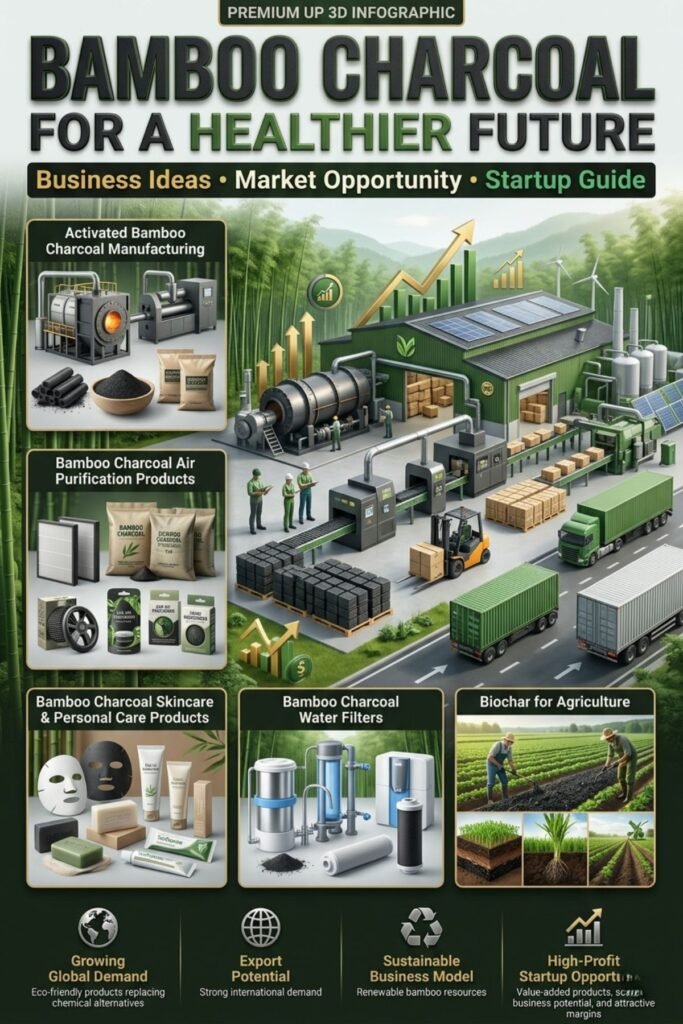
1. Activated Bamboo Charcoal Manufacturing for Industrial Use
Among processed types of bamboo charcoal, activated bamboo charcoal has the highest value. It is created through two-step process: carbonisation and steam or chemical activation, and thus has a 200–300 times larger surface area and adsorption capacity. Buyers in the water treatment, pharmaceuticals, food processing and gold refining industries pay premium prices for food grade and technical grade activated carbon. It is possible to generate high margins by setting up a small scale activated charcoal plant with daily capacity of 300-500 kg in bamboo rich areas of Assam, Tripura, Madhya Pradesh etc. The investment in equipment and infrastructure is usually in the range of ₹30-50 lakh. Once the unit is fully operational, the gross margin is more than 55%, as the raw bamboo is very cheap compared to the activated product.
Get Detailed Insights from This Book: Bamboo Plantation and Utilization Handbook
2. Bamboo Charcoal Air Purification Products
One of the easiest business ideas for first-time entrepreneurs is producing bamboo charcoal air purifiers. These products come as pouches, bags, or panels filled with porous bamboo charcoal. They naturally absorb humidity, odours, and airborne pollutants. They can be found in wardrobes, automobiles, shoe racks, and homes. The magic of this business is the low startup cost. Pre-made bamboo charcoal can be sourced and attractively packaged, allowing a micro unit to start with a capital investment of less than ₹5 lakh. This investment can be recovered within a few months. Margins on branded products are very strong. Raw charcoal costs ₹80–100 per kg, but when packaged and sold as a branded deodoriser, it can retail for ₹150–300 per pack. You can build a brand and list on Amazon, Flipkart, or direct to consumer platforms, which will enable you to scale quickly without significant overheads.
3. Bamboo Charcoal Skincare and Personal Care Products
Activated charcoal is a so-far hero ingredient in the personal care industry for its face wash, face scrubs, soap, toothpaste and face mask applications. The bamboo charcoal is perceived as natural and plant-derived; therefore, it has a premium positioning advantage. A simple formulation set up entrepreneur can produce a variety of bamboo charcoal beauty and personal care products and sell to private label beauty companies, wellness shops, spa chains, or export buyers. Production is easier than for pharmaceuticals and for most uses in cosmetics does not require a drug licence. A small manufacturing unit with a daily production capacity of 500-1000 units can earn ₹4-8 lakh a month in its first year of operation with proper packaging and branding.
4. Bamboo Charcoal Water Filters for Rural and Urban Markets
Pollution of water is a major public health issue in India and bamboo charcoal filters are a cheap, chemical-free and eco-friendly solution. Entrepreneurs can build water filtration units by stacking bamboo charcoal, sand, and gravel, creating gravity-fed systems for rural households, schools, and small institutions. There is a big and increasing NGO or CSR backed procurement market for these kinds of products. In addition, the demand of urban customers for natural water purification systems for their kitchens has also been growing. A bamboo charcoal filter manufacturing business is a business idea that can bring social changes with an immediate market of the government water programme, panchayat and impact investors. Start-up cost is in the range of ₹10-15 lakh for a basic production line.
5. Biochar and Bamboo Charcoal as Soil Amendment for Agriculture
Bamboo biochar is becoming popular as a high-quality soil conditioner for better soil productivity, water holding capacity, and carbon sequestration in farming. A business opportunity is to sell the bamboo biochar to the progressive farmers, organic certification programmes or export buyers to the Europe and US. The agriculture input sector is big and biochar is still relatively niche in India, so it is still possible to build relationships with suppliers as a “first mover”. Furthermore, biochar provides an additional revenue opportunity. Producers can register for carbon credit programmes and earn a second income from the carbon sequestration benefits of biochar production.(Bamboo Charcoal Business in India)
Access Complete Business Plan: Bamboo and Bamboo Products, Value-Added Bamboo Products
Import–Export Opportunity Analysis for Bamboo Charcoal Startups
The paradoxical situation in the trade of bamboo charcoal in India is that despite huge production of bamboo, the export of processed charcoal is negligible, and import of activated carbon is from China. This is an opportunity and a problem. Entrepreneurs who can manufacture the product on their own in the country can replace the imports from China which are costly, and can also secure the export market of the product, as it is food grade or cosmetics grade. The Directorate General of Foreign Trade (DGFT) has estimated that more than hundred crores worth of activated carbon is being imported into India every year under the HSN code for activated carbon products – 3802.
Japan and South Korea are the world’s largest consumers of bamboo charcoal for home use, cosmetics or food uses, particularly on the export side. The demand for charcoal-based cosmetics and dietary supplements that contain organic charcoal is growing rapidly in the EU. The Indian exporter can market bamboo charcoal as a premium and organically grown product at USD 3-8 per kg in international market as compared to domestic market price of ₹150-200 per kg. Export units can apply for registration with Agricultural and Processed Food Products Export Development Authority (APEDA) to avail buyer network facilities and export incentives provided by the Government.
Indian MSME Leaders Showing the Way
Sahyadri Bamboo, Maharashtra
Arranger Manish Jaju started Sahyadri Bamboo and built a vertically integrated bamboo processing business that covers everything from cultivation to product design and export. The company’s business model leverages bamboo as a strategic raw material for industrial applications rather than trading it as a commodity. It also teaches an important lesson: profits are generated through value addition and processing, not through raw material trading. The fact that they have been able to sell their processed bamboo products to buyers from the European countries shows that quality-oriented Indian MSMEs can compete at the international level.
Bamboo India, Bengaluru
With its founding by Yogesh Shinde, the social enterprise model has proven itself to be a viable approach for scaling profitably in the bamboo industry. The company has trained rural artisans and made them a part of an organised supply chain, thus enabling it to manufacture products for the consumer market at competitive rates with quality. Their insight: They found that the cost of inputs is cut and consistency is increased by establishing a stable supply chain instead of relying on a few disorganized traders — a finding that can be applied to bamboo charcoal production.(Bamboo Charcoal Business in India)
Taru Naturals, Himachal Pradesh
Professional Feasibility Support from NPCS
Niir Project Consultancy Services (NPCS) provides professional consulting services for preparing a Market Survey and Detailed Techno-Economic Feasibility Report (DPR) for setting up a new industry or business.In our reports, you will get every detail related to manufacturing processes, market research and demand analysis, process flow diagrams, Product mix and capacity planning, Machinery and raw material details, and complete project financials with a profitability analysis. Our goal for those entrepreneurs looking into bamboo charcoal as a business opportunity is to make sure that before investing one rupee, every rupee is supported by the feasibility, profitability and sustainability of the enterprise.(Bamboo Charcoal Business in India)
Choose the right startup backed by real market demand
Bamboo Charcoal Business: Quick Reference Data Table
| Business Segment | Approx. Investment | Est. Annual Revenue | Gross Margin (%) |
| Activated Charcoal Mfg. | ₹30–50 Lakh | ₹90 Lakh–₹1.5 Cr | 50–60% |
| Air Purification Products | ₹5–10 Lakh | ₹20–40 Lakh | 55–70% |
| Skincare & Personal Care | ₹10–20 Lakh | ₹40–80 Lakh | 60–75% |
| Water Filter Units | ₹10–15 Lakh | ₹35–55 Lakh | 45–55% |
| Biochar for Agriculture | ₹15–25 Lakh | ₹30–60 Lakh | 40–55% |
Frequently Asked Questions (FAQ)
Q1. What is the minimum investment to start a bamboo charcoal business in India?
A micro-level entry point such as branded air purification pouches requires only 3-5 lakh to start, using purchased charcoal and private labels. A full-scale unit producing activated charcoal will cost anywhere from 30-50 lakh or more to set up. The appropriate entry point depends upon the target audience and the delivery mechanism.
Q2. Is bamboo charcoal different from ordinary charcoal?
Yes, it is. Bamboo charcoal is made from bamboo only, which have cell structure and is naturally more adsorbent than any other charcoal. Activated bamboo charcoal further increases the surface area and adsorption capacity for industrial, medical and cosmetic usage.
Q3. In which states of India is it economical to set up a bamboo charcoal unit?
States with natural bamboo forests and hence cheaper raw material would be best: Assam, Tripura, Manipur, Meghalaya, Madhya Pradesh, and Odisha would ideally fit. It may sometimes be worthwhile to set up a factory in Maharashtra or Gujarat for close proximity to buyers or exporters and source charcoal elsewhere.
Q4. Are there any government subsidies for bamboo charcoal manufacturing in India?
There are subsidies of 40-50 percent in National Bamboo Mission for the processing machinery. PMEGP offer project costs at 15-35 percent. CGTMSE covers loans for collateral-free production up to 2 crores, while registered DPIIT start-ups can receive tax holiday and exemptions in the rules for a limited period.
Q5. Are the bamboo charcoal products saleable to outside the country?
Definitely. Japan, South Korea, and countries in EU import enormous quantities of bamboo charcoal for cosmetic, food and environmental purposes. Companies selling to abroad need to register with APEDA and need certification like food-grade or cosmetics-grade certification to find premium customers. Export rates are between two and four times the domestic rates.
Q6. What is the time to break-even in bamboo charcoal business?
An activated charcoal producer could break even within 18 to 30 months if they have sufficient operational management. Companies selling consumer products, such as skincare and air purifiers could break even even sooner, within 12 months as the capital costs involved would be considerably lower.
Conclusion: The Timing Is Right for India’s Bamboo Charcoal Entrepreneurs
Bamboo charcoal is an emerging industry that embodies three global trends: sustainable materials, growing consumer appetite for natural products with health benefits and the growing trend of government investment in bio-based industries. The raw material advantage of India is tremendous – very few countries can boast of the diversity and production potential of the bamboos in India. What has been lacking in the past is the processing and commercialization, and this is where entrepreneurs can bridge the gap today.(Bamboo Charcoal Business in India)
You can start with high-margin consumer goods such as skincare and air purification products. Alternatively, you can focus on industrial supply chains in the water treatment and agriculture sectors. In either case, the underlying foundation is already in place. The government is very supportive and on call. There are available and expanding export markets. This area offers strong opportunities for first movers who focus on quality and build a brand before competition increases. If you’re serious about creating a sustainable, profitable, and social business – the word “charcoal” is no tagline when it comes to bamboo charcoal for a healthier future. It’s a real chance.