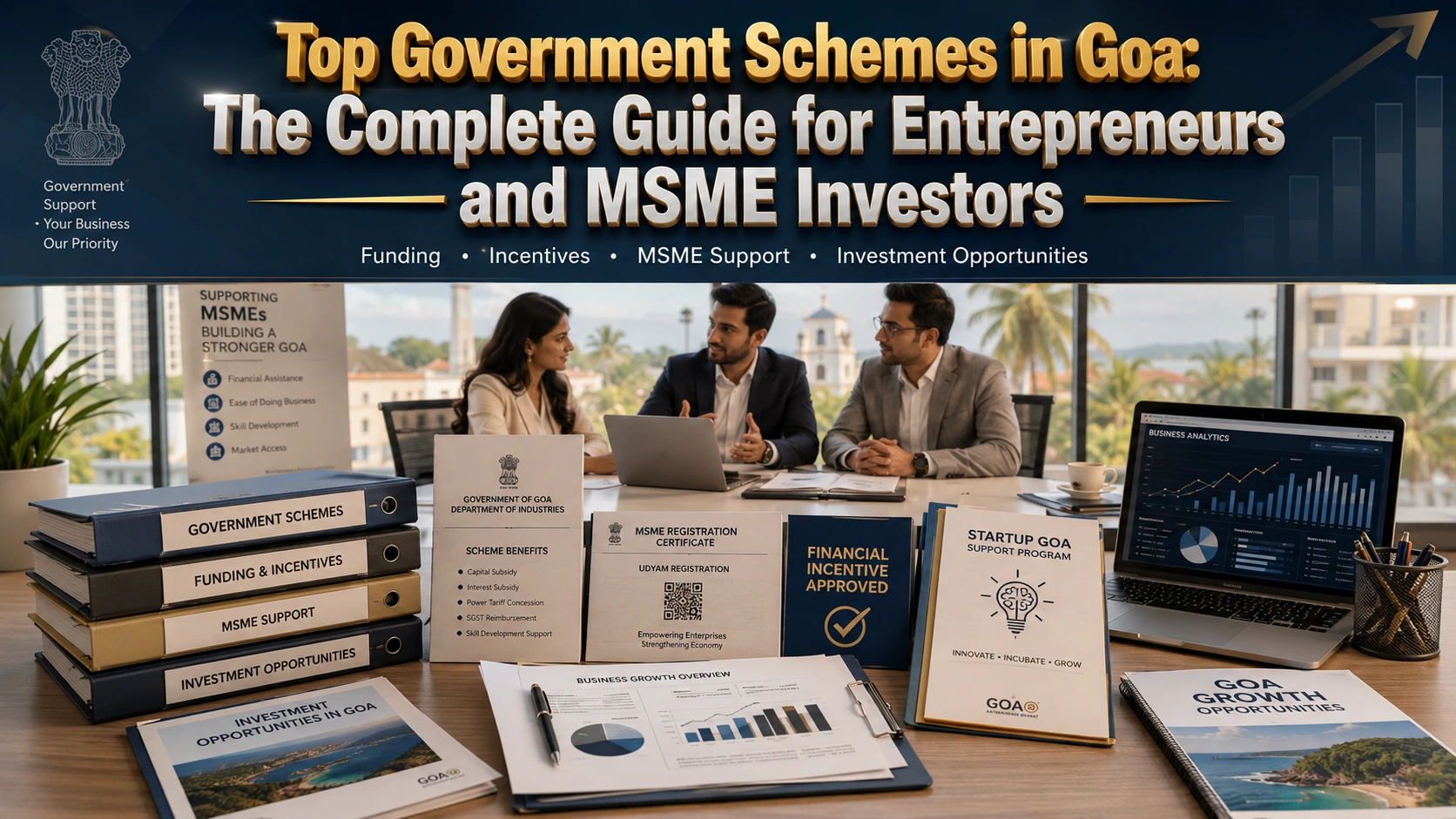

Goa is no more a mere tourist destination. The State is suddenly emerging as one of the most business-friendly in India for sharp entrepreneurs and MSME investors. Simply put, a robust set of government schemes in Goa provides capital subsidies, interest reimbursements, job benefits and start-up grants that few founders are aware of. Goa’s policy structure offers an unprecedented chance to launch a business in either the manufacturing or technology or the services sector with less risk and more investment assistance.
The state government has created a three-tiered incentive program under the umbrella of the Directorate of Industries, Trade and Commerce (DITC), the Economic Development Corporation (EDC) and the Department of Information Technology (DITEC). Entrepreneurs and MSME promoters who are in the know can save a lot on the cost of their projects before they even realize a single rupee of income from the project.
Why Goa Is a Strong Business Destination Right Now
Economically Goa is a unique state in India. It has a qualified workforce of fluent English speakers, a world-class road and port network, close proximity to Mumbai and one of the highest per capita incomes of Indian States. Besides, the state government has been taking conscious efforts on the diversification of Goa’s economy from the tourism sector. Verna, Kundaim, Mapusa and Cuncolim have industrial estates with ready built infrastructure available for manufacturing units at competitive lease rates.
The government has also put in place one window clearance facility in the form of Investment Promotion Board (IPB) and the Goa Online Single Window (GOSW) to make the process of obtaining the approvals quick. This administrative efficiency directly reduces setup costs and timelines for any entrepreneur assessing the feasibility of a project.
What’s more, Goa’s startup scene is booming. Today, it is home to more than 696 startups recognised by the DPIIT and has recently introduced the Goa Startup Policy 2025 set to achieve three key goals: 1000 new startups, 10,000 jobs and 100 startups getting Venture Capital funding. This makes Goa an incredibly exciting place to be on the ground floor to be a founder and an investor.
Key Government Schemes in Goa You Must Know
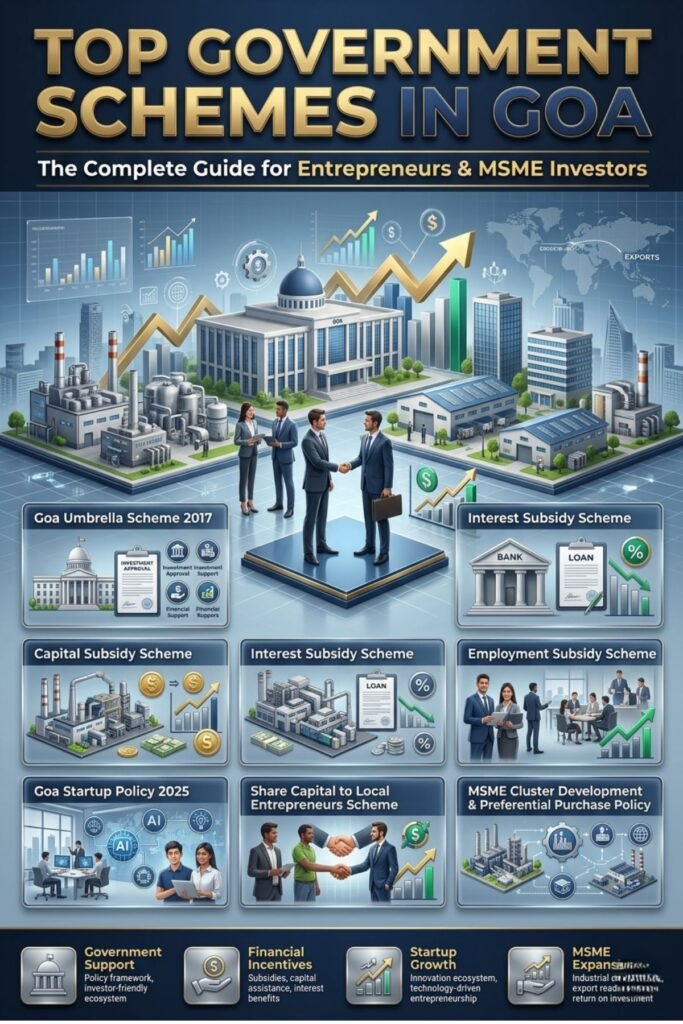
1. Goa Umbrella Scheme 2017 – The Foundation of All Incentives
The Goa State Incentives to Encourage Investments Scheme, 2017 (the Umbrella Scheme) is the backbone of Goa’s industrial policy. It brings together various subsidy schemes in a single coherent package for micro, small and medium manufacturing companies. Units that enter into commercial production under the scheme are entitled to a financial package based on investment and jobs created.
The strategic significance of this scheme is that it is a cumulative one. The total SID available per unit may be up to 70% of the total capital expenditure of the units in backward taluka, up to 50% in other talukas (excluding land capital expenditure). This equates to potential incentives of ₹50–70 lakh for a project of ₹1 crore. New manufacturing units should register under this scheme as early as possible as many other state scheme are related to the Umbrella Scheme registration.
Get Detailed Project Report (DPR): Best Business Opportunities in Goa – Project Identification Guide
2. Capital Subsidy Scheme – Direct Grant on Fixed Investment
The Capital Subsidy Scheme under the Umbrella has been introduced to provide direct assistance of 30% of the capital investment to eligible micro and small manufacturing units. It is a grant, NOT a loan. Qualifying units are those in the white, green, and orange environmental categories. Importantly, the scheme also caters for significant expansion of the existing units making it relevant not only for new entrants but for MSMEs wishing to scale up their capacity.
Details and Scheme documentation is available from Directorate of Industries, Trade and Commerce, Government of Goa. Founders are advised that the first payment of 50% of the sanctioned subsidy will be made once the Task Force Committee has approved it.
3. Interest Subsidy Scheme – Five Years of Loan Relief
The Interest Subsidy Scheme allows the manufacturing units to avail subsidy of 1.5% of the net turnover or 30% of paid interest, whichever is lower, up to ₹5 lakh per annum. The benefit will be available for five years (20 quarters) after commercial production. This scheme is applicable to the units which have availed loans from nationalised banks, scheduled banks, cooperative banks or Economic Development Corporation and the repayment of such loans is pending.
The approximate interest expense for a startup with a bank loan of ₹50 lakh at 12% rate per annum is ₹6 lakh. The subsidy can be availed for up to ₹1.8 lakh per year, which will be worth ₹9 lakh for 5 years. That is a cash-flow increase which can be a saving in materials during the critical early growth phase.
4. Employment Subsidy Scheme – Incentive for Hiring Goans
The Employment Subsidy Scheme, 2017 is an initiative that invites industries to employ local workforce by reimbursing them 50% of the wages paid to Goans subject to a limit of ₹7,000 per month per employee and ₹25 lakh per annum for MSMEs. A “Goan” is defined as a person born in Goa or who had lived for 10 years or more in Goa. The maximum benefit is for companies that employ 60% of Goans or more.
The scheme is especially applicable to companies that have 30–50 employees, such as manufacturing companies or service providers. Direct support for salary costs in the early years of operation significantly improves EBITDA margins. In addition, it harmonizes the interests of business with the State’s desire to provide jobs locally, thereby facilitating regulatory interactions.
5. Goa Startup Policy 2025 – Twelve Schemes for Innovation-Led Businesses
DITEC has unveiled a new Goa Startup Policy 2025, which features a set of 12 specific schemes for tech, creative and innovative startups. The key benefits include 100% reimbursement of IPR and patent filing costs. Startups hiring local freshers can receive full salary reimbursement of up to ₹15,000 per employee per month. Additional support includes seed capital, mentoring, and funding for women-led startups.
The Campus Innovation Scheme (CIS) reimburses students for venture development costs, supporting a pipeline of tech-enabled businesses from Goa’s colleges. PMS scheme is for reimbursement of expenses for attending Government sponsored trade fairs and exhibition. Skill Enhancement Scheme reimburses for the capacity building courses. All these twelve schemes offer considerable early benefits to eligible startups.
Your investment deserves the right opportunity
6. Share Capital to Local Entrepreneurs and Self-Employed Scheme, 2015
Under this scheme, the youth of the locality are offered interest free share capital by EDC Limited to set up an income generating activity. The SC, ST, OBC, Women and Disabled candidates are given preference. This scheme is aimed at self-employment, especially for those who might not be eligible for conventional term loans. For the very small business, this no-interest capital is a useful initial capital instrument.
7. MSME Cluster Development Programme and Preferential Purchase Policy
The Ministry of MSME’s Cluster Development Programme is implemented in Goa with the DITC as the fund-receiving agency. It facilitates usage of common facility centres, toolrooms and shared testing infrastructure by MSME clusters in specific industries. Other market-access benefits include Preferential Purchase Incentives for Micro and Small Enterprises. Under this scheme, the government gives these businesses price preferences and reduced tender costs when procuring goods and services from them.(Government Schemes in Goa)
Business Opportunities That Benefit Most from Goa’s Schemes
Food Processing and Agro-Based Manufacturing
Goa is a leading producer of cashews, coconuts, seafood and tropical fruits. But there is still not much value added at processing level. The benefits of capital subsidy, interest subsidy and employment benefits are applicable to an entrepreneur who establishes a cashew processing unit, coconut-based product line or seafood cold-chain facility. The Government of India encourages the agro-processing sector by providing a credit-linked subsidy of 35% of the project cost for individual units with project costs up to ₹10 lakh under the Pradhan Mantri Formalisation of Micro Food Processing Enterprises (PM FME) Scheme.
Goa has an advantage of its port connectivity and its proximity to the Mormugao Port Trust which is very useful for the export-based food processing industry. For example, a processing unit for production of cashew kernels for export to the Middle East and European markets could avail the benefits of the government and the Agricultural and Processed Food Products Export Development Authority (APEDA) for market development.
Electronics and Light Engineering Manufacturing
Under certain Central schemes, Goa is classified as an electronics manufacturing incentive zone. Light engineering, precision components and electronics assembly units have a low rating for pollution (white or green) and are thus fully eligible for the Umbrella Scheme. Goa attracts manufacturers as a production base through its capital subsidy and interest reimbursement schemes, while its proximity to the Pune and Mumbai supply chains further enhances its commercial appeal. In the initial five years for an electronics component entrepreneur who invests ₹2-3 crore, he can see significant returns from the stacked state incentives.(Government Schemes in Goa)
Tourism-Tech and Creative Economy Startups
The Goa Startup Policy 2025 provides direct support to startups in technology, digital media, creative services and tourism technology. The Goan ecosystem advantage is immense, the tech startup here enjoys less real estate cost than Bengaluru or Hyderabad, environment of quality life for the talent and direct support of the state government in the form of DITEC. Goa’s own tourism industry provides a natural testbed and client base for “tourism-tech” start-ups developing platforms for hospitality management, experience booking or destination services.
Import-Export Opportunity Analysis
Indian major iron ore export port, Goa’s Moruga Port, is now geared towards handling diversified cargo. Export promotion zones and warehousing units have been established by the DGFT (Directorate General of Foreign Trade) near the port. It essentially provides a direct export route for processed food, pharmaceutical ingredients and specialty chemicals for manufacturing entrepreneurs.
In addition, the international airport at Goa has excellent air cargo facilities and the proximity of the free trade zone facilitates perishable exports and shipments of high value goods. Food processing, Ayurvedic products and handicraft-based entrepreneurs can tap into these logistic assets along with MSME export incentives under Market Access Initiative (MAI) scheme and facilities for working capital and buyer’s credit from Export-Import Bank of India.(Government Schemes in Goa)
Indian MSME Success Stories from This Landscape
Vimal Foods – Cashew Processing, Goa
The cashew processing segment has given rise to several MSMEs, which are well suited to the market. State funding helped launch shrinking units in the late 1990s, and these units subsequently reinvested their margins into improved processing facilities and cold-chain infrastructure, enabling them to grow into substantial export businesses. The lesson here is that using subsidies strategically at launch and then redirecting those funds toward product quality and export certification has proven to be a successful, field-tested recipe in this sector.
Read the Complete Book Here: Handbook on Fruits, Vegetables & Food Processing with Canning & Preservation (3rd Edition)
Cipla – Goa as a Pharmaceutical Manufacturing Hub
Cipla is a large company but its manufacturing plant in Goa is useful for the MSME promoters. A key reason for Cipla selecting Goa for its pharmaceutical plant were the state’s technical talent pool, the environment (co-operative), and its port, which allows the import of Active Pharmaceutical Ingredients. In the context of setting up in the state of Goa nowadays, the same decision logic – logistics advantage and workforce quality – is also true for MSME pharma or nutraceutical units.(Government Schemes in Goa)
Related Article: Pharma Project Consultants in India: Why Expert Guidance Is Critical Before Starting a Pharmaceutical Manufacturing Unit
Tourism and Hospitality Entrepreneurs
Several first-generation Goan entrepreneurs can utilize EDC loans and Startup Policy support to establish boutique properties and experiential tourism products, enabling them to build successful hospitality MSMEs. The model is working because the volume of tourists in Goa offers a built-in market and the government offers certain incentives to lower the cost of capital and working capital for the initial stages. Brand positioning and quality consistency have been the main factor between successful operators, not price.
How NPCS Supports Entrepreneurs Entering Goa’s Opportunity Landscape
Niir Project Consultancy Services (NPCS) prepares Market Survey and Detailed Techno-Economic Feasibility Reports (DPRs) for establishing new industries and businesses. The reports cover complete financials of the project along with profitability analysis, detailed manufacturing processes, process flow diagrams, machinery details and raw materials information, market research and demand analysis, product mix and capacity planning, and project financials with profitability analysis etc. The goal is to assist entrepreneurs to assess feasibility, profitability, and potential scalability before investing capital.(Government Schemes in Goa)
For companies considering Goan projects, our DPRs include the relevant state incentive schemes in the financial model. Thus, you get not a template for how long it takes to break even and how much return on investment you will have after subsidies, but a realistic view of the net project cost after subsidies, return on investment and break-even timelines. This is especially crucial for MSME promoters applying for bank loans, as banks increasingly require financial projections in project reports tailored to specific schemes.
Key Government Schemes in Goa: Quick Reference Table
| Scheme Name | Administering Body | Key Benefit | Maximum Benefit |
| Umbrella Scheme (Capital Subsidy) | DITC, Govt. of Goa | 30% capital grant on fixed investment | Up to 70% of capex (backward talukas) |
| Interest Subsidy Scheme | DITC / Nationalised Banks | 30% of interest paid or 1.5% of turnover | Up to ₹5 lakh per annum for 5 years |
| Employment Subsidy Scheme | DITC, Govt. of Goa | 50% salary reimbursement for Goan employees | Up to ₹25 lakh per annum (MSMEs) |
| Goa Startup Policy 2025 | DITEC, Govt. of Goa | IPR reimbursement, seed capital, salary support | 100% IPR costs; ₹15,000/month salary subsidy |
| Share Capital Scheme 2015 | EDC Limited, Goa | Interest-free share capital for local youth | Up to ₹15 lakh (service); ₹25 lakh (manufacturing) |
| PM FME Scheme (Central) | Ministry of Food Processing | Credit-linked subsidy for food processing units | 35% of project cost, up to ₹10 lakh |
| MSME Cluster Development | DITC / Ministry of MSME | Common facility centre, shared infrastructure | Up to ₹15 crore per cluster project |
Frequently Asked Questions (FAQs)
Q1. Who is eligible for the Goa Capital Subsidy Scheme?
The scheme is applicable for micro and small manufacturing units registered under the Udyam portal and the manufacturing units under white, green or orange pollution category, which have started commercial production after October 1, 2017 and/or undertaken eligible substantial expansion. Units that have already availed capital subsidy under Chief Minister’s Rojgar Yojana or any similar Central Government schemes will not be eligible for two benefit schemes.
Q2. Can a start-up have both Umbrella Scheme and Goa Start-up policy 2025 at the same time?
In general, only one scheme – either Umbrella Scheme or Start-up Policy 2025 – is available and a unit can receive benefits under either scheme only once. Some schemes under the Start-up Policy (e.g. IPR Reimbursement Scheme and Promotion & Marketing Assistance Scheme) are stand-alone in nature and not in conflict with the benefits under Umbrella Scheme. However, an entrepreneur is advised to get confirmation from the DITEC Start-up Promotion Cell for specific combinations.
Q3. How long will it take to get approval for the Umbrella Scheme?
As per the guidelines, the Task Force Committee constituted under each scheme shall scrutinize and recommend the applications within a period of 3 months from the receipt of the application and disbursement of the approved amount will take another 6 months. This time frame may extend depending on document submission and the availability of task force members. To ensure an error-free application and project documentation and avoid delays, applicants should hire a professional consultant. Financial sanction for up to 20 lakh is to be approved by Director and beyond that, by the State Level Committee.
Q4. Is the Employment Subsidy Scheme applicable for any units except for manufacturing units?
The employment subsidy scheme primarily targets manufacturing units under the Umbrella Scheme. However, the guidelines also clearly identify eco-tourism and hinterland investment projects as eligible. The Service sector units, registered under Startup Policy 2025, can avail salary reimbursement under specific service sector startups scheme which is akin to the employment subsidy scheme, but administered by DITEC and not DITC.
Q5. What role does EDC play in Goa’s MSME ecosystem?
Economic Development Corporation (EDC) Limited, a Government of Goa undertaking entity, acts as a direct lender to Goan entrepreneurs that are possibly unable to meet the banks’ lending criterion of immediate financial viability and implements The Share Capital Scheme & offers specifically packaged loans to the micro and small enterprises. Recently, the Goa CM Pramod Sawant had directed EDC to devise new loan scheme and ensure easier access to existing ones.
Q6. How a fresh entrepreneur should access scheme landscape in Goa?
An entrepreneur should first obtain a Udyam registration and later apply for the Umbrella scheme registration with the DITC before initiating commercial production since most benefits clock-ticks will begin on that date itself. Simultaneously, register with the DITEC Startup Promotion cell under the startup policy if business is start-up and technology oriented. Finally engage a qualified project consultant who will incorporate all potential incentives within the DPR before approaching any bank for term loan finance.
Conclusion
The government schemes in Goa provide a well-defined, multi-tier reward system which will surely benefit entrepreneurs with meticulous planning. Coupled with a 30% non-refundable capital subsidy, 5 years of interest reimbursement on working capital, subsidies for local employment, and specialized incentives such as seed capital and IPR grants for startups, this scheme currently ranks among the most comprehensive state-level offerings available to MSME promoters in the country. The efficacy of these schemes will solely rely on on-time registration, proper documentation and a realistic cash flow integrating these schemes from Day One.(Government Schemes in Goa)
For entrepreneurs in manufacturing, food processing, electronics, and IT, this state currently offers India’s most compelling investment opportunity. There is a window of opportunity, a framework in place and a good base. The first movers, supported by professional guidance in project feasibility and scheme application preparation, stand to gain the most and develop commercially robust and subsidy-supported ventures.