
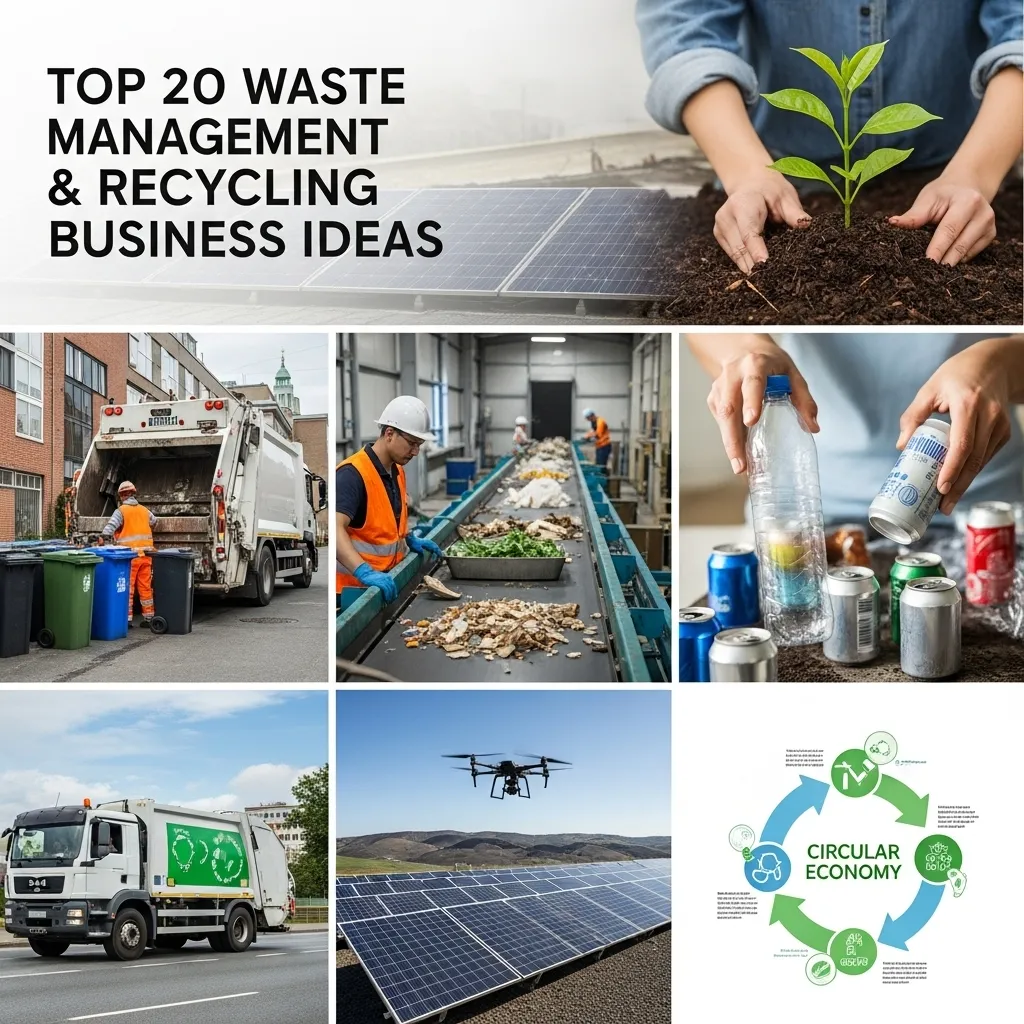

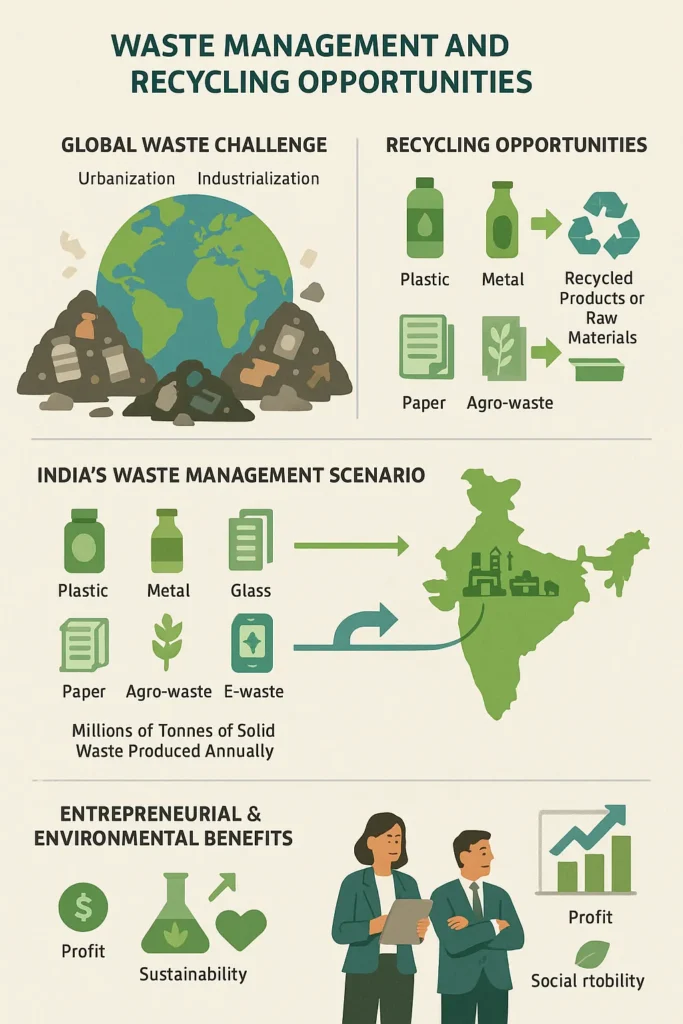
Waste management and recycling are central to sustainable development, environmental protection, and resource conservation. The burgeoning population combined with rapid urbanization, industrialization, and consumerism made the waste volume unprecedentedly global.
Hence, immense opportunities lie for entrepreneurs in recycling and waste management, nowadays, across plastics, metals, glass, paper, agro-waste, e-waste, and myriad other materials.
For example, India alone throws away millions of tonnes of solid waste every year, rendering waste management a nonprofitable but very necessary sector for environmental sustainability-Waste Management Business Ideas. Thus, investments in recycling ventures are both financially rewarding and satisfying social responsibilities.
In this article, 20 profitable waste management and recycling business ideas are presented with insights into feasibility, scalability, and market potential.
1. Plastic Waste Recycling
Recently, plastic waste recycling is fast emerging into one of the top lucrative businesses due to increased awareness towards environmental sustainability, stringent government regulations, and increased demand for eco- friendly products.
Advanced technologies can be put to good use in segregation, processing, and recycling to tap the opportunities in the domestic and export markets of recycled products. Moreover, the concept of a circular economy has facilitated easiness in launching business startups worldwide.
Business Potential:
- Now there is an inherent scope in terms of supply of raw materials that would cover increased unhindered demand from domestic sources and industrial ends.
- The export opportunity would be in both the quantities of recycled raw materials and in the production of eco-friendly products.
- Strong policy support under waste management rules with incentives.
- Long-term scalability through circular economy practices.
Read Our Book: Click Here
2. Paper Waste Recycling
The market potential in paper waste recycling definitely stands shoulder high to that of many other ventures in terms of profits. Modern machinery and processes can be put to use by the entrepreneur to convert waste paper into products that could be reused. Demand for recycled paper continues expanding both locally and internationally as awareness about sustainability grows. Thus, the enterprise is upholding environmental sustainability and profitability.
Business Potential:
- Domestic and industrial demand are continuing to rise.
- export potential for recycled raw materials.
- Government support through waste management rules.
- Opportunities for scalable circular economy ventures.
3. Metal Recycling (Iron, Aluminum, Copper)
Metal recycling plays a great scope for returning investment, which is so beneficial as awareness spreads about sustainable industrial and consumer practices.
Therefore, they can invest in segregation, processing, and recovery technologies for preparing metals such as iron, aluminum, and copper. Metal recycling reduces dependency on raw materials, hence adding economic value to its feature of protection of natural resources.
Business Potential:
- There is a growing demand both at the domestic and industrial levels.
- Export opportunities for processed metals.
- Policy support by means of regulations and incentives.
- Growth in terms of long term prospective circulation of economy practices.
Read Our Project Report: Click Here
4. Glass Recycling
Glass recycling also promises good returns since awareness about environmental and the need for a sustainable solution is becoming huge. Good segregation and processing technologies can be installed to produce recycled glass products for both domestic and export markets.
Additionally, recycling glass saves raw materials and energy, giving an economic and ecological advantage.
Business Potential:
- There is growing demand for eco-friendly solutions in industries.
- Export for recycled glass products.
- Strongly established regulations for waste management.
- Scalability because of the integration into the circular economy.
5. Rubber Waste Recycling
Rubber waste recycling has also made its glare bright, as it helps in converting used tires and industry waste rubber to usable materials. Hence, employing modern processing technology, entrepreneurs can produce recycled rubber for end products in their application.
In fact, recycling rubber is profitable without compromising on causing environmental hazards.
Business Potential:
- Domestic and industrial demand for recycled rubber.
- Export potential for processed materials.
- Policy support through environmental regulations.
- Long-term scalability in circular economy frameworks.
6. E-Waste Recycling
E-waste recycling plays a crucial role as society becomes more technology consuming. Advanced recycling units can be set up to recover waste valuable metals and a number of components from appliances.
E-waste recycling can go a further mile in finding solutions to some environmental problems and generate significant profits through recovered materials.
Business Potential:
- Increasing domestic and industrial demands for solutions.
- Exports potential for recycled metals and components.
- Government support for e-waste regulations.
- Scalability with circular economy practices.
Read More: List of Profitable Business Ideas in Waste Management Disposal and Recycling Industry
7. Medical Waste Treatment and Disposal
Profitable because it serves the twin purposes of safety from hazardous materials disposal and social impact. Established waste treatment facilities with states of the art technologies could be created to comply with the developing government standards.
Besides, that awareness regarding safety, environmentalism ensures demand consistency in medical waste management services.
Business Potential:
- Increasing demand from healthcare facilities.
- Possibility to export treatments technologies.
- Policy support for medical waste management.
- Long-term scalability in circular economy initiatives.
8. Solid Waste Management (Municipal Garbage)
The business has turned into a goldmine because of the exploding urbanization levels and government’s stress on sanitation. With modern segregation, recycling, and composting, an entrepreneur can generate profits from municipal solid waste.
Moreover, effective solid waste management serves the interests of public health while creating opportunities for business.
Business Potential:
- Increasing demand in urban myriads and increasing industries.
- Processed products from waste have good exports potential.
- Policy incentives for waste management projects.
- Scalability through circular economy adoption.
9. Recycle Waste from Agriculture (Husk, Straw, Crop Residue)
Agro-waste recycling would convert residues like husks, straw, and crop residues into biofuels, compost, and animal feed. Modern technologies of processing agricultural residues can be best utilized by entrepreneurs.
Hence, agro-waste recycling works wonders addressing environmental issues and bringing in a good profit venture.
Business Potential:
- Growing demand from industries and agriculture.
- Export markets for agro-based products.
- Strong policy support for recycling initiatives.
- It will be a long-term scalable activity under circular economy models.
Read More: Rubber Powder from Waste Tyres
10. Recycling Wood Wastes and Sawdust
Recycling wood waste and sawdust will open opportunities to develop furniture, particle boards, and bioenergy products. Entrepreneurs can set up processing units with modern processing machinery and recycle wastes to marketable products.
This will help to gain profits and decrease uses of wood to avoid deforestation and reduce waste accumulation.
Business Potential:
- Increasing domestic and industrial demand.
- Export of processed wooden products.
- Government support for feasible sustainable initiatives.
- Integration with a circular economy scales it up.
11. Construction & Demolition Waste Recycling
The business has found a profit trail in recycling construction and demolition waste due to the change in scenario from increasing infrastructure projects.
This means that entrepreneurs are left with the opportunity of investing in technologies for sorting, processing, and reusing concrete, bricks, and metals. The scenario gives rise to a sustainable model of revenue generation by reducing environmental impact.
Business Potential:
- Construction sector demand.
- Market for recycled building materials.
- Policy incentives for sustainable construction.
- Long-term scalability through circular economy practices.
12. Treatment of Hazardous Industrial Wastes
Hazardous waste treatment in industries opens good avenues for entrepreneurs by complying with various environmental needs. Adequate advanced treatment technologies, neutralization, and safe disposal enable companies to meet such requirements. Therefore, hazardous waste treatment is both a necessary and successful business venture.
Business Potential:
- An industrial market for environmentally compliant disposal.
- Export opportunities for treatment technologies.
- Government incentives for safe waste handling.
- Solutions scalable through circular economy frameworks.
13. Waste-to-Energy Projects
Waste to energy occupies a special place within the spectrum of municipal/industrial wastes into energy in the form of electricity, heat, or fuel. Entrepreneurs can make use of modern technologies such as incineration, gasification, or pyrolysis production-wise pyrosing funding facility for energy generation. Hence, this project not only combines sustainable living but also holds the potential for profitable business models.
Business Potential:
- High potential demand for renewable energy solutions.
- Export potential for conversion technologies.
- Policy in favor of waste-to-energy takes off.
- Scalability in the long term with the circular economy.
Read More: Waste Management and Recycling
14. Recycling of Tyres through Pyrolysis
The recycling of tyres and pyrolysis turns all used tyres into fuel, carbon black, and steel, thus providing both a profit and reducing environmental impacts. Entrepreneurs can install pyrolysis units to process used tyres.
So the business will reduce waste in landfills and produce valuable byproducts.
Business Potential:
- Recycled products demand from industry and homes.
- Export of processed outputs.
- Regulatory support for disposal that is environmentally friendly.
- Long-term scalability through circular economy practices.
15. Battery Recycling (Lead-Acid and Lithium-Ion)
Recycling batteries are profit-earning businesses for recovering some metals from lead-acid and lithium-ion batteries.
The entrepreneur will make use of very sophisticated separation and processing technologies in extracting all metals, making this business eco-friendly and great in terms of return on investment.
Business Potential:
- Demand rises in industrial sectors for metal reuse.
- Export opportunities open for research involved with processing battery components.
- Government policy support on recycling.
- Operations scalable in circular economy models.
16. Recycling of Textile and Fabric Waste
The transformation of textile and fabric waste is done by converting waste textiles or scrap generated from the industries into reusable fibers or products.
The modern recycling technology installed will then be a great investment for entrepreneurs in meeting the increased demand for green materials at the end of the day. Thus, recycling textiles can make much less waste in landfills and leave way for new business avenues.
Business Potential:
- Growing demand for sustainable textile solutions.
- Export opportunities for recycled fabrics.
- Policy support in waste management from the textile industry.
- Long-term scalability through circular economy activities.
17. Food Waste Recycling and Composting
Food waste recycling and composting transform organic waste into fertilizers, biogas, or animal feed. Entrepreneurs adopt modern methods in composting and anaerobic digestion to realize efficiency gains.
Thus, food waste management becomes a very interesting business opportunity, addressing the need for environmental benefits.
Business Potential:
- Domestic and industrial demand for compost and bioenergy.
- Export potential for processed organic products.
- Government support for sustainable food waste management.
- Substantial opportunities for scalability with the circular economy.
18. Bio-Medical Residue Processing
Bio-medical waste processing converts medical and laboratory waste into safe byproducts. Entrepreneurs can invest in modern processing units to fulfill requirements directed by laws regarding the environment and health.
In this manner, this business can be profitable for the entrepreneur and socially responsible.
Business Potential:
- The demand keeps increasing from healthcare and research facilities.
- Export for technology processing.
- Policy support for managing medical waste.
- Long-term scalability in circular economy models.
19. Fly Ash Utilization Projects
Fly ash utilization projects convert coal ash and industrial residues into cement, bricks, or soil amendments. Entrepreneurs can adopt modern processing methods to maximize material recovery.
Therefore, fly ash utilization reduces environmental hazards while generating profitable business opportunities.
Business Potential:
- High domestic and industrial demand.
- Export opportunities for processed materials.
- Regulatory incentives for sustainable waste utilization.
- Scalable circular economy ventures.
20. Export-Oriented Recycled Products
Export-oriented recycled products focus on processing various waste materials for international markets. Entrepreneurs can invest in technologies to create high-quality recycled goods for global buyers.
Consequently, this business capitalizes early on rising global standards while being a part of sustainable development.
Business Potential:
- Growing global demand for recycled products.
- High export potential for processed goods.
- Policy support for waste management exports.
- Long-term scalability through circular economy principles.
Find the Best Idea for Yourself With our Startup Selector Tool
How NPCS Can Help You
NPCS offers overall professional consultancy to would-be entrepreneurs planning to establish waste management and recycling business. NPCS became a complete market survey along with preparations for techno-economic feasibility reports.
Such reports, with DPRs, cover the complete manufacturing processes, process flow diagrams, market research, demand sum, product mix and capacity planning, machinery and raw material requirements, full project financials, and profitability analysis.
By leveraging NPCS expertise, entrepreneurs can accurately evaluate feasibility, scalability, and profitability, ensuring successful environmentally responsible ventures.
FAQs-Waste Management Business Ideas
1. What is the most profitable waste management business in India?
A. Plastic recycling, e-waste recycling, and waste-to-energy projects lead to high profitability owing to industrial and domestic demand.
2 What initial investment is needed for a recycling business?
A. The investment varies according to the type and scale of recycling. The small scale can start with just a few lakh rupees, while the big kind costs crores due to its machinery and infrastructure.
3. Are there government incentives for waste management business?
A. Yes, there are policy support, subsidies, and incentives to waste management and circular economy regulations that India has for recycling projects.
4. Can recycled products be exported internationally?
A. Absolutely. There is considerable scope for export for many recycled materials including, metals, plastics, textiles, and agro-products.
5. How NPCS supports the entrepreneurs to set up recycling projects?
A. NPCS does such activity by providing full project reports, market research, process diagrams, financial analysis, and helps in technical guidance so that overall the recycling venture is feasible, profitable, and scalable.


